
If you have ever paused mid-sentence wondering whether to write “I have showed you” or “I have shown you,” you are not alone. The shown vs showed question is one of the most common irregular verb mix-ups in English, and it trips up native speakers just as often as learners.
The short answer: showed is the simple past tense of “show,” while shown is the past participle, used with helping verbs like have, has, had, was, and been. The long answer — with examples, memory tricks, and a printable worksheet — is below.
Definition
Show is an irregular verb, which means it does not follow the standard “add -ed” pattern for its past forms. Instead, it has two distinct past forms that serve two different jobs in a sentence.
Showed is the simple past tense. It stands alone and describes a completed action in the past: “She showed me the photos.”
Shown is the past participle. It never stands alone — it needs a helping verb such as have, has, had, is, was, or been: “She has shown me the photos.”
Understanding the Verb “Show”
The base verb “show” means to display, present, or make something visible or known. It is one of a small group of English verbs with three distinct principal parts instead of the usual two.
| Base Form | Simple Past | Past Participle |
| show | showed | shown |
This three-form pattern puts “show” in the same family as verbs like “know / knew / known” and “grow / grew / grown” — a useful pattern to recognize once you see it.
Show Past Tense and Past Participle
English verbs typically have five forms: base, third-person singular, past tense, past participle, and present participle. For “show,” these break down as follows:
The two forms that cause confusion — showed and shown — are the ones this guide focuses on.
• Base form: show (I show my work every week.)
• Third-person singular: shows (He shows his work every week.)
• Simple past tense: showed (I showed my work yesterday.)
• Past participle: shown (I have shown my work before.)
• Present participle: showing (I am showing my work right now.)
Shown vs Showed Grammar
The grammar rule is simpler than it looks once you isolate it to one question: is there a helping verb in the sentence?
This one test resolves the vast majority of shown vs showed errors, because the past participle almost never appears without support from an auxiliary verb.
• No helping verb → use showed. (“The results showed a clear pattern.”)
• Helping verb present (have, has, had, was, been, is, are) → use shown. (“The results have shown a clear pattern.”)
When to Use “Showed” — The Simple Past Tense
Examples
• The teacher showed the class a new experiment.
• He showed up late to the meeting.
• The data showed a steady increase in sales.
• They showed genuine interest in the proposal.
When to Use It
Use showed whenever you are describing a single, completed action in the past with no helping verb attached. It works exactly like a regular past-tense verb such as “walked” or “talked” — it stands on its own and needs nothing else to form a complete idea.
Is “Showed” a Word?
Yes — showed is a standard, dictionary-recognized word. It is the correct simple past tense of “show” and has been used this way in English for centuries. The confusion usually isn’t about whether “showed” is valid; it’s about whether it’s valid in a specific sentence, especially one that already contains a helping verb like “have” or “had.”
A quick check: if your sentence has “have,” “has,” or “had” right before the verb, “showed” is the wrong choice — you need “shown” instead.
When to Use “Shown” — The Past Participle
Examples
• She has shown remarkable patience with the new hires.
• The report had already shown signs of trouble.
• This has been shown in multiple studies.
• The evidence was shown to the jury.
How to Spot It
Shown almost always appears directly after a form of “have” (have, has, had) or “be” (is, are, was, were, been). If you see one of those helping verbs immediately before the verb slot, shown is the form that belongs there.
shown vs showed grammar girl
Grammar resources that cover irregular verbs consistently point to the same underlying rule described above: showed for simple past, shown for participle use with a helping verb. There is no special exception for “show” — it follows the standard have/has/had-plus-past-participle pattern used across English perfect and passive tenses.
If you have seen this phrase searched alongside grammar advice columns, the takeaway is the same one covered throughout this guide: check for a helping verb, and let that answer decide which form to use.
Shown vs Showed Past Participle
To be precise, only “shown” is a past participle. “Showed” is never a past participle — it is exclusively a simple past-tense form. This distinction matters because past participles do double duty in English: they build perfect tenses (have shown) and they build passive-voice sentences (was shown).
| Use Case | Correct Form | Example |
| Simple past action | showed | He showed me the letter. |
| Present perfect | shown | He has shown me the letter. |
| Past perfect | shown | He had shown me the letter. |
| Passive voice | shown | The letter was shown to me. |
Why “Shown” Matters in Perfect Tenses
Perfect tenses describe actions connected across time — something that happened before now, before another past moment, or that will be complete by a future point. Every perfect tense in English is built the same way: a form of “have” plus the past participle.
Because “show” has an irregular past participle, using “showed” in a perfect-tense slot creates an error that a fluent reader will notice immediately, even if they can’t explain the rule. “I have showed you” reads as a mistake for the same reason “I have wrote you” does — the participle slot demands its own dedicated form.
Breaking Down Perfect Tenses (with “Shown”)
In every one of these patterns, “shown” is the only correct choice. Swapping in “showed” breaks the tense, regardless of which time frame the sentence is describing.
• Present perfect: has/have + shown → She has shown me the ropes.
• Past perfect: had + shown → By noon, he had shown three clients around the building.
• Future perfect: will have + shown → By next year, the data will have shown a clear trend.
Read More: Putting vs Puting: Which Is Correct? Grammar Guide
“Have Showed” vs “Have Shown” — The Grammar Test
“Have showed” is a common but incorrect construction. The correct phrase is always “have shown.” You can test any sentence with this quick substitution: replace “show” with another irregular verb you already use correctly, like “eat / ate / eaten.” Nobody says “I have ate” — they say “I have eaten.” “Show” works the same way: “I have shown,” never “I have showed.”
Pronunciation Flow
“Have shown” flows naturally because English speakers are used to pairing “have” with a true past participle — the same rhythm as “have known,” “have grown,” or “have flown.” “Have showed” breaks that rhythm, which is often why it sounds slightly off even to someone who can’t name the rule.
Real-Life Examples and Common Usage Notes
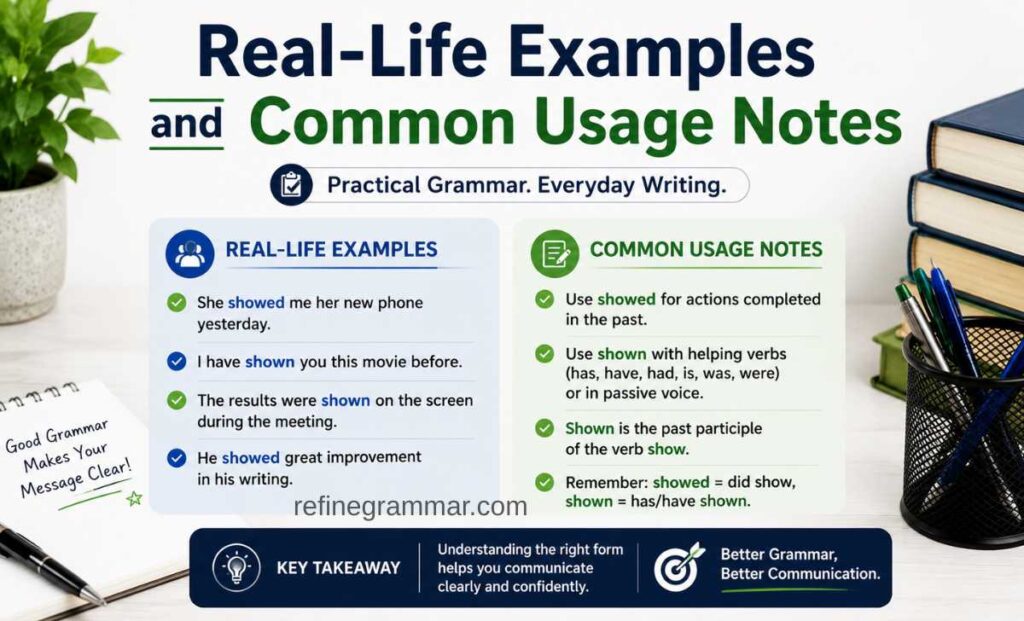
In everyday writing — emails, reports, articles, and conversation — the shown vs showed choice comes up constantly. A few realistic examples:
• Business: “Sales showed a 12% increase last quarter, and this has been shown across every region.”
• Academic: “The experiment showed unexpected results, which have since been shown to be reproducible.”
• Everyday speech: “He showed me his new car, and I have shown mine to him too.”
Regional Note
The rule itself does not change between American and British English. Both varieties use showed for simple past and shown for the participle. Minor differences show up elsewhere in irregular verbs (such as “learned” vs “learnt”), but “show” is treated the same way on both sides of the Atlantic.
Shown vs Showed Sentences
A side-by-side set of paired sentences makes the pattern easy to internalize:
• Showed: The chart showed a downward trend. | Shown: The chart has shown a downward trend for months.
• Showed: She showed him the way. | Shown: She had shown him the way before.
• Showed: The video showed the crash clearly. | Shown: The video was shown to investigators.
• Showed: They showed no hesitation. | Shown: They have shown no hesitation since day one.
Side-by-Side Comparison: “Shown” vs “Showed”
| Feature | Showed | Shown |
| Type of form | Simple past tense | Past participle |
| Needs a helping verb? | No | Yes (have/has/had/is/was/been) |
| Stands alone in a sentence? | Yes | No |
| Used in passive voice? | No | Yes |
| Example | He showed the file. | He has shown the file. |
Quick Reference Summary Table
| Tense/Structure | Correct Form | Example Sentence |
| Simple past | showed | I showed her the report. |
| Present perfect | shown | I have shown her the report. |
| Past perfect | shown | I had shown her the report. |
| Passive voice | shown | The report was shown to her. |
Quick Memory Tips to Remember
• “Shown” needs a friend. It almost never appears without a helping verb standing next to it.
• Think of the -own family. Known, grown, flown, shown — all irregular past participles ending in “-own.”
• “Showed” stands alone, just like a regular past-tense verb (“walked,” “talked”).
• If in doubt, swap in “eaten.” If “have eaten” sounds right, “have shown” is the pattern to follow — not “have showed.”
Common Mistakes and How to Avoid Them
That last example points to a mistake in the opposite direction — using “shown” where simple past “showed” is correct. Both directions of the error are common, so the helping-verb check works either way.
• Mistake: “I have showed you already.” Fix: “I have shown you already.”
• Mistake: “The results have showed improvement.” Fix: “The results have shown improvement.”
• Mistake: “It was showed to the committee.” Fix: “It was shown to the committee.”
• Mistake: “She has shown up late yesterday.” Fix: “She showed up late yesterday” (no helping verb needed for a single completed action).
Case Study: A Common Workplace Mix-Up
A marketing team once sent a client report stating, “Our campaign has showed strong engagement this quarter.” The client didn’t flag the grammar, but an editor reviewing the draft caught it before publication and corrected it to “has shown.” The fix took seconds, but it mattered: professional documents with small grammar slips like this one can quietly undercut a reader’s trust in the accuracy of everything else in the report.
The lesson generalizes well beyond this one example — in any perfect-tense construction (has, have, had + verb), the participle form is non-negotiable, no matter how natural the simple past might sound in the moment of writing.
Linguistic Insight & Expert Opinion

Grammarians classify “show” as a verb in transition. Historically, many English verbs that once had distinct past-tense and participle forms have gradually merged into a single regularized form over centuries of use — a process linguists call analogical leveling. “Show” has resisted this shift more successfully than some similar verbs, which is why “shown” remains firmly standard in formal writing, even though “showed” occasionally appears informally in participle slots in casual speech.
For anyone writing professionally — reports, articles, academic work — the safest and most widely accepted choice is to keep the two forms distinct: showed for simple past, shown for every participle use.
Read More: Eventhough vs Even Though: Which Is Correct? Grammar Guide (2026)
Shown vs Showed Worksheet
Fill in each blank with either “showed” or “shown.”
Answers: 1. showed, 2. shown, 3. shown, 4. showed, 5. shown, 6. showed.
• 1. She ______ me her new apartment last weekend.
• 2. The tests have ______ consistent results.
• 3. By the time we arrived, he had already ______ the guests around.
• 4. The documentary ______ the effects of climate change.
• 5. This method has been ______ to work in clinical trials.
• 6. They ______ up an hour early for the interview.
Self Assessment Section
Before moving on, check your understanding with these three questions:
If you can answer all three confidently, you have mastered the shown vs showed distinction.
• Can you explain, in one sentence, when to use “showed” instead of “shown”?
• Can you correct this sentence: “The photos have showed real progress”?
• Can you write one original sentence using “shown” in the passive voice?
Final Conclusion
The shown vs showed question comes down to one reliable test: look for a helping verb. No helping verb means showed. A helping verb like have, has, had, is, was, or been means shown. This single check resolves the confusion in nearly every sentence you will ever write.
Keep the “-own” family in mind — known, grown, flown, shown — and the pattern will start to feel automatic rather than like a rule you have to look up every time.
FAQs
Is it “has shown” or “has showed”?
It is always “has shown.” “Has showed” is incorrect in standard English.
What is the past participle of “show”?
The past participle of “show” is “shown.”
Can “showed” ever be used with “have”?
No. Any time “have,” “has,” or “had” appears before the verb, the correct form is “shown,” not “showed.”
Is “shown” only used in passive voice?
No. “Shown” is used in both passive voice (“was shown”) and active perfect tenses (“have shown”).
Why does English have two past forms for “show”?
“Show” is an irregular verb, meaning it kept a separate past-tense and past-participle form instead of merging into one regular “-ed” ending.
