
If you have ever paused mid-sentence wondering whether to type “swap” or “swop,” you are not alone. The Swap vs Swop question pops up constantly in emails, texts, and classroom grammar lessons, and the confusion is understandable since both words sound identical and describe the same action. This guide breaks down the meaning, history, regional usage, and correct choice for modern writing — similar to how we untangled putting vs puting in an earlier guide.
Definition
Both “swap” and “swop” describe exchanging one thing for another. The Swap vs Swop debate is not about meaning at all — it is purely about spelling, and only one version is considered standard in modern English writing.
What Do Swap and Swop Mean?
Both words describe the act of trading, exchanging, or substituting one item, idea, seat, or position for another. “I’ll swap my sandwich for your chips” and “I’ll swop my sandwich for your chips” mean exactly the same thing — the only variable is which spelling the writer chooses.
• To swap/swop seats — trade positions
• To swap/swop shifts — exchange work schedules
• To swap/swop stories — share and exchange experiences
Swap Meaning
“Swap” functions as both a verb and a noun. As a verb: “Let’s swap seats.” As a noun: “That was a fair swap.” It is the spelling recognized in every major English-speaking region, from the United States to the United Kingdom, Australia, and Canada.
Swap Vs Swop Meaning
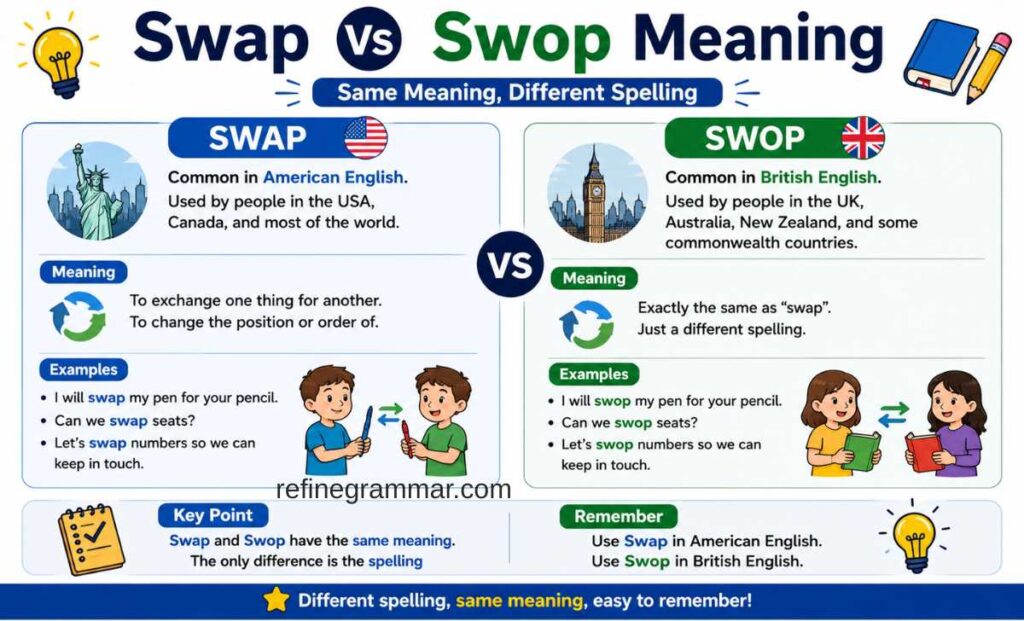
When people search for Swap vs Swop meaning, they usually want one quick answer: is there any real difference in what the words describe? There isn’t. Both mean “to exchange.” The distinction lives entirely in spelling, not semantics.
Historical Roots: How “Swop” Emerged from “Swap”
The verb traces back centuries to an earlier form connected to striking hands together to seal a bargain — a gesture once used to confirm a trade was final. Over time, regional pronunciation in parts of Britain shifted the vowel sound, producing the “swop” spelling as an informal variant. Spelling shifts driven by pronunciation are common in English; readers who enjoyed learning about eventhough vs even though will recognize the same pattern here.
This kind of drift is why the Swap vs Swop question exists at all — “swop” was never wrong, but it simply never overtook “swap” as the accepted standard.
Swap Vs Swop: Key Differences at a Glance
| Feature | Swap | Swop |
| Meaning | To exchange one thing for another | To exchange one thing for another |
| Region | Global standard | Older, mostly British variant |
| Formality | Neutral — fits all writing | Informal, dated in tone |
| Frequency today | Extremely common | Rare, declining |
| Dictionary status | Primary headword | Listed as a variant, if at all |
| Best for | Everyday, professional, and academic writing | Historical or stylistic reference only |
Swap Vs Swop Difference
The real Swap vs Swop difference isn’t about meaning — it’s about usage frequency and era. “Swap” appears as the headword in virtually every modern dictionary, while “swop” is treated as a secondary British variant that has largely faded from everyday use.
Usage in Different English-Speaking Regions
Swop or Swap British
“Swop” was once an accepted casual alternative in British English, appearing in older novels, playground slang, and mid-20th-century advertising. Contemporary British writing, journalism, and publishing now favor “swap” almost exclusively.
Swop or Swap Oxford Dictionary
Major dictionaries, including Oxford’s references, list “swap” as the standard headword and note “swop” as a chiefly British variant spelling with the identical definition.
United Kingdom
“Swop” still appears occasionally in the UK, but “swap” dominates modern print, broadcast, and digital media.
United States
American English uses “swap” exclusively. “Swop” would look like a typo to most US readers.
Australia & New Zealand
Both countries follow British spelling conventions broadly, yet “swap” is still the overwhelming favorite in everyday and media usage.
Other Regions
Across ESL classrooms and international business English worldwide, “swap” is taught as the correct, universal spelling.
Swap or Swop Pronunciation
Both words are pronounced identically: /swɒp/ (rhymes with “stop”). Since spelling is the only difference, pronunciation offers no clue for choosing between them — context and audience should guide the decision instead.
Swop or Swap Past Tense
Both are regular verbs. “Swap” becomes “swapped,” and “swop” becomes “swopped” (note the doubled consonant in both forms). Example: “We swapped seats before the movie started.”
Real-Life Usage Examples
• She swapped her afternoon shift with a coworker.
• The kids swapped trading cards during recess.
• They swapped stories about their travels over dinner.
• Investors swap assets to rebalance a portfolio.
• Neighbors organized a weekend clothing swap to declutter closets.
• The airline let passengers swap seats before boarding closed.
Swap Vs Swop Examples
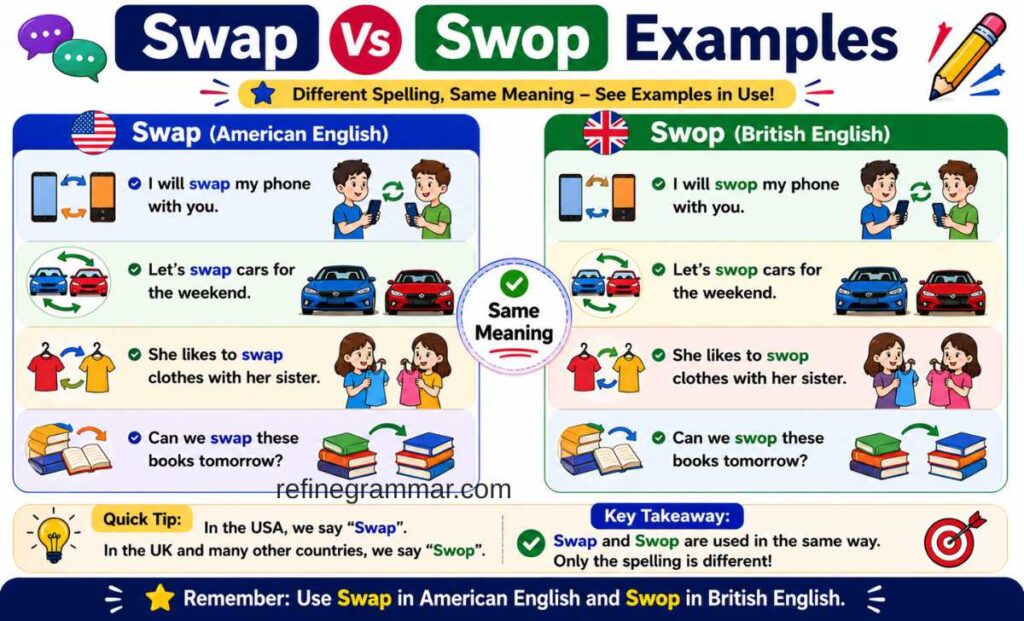
Comparing Swap vs Swop side by side in identical sentences shows there’s no shift in meaning — only tone:
| Swap Sentence | Swop Sentence (same meaning) |
| Let’s swap seats so you can see better. | Let’s swop seats so you can see better. |
| They swapped phone numbers after the meeting. | They swopped phone numbers after the meeting. |
| I’ll swap my dessert for yours. | I’ll swop my dessert for yours. |
Real-World Examples of Swap and Swop
“Swap” appears widely in finance (a “currency swap” or “debt swap”), retail (“swap meets” in American English), and everyday tech (“swap files” in computing). “Swop” survives mostly in nostalgic British branding, older book titles, and regional colloquial speech rather than professional or technical contexts.
Even industries built around exchange — ride-sharing, secondhand marketplaces, and clothing-swap events — consistently choose “swap” in their branding. This reinforces the broader Swap vs Swop conclusion: businesses gravitate toward the spelling their widest possible audience will recognize instantly, which is one more reason “swap” keeps winning in real-world usage.
What Dictionaries & Style Guides Say
Dictionary Insights
Leading dictionaries define “swap” as the primary entry and cross-reference “swop” as a chiefly British variant with an identical meaning — confirming that this is a spelling issue, not a vocabulary one.
Style Guide Recommendations
Most modern style guides recommend defaulting to “swap” for clarity and consistency, reserving “swop” only for direct quotations, historical texts, or deliberate stylistic choices.
Editorial teams at newspapers, publishing houses, and content platforms generally instruct writers to standardize on “swap” across all copy, including headlines, captions, and social posts, so that search engines and readers encounter one consistent spelling everywhere a brand publishes content.
Modern Usage in Everyday English
In 2026, the Swap vs Swop conversation is largely settled outside academic curiosity. Texting, social media, workplace tools, and global content platforms have standardized around “swap” because it reads as clean, modern, and universally understood.
Which One Should You Use Today?
For virtually every situation — emails, essays, resumes, articles, and casual chats — choose “swap.” Reserve “swop” only for quoting older British sources or intentionally evoking a vintage, regional voice.
Why Clarity and Consistency Matter
Choosing one spelling and sticking with it — within a single document, website, or brand — signals professionalism and avoids distracting readers. Since “swap” is recognized everywhere, it is the safer, more consistent choice for any audience.
Inconsistent spelling inside one article or brand voice can quietly erode trust, even when readers can’t pinpoint why something feels off. This is exactly why the Swap vs Swop decision matters more than it first appears — style guides, editors, and SEO tools all reward consistency, and “swap” is the version search engines and readers expect to see.
Rerad More: Sweet vs Sweat: What’s the Difference? Meaning, Pronunciation, Grammar & Examples (2026)
Common Mistakes / Confusions
• Assuming “swop” is a misspelling rather than a legitimate, if outdated, variant.
• Mixing both spellings within the same piece of writing.
• Overusing “swop” in international or American content, where it reads as unfamiliar.
• Treating the Swap vs Swop distinction as a grammar error rather than a spelling preference.
These slip-ups resemble other common English mix-ups, such as too many vs to many or balloon vs ballon, where a small spelling choice changes how polished the writing feels.
Self Assessment Section
Test yourself: choose the better spelling for modern, global writing in each sentence below.
1. “Can we ___ seats for the flight?” — swap or swop?
2. “The traders ___ currencies daily.” — swap or swop?
3. “She ___ her book with a classmate.” — swapped or swopped?
(Answer: “swap” and “swapped” are the recommended choices in each case for modern writing.) For more quick self-checks like this, see our guide on quieter vs more quiet.
Final Thoughts
The Swap vs Swop debate ultimately comes down to one simple rule: they mean the same thing, but “swap” is the modern, globally accepted spelling, while “swop” is a fading British variant best reserved for historical or stylistic use. Just like resolving shown vs showed or taken vs taking, picking the standard form keeps your writing clear, professional, and easy for any reader to understand.
FAQs
FAQ 1: What is the difference between swap and swop?
There is no difference in meaning — only spelling. “Swap” is the modern, globally standard form.
FAQ 2: Is swap or swop correct?
Both are technically correct, but “swap” is the recommended, widely accepted spelling today.
FAQ 3: What does swap mean?
To exchange one thing for another, used as both a verb and a noun.
FAQ 4: What does swop mean?
The exact same thing as “swap” — it is simply an older British spelling variant.
FAQ 5: Is swop used in British English?
Occasionally, mostly in older or informal writing, though “swap” now dominates modern British usage too.
FAQ 6: Does the Oxford Dictionary accept the word swop?
Yes, it is listed as a chiefly British variant spelling of “swap” with an identical definition.
FAQ 7: What is the past tense of swap and swop?
“Swapped” and “swopped,” respectively — both regular, doubled-consonant past tense forms.
FAQ 8: How do you pronounce swap and swop?
Identically — both rhyme with “stop.”
FAQ 9: Why do some people use swop instead of swap?
Regional habit, older reading influence, or a deliberate stylistic or nostalgic choice.
FAQ 10: Is swap vs swop discussed on Reddit?
Yes, the topic comes up occasionally in language and grammar communities, with most users confirming “swap” as the standard choice.
