
If you’ve ever paused mid-sentence wondering whether it’s “writing” or “writting,” you’re not alone. This one extra letter trips up learners, professionals, and even native speakers more often than you’d think. Below, we break down the correct spelling, the grammar rule behind it, and exactly when native speakers still get it wrong.
Writing or Writting – Quick Answer
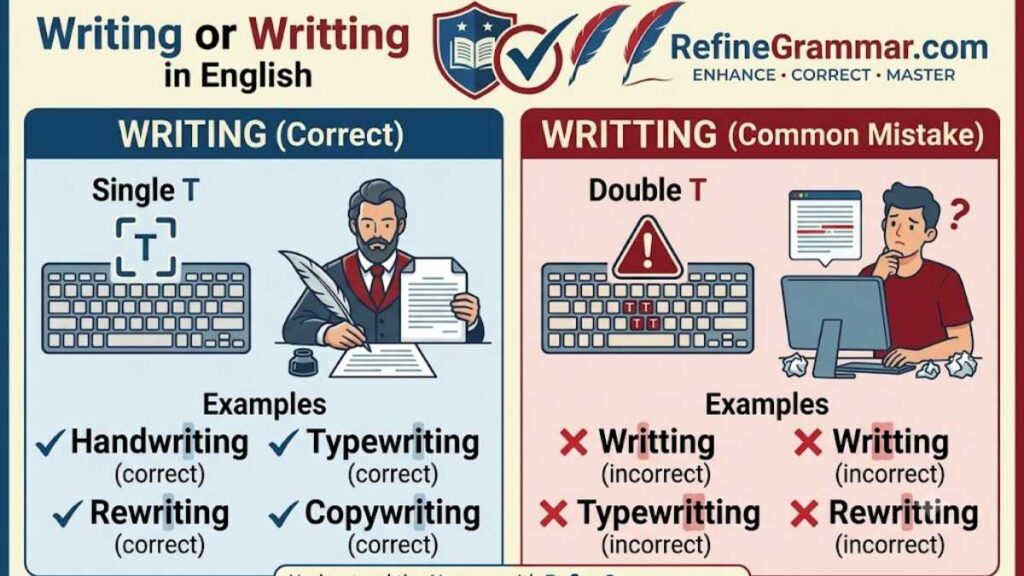
The correct spelling is writing, with a single “t.” “Writting” is a common misspelling and is never correct in standard English, whether in the US, UK, or any other English-speaking country.
Examples
● Correct: She is writing a new short story.
● Incorrect: She is writting a new short story.
● Correct: Good writing takes practice.
What Is Correct Writing or Writting?
Between the two forms, only one is a real English word. It’s the present participle and gerund form of the verb “to write,” formed by adding “-ing” and dropping the silent “e.” The double-“t” version simply doesn’t exist in any dictionary, style guide, or grammar reference—no matter how often it shows up in casual typing, quick text messages, or first drafts.
Dictionaries like Merriam-Webster and Cambridge list only one spelling for this word, and neither includes an alternate or informal double-“t” entry. That absence is itself a strong signal: if a spelling doesn’t appear in any major reference, it isn’t a valid variant—it’s a mistake.
Which Spelling Is Correct Writing or Writting?
Writing or Writting in English
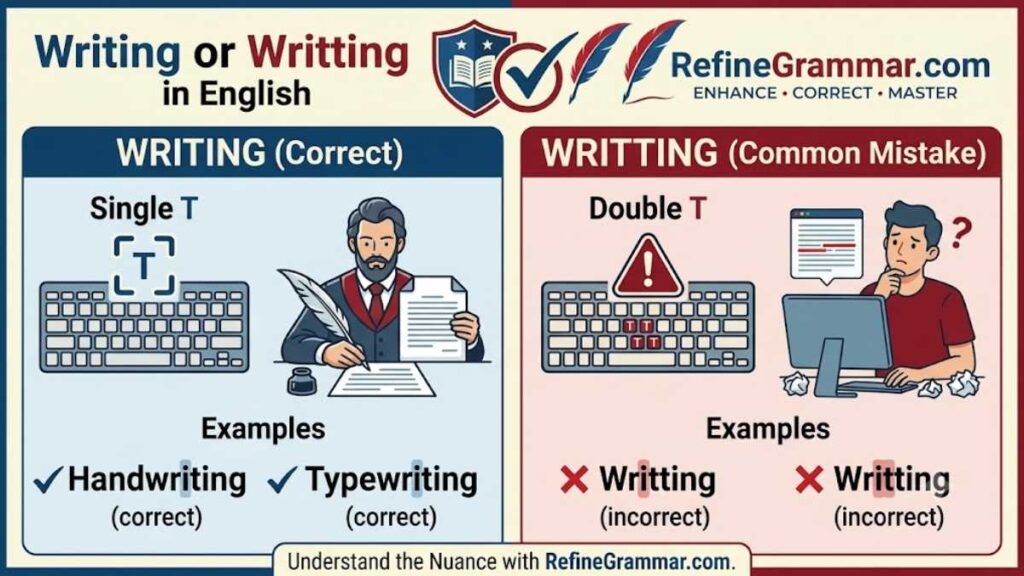
In modern English, this is really not a debate about regional variation, unlike genuine British-versus-American spelling differences (think “colour” versus “color”). It’s simply a spelling error caused by doubling a consonant that shouldn’t be doubled. English learners moving from languages with more phonetic spelling systems sometimes assume that doubling a consonant before “-ing” is a universal rule, when in fact it depends entirely on the base word’s spelling and stress pattern.
Writing or Writting Grammar
Grammatically, “writing” can function as a noun (“her writing is clear”), a gerund (“writing helps memory”), or part of a continuous verb tense (“I am writing”). “Writting” cannot fill any of these roles because it isn’t a recognized word.
Writing or Writting Meaning
The meaning only applies to the correct form: writing refers to the act of forming letters or words, composing text, or the resulting written material itself. It can describe anything from a handwritten note to a published novel. The double-“t” version carries no independent meaning—it’s simply a typo that a spell-checker or careful proofreading will catch.
Read More: 22th or 22nd: Which One Is Correct? Grammar Guide (2026)
The Origin of Writing or Writting
“Writing” descends from the Old English word “writan,” meaning to score, draw, or inscribe—a meaning that traces back to a time when marks were literally scratched into wood or stone. The “-ing” suffix was added following standard English spelling rules, which is why we drop the final “e” in “write” before adding the suffix, rather than doubling the “t.” Understanding this history makes the spelling rule easier to remember: there was never a doubled consonant in the root word to begin with.
British English vs American English Spelling
Both British and American English agree completely here—there’s no regional split for writing or writting, unlike comparisons such as quieter vs more quiet, where usage can shift depending on formality or region.
| Region | Preferred Spelling | Notes |
| US English | writing | Standard, no variation |
| UK English | writing | Standard, no variation |
Which Spelling Should You Use?
Always use “writing.” There is no context—academic, professional, casual, or creative—where “writting” is acceptable.
Examples
● Creative writing courses build storytelling skills.
● Technical writing requires precision and clarity.
● Her writing style is warm and conversational.
Writing or Writting Difference
There isn’t a genuine linguistic difference—only one form is a word. The “difference” people search for is really just confirmation that “writting” is an error, similar to how learners double-check pairs like due to or do to before submitting a final draft.
Writing or Writting Correct Spelling
The correct spelling rule: keep the single “t” in “write,” drop the silent “e,” then add “-ing.” That gives you w-r-i-t-i-n-g, never w-r-i-t-t-i-n-g.
Spelling of Writing or Writting
This spelling confusion usually comes from a general rule learners half-remember: double the final consonant before “-ing” in short words like “running” or “sitting.” But that rule applies to words ending in a single vowel plus consonant with a stressed final syllable—”write” ends in a silent “e,” so the doubling rule doesn’t apply here at all. Instead, the silent “e” is simply dropped before adding “-ing,” the same pattern you see in “hope” becoming “hoping” or “drive” becoming “driving.”
How Do You Spell Writing?
W-R-I-T-I-N-G. Seven letters, one “t,” no exceptions.
Is Writing One T or Two?
Writing has one “t.” Two “t’s” (writting) is always incorrect, regardless of tense, tone, or context.
I Am Writing or Writting
“I am writing” is correct present continuous tense. “I am writting” is a spelling mistake and should be corrected before sending any email, essay, or message.
I’m Writing or Writting
The contracted form follows the same rule: “I’m writing to you” is correct; “I’m writting to you” is not, even in informal texts or social captions.
Hand Writing or Writting
“Handwriting” (one word, one “t”) refers to a person’s individual writing style by hand. “Hand writting” is incorrect in every case, whether referring to a signature, a note, or a journal entry.
Writing or Writting Examples
- The teacher praised my writing for its clarity.
- Freelance writing is a flexible career path.
- He struggled with writing under a tight deadline.
- Good writing habits start with daily practice.
Writing or Writting Exercises
Try these quick exercises to lock in the correct spelling. Reading each sentence aloud can also help you catch the error, since the extra “t” doesn’t change how the word sounds.
- Rewrite this sentence correctly: “She is writting a report.”
- Fill in the blank: My favorite hobby is ____ (write) short stories.
- Identify the error: “Technical writting requires attention to detail.”
Answer key: 1) She is writing a report. 2) writing. 3) The error is “writting”; the correct word is “writing.”
Read More: 22th or 22nd: Which One Is Correct? Grammar Guide (2026)
Writing or Writting in Everyday Examples
I’m writing to confirm our meeting on Thursday.
News
The report highlighted a decline in student writing scores nationwide.
Social Media
Just finished writing my first blog post—so proud of myself!
Formal Writing
The committee requested a formal writing sample from each candidate.
Read More: Inter vs Intra: What’s the Difference? Meaning, Examples & Grammar Rules (2026)
Common Mistakes with Writing or Writting
Mistake 1
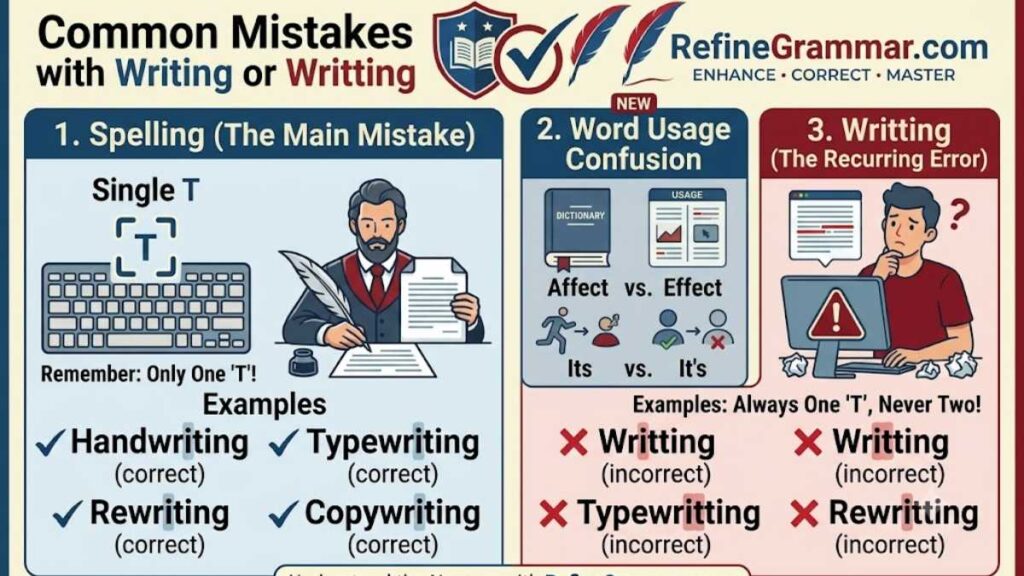
Doubling the “t” out of habit from words like “sitting” or “getting,” forgetting that “write” ends in a silent “e.”
Mistake 2
Autocorrect or fast typing introducing the extra letter without the writer noticing before hitting send.
Mistake 3
Assuming “writting” might be a British spelling variant—it isn’t; both British and American English reject it equally. If you catch yourself unsure, a quick rule of thumb is to check whether the base verb ends in a silent “e”: if it does, you drop the “e” and add “-ing” without doubling anything.
Written” or Writen
Written (two “t’s,” one “n”) is the correct past participle, as in “the letter was written.” “Writen” is a misspelling, just as “writting” is for the present participle.
Writing or Writings
“Writing” is typically uncountable when describing the general activity or skill (“her writing improved”). “Writings” is the countable plural, referring to specific works or texts (“the collected writings of a poet”). Neither should ever be spelled with a double “t.”
Writing or Writting – Google Trends & Usage Data
Search data consistently shows far higher volume for “writing” than “writting,” though the misspelled variant still generates a meaningful number of monthly searches—evidence of how common the error is among English learners worldwide.
Countries Where the Query Appears Often
● India
● Pakistan
● Philippines
● Nigeria
● United States
Comparison Table: Writing vs Writting
| Feature | Writing | Writting |
| Correct spelling | Yes | No |
| Dictionary entry | Yes | No |
| Used in British English | Yes | No |
| Used in American English | Yes | No |
| Acceptable in formal writing | Yes | No |
FAQs
What is correct writing or writting?
Writing is correct; writting is always a misspelling.
Which spelling is correct writing or writting?
Writing, spelled with a single “t,” is the only correct form.
Is writing one T or two?
Writing has one “t.”
How do you spell writing?
W-R-I-T-I-N-G.
Is it written or writen?
Written, with two “t’s” and one “n,” is correct.
What is the difference between writing and writting?
Writing is a real word; writting is simply a spelling error.
Is writing or writting used in British English?
Only writing is used; writting is not valid in any English dialect.
Can I use writting in formal writing?
No, writting is never correct in formal or informal contexts.
Why do people misspell writing as writting?
They mistakenly apply the consonant-doubling rule used for words like “sitting.”
When should I use writing instead of writting?
Always—writting should never appear in any sentence.
Conclusion
The takeaway is simple: writing is correct, writting is not. Whether you’re emailing a colleague, submitting an assignment, or posting on social media, sticking with the single-“t” spelling keeps your writing polished and credible. When in doubt, remember the rule—drop the silent “e,” add “-ing,” and never double the “t.” A quick mental check before you hit publish or send can save you from an easily avoidable error, and over time, the correct spelling will simply become second nature.
