
If you’ve ever paused mid-sentence wondering whether to write “nosy” or “nosey,” you’re not alone. This single adjective trips up native speakers, ESL learners, and professional writers alike. The nosey or nosy debate isn’t about meaning both words describe the same overly curious behavior it’s about which spelling belongs in which context, and getting it wrong can quietly undermine your credibility.
This guide settles the nosey or nosy question once and for all, using dictionary consensus, real usage data, and practical examples so you never have to second-guess yourself again.
Why “Nosey or Nosy” Confuses So Many People
English is full of words that look like they should follow one rule but secretly follow another. “Nosy” comes from “nose” plus the suffix “-y,” and logic suggests keeping the “e” from “nose” when adding a suffix. That’s exactly why so many writers default to “nosey” it simply looks more correct on paper.
The confusion is amplified by regional differences, inconsistent style guides, and the fact that both spellings appear in published writing. Add in autocorrect tools that sometimes flag one and not the other, and it’s easy to see why the nosy or nosey debate keeps resurfacing in grammar forums and search bars everywhere.
Quick Answer: Nosey vs Nosy
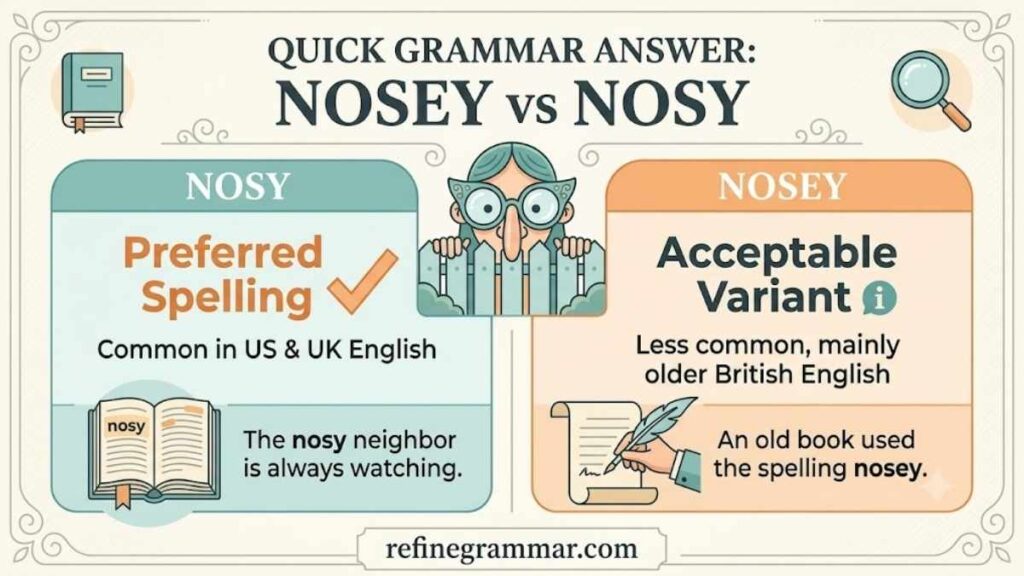
“Nosy” is the correct and standard spelling in modern English, used in both American and British formal writing. “Nosey” is a widely recognized variant, more common in casual British English, but it is not the preferred form in professional or academic contexts.
If you only remember one rule from this article, remember this: when in doubt, choose “nosy.”
What Does “Nosy” Mean? (Clear Definition + Tone)
Simple Definition
“Nosy” is an adjective describing someone who is excessively curious about other people’s private business someone who asks intrusive questions, eavesdrops, or pries into matters that aren’t their concern. Understanding this definition is the first step to settling the nosy or nosey question for good.
Tone Matters More Than You Think
The word almost always carries a negative or mildly disapproving tone. Calling someone “nosy” isn’t a compliment; it implies they’ve crossed a social boundary. That’s an important nuance for anyone using this word in writing, since tone shapes how a reader perceives the entire sentence.
Examples in Real Sentences
- Her nosy coworker kept asking about her salary.
- The neighbors are nosy and always watch who comes and goes.
- I don’t mean to be nosy, but is everything okay?
How to Pronounce “Nosy” (and “Nosey”)
Both spellings are pronounced identically: NOH-zee (rhymes with “cozy” and “rosy”). Pronunciation offers no clue about which spelling to use, which is exactly why the nosey or nosy debate is a spelling issue, not a phonetic one.
Where Did “Nosy” Come From? (The Real Origin)
How the Word Evolved
“Nosy” traces back to the noun “nose,” combined with the adjective-forming suffix “-y,” which means “having the quality of.” The imagery is literal: someone who sticks their nose into other people’s affairs.
So Why Not “Nosey”?
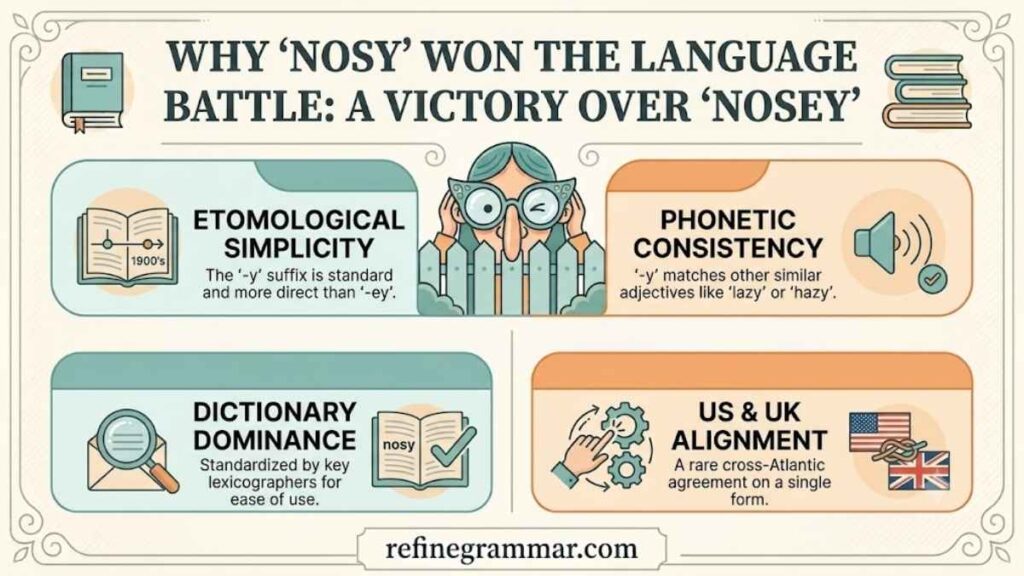
English generally drops a silent “e” before adding a suffix that starts with a vowel think “hope” becoming “hoping,” not “hopeing.” Following that same rule, “nose” plus “-y” becomes “nosy,” not “nosey.” The “e” is dropped for consistency with standard spelling conventions, even though “nosey” persists as an accepted alternative.
Nosy vs Nosey: The Real Difference (Side-by-Side)
| Feature | Nosy | Nosey |
| Standard spelling | Yes | No (variant) |
| Preferred in American English | Yes | Rarely |
| Preferred in British English | Yes (formal) | Sometimes (informal) |
| Found in major dictionaries | Yes, as primary entry | Yes, as secondary variant |
| Recommended for professional writing | Yes | No |
| Word length | Shorter | Longer |
Key Insight
Both words mean exactly the same thing, so the nosy or nosey choice is entirely about formality and audience never about meaning.
What Dictionaries and Experts Actually Say
Consensus Across Trusted Sources
Major dictionaries list “nosy” as the primary headword and “nosey” as a secondary, accepted variant. This pattern holds consistently across American and British reference sources, which reinforces Common Synonyms for Nosy
“nosy” as the safer default.
What That Means for You
If you’re writing anything that might be checked against a style guide a resume, an article, a business email “nosy” is the spelling that will never raise a flag. Every dictionary comparison of nosey or nosy points to the same conclusion.
What the Oxford Dictionary Says
Oxford dictionaries recognize both spellings but list “nosy” as the main entry, with “nosey” noted as a British variant spelling. This is a strong signal that even in UK English, “nosy” holds the more authoritative position.
Why Using the Wrong Spelling Can Hurt Your Writing
Here’s What Happens When You Use “Nosey”
It’s not technically wrong, but it can read as informal, dated, or inconsistent especially if the rest of your writing follows modern American conventions. Small inconsistencies like this compound, the same way switching between important or inportant spelling errors would signal a lack of polish in a document meant to look professional.
In Professional Contexts
Resumes, cover letters, business reports, and academic papers should stick with “nosy.” Editors and hiring managers notice spelling patterns, even subconsciously, and consistency builds trust in your writing.
When You Can Use “Nosey” (Yes, There Are Exceptions)
Situations Where It Works
- Casual British English conversation or writing
- Fiction dialogue meant to sound old-fashioned or regional
- Song lyrics, poetry, or stylistic writing choices
- Informal social media captions
Example
“Ol’ Nosey Parker next door was peeking through the curtains again” fits naturally in a folksy, conversational narrative voice.
But Be Careful
Using “nosey” in a formal document, even once, can look like a typo rather than a stylistic choice so reserve it strictly for informal or creative contexts.
Common Mistakes People Make (And How to Avoid Them)
Mistake 1: Thinking Both Are Equal
Many writers assume the nosey or nosy choice doesn’t matter at all. While both are technically correct, one is clearly preferred in professional settings.
Mistake 2: Trusting Logic Over Usage
Just like people mistakenly write “address” as an address or adress error because it “feels” like it should have one “d,” writers assume “nosey” must be correct because it keeps the “e” from “nose.” Usage data says otherwise.
Mistake #3: Ignoring Context
Using “nosy” in a casual British text message isn’t wrong, but it can feel oddly formal. Context should always guide your final choice.
Quick Fix Checklist
- Formal writing? Use “nosy.”
- Casual British dialogue? “Nosey” is acceptable.
- Unsure of your audience? Default to “nosy.”
Nosy or Noisy? Don’t Confuse These Two
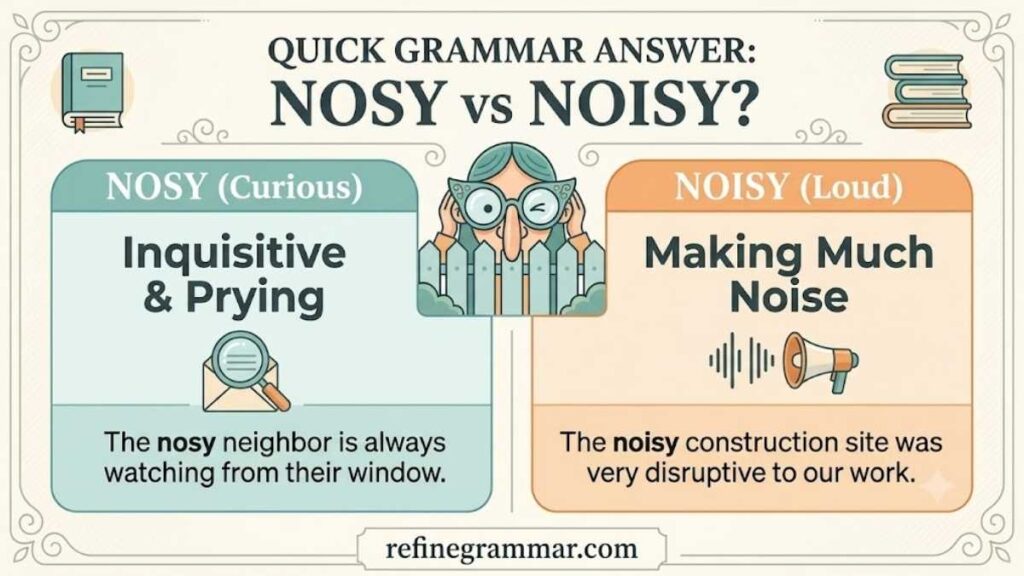
These words look similar but mean completely different things. “Nosy” describes curiosity about others’ business, while “noisy” describes loud sound. A noisy neighbor makes a racket; a nosy neighbor watches your every move. This kind of mix-up is similar to confusing homey or homie spelling easy to make when typing quickly, so always double-check before hitting send.
A Simple Memory Trick That Actually Works
Picture someone’s nose pressed against a window, peeking in that’s “nosy,” spelled just like “nose” with a “y” tacked on, no extra “e” needed. If you can picture the nose, you’ll remember the correct answer to nosy or nosey every time.
How People Use “Nosy” in Real Life
Where You’ll See “Nosy” Most
News articles, published books, formal essays, workplace communications, and virtually all edited professional content default to “nosy.”
Where “Nosey” Still Appears
Older British literature, regional dialogue, casual blogs, and informal messaging still use “nosey” fairly often, particularly in the UK.
Common Synonyms for “Nosy”
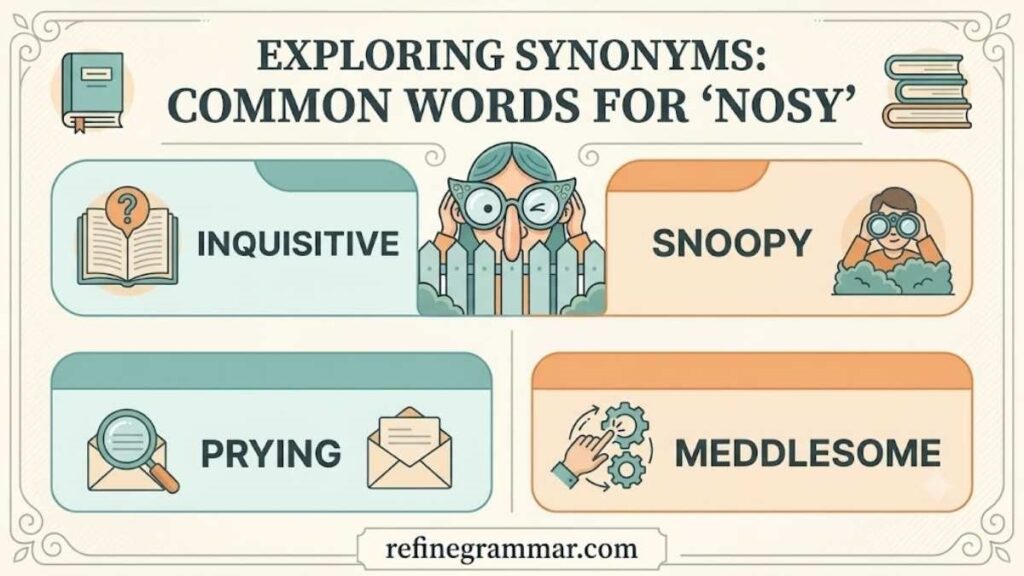
If you want to avoid repeating nosy or nosey too often in your own writing, these synonyms work well:
- Prying
- Curious
- Inquisitive
- Snooping
- Meddlesome
- Intrusive
The “Nosey Parker” Idiom
“Nosey Parker” is a classic British idiom describing someone who is excessively inquisitive about other people’s private affairs. Interestingly, this idiom almost always keeps the traditional “nosey” spelling, even in modern British writing, making it one of the few places where the older form still dominates.
Case Study: Social Media vs Professional Writing
Scenario 1: Twitter Post
“lol my nosey aunt asked about my dating life again 😂” casual, spelling choice barely matters here, similar to how an informal winner or winer typo would slide by unnoticed in a quick tweet.
Scenario 2: Resume or Cover Letter
Never use either word here directly, but if describing soft skills indirectly (e.g., “detail-oriented,” “observant”), avoid casual synonyms like “nosy” altogether it reads as unprofessional regardless of spelling.
Scenario 3: Fiction Dialogue
“Stop being so nosey, Gran,” the character says, if you’re deliberately writing dialect or old-fashioned speech patterns. Here, “nosey” fits stylistically.
Why “Nosy” Won the Language Battle
Three Reasons “Nosy” Took Over
- It follows the standard silent-e-drop spelling rule.
- Major dictionaries and style guides list it as primary.
- It’s shorter and easier to type consistently at scale.
These three reasons explain why the nosy or nosey debate almost always resolves in favor of the shorter spelling.
Deep Dive: How English Handles Spelling Variants
What’s the Pattern?
English regularly drops a silent “e” before adding “-y” or “-ing”: “hope” to “hoping,” “shine” to “shiny,” “nose” to “nosy.” This is the same underlying pattern that eventually resolves debates like gnaw or knaw, where historical spelling and modern convention don’t always agree at first glance.
What You Should Do
Trust the dictionary-preferred form over instinct. When two spellings exist, the version listed first in major dictionaries is almost always the safer professional choice.
Quick Comparison List: Right vs Risky Choices
Always Safe
- Nosy (any formal writing)
- Nosy (American English)
- Nosy (British formal English)
Use With Caution
- Nosey (casual British writing only)
- Nosey (deliberate stylistic dialogue)
Just as confusion around time flies or time flys usage stems from applying the wrong pluralization rule, “nosy” versus “nosey” confusion comes from applying the wrong suffix rule both are solved the same way: check the standard form first.
Final Verdict: Nosey or Nosy?
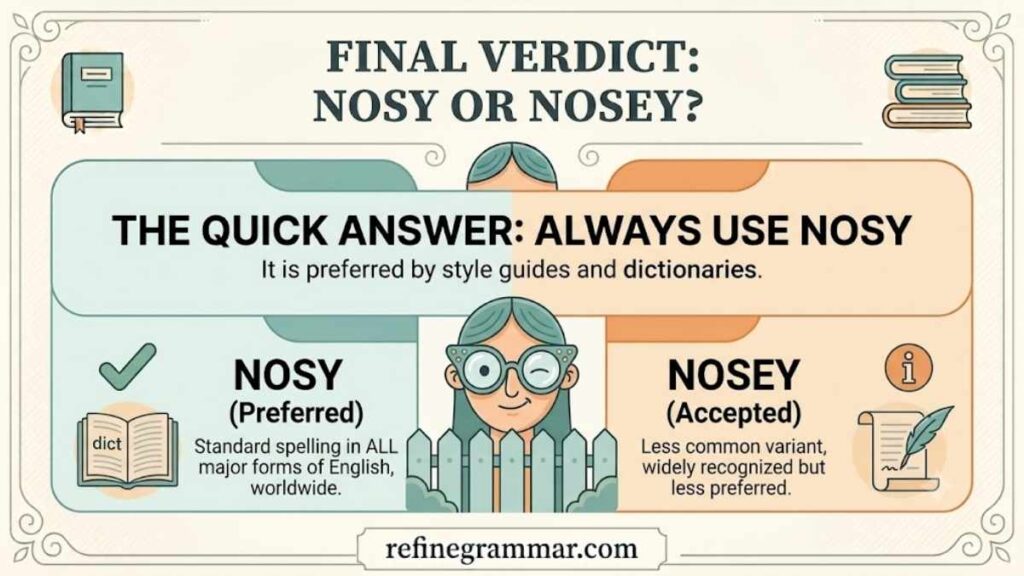
“Nosy” is the correct, standard, and universally accepted spelling. “Nosey” isn’t wrong, but it’s a regional and informal variant best reserved for casual British writing or intentional stylistic effect. When you’re unsure, always default to “nosy” much like defaulting to the standard form settles similar debates around homey or homie word choice in everyday writing.homey or homie word choice“Nosy” is the correct, standard, and universally accepted spelling. “Nosey” isn’t wrong, but it’s a regional and informal variant best reserved for casual British writing or intentional stylistic
. When you’re unsure, always default to “nosy” much like defaulting to the standard form settles similar debates around homey or homie word choice in everyday writing.
TL;DR (Fast Recap)
- Correct spelling: nosy
- Accepted variant: nosey (informal British English)
- Meaning: excessively curious about others’ business
- Tone: negative or disapproving
- Pronunciation: identical for both spellings
- Best rule: when in doubt, use “nosy”
Read More: Dwarfs or Dwarves: The Ultimate Guide to Choosing the Right Plural
FAQs
Is it “nosy” or “nosey”? Which spelling is correct?
“Nosy” is the standard, correct spelling; “nosey” is an accepted but informal variant.
What does “nosy” (or “nosey”) mean?
It means excessively curious about other people’s private affairs or business.
Is “nosey” used in the UK, or is “nosy” preferred everywhere?
“Nosey” appears more in casual British English, but “nosy” is preferred formally in both the UK and US.
How do you pronounce “nosy” or “nosey”?
Both are pronounced the same way: “NOH-zee.”
What’s the difference between “nosy” and “noisy”?
“Nosy” means overly curious; “noisy” means loud. They’re unrelated in meaning.
What are some good synonyms for “nosy” or “nosey”?
Prying, inquisitive, curious, snooping, and meddlesome are common synonyms.
What does the Oxford Dictionary say about “nosy” vs “nosey”?
Oxford lists “nosy” as the primary spelling and “nosey” as a British variant.
Why do so many people search “is it nosy or nosey”?
Because the silent “e” in “nose” makes “nosey” feel more logical, even though it isn’t standard.
What does the phrase “nosey parker” mean?
It’s a British idiom for someone excessively curious about others’ private affairs.
How do you correctly spell “nosey”/”nosy” in a sentence?
Use “nosy” in formal writing: “She gave her nosy neighbor a polite but firm answer.”
Conclusion
The nosey or nosy debate ultimately comes down to one simple rule: “nosy” is the standard, dictionary-preferred spelling, while “nosey” remains an accepted but informal variant. Whether you’re writing a professional email, a novel, or a quick text message, choosing “nosy” will always be the safer, more polished option. Keep this guide bookmarked, and you’ll never have to second-guess this spelling again.
