
Two letters swap, and the whole meaning of a sentence flips. That is exactly what happens with sweet vs sweat — a pair of English words that look almost identical but mean completely different things. One describes sugar, kindness, and charm. The other describes moisture, heat, and effort. If you have ever typed “you’re so sweat” by mistake, you already know how quickly this mix-up can happen.
This guide breaks down sweet vs sweat from every angle: meaning, pronunciation, grammar, idioms, common mistakes, and easy memory tricks — the same kind of close look we give other tricky English pairs like taken vs taking. By the end, you will know exactly which word fits every sentence, every time.
Quick Answer: Sweet vs Sweat Meaning
Sweet vs Sweat Meaning
In short, sweet describes something pleasant, sugary, or kind, while sweat refers to the moisture your body produces from heat, stress, or exercise. Sweet is almost always an adjective; sweat is a noun or a verb. That single distinction solves most sweet vs sweat confusion instantly.
Sweet vs Sweat Example
Compare these two sentences: “She has a sweet smile” describes a pleasant personality trait, while “He was covered in sweat after the run” describes physical exertion. Swapping the words would make both sentences confusing or unintentionally funny.
Sweet Meaning
What Does Sweet Mean?
Sweet is an adjective that describes a sugary taste, a pleasant sensation, or a kind, gentle personality. It traces back to the Old English word swete, meaning “pleasing to the senses or mind,” which is why it now covers everything from flavor to emotion.
Sweet Meaning in English
In everyday English, sweet can describe taste (sweet tea), sound (a sweet melody), behavior (a sweet gesture), or even smell (a sweet fragrance). In British English, sweets is also a common noun for candy or dessert.
Sweet Meaning with Examples
• This mango is incredibly sweet.
• She sent me the sweetest message this morning.
• That was a sweet thing to do for your neighbor.
• Their new puppy has such a sweet temperament.
Sweat Meaning
What Does Sweat Mean?
Sweat refers to the salty fluid released through the skin’s pores when the body is hot, stressed, or working hard. It comes from the Old English sweatan, meaning “to perspire” or “to labor,” and it functions as both a noun and a verb.
Sweat Meaning in English
As a noun, sweat is the physical moisture itself (“drops of sweat”). As a verb, it describes the act of perspiring or, figuratively, working hard under pressure (“I sweated over that report all night”).
Sweat Meaning with Examples
• He was drenched in sweat after the marathon.
• I sweat a lot whenever I’m nervous.
• Don’t sweat the small stuff.
• She sweated through the entire job interview.
Why “Sweet” and “Sweat” Are Often Confused
Sweet or Sweat in Hot?
In hot weather, both words can technically appear in the same sentence, but they mean very different things. “It’s sweet in this heat” doesn’t make sense — you would say “I sweat in this heat” or “I get sweaty in this heat.” Sweet describes taste or charm, never temperature.
Why Do English Learners Mix Up Sweet and Sweat
The confusion around sweet vs sweat usually comes down to four things: near-identical spelling, similar sound in fast speech, autocorrect swapping one for the other, and inconsistent English vowel rules for the “ea” letter combination. It’s the same pattern that causes mix-ups like ballon vs balloon — learners scanning quickly often miss the single letter or sound that separates two similar words.
Understanding the Core Difference Between Sweet and Sweat
Sweet – Meaning and Emotional Use
Sweet lives in the world of emotion and sensation. It praises, describes flavor, and expresses warmth. Saying “that’s so sweet of you” is one of the most common compliments in English.
Sweat – Meaning and Physical Use
Sweat lives in the world of the body and effort. It shows up in fitness, medicine, stress, and hard work. Phrases like “blood, sweat, and tears” capture its association with struggle and dedication.
Pronunciation Guide: Sweet vs Sweat
Sweat vs Sweet Pronunciation
The entire sweet vs sweat pronunciation difference comes down to one vowel sound. Sweet uses the long “ee” sound (/swiːt/), while sweat uses the short “e” sound (/swɛt/), the same short vowel found in “bet” or “wet.”
Sweat Pronunciation
Say sweat quickly and sharply — it rhymes with “wet,” “bet,” and “jet.” The jaw drops slightly and the sound is short.
Sweet Pronunciation
Say sweet with a stretched vowel — it rhymes with “heat,” “feet,” and “meet.” The lips spread and the sound holds longer.
How to Pronounce Sweet and Sweat Correctly
A simple trick: if the word sounds like “heat,” you mean sweet. If it sounds like “bet,” you mean sweat. Practicing this minimal pair out loud a few times trains your ear fast.
Grammar and Word Forms Compared
Parts of Speech
Sweet functions mainly as an adjective (and occasionally a noun for candy in British English). Sweat functions as both a noun and a verb, with sweaty as its related adjective form.
Grammar Rules for Sweet and Sweat
Getting the part of speech right matters just as much as spelling — the same principle applies to commonly confused grammar pairs like too many vs to many.
• Sweet → adjective: a sweet cake, a sweet voice.
• Sweetly → adverb: she smiled sweetly.
• Sweetness → noun: the sweetness of the fruit.
• Sweat → noun: beads of sweat.
• Sweat → verb: I sweat / I sweated / I have sweated.
• Sweaty → adjective: sweaty palms.
Usage in Everyday Contexts
Using “Sweet” in Daily Life
Sweet appears constantly in compliments, food descriptions, and casual slang meaning “great” or “awesome” (“Sweet, thanks for the update!”). It softens tone and adds warmth to writing, whether in a text message or a grammar lesson about verb pairs like shown vs showed.
Using “Sweat” in Daily Life
Sweat shows up in fitness routines, workplace stress talk, and idioms about hard work. You’ll hear it in gyms, exam halls, and job interviews alike — anywhere effort or pressure is involved.
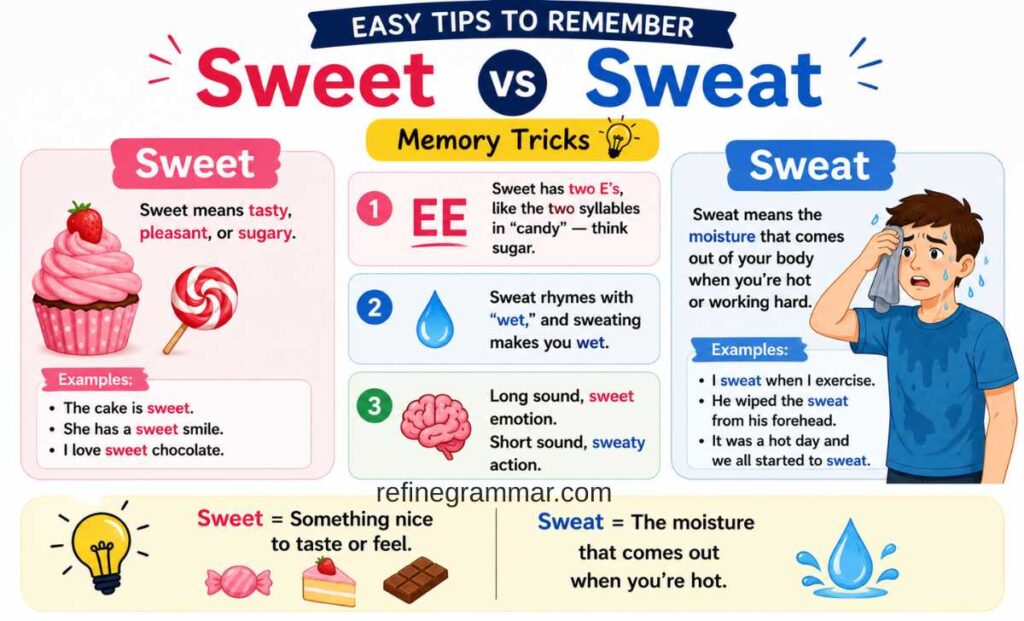
Easy Tips to Remember Sweet vs Sweat
Memory Tricks
• Sweet has two E’s, like the two syllables in “candy” — think sugar.
• Sweat rhymes with “wet,” and sweating makes you wet.
• Long sound, sweet emotion. Short sound, sweaty action.
Never Confuse Sweet and Sweat Again
Once you link the long “ee” sound to pleasant feelings and the short “e” sound to physical effort, sweet vs sweat becomes an easy call every time you write or speak.
Idioms and Common Expressions
Idioms with “Sweet”
• Sweet dreams
• Home sweet home
• Sweet tooth
• Sweet spot
Idioms with “Sweat”
• No sweat
• Break into a sweat
• Sweat it out
• Sweat blood
Common Mistakes and Confusions
Sweet Smelling Sweat Meaning
“Sweet-smelling sweat” is a real, if unusual, phrase describing perspiration that carries a pleasant scent rather than the usual musky odor — often linked to diet, hydration, or certain health conditions. It combines both words correctly: sweet as the adjective, sweat as the noun it modifies.
Is “Sweet Sweat” Correct English?
Grammatically, yes — “sweet sweat” is a valid adjective-noun pairing, similar to how putting vs puting style spelling questions get resolved once you check the base word. It’s also a well-known brand name for a workout gel, which is different from the everyday grammatical meaning discussed here.
Common Errors Students Make
• Writing “You’re so sweat” instead of “You’re so sweet.”
• Using sweet to describe physical exertion (“I feel sweet after the gym”).
• Using sweat to describe flavor or personality (“She has a sweat smile”).
• Confusing sweat with related word pairs like taken vs taking or too many vs to many during fast typing.
How to Remember the Difference Easily
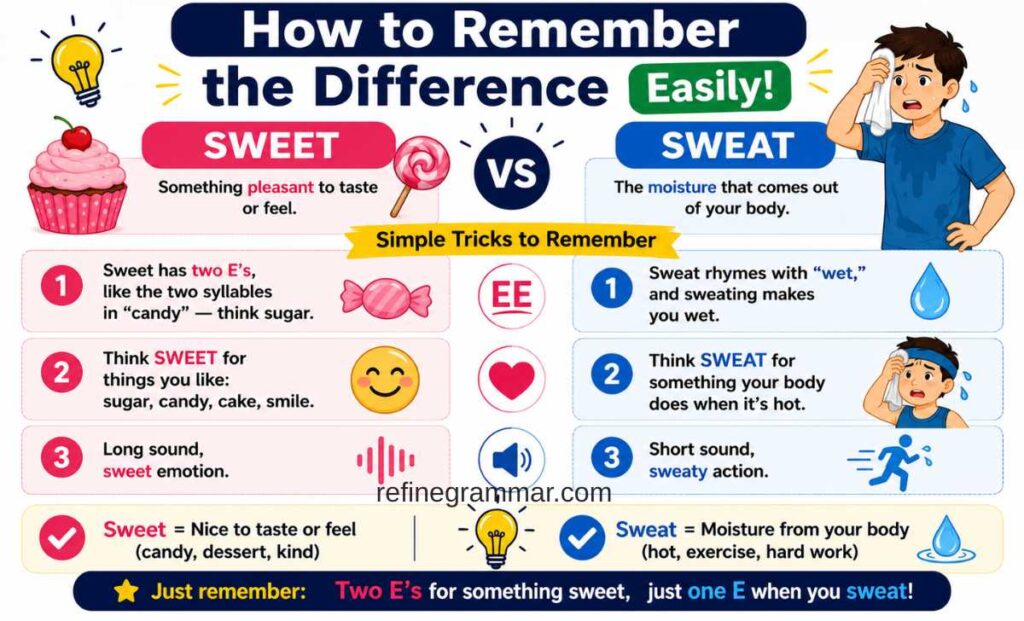
Visual Memory Technique
Picture a candy bar for sweet and a gym towel for sweat. Attaching a mental image to each word makes recall almost automatic, the same way visual tricks help with tricky pairs like even though vs eventhough.
Sound Comparison Method
Say both words back-to-back — sweet, sweat, sweet, sweat — and notice how the vowel shortens on the second word. Repeating minimal pairs out loud is one of the fastest ways to fix pronunciation-based confusion for good.
Comparison Table: Sweet vs Sweat
Side-by-Side Comparison
| Feature | Sweet | Sweat |
| Part of Speech | Adjective (noun in British English) | Noun / Verb |
| Meaning | Sugary, pleasant, kind | Body moisture, effort |
| Pronunciation | /swiːt/ – long “ee” | /swɛt/ – short “e” |
| Related Forms | Sweetly, sweetness, sweetie | Sweaty, sweated, sweating |
| Common Idiom | Sweet spot | No sweat |
Linguistic Insight: Why Small Vowels Change Meaning
Why /iː/ and /ɛ/ Sound Different
English relies heavily on minimal pairs — words that differ by a single sound but carry entirely different meanings. Sweet vs sweat is a textbook example: the long vowel /iː/ and the short vowel /ɛ/ are produced with different tongue height and jaw position, which is why native speakers rarely confuse them, even though learners sometimes do.
Expert Opinion: Choosing the Right Word Confidently
When Native Speakers Use Sweet vs Sweat
Experienced English teachers consistently point to context as the fastest fix for sweet vs sweat confusion: ask whether the sentence is about taste and emotion (sweet) or heat and effort (sweat). Native speakers rarely think about grammar rules in the moment — they rely on this same context check almost instinctively.
Practice Section: Choose Sweet or Sweat
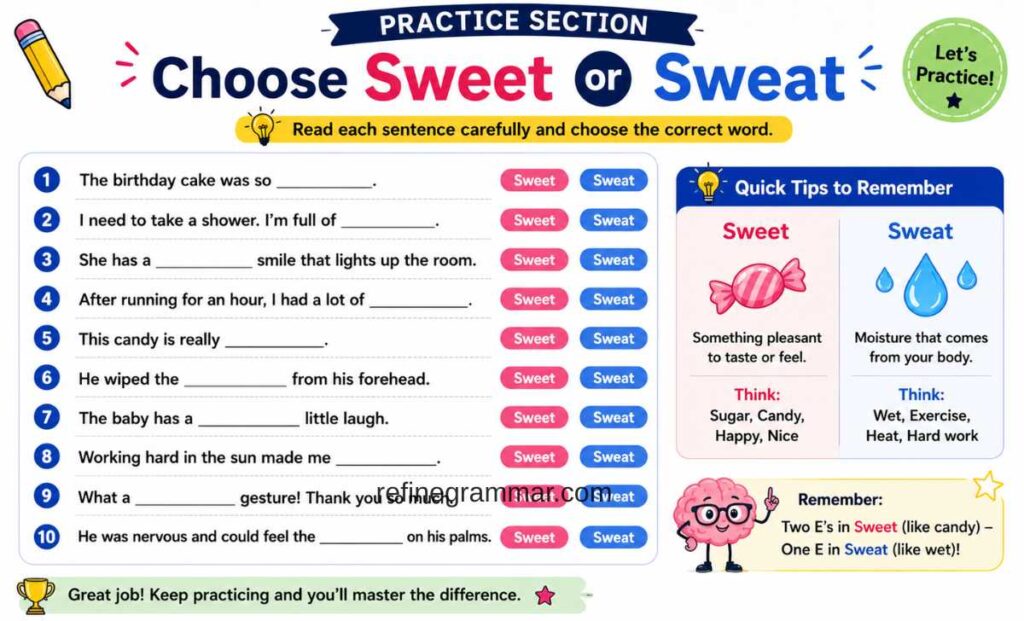
Fill in the Blanks
1. The lemonade tasted very ______.
2. He began to ______ after climbing the stairs.
3. She wrote me the most ______ note.
4. My shirt was soaked in ______ after the workout.
Choose the Correct Word
5. (Sweet / Sweat) dreams, sleep well!
6. Don’t (sweet / sweat) it — everything will work out.
7. That puppy has such a (sweet / sweat) personality.
8. Athletes lose fluids through (sweet / sweat) during training.
Common Questions
What is the difference between sweet and sweat?
Sweet describes something pleasant, sugary, or kind, while sweat refers to the moisture the body releases from heat, stress, or exercise.
Is it sweet or sweat in hot weather?
You sweat in hot weather; sweet never describes temperature or perspiration.
What are the differences between sweet and sweat in common usage?
Sweet is mainly an adjective used for taste and emotion, while sweat is a noun or verb used for physical effort and body moisture.
How do you pronounce sweet and sweat?
Sweet uses a long “ee” sound (/swiːt/); sweat uses a short “e” sound (/swɛt/), like in “wet.”
Why are sweet and sweat commonly confused?
Their nearly identical spelling, similar sound in fast speech, and frequent autocorrect swaps make sweet vs sweat a common mix-up for learners.
What is the meaning of the idiom “sweet vs sweat”?
It isn’t a fixed idiom — it’s simply the comparison of two easily confused English words with opposite emotional tones.
What does sweet mean in English?
Sweet means having a sugary taste, or being pleasant, kind, and enjoyable in behavior or experience.
What does sweat mean in English?
Sweat means the salty fluid released by the body from heat or exertion, or the act of perspiring or working hard.
What is the meaning of sweet smelling sweat?
It describes perspiration that has a pleasant rather than musky odor, often influenced by diet, hydration, or health factors.
Is Sweet Sweat Waist Trimmer effective?
Sweet Sweat is simply a branded workout gel product name — it isn’t related to the grammar topic of sweet vs sweat covered in this article.
Can sweet and sweat be used interchangeably?
No. They have completely different meanings and grammatical roles, so swapping them changes or breaks the sentence.
How can I remember the difference between sweet and sweat?
Link the long “ee” sound to sugar and kindness, and the short “e” sound to effort and moisture — practice the minimal pair out loud.
Conclusion
At the end of the day, sweet vs sweat comes down to one vowel and two completely different worlds of meaning — one sugary and kind, the other physical and effortful. Once you lock in the pronunciation difference and picture the right context, you’ll never send an awkward “you’re so sweat” message again. Keep practicing with real sentences, and choosing correctly between sweet and sweat will become second nature.
