
If you’ve ever paused mid-sentence wondering whether to write “there are too many mistakes” or “there are to many mistakes,” you’re not alone. The too many vs to many mix-up is one of the most common spelling slips in English, and it trips up native speakers and learners alike.
This guide breaks down the too many vs to many meaning, the grammar rule behind it, and plenty of real-world examples, so you can write with confidence every time.
Too many vs to many meaning
In the too many vs to many debate, only one phrase expresses quantity. “Too many” means an excessive or undesirable number of countable things. “To many,” on the other hand, is not a standalone phrase — it only works when “to” is a preposition pointing toward people, such as “I spoke to many students.”
Too many vs to many grammar
Grammatically, “too” is an adverb that intensifies a quantifier, while “to” is a preposition or infinitive marker. That single letter changes the entire function of the sentence, which is exactly why too many vs to many confusion happens so often in fast typing and casual writing.
What Does Too Many Mean?
“Too many” signals that a number of countable items has gone beyond what’s reasonable, needed, or comfortable.
• There are too many cars on this street.
• She has too many browser tabs open.
• We received too many complaints this month.
Grammar Rule Behind “Too Many”
The rule is simple: “too” + “many” + a plural countable noun. If you can count the noun one by one (books, emails, mistakes), “too many” is correct. If the noun can’t be counted individually (water, advice, traffic), you need “too much” instead.
Should I Write To Many or Too Many?
When you’re describing an excessive quantity, always choose “too many.” Reserve “to many” strictly for sentences where “to” is directing an action toward a group of people, a distinction similar to the one explained in this guide on taken vs taking.
To many more or too many more
“Too many more” is the correct form when adding emphasis to excess, as in “We can’t accept too many more applications this week.” “To many more” is only valid when “to” introduces a recipient, such as “I explained the policy to many more employees today.”
Difference Between Too Many, Too Much, and Too Few
These three quantifiers are easy to separate once you know what type of noun they pair with:
| Phrase | Noun Type | Example |
| Too many | Countable | Too many chairs in the room |
| Too much | Uncountable | Too much noise outside |
| Too few | Countable (opposite of too many) | Too few volunteers signed up |
Too much and too many examples
• Too much: There’s too much sugar in this coffee.
• Too many: There are too many typos in this draft.
• Too much: He spends too much time on his phone.
• Too many: She owns too many pairs of shoes.
How to Identify Countable and Uncountable Nouns
A quick test settles most too many vs to many and too much decisions: try placing a number directly in front of the noun.
1. Can you say “three books”? Yes — it’s countable, so use “too many.”
2. Can you say “three waters” in the everyday sense? No — it’s uncountable, so use “too much.”
3. Still unsure? Swap in “several” — if it fits naturally, the noun is countable.
Common Real-Life Usage of Too Many
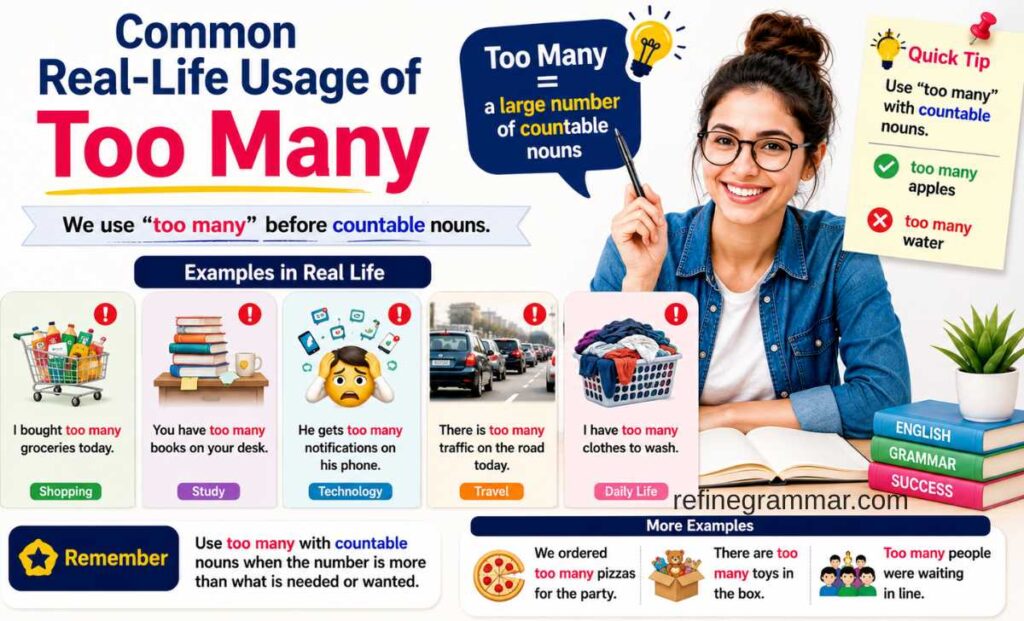
“Too many” shows up constantly in everyday and professional English — inboxes, meetings, deadlines, and notifications are frequent culprits. It’s just as common in casual writing as it is in workplace emails, which is why getting the too many vs to many distinction right matters for credibility.
Too Many Sentence Examples
4. Too many people showed up without RSVPing.
5. I have too many unread messages.
6. There were too many errors in the final report.
7. The team set too many goals for one quarter.
Too many vs to many examples
Seeing both phrases side by side makes the too many vs to many distinction click faster:
• Correct: There are too many cooks in the kitchen.
• Correct: I sent the invite to many colleagues.
• Incorrect: There are to many cooks in the kitchen.
• Incorrect: I sent the invite too many colleagues.
To Many Sentence Examples (Why They’re Wrong)
Each incorrect example below breaks down exactly why it fails, much like the letter-level mix-ups covered in this guide on shown vs showed.
• ❌ “There are to many issues.” — should be “too many” (expresses excess, not direction).
• ❌ “He gave too many students.” — should be “to many” (students are recipients, not an excess).
• ❌ “I have to many things planned.” — should be “too many” (quantity of countable plans).
Comparison Table: Too Many vs To Many
| Feature | Too Many | To Many |
| Function | Expresses excess quantity | Preposition + recipient |
| Pairs with | Countable plural nouns | People or groups |
| Example | Too many cars on the road | Sent flyers to many neighbors |
| Common error? | Rarely misused alone | Frequently a typo for “too many” |
Tips to Avoid Confusing Too Many and To Many
8. Remember: the extra “o” in “too” stands for “over the top” or excess.
9. Read your sentence aloud — if it describes an amount, it needs “too many.”
10. Try the replacement test: swap “too” with “excessively.” If it still makes sense, you’re correct.
11. When in doubt, check whether the noun after it is a person being given something (“to”) or a countable item in excess (“too”).
Common Grammar Mistakes Learners Make
• Mixing up too many with too much for uncountable nouns.
• Dropping the second “o” out of habit or typing speed.
• Relying on autocorrect instead of understanding the too many vs to many rule.
• Overcorrecting and replacing every “to” with “too.”
Linguistic Insight: Why This Confusion Happens
“Too” and “to” are homophones — they sound identical in fast speech, which is why the error slips into writing so easily. Second-language learners often compound the issue because many languages don’t distinguish between an intensifying adverb and a directional preposition the way English does. This is a similar pattern to the mix-up covered in eventhough vs even though, where a single spacing or spelling choice changes correctness.
Expert Opinion on Correct Usage
Style guides and grammar references consistently treat “too many” as the only standard way to express excessive countable quantity, while “to many” is accepted only in its prepositional sense. For an authoritative breakdown of a similar single-letter mix-up, see the guide on putting vs puting.
Self Assessment
Test yourself before moving on to the full exercises below.
12. I have ___ emails to answer today. (too many / to many)
13. She spoke ___ many parents at the meeting. (too / to)
14. There is ___ traffic on this road. (too much / too many)
Too many vs to many worksheet
Fill in each blank with the correct phrase, then check your answers against the too many vs to many rule covered earlier in this guide.
15. We had ___ cancellations this week.
16. I already explained this ___ people.
17. There are ___ apps on my phone.
18. The coach gave the ball ___ players at once.
Too many vs to many exercises
Practice makes the too many vs to many rule automatic. Rewrite each incorrect sentence below:
19. “There are to many cars in the lot.” → Correct: There are too many cars in the lot.
20. “I sent it too many friends.” → Correct: I sent it to many friends.
21. “She has to many pairs of shoes.” → Correct: She has too many pairs of shoes.
Too many vs to many quiz
Choose the correct option for each sentence:
22. There are ___ chairs for this small room. (too many / to many)
23. He waved ___ many fans after the show. (too / to)
24. We added ___ toppings to the pizza. (too many / to many)
Wrapping Up: To Many or Too Many?
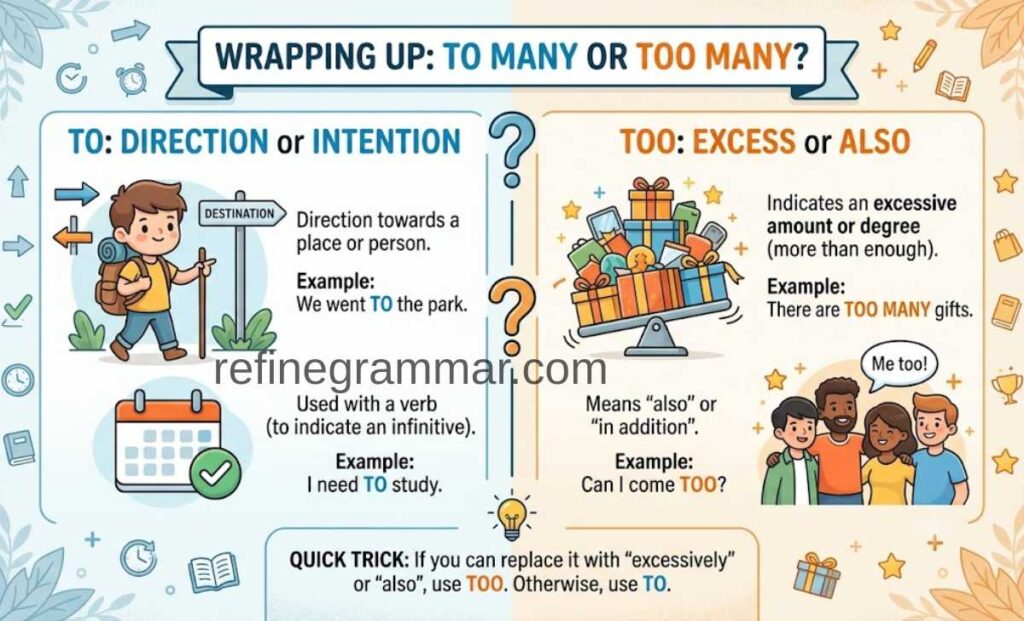
The too many vs to many rule comes down to one question: are you describing an excessive quantity, or directing something toward people? Use “too many” for excess and countable nouns, and reserve “to many” for its prepositional role. Keep the extra “o” in mind as your quantity signal, and this mix-up will stop showing up in your writing for good.
Final Conclusion
Mastering too many vs to many is a small fix with a big payoff for clarity and credibility. Whether you’re writing an email, an essay, or a blog post, applying the countable-noun test and the direction-versus-excess check will keep your grammar accurate every time.
FAQs
Is too many grammatically correct?
Yes, “too many” is the grammatically correct phrase for describing an excessive number of countable items.
What is the correct grammar for to many?
“To many” is correct only when “to” functions as a preposition directing an action toward multiple people.
What does too many mean?
It means a quantity of countable things that exceeds what is reasonable, needed, or desired.
Is “to many” ever correct?
Yes, when it’s followed by people or a group receiving something, such as “I wrote to many customers.”
When should I use too or to?
Use “too” for excess or intensity, and “to” as a preposition or before a verb, like “to go” or “to many people.”
How do you use too many in a sentence?
Pair it with a plural countable noun, as in “There are too many notifications on my phone.”
What is the difference between too many and too much?
“Too many” pairs with countable nouns, while “too much” pairs with uncountable nouns.
Do you say too many clothes or too much clothes?
“Too many clothes” is correct because “clothes” is treated as a countable, plural noun.
How do I know if a noun is countable or uncountable?
Try placing a number in front of it — if it fits naturally, like “three chairs,” it’s countable.
What are the most common mistakes with too many and to many?
Dropping the second “o” in “too” and confusing “too many” with “too much” for uncountable nouns.
Can too many be used in formal writing?
Yes, “too many” is appropriate in academic, business, and formal writing whenever excess quantity is being described.
How can I remember the difference between too many and to many?
Remember that the extra “o” in “too” stands for “over” or excess, while “to” simply points toward someone or something.
