
If you’ve ever paused mid-sentence wondering whether to write “quieter” or “more quiet,” you’re not alone. The Quieter vs More Quiet question is one of the most common comparative-adjective mix-ups in English, and while both forms are technically valid, only one is the everyday standard. This guide breaks down the grammar rules, shows real examples, and clears up exactly when each form belongs in your writing — so the Quieter vs More Quiet confusion never slows you down again.
Definition: Quieter vs More Quiet
“Quieter” is the comparative form of the adjective quiet, formed by adding “-er” to the base word. “More quiet” is an alternative comparative that uses “more” instead of the “-er” suffix. Both describe a lower level of noise or a calmer state, but they are not used with equal frequency. In the Quieter vs More Quiet comparison, quieter is the standard, everyday choice, while more quiet is reserved for specific stylistic moments.
Understanding “Quiet” as an Adjective
Quiet describes an absence of noise, a state of calm, or gentle, peaceful behavior. A few base-form examples:
• The library was quiet all afternoon.
• She has a quiet way of leading her team.
• The neighborhood turns quiet after 9 p.m.
Because quiet is a descriptive word, it naturally takes comparative and superlative forms whenever we compare two or more things — which is exactly where Quieter vs More Quiet comes into play.
Is “Quieter” or “More Quiet” Correct?
Short answer: both are grammatically correct, but quieter is used far more often. English usually adds “-er” to short, one-syllable adjectives, but quiet technically has two syllables (qui-et), which places it in a gray zone between the “-er” group and the “more” group. That gray zone is exactly why the Quieter vs More Quiet debate exists in the first place.
The Grammar Behind Comparatives
English forms comparative adjectives using one of two patterns, based mainly on syllable count:
| Adjective Length | Comparative Rule | Example |
| One syllable | Add “-er” | tall → taller |
| Two syllables (like quiet) | Either “-er” or “more” | quiet → quieter / more quiet |
| Three or more syllables | Use “more” | beautiful → more beautiful |
“Quieter”: The Standard Comparative Form
Quieter follows the pattern used for short adjectives ending in a soft consonant sound. It’s shorter, smoother to say, and overwhelmingly preferred in both speech and writing. This is why, whenever the Quieter vs More Quiet question comes up, grammar guides point to quieter first.
• This café is quieter than the one downtown.
• Please be quieter during the exam.
• The new engine runs quieter at low speed.
When “More Quiet” Can Be Grammatically Acceptable
More quiet isn’t wrong — it’s simply a stylistic choice. Writers reach for it when they want:
• A slower, more reflective rhythm
• Extra emphasis or a formal tone
• A literary or poetic effect
Example: “The house grew more quiet as the evening wore on.” Here, more quiet slows the sentence down and adds a reflective mood that quieter wouldn’t create.
Quieter vs More Quiet in British English
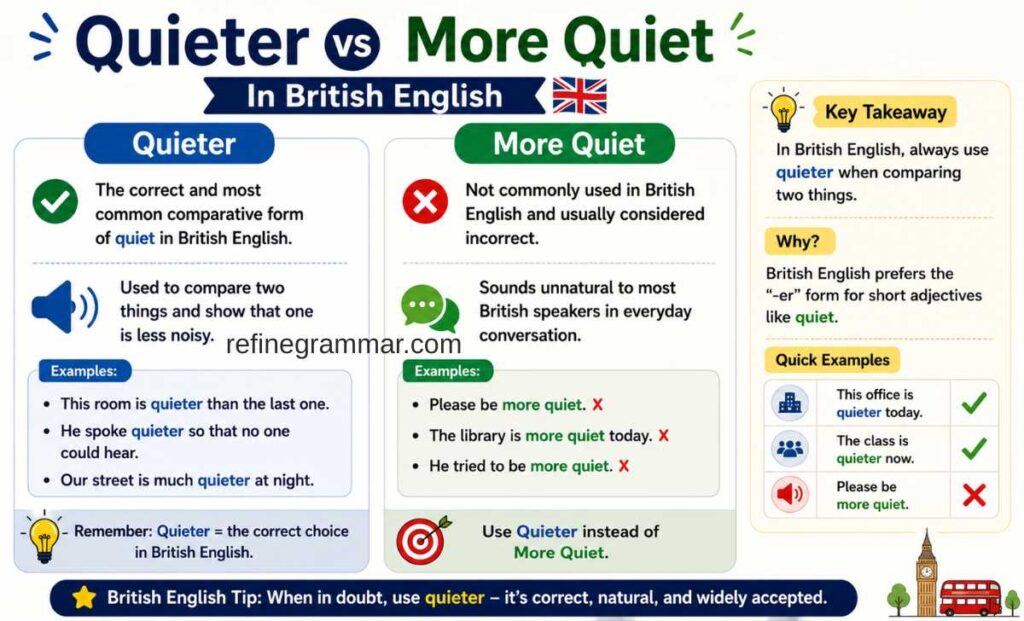
In British English, quieter remains the dominant form. That said, more quiet shows up slightly more often in spoken British English than in American speech, particularly in polite requests such as “Could you be a bit more quiet, please?”
Quieter vs More Quiet in American English
American English shows an even stronger preference for quieter. Language corpora consistently show quieter appearing far more often than more quiet across American books, news writing, and everyday conversation, reinforcing quieter as the go-to answer in the Quieter vs More Quiet debate.
Quieter vs More Quiet in Real-World Usage
Both forms appear in published writing, but usage-tracking tools confirm quieter is used roughly ten times more often than more quiet across English-language books and articles. Historical writers occasionally used more quiet for effect, but modern usage leans firmly toward the shorter form.
Comparison Table: Quieter vs More Quiet
| Feature | Quieter | More Quiet |
| Grammar rule | Standard “-er” comparative | Alternative “more” comparative |
| Frequency of use | Very common | Rare |
| Tone | Neutral, direct | Formal, reflective, poetic |
| Best for | Everyday speech and writing | Literary or emphatic writing |
| Example | “It’s quieter here.” | “It felt more quiet here.” |
“Quietest” vs “Most Quiet” — Which Superlative Is Correct?
The same pattern carries over to superlatives. Quietest is the standard superlative form, while most quiet is the rare, stylistic alternative. “This is the quietest room in the house” sounds natural, while “the most quiet room” feels noticeably more formal or poetic.
Quiet Adjective Degrees Explained
1. Positive: quiet
2. Comparative: quieter (or more quiet)
3. Superlative: quietest (or most quiet)
Quieter vs Less Noisy — What’s the Difference?
Quieter emphasizes calmness or a peaceful quality, while less noisy focuses specifically on a measurable reduction in sound. Compare: “The new engine is less noisy at high RPM” (a technical, sound-level claim) versus “The new engine is quieter overall” (a broader, more general impression).
Common Usage Constructions
• Quieter than — “The suburbs are quieter than downtown.”
• As quiet as — “The room is as quiet as a library.”
• Quiet as a mouse — an idiom for extreme silence.
Quieter Sentence Examples
• The office feels quieter now that half the team works remotely.
• Try to keep your voice quieter in the waiting room.
• Electric cars run noticeably quieter than gas-powered ones.
• Evenings here are quieter than mornings.
• The new headphones make the world feel quieter.
Common Mistakes and Misunderstandings
• Using “more quieter” — this double comparative is always incorrect; choose one form, not both.
• Assuming more quiet is flat-out wrong — it isn’t; it’s simply less common and more formal.
• Mixing comparative forms inconsistently in the same paragraph — a slip similar to confusing verb pairs like taken vs. taking or putting vs. puting.
• Overusing quantity words the wrong way, a mistake in the same family as mixing up too many vs. to many.
How to Choose Between “Quieter” and “More Quiet”
Use this quick decision guide whenever the Quieter vs More Quiet question comes up:
• Default to quieter for everyday speech, emails, and articles.
• Reach for more quiet only when you want emphasis, formality, or a reflective tone.
• Never combine the two forms into “more quieter.”
• Read the sentence aloud — the smoother-sounding option is usually the better choice.
Linguistic Insight & Expert Opinion
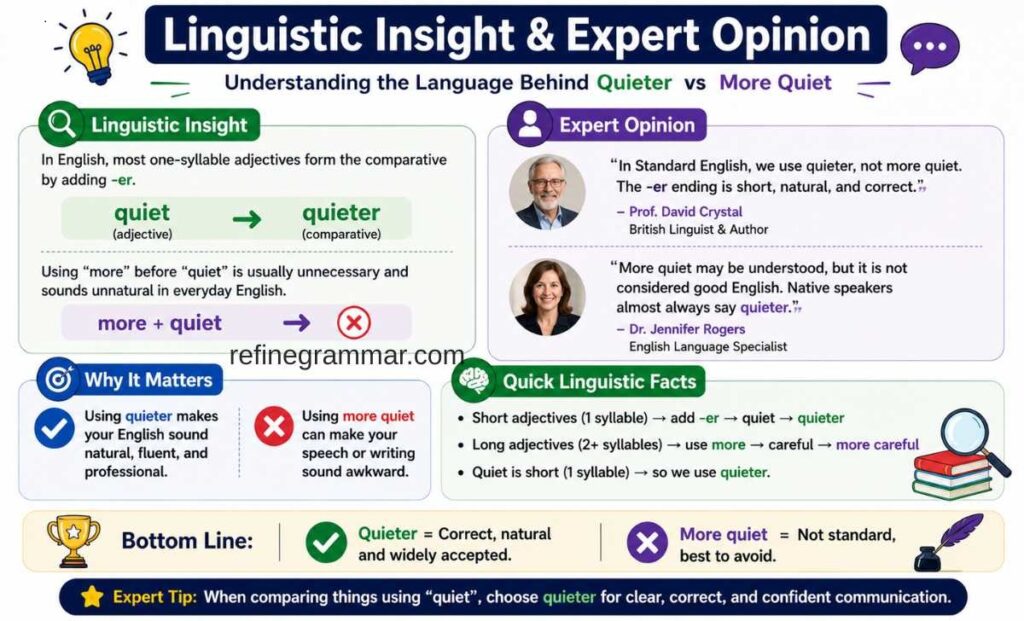
Grammar references generally agree that both quieter and more quiet are correct, but they differ in how naturally each one flows in speech. Dictionaries and style guides list quieter as the primary comparative form, while noting that more quiet remains grammatically valid for stylistic or emphatic writing. Frequency data from major English-language corpora backs this up: quieter appears many times more often than more quiet in everyday usage, which is why most editors default to it unless a specific tone calls for the alternative.
Quick Summary Rules
• Quieter is the standard comparative form of quiet.
• More quiet is valid but reserved for emphasis or formal/literary tone.
• Quietest is the standard superlative; most quiet is the rare alternative.
• Never write “more quieter” — it double-marks the comparison.
• When in doubt in the Quieter vs More Quiet choice, go with quieter.
Real-World Examples in Context
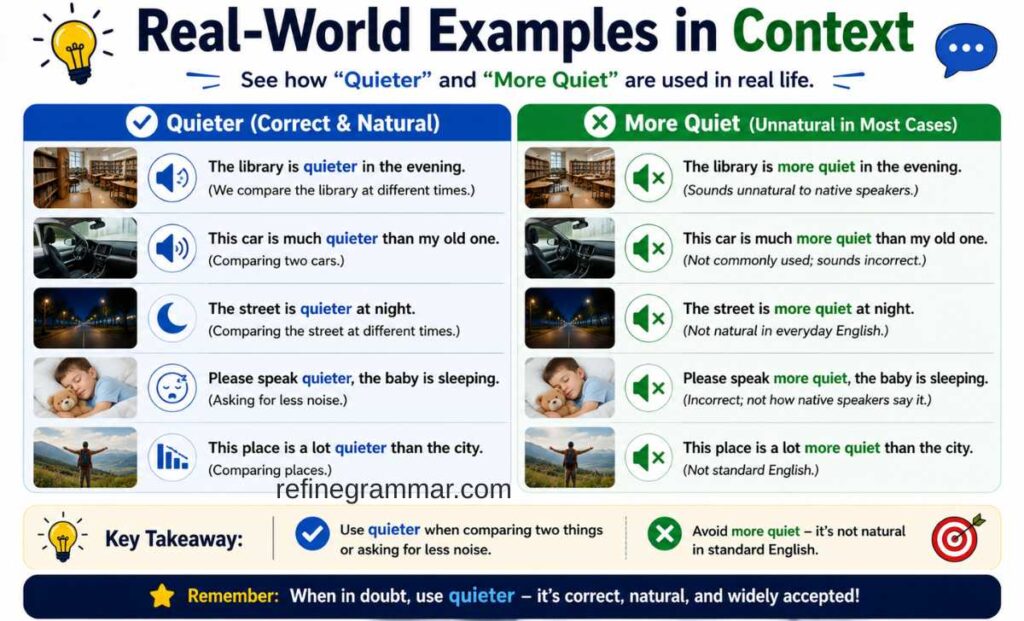
Casual conversation: “Can you turn that down? It’s way quieter without the TV on.”
Formal email: “We kindly request that the office remain more quiet during scheduled focus hours.”
Descriptive writing: “The forest grew more quiet as dusk settled over the hills.”
Self-Assessment Quiz
4. Fill in the blank: “This room is much ___ than the last one.” (quieter / more quiet)
5. True or False: “More quieter” is an acceptable comparative form.
6. Which sounds more natural in casual speech — quieter or more quiet?
7. What is the superlative form of quiet?
8. Rewrite this sentence correctly: “She was the more quieter student in class.”
Answer key: 1) quieter, 2) False, 3) quieter, 4) quietest, 5) “She was the quietest student in class.”
Recommended Reading
Sharpen your grammar further with these related guides:
• Shown vs. Showed — the correct past participle explained.
• Even Though vs. Eventhough — clearing up a common spelling mix-up.
• Ballon vs. Balloon — the correct spelling and usage.
• Putting vs. Puting — why the double “t” matters.
Final Thoughts
The Quieter vs More Quiet question comes down to one simple idea: both forms are grammatically correct, but they aren’t used the same way. Quieter is the natural, everyday choice for nearly every sentence you’ll write or speak, while more quiet is a deliberate, stylistic option best saved for formal or reflective writing. Once you internalize that distinction, you’ll never second-guess the Quieter vs More Quiet choice again.
Frequently Asked Questions (FAQs)
Is quieter grammatically correct?
Yes. Quieter is the standard comparative form of the adjective quiet, formed by adding “-er”.
Is more quiet wrong?
No. More quiet is grammatically valid, though it’s far less common and typically used for emphasis or formal tone.
Which is correct in British English: quieter or more quiet?
Quieter is dominant in British English, though more quiet still appears in polite or spoken contexts.
What is the comparative form of quiet?
The comparative form is quieter, with more quiet as a less common, stylistic alternative.
What is the superlative of quiet?
The superlative is quietest, while most quiet is the rare, formal alternative.
Can I say most quiet instead of quietest?
Yes, it’s grammatically acceptable, but it sounds more formal or poetic than quietest.
Is quieter more common than more quiet?
Yes, by a wide margin — quieter appears far more often in everyday speech and writing.
What is the difference between quiet and less noisy?
Quiet describes overall calmness, while less noisy points to a specific, measurable drop in sound level.
