
I used to type “time flys” without a second thought until a client circled it in red ink. That one correction sent me down a grammar rabbit hole, and what I found actually surprised me. The debate over Time Flies or Time Flys isn’t really a debate at all once you understand one simple spelling rule most of us forgot after grade school.
In this guide, I’ll walk you through exactly what I discovered: the correct spelling, the grammar rule behind it, real-world examples, memory tricks, and answers to every question people ask about this popular idiom.
My Quick Answer
“Time flies” is the only correct spelling. “Time flys” is a common misspelling that breaks a basic English verb rule. I’ll show you exactly why below, along with the pattern that explains dozens of similar words.
Why I Found It’s “Time Flies”
When I first researched Time Flies or Time Flys, I expected a complicated explanation. Instead, I found a rule I’d already learned in school and completely forgotten. “Fly” is a verb, and like every verb, it changes form depending on who or what is doing the action. When the subject is singular he, she, it, or time the verb needs to shift into its third-person singular form. But “fly” doesn’t simply add an -s. Because it ends in a consonant plus y, the y transforms into “ies.” That one detail is the entire answer to Time Flies or Time Flys.
The Grammar Rule I Discovered
● Verbs ending in a consonant + y drop the y and add -ies in the third-person singular.
● “Time” functions as a singular subject here, exactly like “he” or “she.”
● That is why “fly” becomes “flies,” never “flys,” when time is doing the flying.
Time Flies or Time Flys: Which Is Correct?
English is full of these near-identical spelling traps. I’ve run into the same kind of confusion while researching other word pairs, like when writers mix up inter vs intra. Time Flies or Time Flys works the same way: two spellings exist in everyday writing, but only one follows the actual rules of English grammar and that one is “time flies.”
Time Flies or Time Flys Grammar
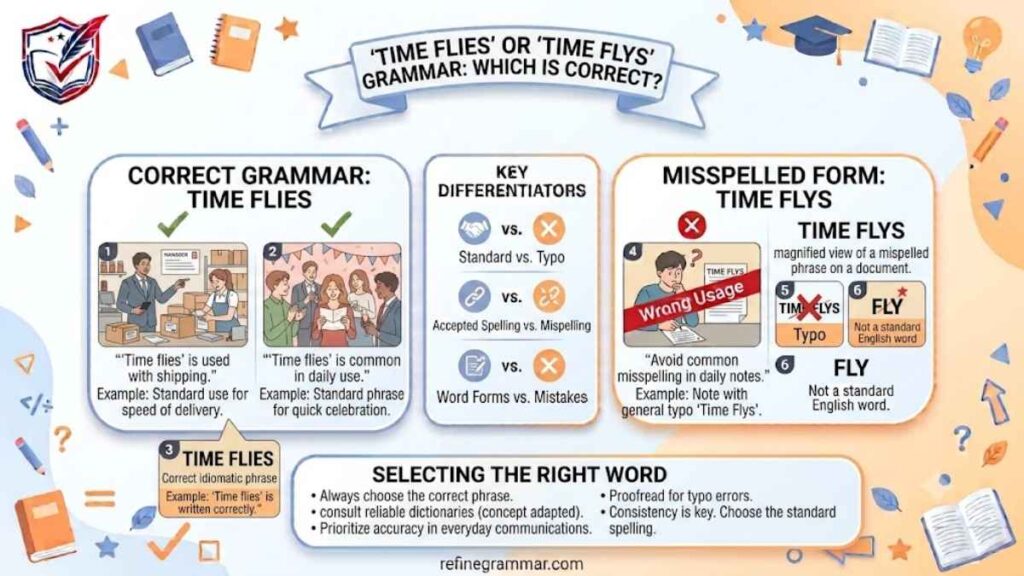
Grammatically, “time” is the subject and “flies” is the verb in the present tense. Because “time” is treated as a third-person singular noun, the verb must match it in form. This is the same agreement rule you’d apply to “she runs” or “he tries.” Once you see “time” sitting in that same grammatical seat as “he” or “she,” the answer to Time Flies or Time Flys stops being a mystery.
Do You Say Time Flys or Time Flies?
You say “time flies.” I say it too, every single time, because “time flys” simply isn’t a recognized English spelling. For example: “I can’t believe it’s already December time flies!” is correct. “I can’t believe it’s already December time flys!” is not.
Which Is Correct, Flys or Flies?
“Flies” is correct as the verb form. “Flys” only appears as a rare, non-standard spelling and is never accepted in formal writing. If you’re ever unsure which one to use when talking about time passing quickly, default to “flies” and you’ll be right.
The Consonant + Y Rule I Learned
Here’s the pattern I found across every reputable grammar source, laid out side by side:
| Base Verb | Third-Person Singular | Example Sentence |
| fly | flies | Time flies when you’re busy. |
| try | tries | She tries her best every day. |
| cry | cries | The baby cries at night. |
| dry | dries | The towel dries in the sun. |
| apply | applies | He applies the rule correctly. |
Important Exception I Found
The rule flips when a vowel comes right before the y. Words like “play,” “stay,” and “enjoy” simply add -s: “plays,” “stays,” “enjoys.” No y-to-ies change happens there, because the vowel protects the y. “Fly” doesn’t get that protection, which is exactly why this pair keeps tripping people up.
What “Time Flies” Means
Beyond spelling, “time flies” is an idiom. It doesn’t describe time literally growing wings it describes the feeling that time is passing faster than expected, especially during busy or enjoyable moments.
Time Flies Meaning
At its core, the phrase captures a very human experience: the sense that hours, days, or years slipped by without us noticing. Understanding meaning matters just as much as spelling. The same logic applies to smaller everyday details, like knowing whether a date should read the 22nd, not 22th small errors, big impact on how polished your writing looks.
Time Flies or Time Flys Meaning
Whichever way people spell it, the intended meaning stays the same: time feels like it’s moving quickly. But since only “flies” is grammatically correct, that’s the spelling you should use whenever you write it down, even though the meaning behind Time Flies or Time Flys is instantly understood either way.
1. Expressing Surprise
“Is it really Friday already? Time flies!” This use captures genuine surprise at how quickly a day or week has gone.
2. Reflecting on Memories
“Looking at these old photos, time flies my kids were so small back then.” Here, the phrase carries a nostalgic, reflective tone.
3. Time Flys or Flies When You’re Having Fun
This is the most popular version of the idiom. It’s always spelled “time flies when you’re having fun,” describing how enjoyable moments seem to pass faster than boring ones.
4. Time Flies By
Adding “by” is completely natural and grammatically fine: “Time flies by so fast when you’re on vacation.” The word “by” simply emphasizes the motion.
Is It Okay to Say Time Flies?
Yes. “Time flies” is standard, widely accepted English used in formal writing, casual conversation, emails, and social media alike. There’s no context where it’s considered incorrect or too informal.
Is It Correct to Say Time Flies By So Fast?
Yes, this extended version is grammatically correct and very common in everyday speech. “By” and “so fast” both add emphasis without breaking any grammar rules.
Common Mistakes I’ve Found and How to Avoid Them
Researching this phrase, I noticed the same few mistakes appearing again and again. Simple spelling mix-ups happen everywhere in English, not unlike when people write “amount” as ammount. Here are the most common ones I found for this phrase:
● Writing “time flys” instead of “time flies” (the most frequent error by far).
● Adding an apostrophe: “time fly’s” is never correct here, since this isn’t possession.
● Confusing the verb “flies” with the plural noun “flies” (the insects), which is spelled the same but means something entirely different.
● Assuming “flys” is acceptable because it “looks” like a normal plural, the way “boys” or “guys” would be spelled.
Real-World Examples I’ve Collected
Example 1: Social Media Post
“Can’t believe my daughter turns five tomorrow. Time flies!”
Example 2: Birthday Card
“Another year older, another year wiser time flies, but the memories stay.”
Example 3: Work Email
“Sorry for the delayed reply time flies during the last week of the quarter.”
Example 4: Conversation
“I feel like I just started this job yesterday. Time really flies, doesn’t it?”
Time Flies or Time Flys Examples
1. Correct: “Time flies when you’re traveling.”
2. Incorrect: “Time flys when you’re traveling.”
3. Correct: “I swear time flies faster every year.”
4. Incorrect: “I swear time flys faster every year.”
Time Flies vs Time Flys: My Summary Table
| Feature | Time Flies | Time Flys |
| Grammatically correct? | Yes | No |
| Follows consonant + y rule? | Yes | No |
| Accepted in formal writing? | Yes | Never |
| Commonly searched online? | Yes | Yes (as a misspelling) |
Other Common Variations I Found
Other tricky expressions cause the exact same kind of confusion. Building rapport, for instance, is often misspelled as repore for very similar phonetic reasons. Whenever a word sounds one way but is spelled another, mistakes like this one tend to follow.
Key Pattern I Noticed
Nearly every mistake I found traces back to sound. English speakers hear a word and guess the spelling based on similar-sounding patterns, rather than the underlying grammar rule. That guesswork is exactly what turns “flies” into “flys” in so many people’s writing.
Memory Tips I Use to Remember the Rule
Memory Trick #1: The “Baby” Method
Think of how “baby” becomes “babies,” not “babys.” If you remember that one word, you’ll remember “flies” too, since both follow the identical consonant + y rule.
Memory Trick #2: The French Fry Test
“Fry” becomes “fries,” just like “fly” becomes “flies.” If you can picture a plate of French fries, you can picture the correct spelling right away.
Memory Trick #3: The Real Flies
Insects that fly are called “flies” too same spelling, different meaning. If you already spell the bug correctly, you already know how to spell the idiom.
Other Words That Follow the Same Rule
This consonant + y pattern shows up constantly in English. Words like “gnaw,” often misspelled as knaw, follow their own tricky spelling logic, but verbs such as “carry,” “worry,” “hurry,” and “marry” all shift to “carries,” “worries,” “hurries,” and “marries” in exactly the same way “fly” becomes “flies.”
Pro Tip I Learned
Whenever you’re unsure whether a verb needs -ies or just -s, check what comes right before the final y. Consonant before y? Change it to -ies. Vowel before y? Just add -s. That single test resolves almost every case like this one.
Time Flies Quotes
Writers and speakers have leaned on this idiom for centuries to capture how quickly life moves. A well-known line from 17th-century English poetry urges readers to seize the day because time is always slipping away, while countless modern songs and speeches echo the same sentiment in their own words. The idea behind Time Flies or Time Flys has clearly outlived any single writer who’s ever used it.
Explore More Grammar Guides
If Time Flies or Time Flys cleared up a spelling question for you, a few more common mix-ups are worth bookmarking: getting the tone right in a formal email often comes down to spelling “important” correctly instead of inportant, and double-checking your address before you hit send matters just as much.
It’s the same habit that keeps you from writing your home address incorrectly on an important form a quick second look saves you from small, avoidable errors.
Frequently Asked Questions
Would It Be Time Flies or Time Flys?
It would always be “time flies.” “Time flys” is a spelling error and is never grammatically correct.
How Do You Spell Time Flies or Time Flys?
Spell it T-I-M-E F-L-I-E-S. Remember the consonant + y rule: fly becomes flies, never flys.
Why Do People Say Time Flies?
People say it because time often feels like it passes quickly, especially during busy, enjoyable, or memorable moments.
What Is Another Way to Say Time Flies?
You can say “time passes quickly,” “the years fly by,” or “time moves so fast” to express the same idea.
Can You Say Time Flies So Fast?
Yes, this phrasing is natural and grammatically correct, and it’s commonly used in everyday conversation.
Is Time Flies So Fast Grammatically Correct?
Yes. “Time flies so fast” follows standard subject-verb agreement and needs no correction.
How Do You Say Time Flies in Another Way?
Try alternatives like “time is flying by,” “the days are slipping away,” or “where did the time go?”
What Can I Say Instead of Time Flies?
Consider “time slips away,” “the clock moves fast,” or “before you know it, it’s over” as natural substitutes.
Time Flies or Time Flys Answer
The definitive answer is “time flies.” “Time flys” is incorrect in every context.
Time Flies or Time Flys Quiz
Quick check: fill in the blank “I can’t believe summer is over already, ___ flies.” The answer is “time,” and the verb is always “flies,” never “flys.”
Final Takeaway
After digging through grammar rules, real examples, and years of common mistakes, my answer to Time Flies or Time Flys hasn’t changed: it’s always “time flies.” The consonant + y rule explains it completely, and once you’ve seen the pattern in words like “tries,” “cries,” and “babies,” you’ll never second-guess Time Flies or Time Flys again.
