
If you’ve ever paused mid-sentence wondering whether to write “repore” or “rapport,” you’re not alone. This is one of the most commonly misspelled words in English, especially in business, therapy, and customer-service writing. This guide settles the debate for good and shows you exactly how to use the word with confidence.
Repore or Rapport Quick Answer
Rapport is the correct spelling. Repore is not a real word it’s simply a common misspelling that happens because people spell the word the way it sounds rather than the way it’s written. Whenever you’re building a relationship, connection, or mutual understanding with someone, the word you want is rapport.
Is It Repore or Rapport?
The short answer: it’s always rapport. There is no dictionary entry for “repore,” “repoire,” “repor,” or “raport” in standard English. These are all phonetic guesses at a French loanword that doesn’t follow typical English spelling patterns.
Here’s why the confusion happens so often:
- The silent final “t” in rapport isn’t pronounced, so it doesn’t “sound” like it belongs.
- English speakers instinctively reach for spellings like “repore” because they resemble familiar words such as “before” or “explore.”
- Autocorrect and voice-to-text tools sometimes make the mistake worse by suggesting incorrect variants.
Mix-ups like this are more common than people realize English is full of pairs that trip writers up, from balloon vs balloon spelling errors to confusion over when to use “due to” correctly.
Once you know the word comes from French, the spelling starts to make a lot more sense more on that in the origin section below.
What Does Repor Mean?
“Repor” has no meaning in English. It’s an incomplete or truncated misspelling of rapport, usually caused by typing too quickly or relying on how the word sounds when spoken aloud. If you meant “repor with someone,” “have a repor,” or “build repor,” the word you’re actually looking for is rapport.
What Is a Repore?
Similarly, “repore” is not a recognized word in any English dictionary. It’s a spelling error, not an alternate form. If you’ve searched “what is a repore,” the answer you’re looking for is rapport a relationship marked by mutual trust, understanding, and agreement. This kind of spelling confusion is similar to debates like quieter vs more quiet, where the “correct-sounding” option isn’t always the grammatically right one.
Rapport Meaning
Rapport (noun) refers to a close, harmonious relationship in which the people involved understand each other’s feelings or ideas and communicate well. It’s commonly used in contexts like:
- Sales and customer service (“build rapport with clients”)
- Therapy and counseling (“establish rapport with a patient”)
- Teaching (“a teacher who has great rapport with students”)
- Everyday relationships (“we had instant rapport”)
In short, rapport is the sense of connection that makes communication easier and more trusting. Precision matters here just as much as it does with other tricky word pairs, like swap vs swop, where regional usage often causes confusion.
The Origin of Repore or Rapport
The word rapport comes directly from French, where it means “a bringing back” or “relation, connection.” It traces further back to the French verb rapporter, meaning “to bring back,” which itself derives from Latin roots. English adopted the word largely unchanged in spelling during the 17th century, which is exactly why it keeps its French-style silent “t.”
This French origin is also why English has no natural instinct for the correct spelling unlike native English words, rapport doesn’t follow the phonetic rules most speakers rely on. Loanwords aren’t the only source of spelling trouble, either; even native prefixes like inter vs intra regularly confuse writers.
Repore or Rapport Psychology
In psychology and counseling, rapport is considered a foundational skill. Therapists, coaches, and psychologists are trained to build rapport early in a relationship because it directly affects trust, openness, and the willingness of a client to share honestly.
Common psychological techniques for building rapport include:
- Active listening giving full attention and reflecting back what’s heard
- Mirroring subtly matching body language or tone
- Empathy acknowledging feelings without judgment
- Consistency showing up reliably over time
None of this changes the spelling, of course in psychology texts, academic journals, and clinical notes, it is always written as rapport, never “repore.”
British English vs American English Spelling
Good news: this is one of the rare cases where spelling doesn’t change between British and American English. Unlike words such as “colour/color” or “organise/organize,” rapport keeps the same French-derived spelling on both sides of the Atlantic. If you’re curious about other spelling quirks that do shift by usage or context, see swap vs swop for another example.
| Region | Correct Spelling | Common Misspellings |
| American English | rapport | repore, repor, raport |
| British English | rapport | repore, repor, raport |
Which Spelling Should You Use?
Always use rapport, regardless of your audience’s location, industry, or writing style. There is no formal, informal, regional, or historical context in which “repore” is acceptable. If you’re writing a resume, an email, an academic paper, or a customer-service script, “rapport” is the only correct choice.
Raport or Rapport
“Raport” is another frequent misspelling. It usually drops one “p.” Like “repore,” it isn’t a recognized English word. The double “p” and the silent final “t” in rapport come straight from its French spelling, so you need both. Number-related spelling quirks follow a similar logic. See how ordinal numbers work in 22th or 22nd for another commonly misspelled pattern.
Rapport Pronunciation
Rapport is pronounced ra-POR (UK: /ræˈpɔː/, US: /ræˈpɔːr/), with the stress on the second syllable. The final “t” is silent, which is the single biggest reason people misspell it. Saying the word slowly and remembering its French origin can help cement the correct spelling in memory.
Rapport Synonym
If you want to vary your writing, here are some solid synonyms for rapport:
- Connection
- Bond
- Understanding
- Affinity
- Harmony
- Relationship
- Chemistry
These words work well in different contexts for example, “chemistry” fits casual or interpersonal writing, while “affinity” suits more formal or academic tone.
Repor With Someone Meaning
If you’ve typed “repor with someone” into a search bar, what you’re really asking about is what it means to have rapport with someone. It describes a state where communication flows naturally, trust is present, and both people feel understood.
Repor With Someone
Again, “repor with someone” isn’t correct the phrase should always read “rapport with someone.” For example: “She quickly built rapport with someone she’d just met.”
Good Rapport Meaning
Having good rapport means the relationship goes beyond basic communication there’s genuine trust, ease, and mutual respect. Signs of good rapport include:
- Comfortable, natural conversation
- Fewer misunderstandings
- Willingness to share honestly
- A sense of being “on the same page”
This is especially valuable in sales, healthcare, education, and leadership, where trust directly influences outcomes.
Common Mistakes with Repore or Rapport
Here are the most frequent errors people make:
- Writing “repore” instead of “rapport”
- Dropping a letter to get “repor” or “raport”
- Mispronouncing the silent “t,” which reinforces the wrong spelling
- Confusing rapport with unrelated words like “report” (a document) or “support”
Here’s a simple memory trick. Split the word into “rap” and “port.” You don’t say the final “t,” but you still have to write it.
Repore or Rapport in Everyday Examples
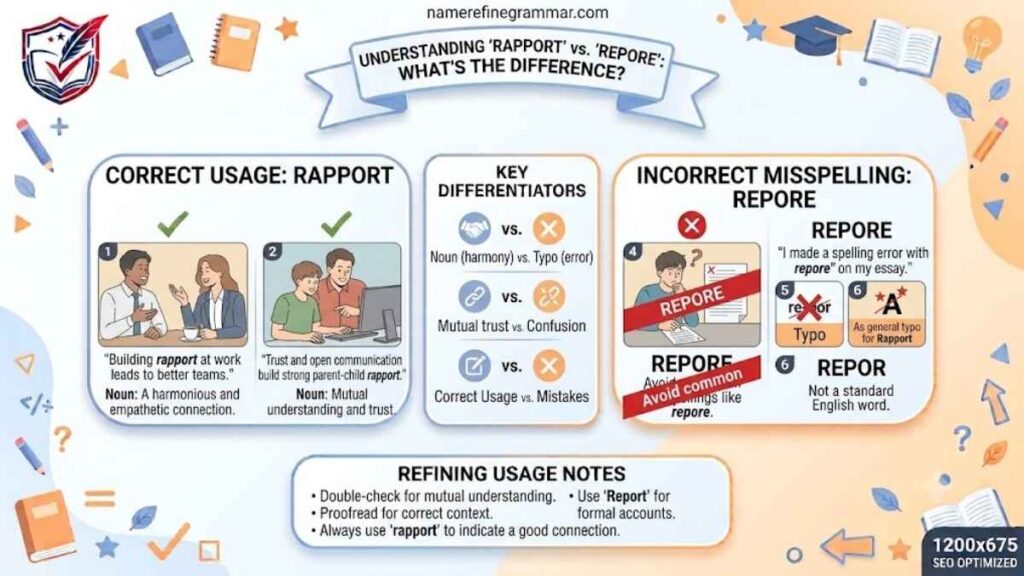
- “The interviewer built strong rapport before asking difficult questions.”
- “It only took a few minutes for the two coworkers to establish rapport.”
- “Good rapport between a doctor and patient improves treatment outcomes.”
- “Their natural rapport made the podcast conversation feel effortless.”
Comparison Table: Keyword Variations
| Search Term | Correct? | Should Be Written As |
| Repore | ❌ Incorrect | Rapport |
| Repor | ❌ Incorrect | Rapport |
| Raport | ❌ Incorrect | Rapport |
| Repoire | ❌ Incorrect | Rapport |
| Rapport | ✅ Correct | Rapport |
Repore or Rapport Google Trends & Usage Data
Search interest for “repore” and similar misspellings remains steady year-round, largely driven by how the word sounds rather than how it’s spelled. “Rapport” itself sees consistent, high search volume across business, HR, psychology, and education-related queries, confirming it’s a term people actively want to use correctly rather than avoid. This pattern is common with silent-letter, foreign-origin words search demand for the misspelling almost always signals genuine interest in learning the correct form.
FAQs
Is it repore or rapport?
It’s always rapport. “Repore” is a common misspelling with no dictionary meaning.
What is a repore with someone?
There’s no such thing as a “repore” the correct phrase is rapport with someone, meaning a trusting, understanding connection.
What does it mean to have a good repore with someone?
It means having a strong, trusting connection correctly written as good rapport with someone.
What does repor mean?
“Repor” has no meaning; it’s an incomplete misspelling of rapport.
What is a repore?
“Repore” isn’t a real word it should always be spelled rapport.
What is a simple definition of rapport?
Rapport is a close, trusting relationship where people understand and communicate well with each other.
What is an example of a rapport?
A therapist and client who communicate openly and trust each other have strong rapport.
What is having a good rapport?
It means enjoying an easy, trusting, mutually understanding relationship with someone.
How do you spell repour with someone?
The correct spelling is rapport with someone; “repour” is incorrect.
What is another word for rapport?
Common synonyms include connection, bond, affinity, and understanding.
Conclusion
The confusion between “repore” and “rapport” comes down to one simple fact: rapport is a French-derived word with a silent “t,” and English spelling instincts don’t naturally account for that. No matter the context business, psychology, casual conversation, British or American English rapport is the only correct spelling. Once you remember its French roots and silent ending, you’ll never second-guess it again.
