
If you’ve ever paused mid-sentence wondering whether to write “swap” or “swop,” you’re not alone. The swap vs swop question trips up writers, students, and even native speakers, because both words sound identical and mean exactly the same thing. This guide breaks down the swap vs swop meaning, traces where “swop” came from, and shows exactly which spelling to use in the UK, US, Australia, and beyond, so you never second-guess yourself again.
Definition
Swap and swop are both verbs meaning to exchange one thing for another. Whether you’re trading seats, sandwiches, or work shifts, the action behind swap vs swop is identical, only the spelling differs.
What Do Swap and Swop Mean?
At their core, both words describe giving something up in return for something else. You can swap (or swop) physical items, ideas, positions, or even words in a sentence. Neither spelling changes the definition, the swap vs swop debate is purely about which letters you use, not what the word communicates.
swap vs swop meaning
Dictionaries confirm there’s no difference in meaning between the two words. Both describe:
● Exchanging objects, such as swapping or swopping books
● Trading places, as in “swap seats”
● Substituting one thing for another, as in “swap plans”
The only variable across swap vs swop is regional spelling preference, not definition.
Historical Roots: How “Swop” Emerged from “Swap”
The word swap traces back to Middle English, likely linked to a term meaning to strike or exchange quickly, with some accounts connecting it to old handshake customs used to seal a deal. Before English spelling was standardized, regional pronunciation shifted the vowel sound, and “swop” emerged in parts of Britain as a phonetic variant. Once dictionaries and printing houses formalized spelling in the 18th and 19th centuries, swap became the dominant form, while swop persisted mainly in British print and everyday speech for a while longer.
Swap vs Swop: Key Differences at a Glance
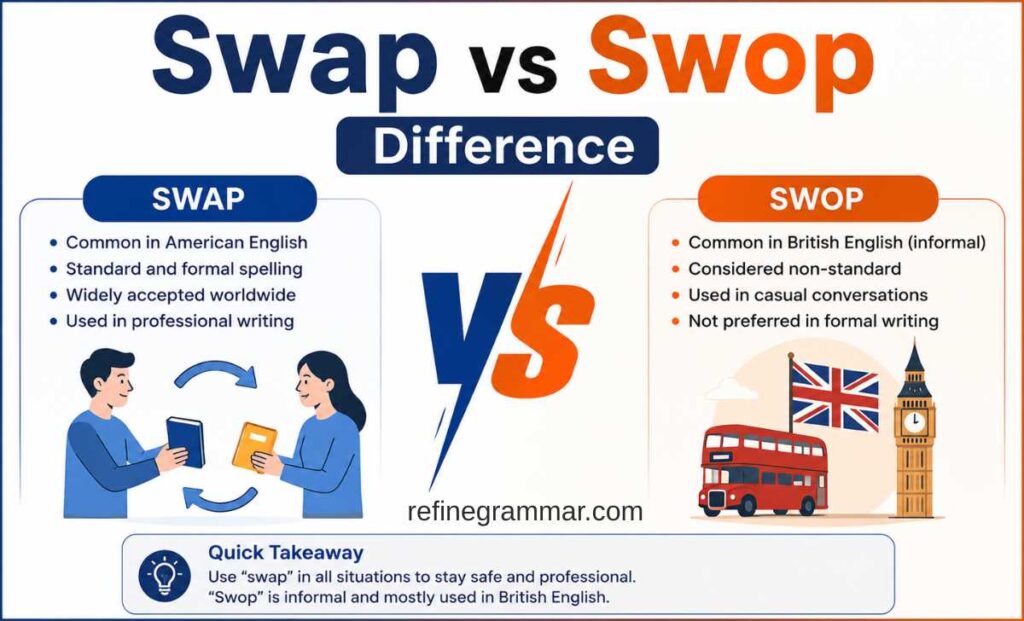
| Aspect | Swap | Swop |
| Meaning | To exchange | To exchange (identical) |
| Origin | Middle English, global standard | British phonetic variant |
| Region | Used everywhere: UK, US, Australia, etc. | Mostly historical British usage |
| Modern frequency | Extremely common | Rare, considered old-fashioned |
| Formality | Neutral, professional | Slightly informal or dated |
| Dictionary status | Primary, standard entry | Listed as variant spelling |
swap vs swop grammar
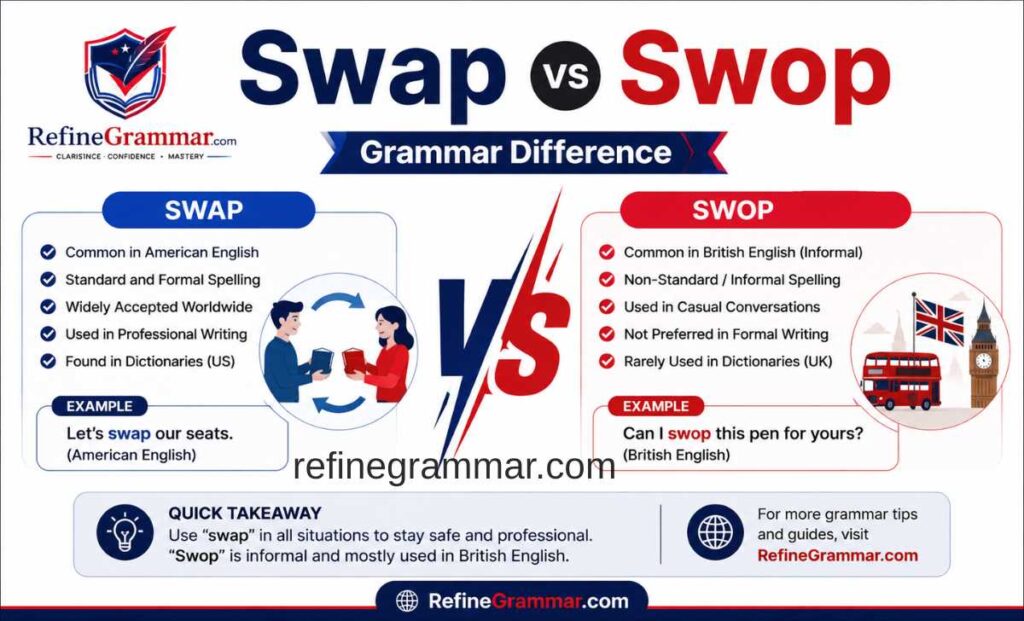
Grammatically, swap and swop behave identically. Both function as regular verbs:
● Base form: swap / swop
● Past tense: swapped / swopped
● Present participle: swapping / swopping
●Noun form: a swap / a swop
Whichever spelling you choose, double the final consonant before adding -ed or -ing, since both words end in a single vowel followed by a single consonant.
Usage in Different English-Speaking Regions
United Kingdom
Britain is technically the birthplace of swop, but modern British publishing overwhelmingly favors swap. You’ll still spot swop in older novels or nostalgic writing, but everyday British writing, journalism, and business communication use swap almost exclusively.
United States
American English never really adopted swop. In the US, swap is the only accepted spelling, using swop in American writing reads as a typo or an unfamiliar import.
Australia & New Zealand
Australian and New Zealand English generally follow British spelling conventions for many words, but not this one. Swap dominates in both countries, with swop appearing only occasionally in older or informal contexts.
Other Regions
Countries with strong British-English influence, such as India, South Africa, and Nigeria, teach and use swap in schools and professional writing today. Swop has largely faded even where British spelling conventions otherwise persist.
swop or swap british
So is it swop or swap in British English? Historically, both existed side by side, but modern British style guides and newspapers now default to swap. If you’re writing for a British audience today, swap is the safer, more current choice, swop mostly survives in period pieces or intentionally old-fashioned prose.
swap meaning

On its own, swap meaning refers to the act of giving something and receiving something else in return. It applies literally, such as swapping shoes or seats, and figuratively, such as swapping ideas or roles at work. It’s also widely used as a noun, as in “a fair swap,” and as part of modern phrases like a book swap or a job swap.
Real-Life Usage Example
Imagine two coworkers adjusting their schedules. One might say, “Can we swap shifts this Friday?” That sentence reads as natural, modern English anywhere in the world. Replace swap with swop, and it instantly feels older or regionally specific, the same kind of subtle shift that matters when you want your writing, much like the breakdown in our taken vs taking guide, to read as current and polished.
swap vs swop examples
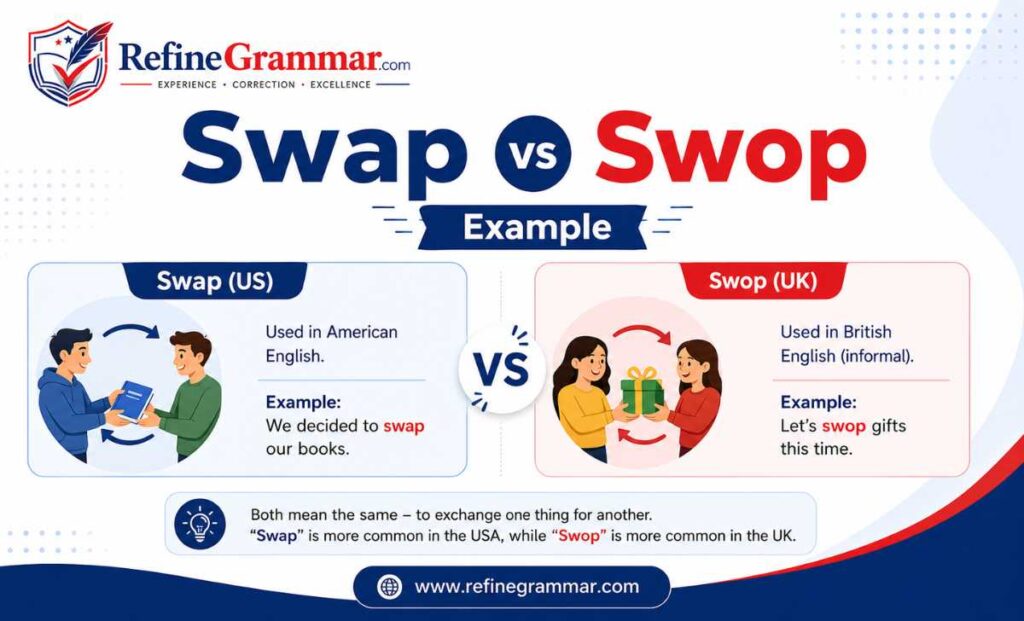
1. She wanted to swap her afternoon shift for a morning one.
2. In the 1950s, British schoolchildren would swop comic books during lunch.
3. Let’s swap seats so you can see the screen better.
4. They swopped stories about their childhood over dinner (older, informal usage).
5. The two companies agreed to swap assets as part of the merger.
6. He swopped his old bike for a new one at the community market (rare, informal usage).
What Dictionaries & Style Guides Say
Dictionary Insights
Major dictionaries list swap as the primary, standard entry, with swop noted as a chiefly British variant. This mirrors a pattern found in other tricky word pairs, for instance, the same kind of primary-versus-variant listing shows up when comparing forms in our quieter vs more quiet breakdown.
Style Guide Recommendations
Most professional style guides used by journalists, editors, and content teams recommend defaulting to swap regardless of region, since it reads as modern and internationally understood. Swop is reserved for deliberate stylistic or historical effect.
swap vs swop oxford dictionary
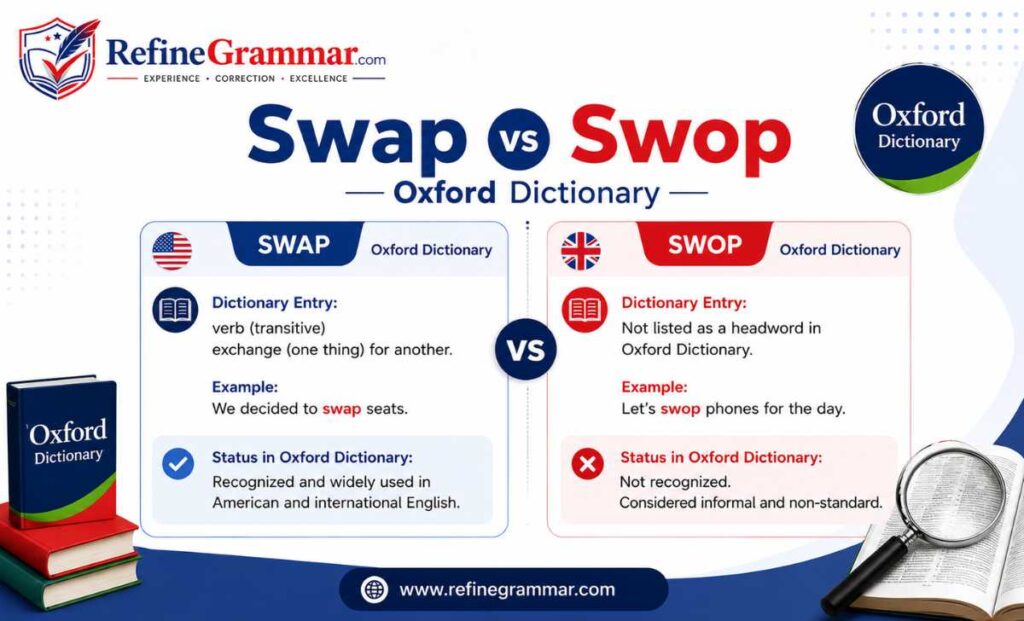
According to Oxford-based references, swop is a recognized variant of swap, not a separate word. Oxford’s guidance mirrors general dictionary consensus: identical meaning, with swap treated as the standard headword.
swop or swap oxford dictionary
If you’re checking swop or swap in an Oxford-style reference specifically, you’ll typically find swop cross-referenced back to swap, confirming that swap carries the primary definition while swop is simply flagged as a British spelling variant.
Modern Usage in Everyday Englis
Today, swap dominates across texting, social media, workplace emails, and published writing. Swop has become rare enough that many younger English speakers, even in the UK, have never used it at all, much like other spelling pairs that quietly resolve in favor of one modern form, similar to how learners often need clarity on too many vs to many usage.
Which One Should You Use Today?
Unless you have a specific stylistic or historical reason to use swop, choose swap. It’s the spelling recognized worldwide, accepted in every major English-speaking region, and won’t distract or confuse your reader.
Why Clarity and Consistency Matter
Consistency in spelling builds trust with readers. Just as mixing up similar-looking word pairs, like the common misspelling covered in our balloon spelling guide, can undercut a piece of writing’s credibility, switching between swap and swop within the same document can make your content look inconsistent or poorly edited.
Real-World Examples of Swap and Swop
● News headlines almost universally use swap, for example “Companies Swap Shares in New Deal.”
● Retail and marketplace apps use swap in features like “Swap Meet” or “Item Swap.”
● Older British literature occasionally preserves swop for authentic period tone.
● Modern British broadcasting and print use swap nearly exclusively today.
swap vs swop reddit
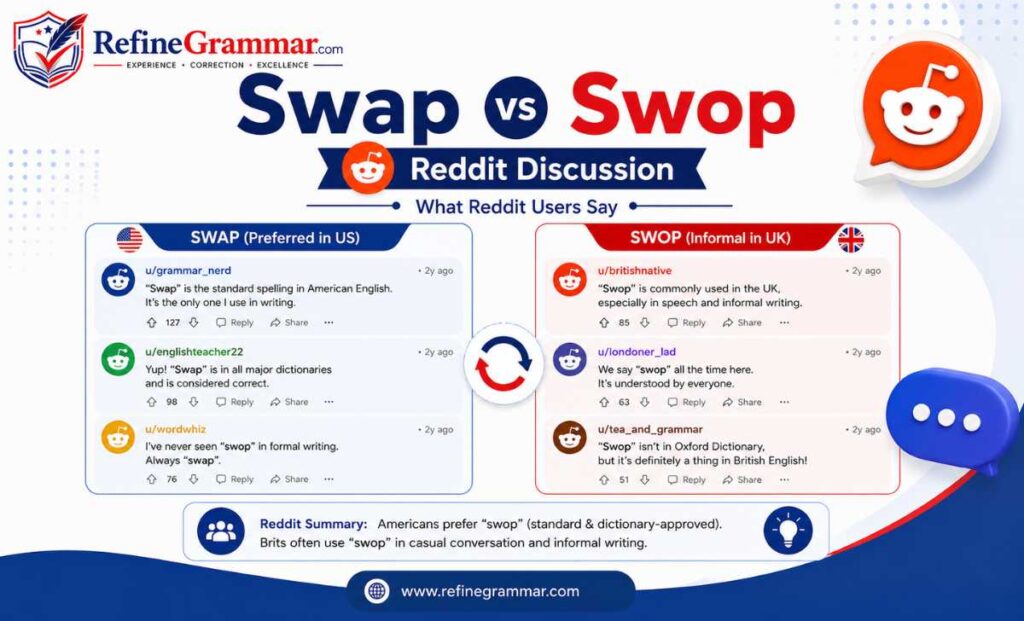
Community discussions across Reddit and similar forums about swap vs swop consistently arrive at the same conclusion: the words mean the same thing, but users overwhelmingly recommend swap for everyday writing, with swop treated as a curiosity or a nostalgic nod to older British usage.
Self Assessment Section
Test yourself, fill in the blank with the modern, standard spelling:
● 1. Let’s ___ seats before the movie starts.
● 2. The two friends agreed to ___ books for the summer.
● 3. Can we ___ shifts next week?
● 4. They ___ jokes and stories all afternoon.
Answer key: swap / swap / swap / swapped, since swap is the recommended spelling in modern English.
Common Mistakes / Confusions
● Using swop in American English content (should always be swap).
● Mixing swap and swop inconsistently within the same article.
● Assuming swop is grammatically incorrect, it isn’t wrong, just outdated.
● Treating swap vs swop as a meaning difference rather than a spelling one.
Final Thoughts
At the end of the day, swap vs swop isn’t really a grammar debate, it’s a spelling and regional-preference question. Both words mean exactly the same thing, but swap is the modern, globally accepted spelling, while swop lingers mostly in older British texts. When in doubt, swap is always the safe, professional choice.
FAQs
1. What is the difference between swap and swop?
There’s no difference in meaning, only spelling. Swap is the modern, global standard, while swop is an older British variant.
2. Is swap vs swop meaning exactly the same?
Yes, both words describe exchanging one thing for another with an identical meaning.
3. Which spelling is correct according to the Oxford Dictionary?
Oxford references list swap as the standard headword, with swop noted as a variant spelling.
4. Is swop or swap British English?
Both originated in British usage, but modern British English now strongly favors swap.
5. Do people in the UK still use the word swop?
Rarely, it mostly appears in older literature or intentionally nostalgic writing.
6. What are some real swap vs swop examples?
Examples include “swap seats,” “swap shifts,” and the older “swop comic books,” all meaning to exchange.
7. Is swop considered incorrect grammar?
No, it’s not incorrect, just outdated and uncommon in modern English.
8. What does Reddit say about swap vs swop?
Online communities generally agree that swap is the practical, everyday choice, with swop seen as old-fashioned.
9. Should I use swap or swop in professional writing?
Always use swap for professional and international writing, since it’s universally recognized.
10. Which spelling should I use for USA and UK audiences?
Use swap for both, it’s the only accepted spelling in the US and the dominant one in the UK today.
