
If you have ever typed a text and watched autocorrect flip your words around, you already know the confusion. Homey or Homie is one of the most commonly mixed-up word pairs in casual English, and getting it wrong can change your entire meaning. One word describes a feeling, the other describes a person. This guide breaks down the meaning, spelling, grammar, and slang history behind each term so you never second-guess yourself again.
Homey or Homie – Quick Answer
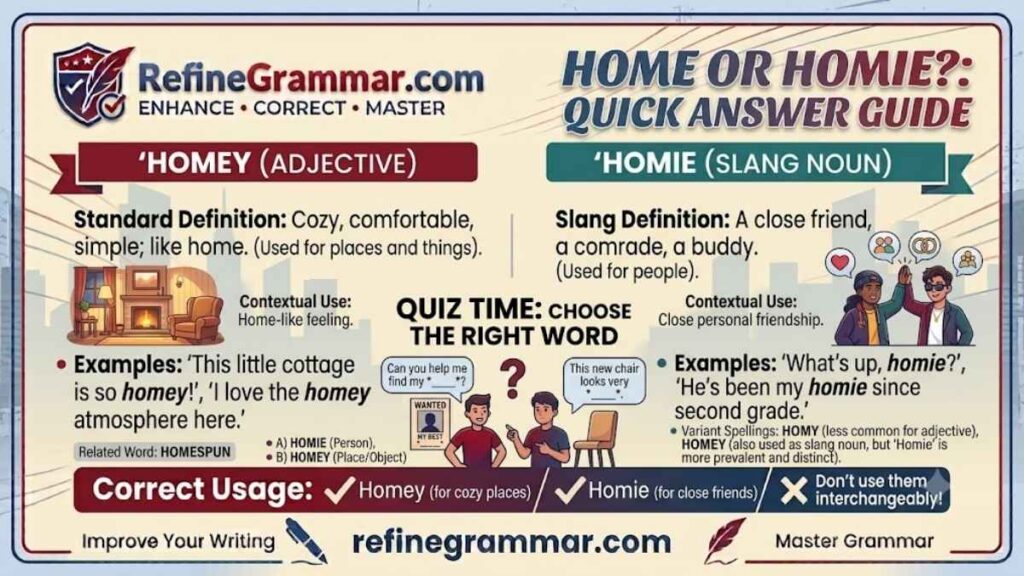
Use homey when you mean cozy, warm, or comfortable, usually to describe a place. Use homie when you mean a close friend or someone from your neighborhood. It comes down to one simple test: are you describing a feeling or a person?
Is it homie or homey
Both spellings are correct, just for different purposes. Homie is a noun for a friend, while homey is an adjective for comfort. Some dictionaries also list homey as an informal noun for a friend, but homie remains the far more common slang spelling in that sense.
Homey or Homie Meaning
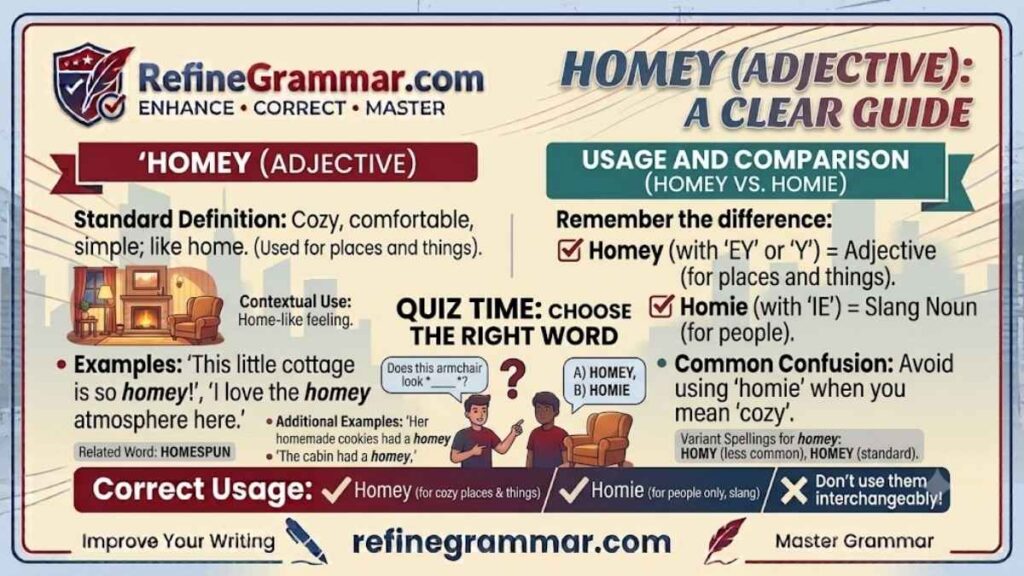
At the core, both words trace back to the idea of “home,” yet they branched into separate meanings over time. Homey describes an atmosphere that feels welcoming, safe, and familiar, similar to how the difference between inter and intra shows how two similar-looking word roots can carry very different meanings. Homie, on the other hand, is purely about people: a friend, a buddy, or someone you consider close. Once you separate the “place” meaning from the “person” meaning, the confusion disappears.
What Does Homey Mean?
Homey means cozy, comfortable, and warm, almost always describing a place, room, or atmosphere. A small apartment with soft lighting and familiar furniture can feel homey even if it is not fancy. Real estate listings, hospitality writing, and interior design articles use homey constantly because it signals emotional comfort rather than luxury.
What Does Homie Mean?
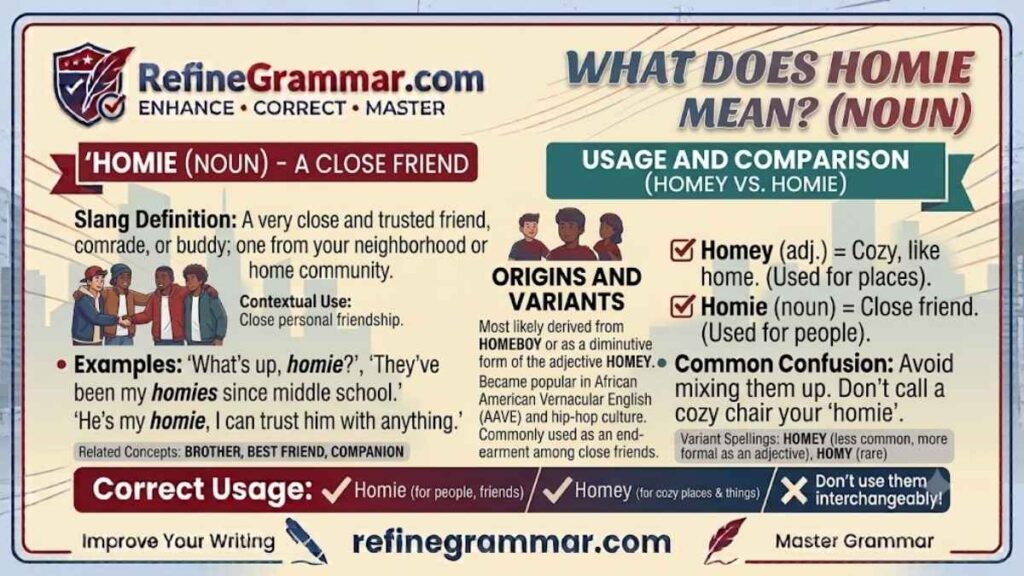
Homie is slang for a close friend, companion, or someone from your neighborhood. It grew out of hip-hop and urban culture and is now used casually across texting, social media, and everyday conversation. You would never call a cozy living room a homie, and you would rarely call your best friend homey in modern slang, though older or regional usage sometimes blurs the two.
Homey Person
The phrase homey person usually appears when someone is trying to describe a friend using the wrong spelling. Grammatically, homey describes things and feelings, not people, so the more accurate slang term for a person is homie or homeboy. If you mean a person who makes a space feel warm and inviting, you can still say they have a homey presence, but that is describing a quality, not naming them directly.
Homey Person Meaning
When people search homey person meaning, they are usually asking about someone with a warm, welcoming personality, the kind of person who makes any room feel comfortable. This is a legitimate use of the adjective homey applied figuratively to a personality trait rather than the noun form used for a friend.
Is Homey a Word?
Yes, homey is a real, dictionary-recognized word. It has been used in English for over a century as an adjective describing comfort and familiarity. It is informal but widely accepted, appearing in everyday writing, marketing copy, and casual conversation without raising eyebrows.
Homey Adjective
As an adjective, homey follows regular comparison rules: homey, more homey, most homey (or homier, homiest in some style guides). It modifies nouns like room, kitchen, café, or atmosphere. Because it is an adjective, it always needs something to describe; you cannot use it alone the way you would use homie to address a friend.
Homey or Homely
Homely is a close cousin that adds another layer of confusion. In American English, homely often means plain or unattractive, while in British English it can mean cozy and comfortable, closer to homey. This regional split is similar to tricky spelling pairs like important, not inportant, where a small letter difference changes how professional your writing looks. When in doubt, stick with homey for comfort and avoid homely unless you know your audience’s regional expectations.
Homey or Homie for House
When describing a house, always use homey. A homey house feels lived-in, warm, and welcoming, the kind of place where guests instantly relax. Homie for house is incorrect since homie only refers to people, never objects or spaces.
Homey or Homie Slang
In slang contexts, homie dominates. It is used to greet friends, refer to a crew, or express loyalty, as in “that’s my homie.” Homey occasionally appears as an older or regional slang variant for the same meaning, but modern slang almost exclusively favors homie for referring to people.
Homey or Homie Urban Dictionary
Crowd-sourced slang dictionaries generally agree with formal usage here: homie is listed as a term for a close friend, while homey shows up mostly as an alternate spelling of the same slang term rather than the comfort-related adjective. Because these sites are informal, spelling is inconsistent, so they are not a reliable place to settle this spelling question for professional writing.
My Homey or Homie
“My homie” is the standard, widely recognized phrase for referring to a close friend. “My homey” appears occasionally in older slang or song lyrics, but it is far less common today. For clear, modern writing, “my homie” is the safer and more natural choice.
More Homey or Homie
“More homey” is a correct comparative form used to describe increasing comfort, such as “this cabin feels more homey than the last one.” There is no comparative form of homie, since it is a noun referring to a specific person rather than a quality that can increase or decrease.
Homey or Homies
When talking about a group of friends, the plural is homies, not homeys. This question usually comes down to whether you are speaking about one comfortable place (homey) or multiple friends (homies), so context makes the choice easy.
How Do You Spell Homie or Homey
Spelling homie or homey correctly depends entirely on meaning. Homie is spelled h-o-m-i-e when referring to a friend. Homey is spelled h-o-m-e-y when referring to comfort. This is the same logic behind other frequently confused spelling pairs, like common spelling errors like amount vs ammount, where one extra or missing letter completely changes whether the word looks correct.
How Do You Spell Homies
The plural of homie is spelled homies, simply adding an s. There is no apostrophe unless you are showing possession, such as “my homies’ hangout spot.”
Is It Spelled Homey or Homie
There is no single universal spelling; the correct one depends on what you are describing. If you are unsure, ask yourself whether you mean a feeling or a friend. A feeling is always homey, and a friend is always homie.
Homey or Homie or Homey
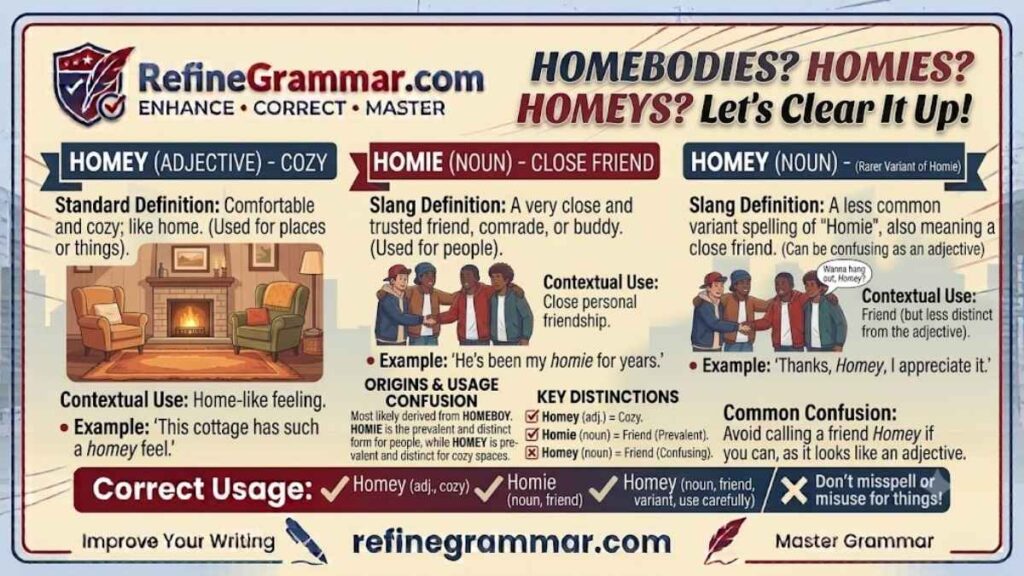
Some writers repeat the words back and forth because both spellings sound identical when spoken aloud. This is purely a written-language issue, since English pronunciation does not distinguish between homey and homie the way spelling does. Reading the sentence’s intended meaning is the only reliable guide.
Homie or Homey Simpsons
Pop culture adds another wrinkle. The Simpsons episode titled “Homie the Clown” is a direct pun on Homer Simpson’s name combined with Homey D. Clown, a well-known character from the sketch comedy series In Living Color. That original character’s name is spelled “Homey,” which is why some fans still associate the comfort-related spelling with a person, even though standard slang usage today favors homie for referring to a friend.
The Origin of Homey or Homie

Homie traces back to “homeboy” and “homegirl,” terms that originally described someone from your hometown or neighborhood. Over decades, especially through hip-hop culture starting in the 1980s, the term shortened to homie and broadened to mean any close friend, regardless of geography. Homey has a separate, older history as a plain adjective built from “home” plus the “-y” suffix, following the same pattern as knaw or gnaw spelling mix-up and other word pairs where similar sounds hide two completely different origins. Knowing this history makes it easier to remember that the two spellings split into separate lanes long ago, even though they share a root word.
British English vs American English Usage
Homey is understood and accepted in both British and American English, mostly describing comfort. Homie is strongly associated with American slang and hip-hop culture, and it appears far less often in British English, where readers may find it unfamiliar or overly casual. If you are writing for an international or formal audience, homey is the safer, more universally understood option.
Which One Should You Use?
Choose homey when writing about a place, room, or atmosphere, especially in real estate, hospitality, or lifestyle content. Choose homie only in casual, informal writing where you are referring to a friend, and avoid it entirely in professional or formal documents. When in doubt, homey is the more broadly acceptable word across contexts.
Common Mistakes with Homey or Homie
- Using homie to describe a cozy room instead of homey.
- Writing homey when referring to a friend in slang contexts.
- Assuming autocorrect chose the right word without double-checking meaning.
- Mixing homey with homely without knowing the regional meaning shift.
- Pluralizing homie as “homeys” instead of the correct “homies.”
Homey or Homie in Everyday Examples
1. Correct: “The bakery has such a homey feel to it.”
2. Correct: “I’m grabbing lunch with my homie later.”
3. Incorrect: “This living room feels so homie.”
4. Incorrect: “That’s my best homey from college.”
Comparison Table: Homey vs Homie
Here is a side-by-side breakdown to settle the spelling at a glance:
| Feature | Homey | Homie |
| Part of speech | Adjective | Noun |
| Meaning | Cozy, comfortable, warm | Close friend, buddy |
| Describes | Places, atmospheres | People |
| Formality | Informal, widely accepted | Very informal, slang |
| Plural | Not applicable | Homies |
| Region | British & American English | Mostly American English |
Homey or Homie – Google Trends & Usage Data
Search interest for these two spellings tends to spike whenever slang or interior-design content trends online, with homie generally drawing more search volume among younger audiences due to its constant use in music and social media captions. Homey stays consistently popular in real estate and hospitality searches, similar to how confusion around building rapport, not repore, with new friends stays steady because people repeatedly encounter the word without ever seeing it spelled out correctly.
FAQs
Is it spelled homie or homey?
It depends on meaning: homie for a friend, homey for something cozy or comfortable.
What is homey slang for?
Homey can informally refer to a friend, though homie is the far more common slang spelling.
What does homie mean?
Homie means a close friend, buddy, or someone from your neighborhood.
What does homey mean?
Homey means cozy, warm, and comfortable, usually describing a place or atmosphere.
Is homey a real word?
Yes, homey is a recognized adjective that has been used in English for over a century.
What is the difference between homey and homely?
Homey means cozy in both British and American English, while homely means plain in American English but cozy in British English.
Is homey an adjective?
Yes, homey is an adjective used to describe comfortable, welcoming places or atmospheres.
How do you spell homies?
The plural of homie is spelled homies, simply by adding an s.
Which is correct: homey or homie?
Both are correct in the right context: homey for comfort, homie for a friend.
Should I use homey or homie in everyday English?
Use homey in most everyday and professional writing, and reserve homie for casual, informal conversation.
Conclusion
The homey or homie debate comes down to a simple rule: homey describes comfort, while homie describes a person. Once that distinction clicks, you will never second-guess your spelling again, whether you are writing a cozy real estate listing or texting a close friend. Like many easily confused word pairs, from how to correctly write 22nd to address vs adress spelling guide, a little context goes a long way. Keep this guide handy, and this word pair will never trip you up again.
