
Have you ever paused mid-sentence, unsure whether to write an in-person meeting or meet in person? You’re not alone. The in-person vs in person question is one of the most common hyphenation puzzles in everyday business, academic, and marketing writing.
Understanding when in-person takes a hyphen and when in person stands as two separate words can be the difference between polished, professional copy and an awkward mistake. This guide breaks down the in-person vs in person distinction with clear rules, real examples, a comparison table, and a mini quiz, so you never have to second-guess the correct usage again.
What Is the Difference Between In-Person and In Person?
Quick Answer
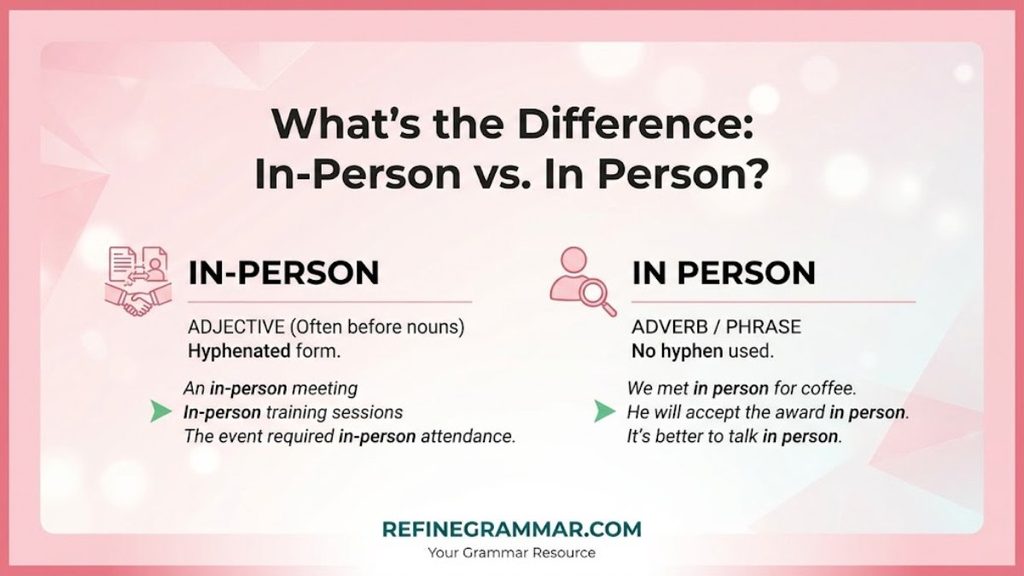
In-person (hyphenated) is a compound adjective that describes a noun, such as an in-person interview or an in-person class. In person (two words, no hyphen) is an adverbial phrase describing how an action happens, as in “we met in person.” The core in-person vs in person rule comes down to grammatical function, not meaning.
Why the Difference Matters
Getting the in-person vs in person distinction wrong doesn’t just look careless. It can confuse readers and weaken professional writing in resumes, emails, event pages, and marketing copy. Style guides and careful editors consistently reward writers who follow standard hyphenation rules, which is why this small detail matters for both clarity and credibility.
Featured Snippet Answer
Use in-person before a noun (in-person meeting). Use in person after a verb (attend in person). That one line captures the entire in-person vs in person rule.
Understanding “In-Person” as an Adjective
When to Use In-Person
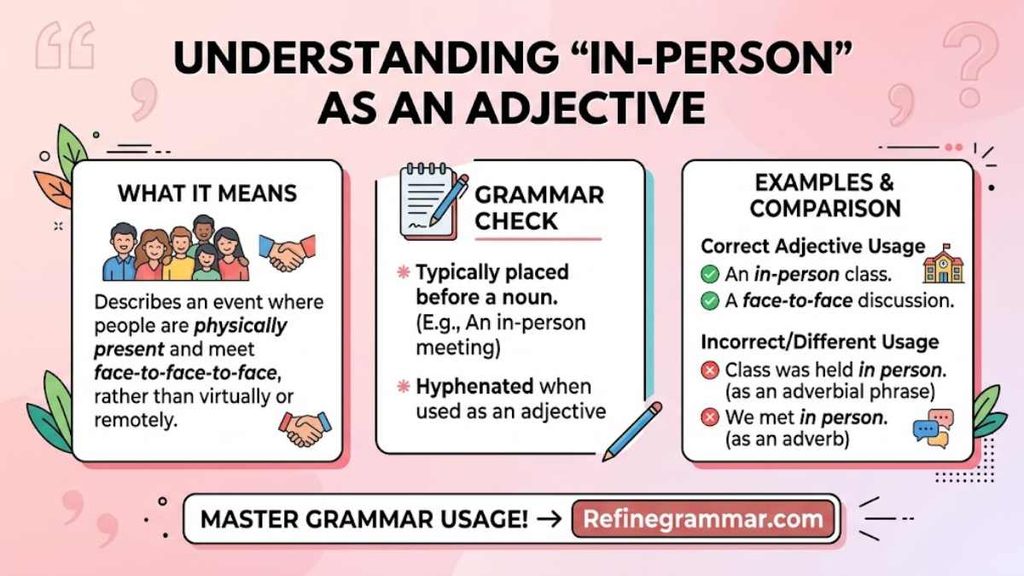
In-person functions as a compound adjective. Like other compound adjectives such as well-known, part-time, or up-to-date, it takes a hyphen when it directly modifies the noun that follows it. Whenever the phrase describes a person, event, class, or interaction as a single modifying unit, in-person is the correct choice.
Example Sentences
- The company scheduled an in-person interview for Tuesday.
- Our in-person events attract more engagement than webinars.
- She prefers in-person classes over online courses.
- The clinic now offers in person appointments again.
Common Pattern
The pattern is: in-person + noun. If you can swap in-person for another adjective like virtual, remote, or online and the sentence still makes sense, keep the hyphen.
Understanding “In Person” as an Adverbial Phrase
When to Use In Person
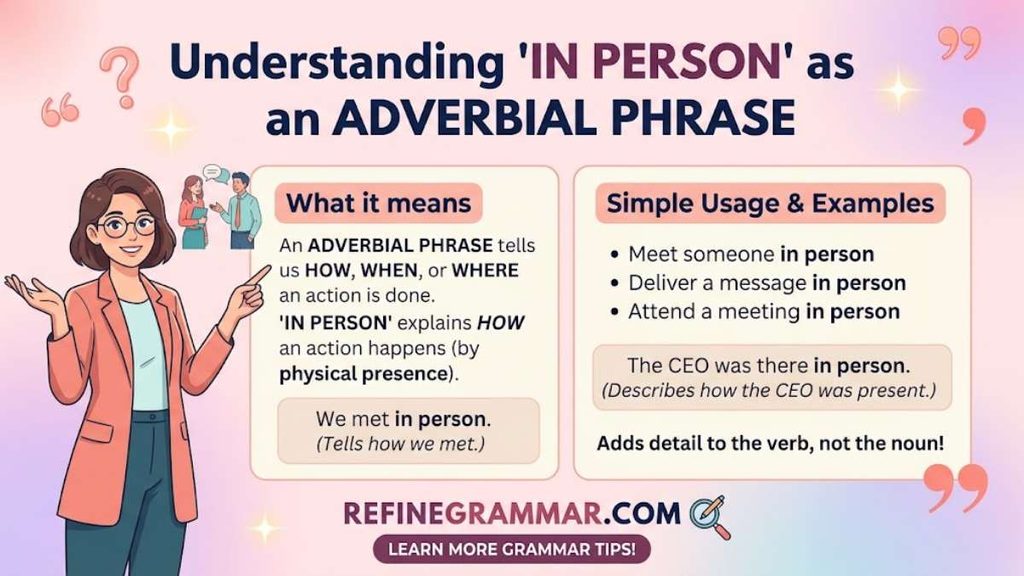
When the phrase follows a verb and answers how the action took place, drop the hyphen. In person behaves like by hand or on foot: a two-word phrase describing manner, not a noun.
Example Sentences
- Please submit the form in person.
- We finally met in person after months of video calls.
- You must sign the lease in person at our office.
- I’d rather discuss this in person than over email.
Common Pattern
The pattern here is: verb + in person. If the phrase follows an action word and explains how something was done, no hyphen is needed.
In-Person vs In Person: Side-by-Side Comparison
| Feature | In-Person | In Person |
| Part of speech | Compound adjective | Adverbial phrase |
| Position in sentence | Before a noun | After a verb |
| Hyphen used? | Yes | No |
| Example | in-person training | train in person |
| Question it answers | Which kind? | How? |
Memory Trick
Picture the hyphen as glue. It appears only when in-person is glued directly to a noun. Once the phrase drifts after a verb, the glue disappears, and it becomes in person.
Learn More: Vender or Vendor: I Solved the Confusion (2026 Guide)
Real-Life Example: How Businesses Use These Terms
Consider a university advertising an in-person orientation for new students. The compound adjective describes the type of orientation. Later in the same email, the university might write, “Please attend in person, as virtual seating is limited.” Here the phrase shifts to two words because it follows the verb attend. Many companies, HR teams, and event organizers make this exact switch within a single document, and keeping it consistent signals careful, professional writing.
Usage Trends and Language Data (2025–2026)
Since the shift toward remote and hybrid work, the in-person vs in person comparison has stayed highly relevant. Major style guides continue to list in-person as the standard hyphenated adjectival form, while treating in person as the correct two-word phrase after a verb. As hybrid meetings, hybrid classrooms, and hybrid events remain common in 2026, writers frequently need both forms within the same paragraph, which makes accuracy more important than ever.
Why This Matters
Search behavior shows that people actively look up in-person vs in person questions before publishing resumes, job postings, event pages, and academic assignments, which is exactly why precision here directly affects professional credibility.
Common Mistakes Writers Make
Mistake 1: Using In Person Before a Noun
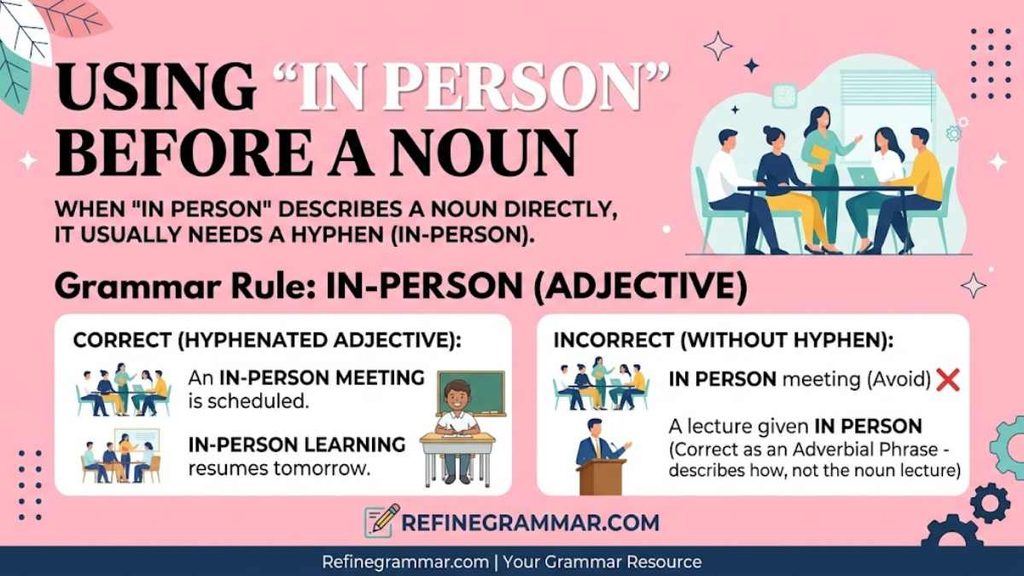
Writing “in person meeting” without a hyphen is incorrect. Since meeting is a noun being modified, the compound adjective needs its hyphen: in-person meeting.
Read More: Enrolment or Enrollment: The Correct Spelling Explained
Mistake 2: Using In-Person After a Verb
Writing “we talked in-person” is incorrect. Since talked is a verb and in person tells you how, no hyphen belongs here.
Mistake 3: Hyphenating Everything
Some writers hyphenate the phrase out of habit in every sentence. This over-correction creates inconsistency and reads as less professional than simply following the noun-versus-verb rule.
Mistake 4: Mixing Formal and Informal Usage
Switching between hyphenated and unhyphenated forms at random within the same document confuses readers and weakens tone consistency, especially in formal writing like reports or resumes.
How to Remember the Rule Every Time
Use “In-Person” If:
- It sits directly before a noun
- It answers “what kind”
- It could be swapped with “virtual” or “remote”
Use “In Person” If:
- It follows a verb
- It answers “how”
- It could be swapped with “by phone” or “online”
One-Sentence Formula
Noun right after it? Add the hyphen. Verb right before it? Drop the hyphen. That single formula resolves nearly every in-person vs in person decision you’ll ever face.
Mini Quiz: In-Person vs In Person
Test what you’ve learned with these fifteen quick in-person vs in person questions. Answers follow each prompt.
Quiz 1: Which one describes a noun?
Answer: “In-person” describes a noun, as in an in-person workshop.
Read More: Weather vs Whether vs Wether: The Simple Difference
Quiz 2: Fill in the blank: Please attend the seminar ___.
Answer: in person it follows the verb “attend.”
Quiz 3: Quick choice: “___ meeting” or “meet ___”?
Answer: in-person meeting; meet in person.
Quiz 4: Fill in the blank: We offer ___ tutoring twice a week.
Answer: in-person it modifies the noun “tutoring.”
Quiz 5: True or False: “In person” is always hyphenated.
Answer: False. It is only hyphenated before a noun.
Quiz 6: Fill in the blank: You can pay online or ___.
Answer: in person it follows the phrase describing manner.
Quiz 7: Spot the correct sentence: “I prefer in-person over calls” or “I prefer in person over calls.”
Answer: “I prefer in person over calls” is correct here since it follows a verb-like preference phrase.
Quiz 8: Fill in the blank: The ___ interview is scheduled for 3 PM.
Answer: in-person it modifies “interview.”
Quiz 9: Grammar check: “She signed up in-person.” Correct or incorrect?
Answer: Incorrect. It should be “She signed up in person.”
Quiz 10: Fill in the blank: Our ___ store hours have changed.
Answer: in-person it modifies “store hours.”
Quiz 11: What does “in-person” describe in “in-person consultation”?
Answer: It describes the noun “consultation” as a compound adjective.
Quiz 12: Fill in the blank: They chose to negotiate ___ rather than by phone.
Answer: in person it follows the verb “negotiate.”
Quiz 13: Choose the right form: “an ___ event” or “attend ___”?
Answer: an in-person event; attend in person.
Quiz 14: Quick rule test: Does “in-person” or “in person” follow a verb?
Answer: “In person” follows a verb.
Quiz 15: Final challenge: Rewrite “We do in-person over the phone too” correctly.
Answer: We do it in person, over the phone too or simply: We offer this in person as well.
People Also Search For
Readers researching in-person vs in person usage often also search for these related terms:
- in person vs in person meeting
- in person vs in person meaning
- when to use in person vs in person
- person in authority vs agent of person in authority
- writing in first person vs writing in third person
- difference between in person and in-person
- is it better to meet in person or online
- is it better to date online or in person
- person vs individual
- in person or in person uk
References
This guide follows conventions confirmed by leading dictionaries and style authorities, including Merriam-Webster, Cambridge Dictionary, Oxford Learner’s Dictionaries, and the AP Stylebook, all of which list in-person as a hyphenated compound adjective and in person as an unhyphenated adverbial phrase.
Free Grammar Chicker
FAQs
Is in-person class hyphenated?
Yes. Since “in-person” modifies the noun “class,” it takes a hyphen: in-person class.
Does “in person” use a hyphen?
No, not when it follows a verb, such as “we met in person.”
Is in person one word or two words?
It is two words with no hyphen when used as an adverbial phrase.
What is a better way to say “in person”?
Alternatives include “face-to-face,” “in the flesh,” or “physically present.”
Do I need a hyphen for “in person”?
Only when it comes directly before a noun, turning it into “in-person.”
Which is correct: “in person” or “in-person”?
Both are correct depending on context: hyphenated before a noun, unhyphenated after a verb.
Is “in person” a hyphenated word?
By itself, no. It becomes hyphenated only in its adjective form, in-person.
What is a formal word for “in person”?
“In the flesh” and “face-to-face” are common formal alternatives.
What are some common mistakes when using hyphens?
Common errors include hyphenating after a verb, skipping the hyphen before a noun, and inconsistent use within the same document.
What does it mean to say “in person”?
It means physically present, as opposed to attending virtually, by phone, or online.
Final Thought
The in-person vs in person rule is simple once you see the pattern: hyphenate before a noun, leave it open after a verb. Keep that formula in mind, and you’ll write in-person and in person correctly every single time, in any document you publish.
