
If you’ve ever paused mid-sentence wondering whether you typed the right word, you’re not alone. The trio of weather vs whether vs wether trips up even confident writers because all three words sound almost identical when spoken aloud.
Yet each one carries a completely different meaning, and mixing them up can make an email, essay, or business message look careless. This guide breaks down weather vs whether vs wether in plain English, with examples, memory tricks, and a quick cheat sheet so you never second-guess yourself again.
The Quick Answer: Wether vs. Weather vs. Whether
Here’s the short version before we go deeper into weather vs whether vs wether:
- Weather refers to the condition of the atmosphere rain, sunshine, wind, or snow.
- Whether introduces a choice between two or more possibilities, similar to “if.”
- Wether is a rarely used noun for a castrated male sheep or goat.
Two of these words show up constantly in everyday writing, while the third wether is so uncommon that many people have never seen it in print. Understanding whether there is a difference between these three words comes down to recognizing that they aren’t interchangeable at all; they simply share a similar sound.
The easiest way to remember them
- Weather has “heat” hidden inside it think temperature and climate.
- Whether has “ether,” a nod to something uncertain or up in the air, like a choice.
- Wether rhymes with “feather” and refers to an animal, not a concept.
Weather Meaning: What Does “Weather” Mean?
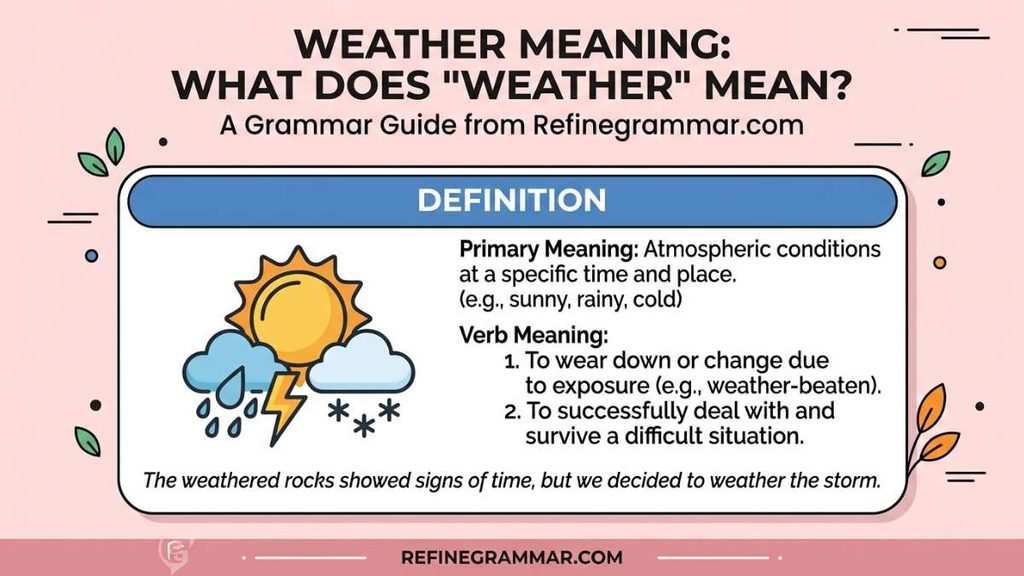
Weather is the most familiar of the three words in the weather vs whether vs wether trio, and weather and weather meaning in english questions are among the most searched language queries online.
Weather as a noun
As a noun, weather describes short-term atmospheric conditions in a specific place temperature, humidity, cloud cover, precipitation, and wind. For example: “The weather in Lahore turns humid before the monsoon arrives.”
Common types of weather
- Sunny or clear weather
- Rainy or stormy weather
- Snowy or icy weather
- Windy or foggy weather
A common weather or season difference question arises because people confuse short-term weather with the broader, longer patterns that define a season. Weather changes hour to hour; a season describes months of typical weather.
Weather as a verb
Weather can also function as a verb meaning “to endure” or “to come through something difficult.” For instance: “The company weathered the economic downturn.”
Common phrases using “weather”
Under the weather
This idiom means feeling slightly unwell: “I’m staying home today because I’m under the weather.”
Weather forecast
A weather forecast predicts upcoming atmospheric conditions using data, radar, and satellite imagery.
Fair-weather friend
A fair-weather friend only sticks around when things are going well, disappearing during hard times.
Whether Meaning: What Does “Whether” Mean?
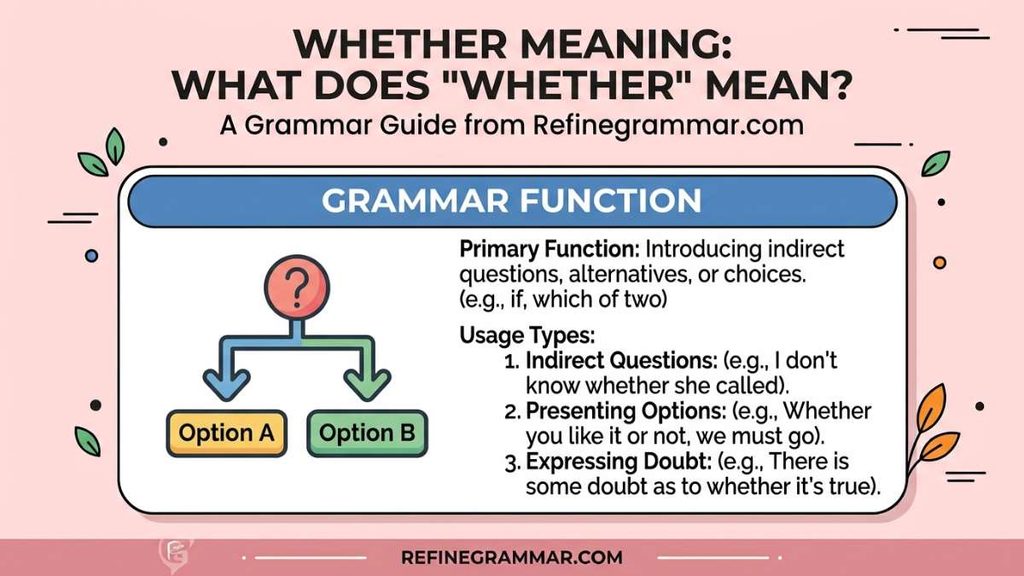
Whether is a conjunction used to present options, doubts, or alternatives. It’s the word most often confused with “weather” simply because of pronunciation, not meaning a core reason the weather vs whether vs wether mix-up keeps happening.
When should you use “whether”?
Use whether when you’re discussing a choice, a possibility, or an unresolved question: “I haven’t decided whether to travel this weekend.”
Whether for choices
“Whether you choose tea or coffee, breakfast will be ready by eight.”
Whether for uncertainty
“She wasn’t sure whether the flight had been delayed.”
Whether with alternatives
Whether frequently pairs with “or” to present two sides of a decision: “Whether or not it rains, the event will continue as planned.” This whether vs whether or not distinction is largely stylistic both forms are grammatically correct, though “whether or not” adds emphasis.
Whether after prepositions
Whether is the only correct choice after a preposition, since “if” cannot follow words like “of,” “about,” or “on”: “There was a debate about whether the policy would work.”
Read More: Enrolment or Enrollment: The Correct Spelling Explained
Whether vs If: What’s the Difference?
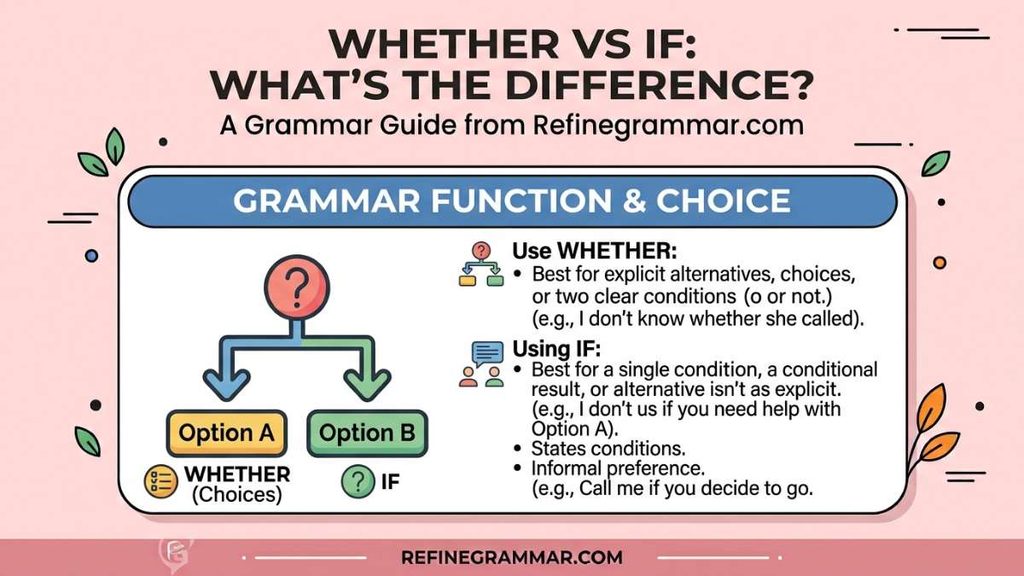
Many English learners search whether vs if because the words seem interchangeable. In casual speech they often are, but formal writing draws a clear line.
When “if” works
“If” works well for simple conditional statements: “If it rains, we’ll stay inside.”
When only “whether” works
Before infinitives
“I couldn’t decide whether to call or email.” “If” doesn’t fit naturally before an infinitive verb.
With alternatives
When two options are explicitly compared, whether is the standard choice: “Whether by car or by train, we’ll arrive on time.”
After prepositions
As noted above, only whether can follow a preposition directly.
Quick comparison table
| Situation | Correct Word | Example |
| Simple condition | If | If you’re free, call me. |
| Choice between options | Whether | I’m unsure whether to stay or leave. |
| After a preposition | Whether | We argued about whether it was fair. |
| Before an infinitive | Whether | She asked whether to proceed. |
Wether Meaning: What Does “Wether” Mean?
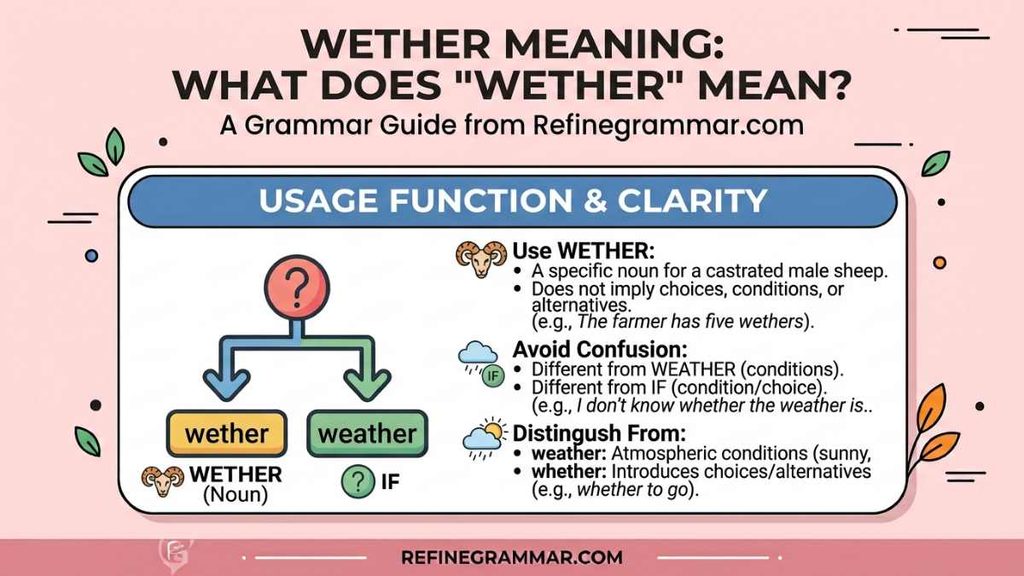
Wether is the least common word in the weather vs whether vs wether comparison, and for good reason it belongs to a specialized vocabulary rather than everyday conversation.
Why does this word exist?
A wether is a castrated male sheep or goat, a term still used in farming, livestock auctions, and agricultural writing. It has existed in English for centuries, long before “weather” and “whether” took their modern spellings.
Why “wether” confuses people
Because wether looks like a typo of “weather” or “whether,” readers often assume it’s a mistake. In reality, it’s a legitimate, dictionary-recognized word just one confined to a narrow context. Searches like whether or wether uk and weather or whether uk usually appear because someone spotted “wether” in a farming article and assumed it was misspelled.
Wether vs Weather vs Whether: Side-by-Side Examples
Seeing all three words used correctly in one place makes the wether vs weather vs whether what’s the difference question much easier to answer.
| Word | Part of Speech | Example Sentence |
| Weather | Noun/Verb | The weather turned cold overnight. |
| Whether | Conjunction | I don’t know whether he’s coming. |
| Wether | Noun | The farmer sold three wethers at auction. |
Why these examples matter
Placing weather, whether, and wether side by side highlights how different their roles really are: one describes climate, one introduces a choice, and one names an animal. None of them can substitute for another without changing the meaning of the sentence entirely.
Easy Memory Tricks to Remember the Difference
Weather = Earth
Weather relates to the physical world sun, rain, wind. Picture a cloud whenever you write it.
Whether = Choice
Whether always signals two or more options. If you can mentally insert “or not” after the word, you’ve picked correctly.
Wether = Sheep
If a sentence mentions farms, livestock, or breeding, “wether” is probably the right word otherwise, it almost certainly isn’t.
The three-second test
Ask yourself: Am I talking about climate (weather), a choice (whether), or an animal (wether)? That three-second check resolves almost every mix-up.
Common Mistakes People Make
Most weather vs whether vs wether errors fall into one of three predictable patterns.
Using weather instead of whether
This is by far the most frequent error, since spellcheck often won’t catch it both are valid words, just wrong in context.
Thinking wether is fake
Some writers delete “wether” from their writing entirely, assuming it’s a misspelling, when it’s simply a specialized agricultural term.
Trusting autocorrect too much
Autocorrect tools rarely flag weather/whether errors because both spellings are technically correct words; only careful proofreading catches the mistake.
Read More: Vender or Vendor: I Solved the Confusion (2026 Guide)
Why Pronunciation Makes These Words So Confusing
In most English accents, “weather” and “whether” sound nearly identical, which is exactly why the classic tongue-twister about the weather and whether it will weather the weather continues to circulate online. The playful line works precisely because listeners can’t distinguish the words by ear only spelling reveals the difference.
Real-Life Examples in Everyday Writing
Seeing weather vs whether vs wether used correctly across different settings makes the rules easier to apply in your own writing.
In emails
“Please confirm whether the meeting is still happening, regardless of the weather forecast.”
In text messages
“Not sure whether we’re still on for tonight the weather looks rough.”
In business writing
“Management is evaluating whether the current weather patterns will affect shipping schedules.”
In farming discussions
“The wether was kept separate from the breeding flock during the winter weather.”
Case Study: How One Wrong Word Changes Meaning
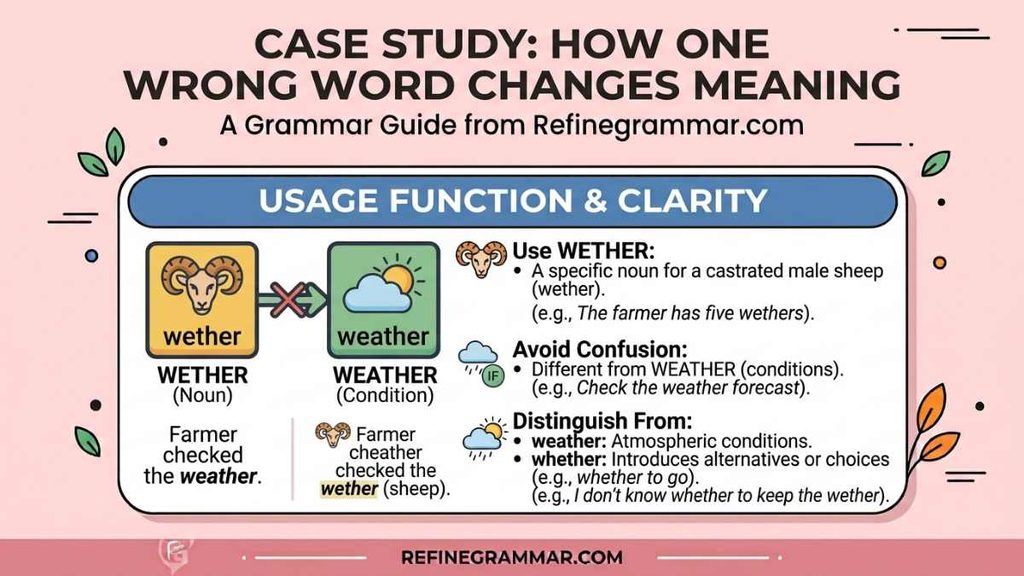
Imagine a company memo that reads: “We are unsure weather the office will reopen Monday.” A single swapped letter changes an intelligent, professional sentence into one that reads as a careless error, potentially undermining the writer’s credibility. Swapping in the correct word whether instantly restores clarity and trust in the message.
Mini Quiz: Can You Pick the Correct Word?
Test what you’ve learned about weather vs whether vs wether with the short quiz below.
Fill in the blanks
- I’m not sure ___ we should leave now or wait.
- The ___ report predicts heavy rain tomorrow.
- The farmer raised the ___ alongside his other livestock.
- She asked ___ to bring an umbrella.
- Rain or shine, the team will ___ the storm.
Answers
- 1. Whether
- 2. Weather
- 3. Wether
- 4. Whether
- 5. Weather
Quick Cheat Sheet for Fast Recall
Bookmark this weather vs whether vs wether cheat sheet for the next time you’re typing in a hurry.
| Word | Meaning | Memory Cue |
| Weather | Atmospheric conditions | Contains “heat” |
| Whether | Introduces a choice | Contains “ether,” like uncertainty |
| Wether | A castrated male sheep/goat | Rhymes with “feather” |
FAQs
Here are quick answers to the most common weather vs whether vs wether questions people ask.
What does “wether” mean?
A wether is a castrated male sheep or goat, a term mainly used in farming and livestock contexts.
Is “whether” a correct word?
Yes, whether is a standard English conjunction used to introduce choices or uncertainty.
How do you use “whether” correctly?
Use whether before options, doubts, infinitives, or after prepositions, such as “I don’t know whether to go.”
Is it spelled “whether” or “wether”?
Both spellings exist, but they mean completely different things whether means “if,” while wether refers to an animal.
When should you use “whether” or “either”?
Use whether for choices tied to actions or conditions, and either when choosing between two specific nouns or options.
What are the two meanings of “whether”?
Whether can introduce a direct question of choice or express doubt about an outcome, but both uses point to uncertainty.
What are the two meanings of “weather”?
Weather can be a noun describing atmospheric conditions or a verb meaning to endure something difficult.
How can you remember the difference between “weather” and “whether”?
Remember that weather relates to climate, while whether relates to choices picturing a cloud versus a fork in the road helps.
Which is correct, “wether” or “whether”?
Neither is universally “correct” it depends on context: wether for sheep, whether for choices.
What is the origin of the word “wether”?
Wether comes from Old English and Germanic roots referring specifically to a castrated ram, long predating modern spelling conventions.
Final Thought
Mastering weather vs whether vs wether comes down to context, not memorization alone. Once you connect weather to climate, whether to choice, and wether to livestock, the confusion disappears for good. A few seconds of thought before hitting send is all it takes to get it right every time.
