
If you’ve ever paused mid-sentence wondering whether to type “beginning” or “begining,” you’re not alone. This beginning vs begining mix-up sits near the top of the list of common English typos, right alongside words like “recieve” and “definately.” The good news? Once you learn the rule behind it, you’ll never second-guess yourself again. This guide walks you through the correct spelling, the reasons people slip up, easy memory tricks, and real examples you can use right away.
Whether you’re writing a school essay, a work email, or a quick text, getting beginning vs begining right matters more than you might think. A misspelled word can distract readers and chip away at your credibility, especially in professional writing. By the end of this article, you’ll have a clear, lasting answer to the beginning vs begining question, plus a handful of tricks to keep the mistake from creeping back in.
What Is the Correct Spelling: Beginning or Begining?
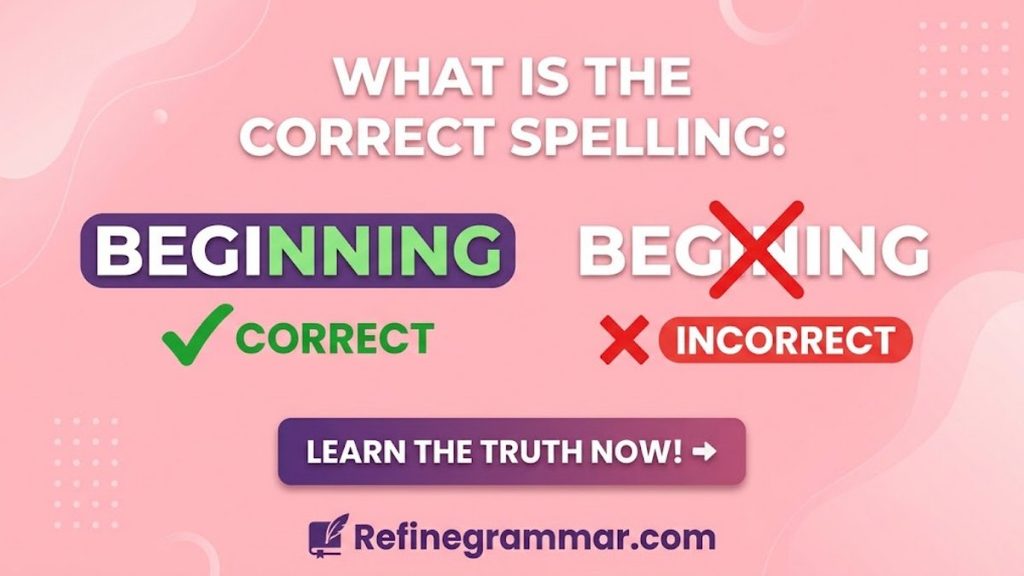
“Beginning” is the only correct spelling. “Begining” is a misspelling, plain and simple, and you won’t find it in any dictionary. When people debate beginning vs begining, the confusion usually comes down to one missing letter: the second “n.” The word beginning carries a doubled “n” because of how English handles suffixes added to short verbs ending in a single consonant.
Think of it this way: “begin” already ends in “n.” When you add “-ing” to form the continuous tense or the noun, English spelling convention doubles that final consonant. Skip the double letter, and you get the incorrect “begining.” Keep it, and you land on the correct, dictionary-approved “beginning.”
If you search beginning vs begining online, you’ll notice that dictionaries, style guides, and grammar sites all agree on the same answer: “beginning” wins, every time, in every context. No regional variation, no informal exception, and no accepted alternate spelling changes that fact.
Learn More: Tried or Tryed? The Correct Spelling Revealed (2026)
Why Do People Write “Begining” by Mistake?
The beginning vs begining error isn’t a sign of poor grammar skills. It’s a predictable slip rooted in how English sounds, how its rules work, and how quickly most of us type these days.
Pronunciation confusion
Spoken English often blurs double consonants. When you say “beginning” out loud, the two n’s blend into a single sound, so your ear doesn’t pick up on the doubling the way your eye needs to when spelling it. That mismatch between sound and spelling is exactly why the beginning vs begining question trips up so many writers, native speakers included.
This is especially common among English language learners, whose native languages may not double consonants the same way English does. If your first language treats each letter as a distinct, separately pronounced sound, the silent doubling in “beginning” can feel arbitrary, which only fuels the beginning vs begining confusion further.
English spelling rules are tricky
English inherited spelling patterns from Latin, French, and Old English, and the rules for doubling consonants before a suffix aren’t always intuitive. Words like “running,” “stopping,” and “beginning” all double their final consonant, while others, such as “opening” or “listening,” don’t. Without a clear pattern to lean on, it’s easy to guess wrong.
Fast typing habits
Autocorrect catches plenty of typos, but on mobile keyboards or during rapid typing, a dropped letter can slip through, especially in double-letter words. Add in autocomplete suggestions and muscle memory from typing “begin” a hundred times, and “begining” sneaks into emails, texts, and documents more often than you’d expect.
Chat apps and social media make this worse. When you’re firing off a quick message, you’re less likely to proofread, and a small slip like dropping one “n” rarely gets a second glance. Over time, that habit can carry over into more formal writing, keeping the beginning vs begining error alive long after you first learned the rule.
Meaning of “Beginning” in English Grammar
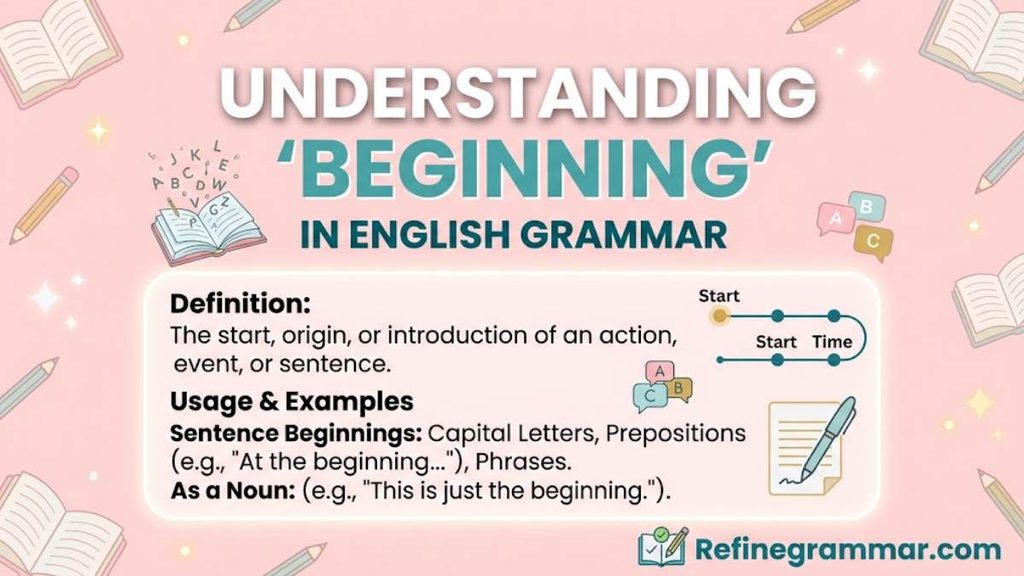
Beyond spelling, it helps to understand what “beginning” actually does in a sentence. It plays two different grammatical roles, and both matter when you’re deciding between beginning vs begining.
As a noun
As a noun, “beginning” refers to the start or origin of something: an event, a story, a relationship, a project. For example, “The beginning of the movie hooked me instantly.” Here, the word names a point in time, not an action.
As a verb form (continuous tense)
As a verb form, “beginning” is the present participle of “begin,” used to build continuous tenses. For example, “She is beginning her new job today,” or “They were beginning to worry.” In both roles, the spelling stays the same: two n’s, no exceptions.
Understanding these two roles helps you see why the beginning vs begining debate isn’t really about grammar at all, it’s purely about spelling. The word’s job in the sentence never changes the letters you need.
Easy Rules to Remember “Beginning”
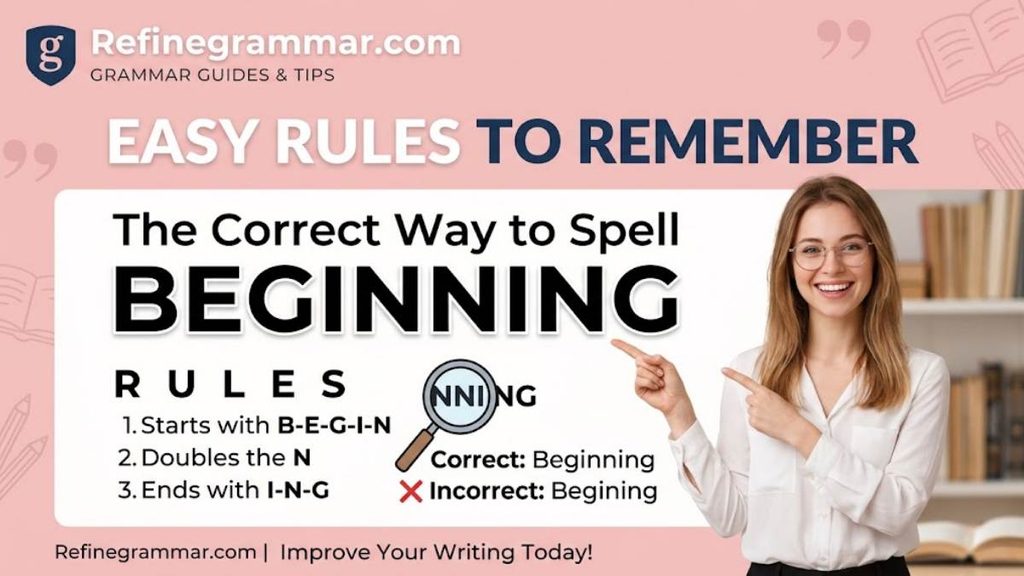
If the beginning vs begining debate keeps catching you off guard, a few simple memory tricks can settle it for good. Pick one that clicks for you and practice it until the correct spelling becomes second nature.
Double the “n”
Picture two candles lit side by side at the start of a journey. That image of “two” can remind you that beginning needs two n’s, not one. Whenever you type the word, pause after “begin” and consciously add both n’s before the “ing.”
Think of “start + start again”
Another trick: mentally split the word into “begin” and “ning,” then imagine you’re emphasizing the start twice, once with each n. This small mental nudge helps the doubled letter stick in long-term memory.
Break it down
Sound out the word in three chunks: be-gin-ning. Saying it slowly, syllable by syllable, makes the double “n” far more obvious than rushing through the whole word at once. This technique works well for spelling drills and for teaching kids or English learners the beginning vs begining rule.
You can also try writing the word by hand a few times. Physically forming each letter, rather than typing on autopilot, tends to lock the correct spelling into memory far more effectively than passive reading.
Common Examples of “Beginning” in Sentences
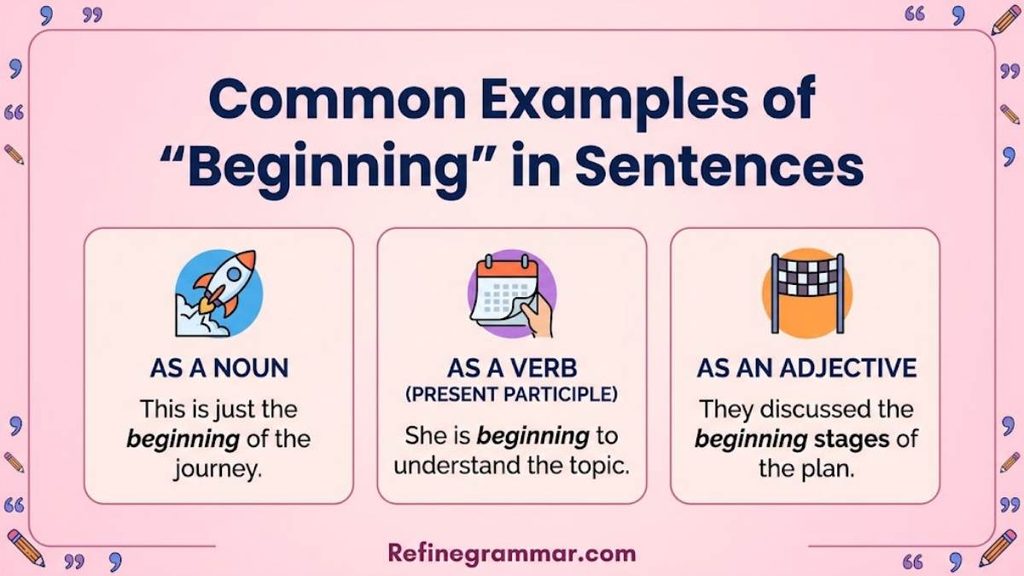
Seeing the word in context makes the correct spelling easier to remember, and it reinforces the beginning vs begining rule through repetition. Here are a few natural examples:
- We’re starting fresh at the beginning of the new year.
- The teacher explained the beginning of the chapter before assigning homework.
- He’s beginning to understand why the beginning vs begining mix-up happens so often.
- From beginning to end, the documentary held my attention.
- Every new beginning brings a mix of excitement and nerves.
- The company is beginning its expansion into new markets this quarter.
Common Spelling Mistakes Related to “Beginning”
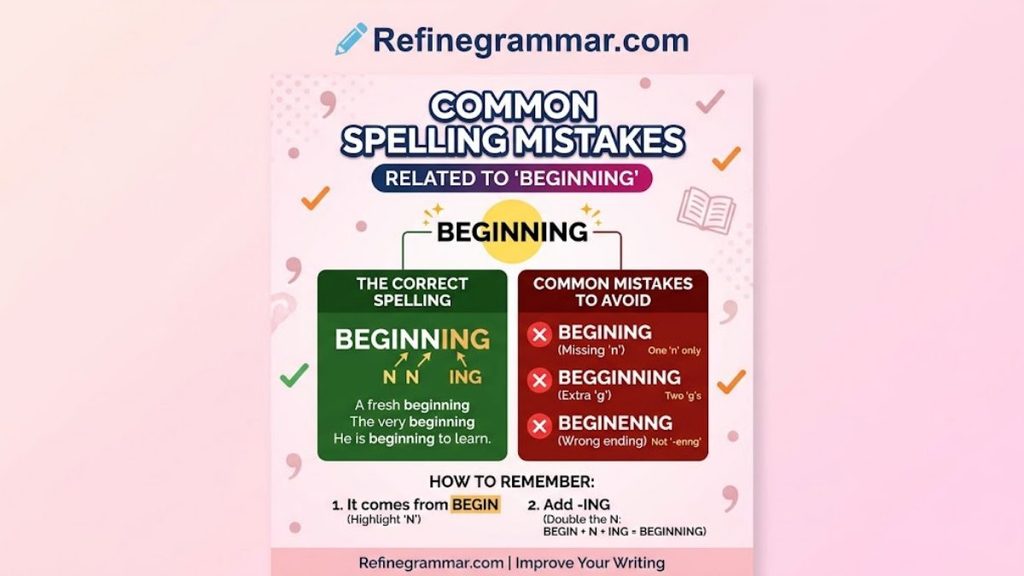
The table below lists frequent variations people search for when they’re unsure about beginning vs begining, along with the spelling that’s actually correct. Keeping this reference handy can save you a quick search the next time doubt creeps in.
| Incorrect Spelling | Correct Spelling |
| begining | beginning |
| beggining | beginning |
| begining of the year | beginning of the year |
| in the begining | in the beginning |
| new begining | new beginning |
| begining stages | beginning stages |
Quick Tips to Avoid the Mistake
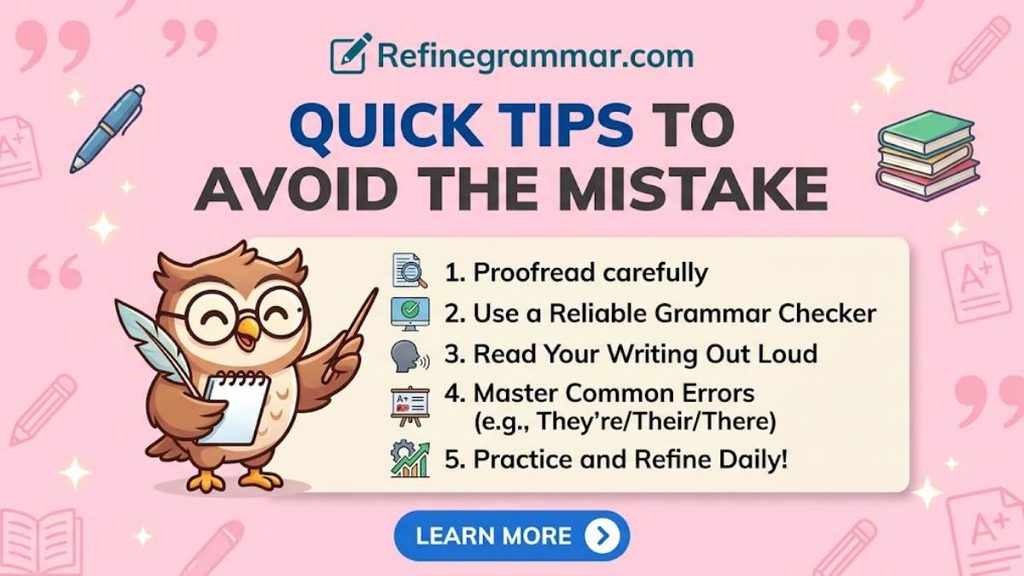
- Always double-check for the double “n” before you hit send or submit.
- Use your device’s spell-checker, but don’t rely on it blindly since some tools miss context-based errors.
- Practice writing the word slowly a few times until the double “n” feels automatic.
- Read the word aloud in syllables (be-gin-ning) to reinforce the correct pattern.
- Bookmark a trusted dictionary site for quick spelling checks when you’re in doubt.
- Whenever you catch yourself typing quickly, slow down for words like beginning that are prone to dropped letters.
FAQs
Which is correct, beginning or begining?
“Beginning” is correct. “Begining” is a common misspelling that drops the second “n.”
Is “begining” or “beginning” the correct spelling?
“Beginning” is the only correct spelling recognized by dictionaries; “begining” is always wrong.
How do you spell beginning in English?
Spell it b-e-g-i-n-n-i-n-g, with a doubled “n” right after “begi.”
Can you use “beginning” in a sentence?
Yes, for example: “The beginning of the trip was rainy, but the sun came out by afternoon.”
Which is correct, new beginning or new beginnings?
Both are correct; use “new beginning” for one fresh start and “new beginnings” for several.
What’s a better word for beginning?
Depending on context, try “start,” “onset,” “outset,” or “origin” as natural synonyms.
Why does the beginning have a double “n”?
English doubles the final consonant of short verbs like “begin” before adding “-ing” or similar suffixes.
What is the USA spelling of beginning?
American and British English both spell it “beginning,” so there’s no regional difference here.
Do I say “began” or “begun”?
Use “began” for simple past tense and “begun” with a helping verb like “has” or “had.”
Which is correct: “began” or “started”?
Both work; “began” fits formal or narrative writing, while “started” feels more casual.
Final Thought
The beginning vs begining question comes down to one simple fact: “beginning” is correct, and “begining” never is. Remember the doubled “n,” lean on the tricks above, and this spelling stumble will become a thing of the past. Every strong piece of writing deserves a strong beginning, spelled the right way.
