
You’ve probably typed it both ways without thinking twice. But when it comes to goodmorning or good morning, only one version is actually correct English. The other one just feels right because we type fast and read even faster.
This guide clears up the confusion for good. You’ll learn why “good morning” is the only correct form, why so many people still write it as one word, and how to use it properly in texts, emails, and everyday conversation.
What Is the Correct Form: Goodmorning or Good Morning?
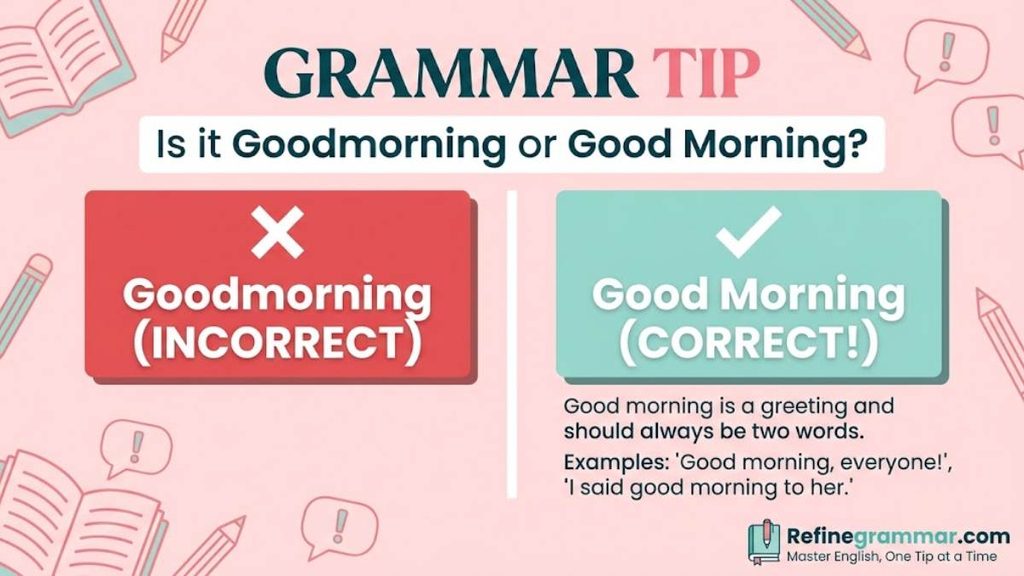
The correct form is always good morning, written as two separate words. “Goodmorning” is not recognized as a standard English word by any major dictionary, including Merriam-Webster or Cambridge.
Why “Goodmorning” Is Incorrect
English greetings built from “good” plus a time of day stay as two words in almost every case. “Good morning,” “good afternoon,” and “good evening” are phrases, not compound nouns. There’s no rule in English grammar that merges an adjective and a noun into one word just because they’re used together often.
Examples of Correct Usage
- Good morning! Did you sleep well?
- She smiled and said good morning to the whole office.
- Good morning, everyone. Let’s get started.
Examples of Incorrect Usage
- Goodmorning, hope you had a nice trip.
- Goodmorning team, quick update below.
Every one of these should split into two words: good morning.
Why Do People Write “Goodmorning” Instead of “Good Morning”?
Fast Digital Communication
Texting and chat apps reward speed over precision. When you’re firing off a quick message, your fingers naturally want to compress two short words into one.
Influence of Compound Words
English is full of legitimate compounds like “goodbye” and “goodnight.” That pattern quietly convinces people that “goodmorning” should follow the same logic, even though it doesn’t.
Autocorrect and Informal Habits
Some keyboards don’t flag “goodmorning” as an error, especially in casual apps. Repeated exposure to the wrong version in group chats and social captions makes it feel normal.
Understanding the Grammar Behind “Good Morning”
“Good” Functions as an Adjective
In this phrase, “good” describes “morning” the same way it describes “day” or “idea.” Adjectives and nouns in English don’t automatically fuse together, so “good morning” stays split just like “good idea” or “nice day.”
Greeting Phrases Usually Stay Separate
Most time-based greetings in English keep their words apart: good afternoon, good evening, good day. This is the pattern to remember whenever you’re unsure about goodmorning or good morning.
Why “Goodnight” Is Different
“Goodnight” is the exception people point to, and it’s a fair question. Over centuries of use, “goodnight” became accepted as a single word (or hyphenated as “good-night”) mainly as a farewell rather than a greeting. Dictionaries now list it both ways. “Good morning” never went through that same shift, so the two-word form remains the only accepted spelling.
When Should You Use “Good Morning”?
Professional Situations
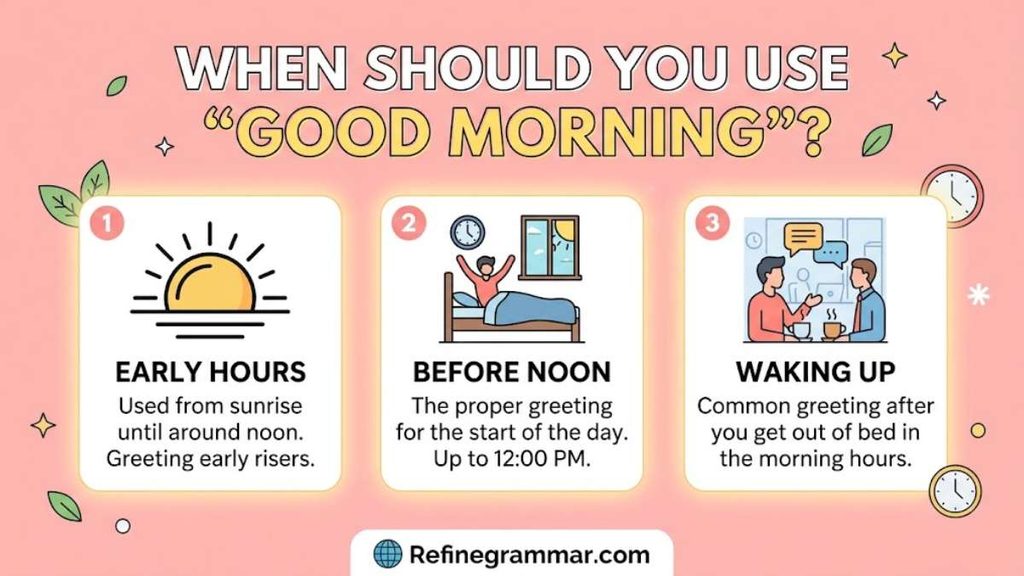
Emails, meetings, and formal messages call for “good morning” spelled correctly and capitalized properly. It signals attention to detail before the reader even gets to your main point.
Casual Conversations
In texts to friends or family, “good morning” still reads naturally and warmly. You can shorten it to “morning!” in very casual settings, but avoid squashing it into one word.
Time Range for “Good Morning”
Most style guides treat morning as running from around 5 a.m. to noon, though the exact cutoff shifts by culture and workplace habit.
Capitalization Rules
Capitalize the first letter when it starts a sentence or greeting line (“Good morning, team”). Mid-sentence, only capitalize it if it’s part of a title or heading.
Common Mistakes Related to “Good Morning”
| Mistake | Why It’s Wrong | Correct Version |
| Goodmorning | Not a recognized word | Good morning |
| Good Morning. (mid-sentence) | Unneeded capital on “Morning” | Good morning. |
| GOOD MORNING!!! | Reads as shouting | Good morning! |
| Good morning,, team | Double punctuation | Good morning, team |
Writing It as One Word
This is the single most common error tied to this topic, and it’s the one spellcheckers usually catch first.
Using Incorrect Punctuation
Skipping the comma before a name (“Good morning Sarah”) is a small but noticeable slip. The comma should sit right after “morning.”
Overcapitalization
Capitalizing every word (“Good Morning”) outside of a title or subject line looks stiff and unnecessary in regular sentences.
Confusing It With Email Subject Styles
Subject lines often use title case, which is why people mistakenly carry that capitalization into the body of an email or message.
Good Morning in Professional Writing and Emails
Why Correct Greetings Matter
A greeting is often the first thing a reader notices. Getting goodmorning or good morning wrong in a client email can quietly undercut your credibility, even if the rest of the message is polished.
Professional Email Examples
- Good morning, Mr. Ahmed. I wanted to follow up on yesterday’s call.
- Good morning, team here’s the weekly update.
Should You Use “Hi” or “Good Morning”?
“Good morning” tends to feel warmer and slightly more formal, which suits client communication or messages to senior colleagues. “Hi” works well for quick, familiar exchanges with peers.
Read More: Take Effect or Take Affect? Finally Explained Simply
Real-Life Example: How a Small Grammar Mistake Affected Professional Communication
A marketing coordinator once sent a client proposal that opened with “Goodmorning Team.” The client didn’t mention it directly, but a colleague later noted that the misspelling made the email look rushed, and the coordinator lost a bit of confidence going into the pitch. The fix took ten seconds, just adding a space, but it’s a reminder that small details shape first impressions, especially in written business communication.
Good Morning vs Similar Greeting Expressions
Comparison Table
| Greeting | Correct Spelling | Typical Use |
| Good morning | Two words | Before noon |
| Good afternoon | Two words | Noon to early evening |
| Good evening | Two words | Evening greeting |
| Goodnight | One word or hyphenated | Farewell at night |
| Goodbye | One word | Farewell, any time |
Why English Greetings Can Be Confusing
English mixes historical spelling shifts with modern habits, so some greetings compressed into single words over time while others didn’t. There’s no single rule; it comes down to how each phrase evolved in common use.
Good Morning: Quotes, Messages, and Everyday Use
People search for “good morning” far beyond grammar questions: good morning images, good morning quotes, good morning messages for a partner, or a good morning text to brighten someone’s day. Whatever the context, the spelling rule doesn’t change. Keep it as two words, whether it’s a caption under a sunrise photo, a quote card, or a short good morning text to a friend. The same applies to a good morning message in an email subject line or a casual GIF caption two words, every time.
Data and Trends: How Common Is the “Goodmorning” Mistake?
2025–2026 Writing Trend Insights
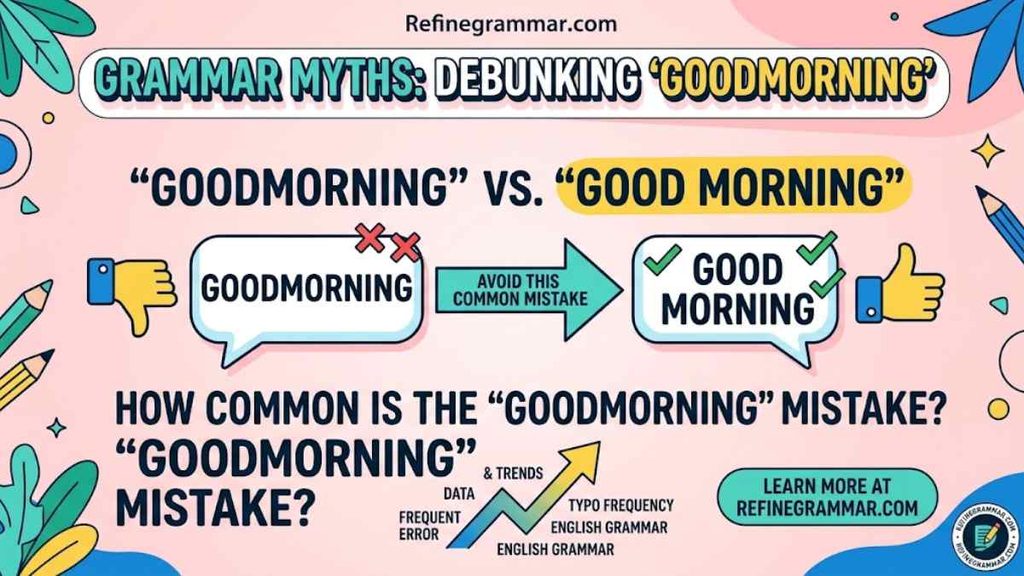
Grammar tools and writing-assistant data consistently flag “goodmorning” as one of the more frequent greeting errors in casual digital writing, particularly in text messages and social captions rather than formal documents. The mistake shows up far less often in edited or professionally reviewed writing, which suggests awareness, not vocabulary, is the real gap.
Learn More: Of Course or Ofcourse: The Correct Spelling Explained
How to Remember the Correct Spelling Easily
Simple Rule
If you wouldn’t merge the words in “good afternoon” or “good evening,” don’t merge them in “good morning” either.
Memory Trick
Picture the phrase as two separate items on a shopping list: “good” and “morning.” They’re never packaged together.
Read It Naturally
Say the phrase slowly. You’ll naturally pause between “good” and “morning” that pause is your reminder to keep the space.
Learn More: Tying vs Tieing: Correct Spelling & Easy Rule to Remember
Use Grammar Checking Tools
A quick pass through a grammar checker before sending an email will catch this instantly if it slips through.
Step-by-Step Guide to Using “Good Morning” Correctly
Step 1: Keep the words separate. Always write “good” and “morning” as two words.
Step 2: Add proper punctuation. Use a comma before a name: “Good morning, Alex.”
Step 3: Match the tone. Choose a formal or casual version depending on your audience.
Step 4: Proofread before sending. A five-second check prevents an easy, avoidable mistake.
Mini Quiz: Goodmorning or Good Morning
Test yourself with a few quick prompts:
- Which is correct: “Goodmorning class” or “Good morning class”?
- True or false: “Goodnight” and “goodmorning” follow the same spelling rule.
- Fix this sentence: “Good Morning, hope you’re well.”
- Is a comma needed in “Good morning Sarah”?
Answers: 1. Good morning class 2. False 3. Good morning, hope you’re well. 4. Yes, “Good morning, Sarah.”
Frequently Asked Questions
Is it spelled goodmorning or good morning?
It’s always “good morning,” written as two words.
What is a better greeting than “good morning”?
“Hi” or “hello” work well for casual settings; “good morning” suits more polite or professional contexts.
Is it “good afternoon” or “goodafternoon”?
“Good afternoon” always two words, following the same rule as “good morning.”
What is the correct way of writing “good morning”?
Two separate words, capitalized only at the start of a sentence or greeting.
How do you say good morning in a classy way?
Try “Good morning, I hope your day is off to a great start” for a warmer, more polished tone.
What is the proper punctuation for “good morning”?
Add a comma before a name or before the rest of the sentence: “Good morning, team.”
Is “goodmorning” a single word?
No. It’s not recognized as a standard word in English dictionaries.
Is “goodmorning” one word or two?
It should always be written as two words: good morning.
Should “goodmorning” be one word?
No treat it the same way as “good afternoon” and “good evening.”
Which is correct: “good morning” or “goodmorning”?
“Good morning” is the only correct, dictionary-recognized spelling.
Final Thought
The good morning or good morning debate really comes down to one simple habit: keep the two words apart. Once you notice the pattern in “good afternoon” and “good evening,” “good morning” stops feeling like a puzzle. A small fix like this makes your writing look sharper, whether it’s a quick text or a client email.
