
Quick Answer
“Of course” is the correct spelling. It is always written as two separate words. “Ofcourse” is a commWhy Do People Write Ofcourse Instead of Of Courseon misspelling that merges the preposition “of” with the noun “course,” and it does not appear in any standard English dictionary. If you remember one rule from this guide, remember this: the of course or ofcourse question isn’t really a debate “of course” wins every time.
What Does “Of Course” Mean?
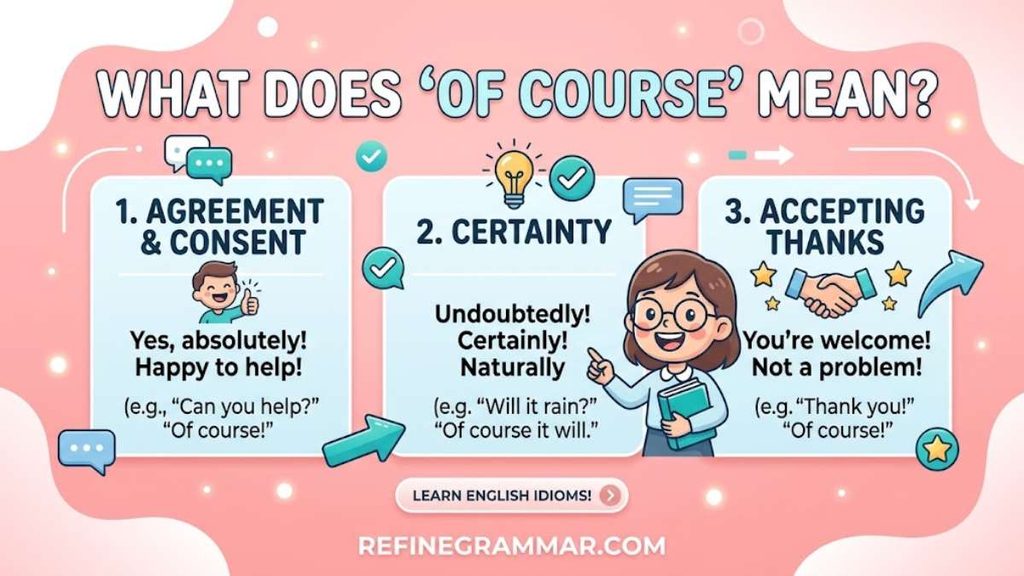
Correct Meaning of “Of Course”
“Of course” is an adverbial phrase used to express certainty, agreement, or something obvious or expected. It can mean “certainly,” “naturally,” or “as expected,” depending on context. Native speakers use it constantly in speech and writing, which is exactly why the of course or ofcourse mix-up happens so often the phrase is so familiar that people start typing it on autopilot.
Examples of “Of Course” in Sentences
● Of course, I’ll help you move this weekend.
● She knew, of course, that the meeting had been rescheduled.
● “Can I borrow your charger?” “Of course!”
● Of course, the traffic was terrible on a Friday afternoon.
Is “Ofcourse” a Real Word?
No. “Ofcourse” is not a word recognized by Merriam-Webster, Cambridge Dictionary, or Oxford Learner’s Dictionaries. It is simply “of” and “course” written without the necessary space, and treating it as one word is always incorrect, in both formal and informal writing.
Why Do People Write “Ofcourse” Instead of “Of Course”?
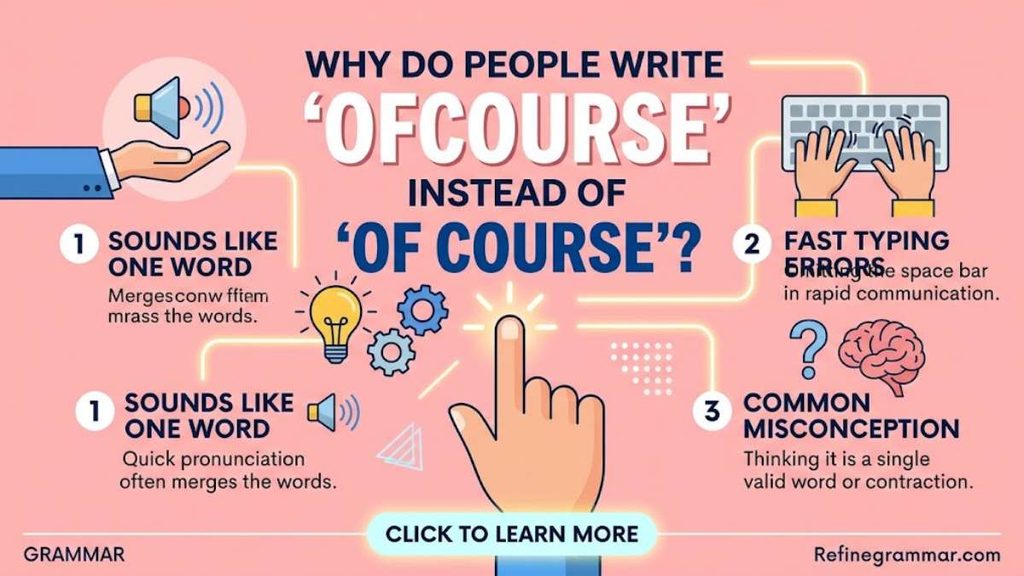
Common Reasons Behind the Mistake
● Speech habits: In fast speech, “of course” often blends together, so it can sound like a single word.
● Autocorrect and typing speed: Quick typing on mobile keyboards often drops the space between short words.
● Confusion with compound words: some writers assume every frequent phrase eventually merges into one word a bit like the confusion around transferred vs transfered, where one extra letter changes the whole spelling.
● Copying informal writing: text messages and social captions are full of the error, and readers absorb it without noticing.
● Muscle memory from similar errors: the same instinct that produces “ofcourse” also produces slips like puting vs putting, where a missing letter breaks a spelling rule.
Of Course vs Ofcourse: Key Difference
| Feature | Of Course | Ofcourse | Notes |
| Word count | Two words | One word (incorrect) | Never merge the two |
| Dictionary status | Valid, standard English | Not recognized | Confirmed by major dictionaries |
| Grammar role | Adverbial phrase | No grammatical role | Functions as a sentence adverb |
| Formal writing | Always acceptable | Always an error | Applies to emails, essays, articles |
| Common context | Speech, emails, articles | Typos, texting | Rushed writing is the main culprit |
Quick Rule to Remember
If you can pause between the two parts and it still makes sense “of… course” you’re dealing with a phrase, not a compound word. Phrases built from a preposition plus a noun, like “of course,” are written separately in English.
How to Use “Of Course” Correctly in Sentences
“Of Course” at the Beginning of a Sentence
Place a comma right after it: “Of course, we can reschedule the call.”
“Of Course” in the Middle of a Sentence
Set it off with commas on both sides: “He knew, of course, that the deadline had passed.”
“Of Course” as a Complete Response
It can stand alone, often with an exclamation point, to answer a request or question: “Of course!”
Real-Life Example: How a Small Grammar Mistake Affected a Blog
A freelance writer once submitted a client blog post where “ofcourse” appeared six times. The editor flagged every instance, and the client asked whether the writer had used AI without checking the output. The post had to be revised before publishing, which delayed payment and cost the writer future assignments. One small, repeated spelling error was enough to make the client question the writer’s overall quality — a reminder that the of course or ofcourse distinction is not just academic; it affects how professional your writing looks.
Grammar Rule Behind “Of Course”
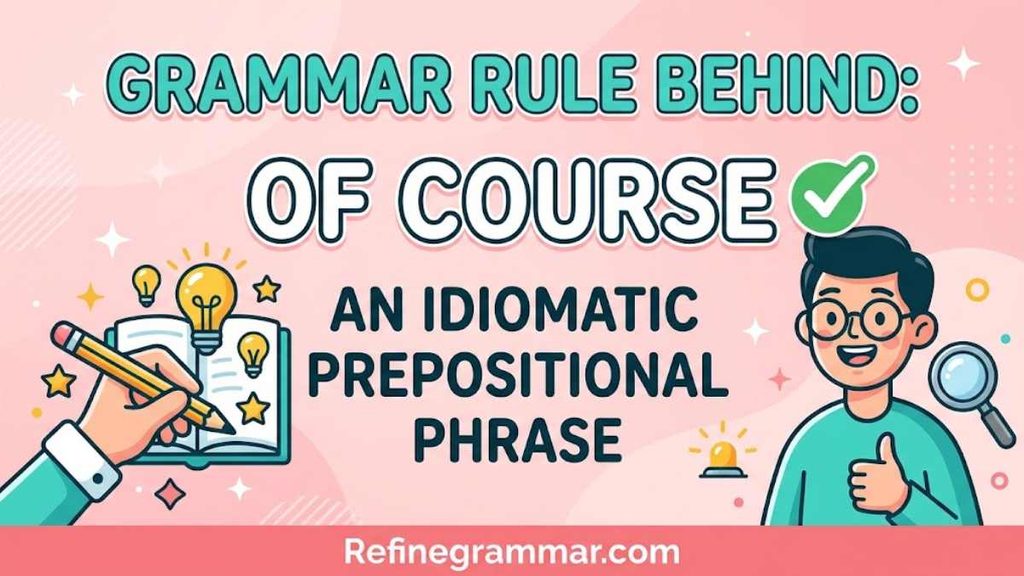
Why It Is Not a Compound Word
English compounds usually form when two words are used together so often that they fuse, like “however” or “notebook.” “Of course” has resisted this because “of” is a preposition, and prepositional phrases in English typically don’t compound. The same logic applies to ordinal spelling errors like nineth or ninth familiarity with a word doesn’t change the rule that governs its correct form.
Similar Two-Word Expressions
Several phrases suffer from the same “should this be one word or two?” confusion:
Learning the pattern behind one of these makes it much easier to spot the others.
SEO and Writing Importance of Correct Spelling
2025–2026 Content Quality Trends
Search engines increasingly reward content that reads as carefully written and expert-reviewed. Spelling slips like “ofcourse” can hurt readability scores, raise bounce rates, and signal low editorial quality to readers and algorithms alike. Just as writers now double-check weather vs whether vs wether before publishing, checking “of course” should be part of every content quality checklist.
Why Bloggers Should Avoid “Ofcourse”
● It undermines trust and authority, two pillars search engines evaluate closely.
● It can trigger grammar-checker flags that lower a page’s perceived quality.
● It looks careless next to other common slip-ups, such as writing vender instead of vendor.
● It distracts readers from your actual message.
Easy Tricks to Remember the Correct Form
Think of It as a Phrase
Treat “of course” the same way you’d treat “in fact” or “at least” nobody merges those into one word, and “of course” deserves the same treatment.
Read It Slowly
Sound out “of” and “course” separately in your head before you type. The pause almost always reminds you to add the space.
Use Grammar Tools
Spell-checkers and grammar assistants catch this error instantly. They’re just as useful for flagging less obvious mix-ups, like tried or tryed, where a small error can slip past a quick read-through.
Common Mistakes People Make
Writing “Ofcourse” in Formal Emails
Business emails with “ofcourse” can make the sender look rushed or inattentive to detail, even when the message itself is professional.
Using It in Academic Writing
Instructors and reviewers often treat “ofcourse” as a basic spelling error, which can lower the overall credibility of an otherwise strong paper.
Copying Informal Internet Usage
Casual platforms are full of the misspelling, and writers who read a lot of unedited online content sometimes absorb it without realizing it isn’t standard English.
Mini Quiz: Of Course or Ofcourse?
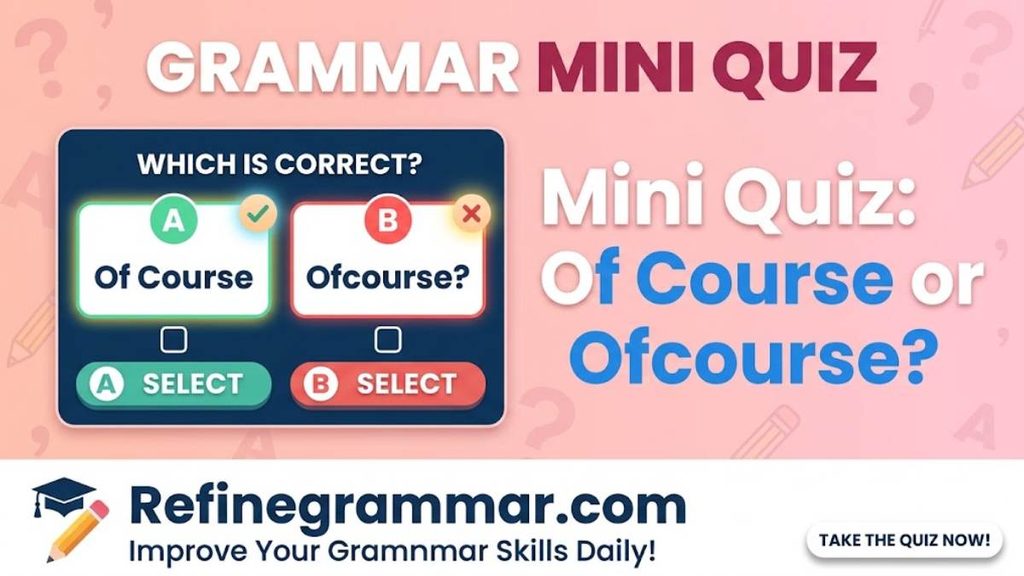
1. Which spelling is correct?
a) Ofcourse b) Of course — Answer: b
2. Fill in the blank:
“___, I’d love to join you for dinner.” — Answer: Of course
3. True or False?
“Ofcourse” appears in Merriam-Webster. — Answer: False
4. Which one should you avoid in professional writing?
Answer: Ofcourse
5. Complete the sentence:
“She agreed, ___, without any hesitation.” — Answer: of course
6. Which phrase is grammatically correct?
“Of course you can” or “Ofcourse you can” — Answer: Of course you can
7. Quick Check!
Is “of course” one word or two? — Answer: Two words, always.
People Also Search For
of course or ofcourse meaning
of course meaning
of course or ofcourse reddit
of course or ofcourse grammar
of course or ofcourse examples
yes of course meaning
of course or ofcourse spelling
of course synonyms
FAQs
1. What does it mean when someone says “but of course”?
It’s an emphatic way of saying “obviously” or “naturally,” often used for polite or dramatic effect.
2. Does “of course” always mean yes?
Usually yes, but it can also simply confirm something is expected or well known, not just grant permission.
3. What else can I say instead of “of course”?
Alternatives include “certainly,” “absolutely,” “naturally,” and “without a doubt.”
4. Is it polite to say “of course”?
Yes, it’s generally seen as warm and accommodating, especially when responding to a request.
5. Can you start a sentence with “of course”?
Yes, followed by a comma, as in “Of course, I’ll be there.”
6. How do Brits say “of course”?
The same phrase is standard in British English, sometimes shortened informally to “‘course.”
7. How do you say “of course” in slang?
Casual variants include “sure thing,” “for sure,” and “‘course.”
8. Is “yes of course” or “of course yes” correct?
“Yes, of course” is the natural word order; “of course yes” sounds unnatural in standard English.
9. Is “yes of course” grammatically correct?
Yes, when punctuated as “Yes, of course,” it is grammatically correct and commonly used.
10. How do you say “of course” in a nice way?
Try “Absolutely, happy to help” or “Of course, no problem at all” for a warmer tone.
Conclusion
The of course or ofcourse question has one clear answer: “of course” is correct, and “ofcourse” is a spelling error to avoid in every context, from texting to academic writing. Keep the two words separated, use the tricks above to build the habit, and your writing will look sharper and more professional every time.
