
Quick Answer: Is It To Bad or Too Bad?
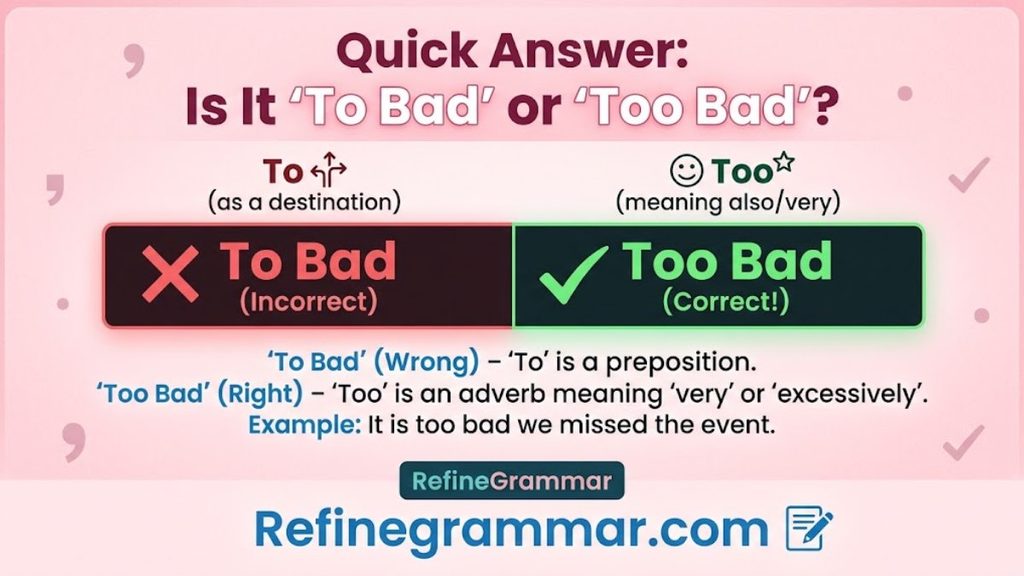
Too bad is the correct phrase. To bad is a misspelling that shows up because to and too are homophones they sound identical but serve completely different grammatical jobs in a sentence. Whenever you mean unfortunate, regrettable, or excessively bad, the correct spelling always uses two O’s: too.
To is a preposition or an infinitive marker it points toward a destination, a verb, or an object, as in going to the store or to understand. Too, on the other hand, is an adverb meaning also or excessively. Since bad is an adjective being intensified in this phrase, only too fits the grammar. To bad is never correct, in any context, no matter how the sentence is phrased.
Why Too Bad Is Grammatically Correct
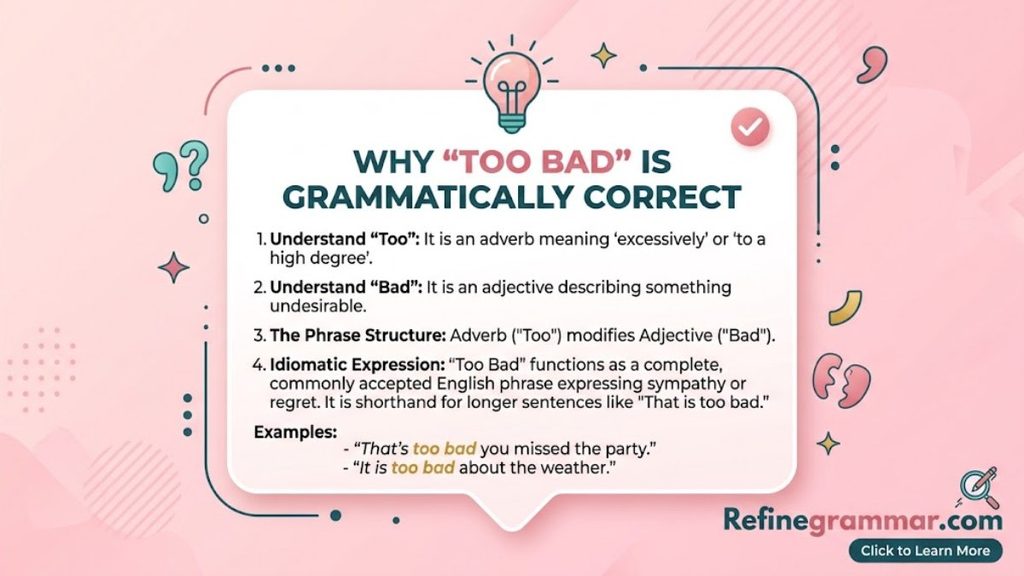
The Core Grammar Rule
The easiest way to keep to and too straight is to remember what job each word does in a sentence:
- To connects to a destination, a verb, or an object to the party, to run, to understand.
- Too modifies an adjective or adverb to mean excessively or as well too cold, too fast, me too.
Breaking Down Too Bad
In the phrase too bad, the word bad is an adjective, and too is intensifying it meaning extremely unfortunate or regrettable. There’s no destination, recipient, or verb involved, so to simply has no job to do here. This is the exact same pattern that governs too much, too far, and too late. If you already write those three correctly, you already understand why too bad needs two O’s as well.
The Three Meanings of Too Bad
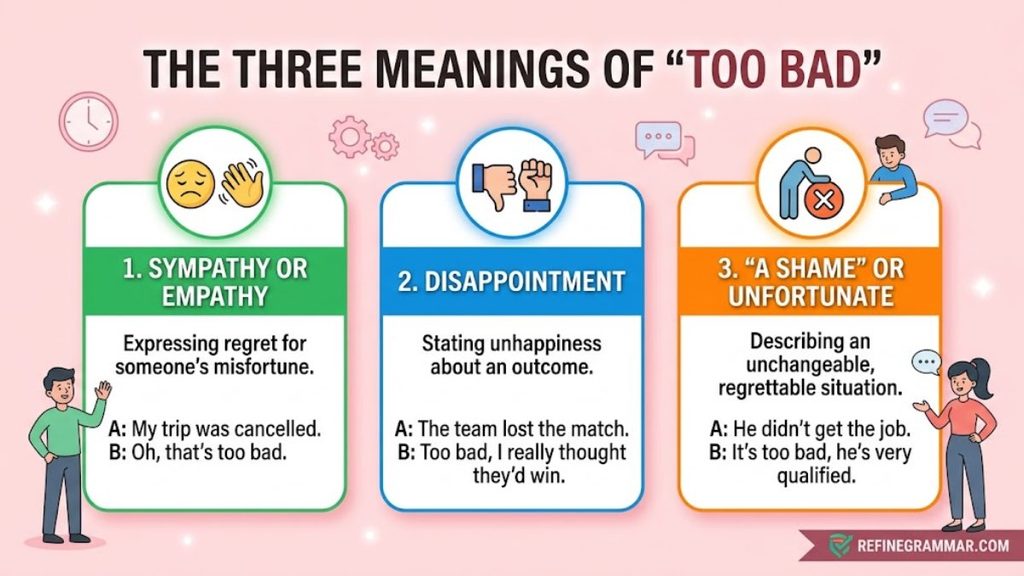
Too bad isn’t a single, flat expression depending on tone and context, it can carry a few different shades of meaning.
1. Sincere sympathy. Used to express genuine regret about a situation: Too bad you couldn’t make it to the wedding.
2. Plain disappointment. Used when something doesn’t go as hoped, often with a note of resignation: It’s too bad the store was already closed.
3. Dismissive indifference (informal). In casual speech, too bad can flip to sound almost unsympathetic: You don’t like the plan? Too bad, we’re doing it anyway.
Tone and context not spelling determine which of these three meanings applies in a given sentence.
Too Bad vs To Bad: Side-by-Side Comparison
| Phrase | Correct? | Function | Example |
| Too bad | Yes | Adverb + adjective | Too bad you missed it. |
| To bad | No | Not a valid structure | To bad you missed it. |
| Too damn bad | Yes (informal) | Intensified version | Too damn bad, we’re leaving. |
| Not too bad | Yes | Idiom meaning fairly good | The food wasn’t too bad. |
| Not to bad | No | Common typo of the above | The food wasn’t to bad. |
Real Examples: Correct vs Incorrect Usage
Correct examples
If you’ve ever typed that’s to bad in a text message, hit send, and then paused wondering if something looked off, you’ve run into one of the most common spelling mix-ups in everyday English. The to bad vs too bad confusion trips up native speakers and language learners alike, mostly because the two words sound completely identical when spoken out loud.
This guide breaks down exactly which spelling is correct, why the mistake happens so often, which meaning too bad carries in different situations, and how to stop second-guessing yourself every time you type it.
- Too bad the concert got cancelled.
- That’s too bad I hope you feel better soon.
- It’s too bad we couldn’t agree on a time.
- Not too bad for a first attempt.
Incorrect examples to avoid
- To bad about the weather.
- That’s to bad, honestly.
- Not to bad, considering.
- It’s to bad you feel that way.
Memory Tricks That Make This Mistake Disappear
1. The Extra O Rule
Think of the extra o in too as standing in for extra or excessive. More letters, more intensity too always adds emphasis, which is exactly what it’s doing to bad in this phrase.
2. The Replacement Test
Swap in also or excessively. If the sentence still makes sense, you need too. That’s too [excessively] bad works fine That’s to [also] bad clearly does not.
3. The Direction Test
Ask whether the word is pointing toward something a place, a person, an action. If yes, use to. If you’re instead measuring degree or intensity, use too. Bad has no direction to point toward, so too wins every time.
Common Phrases Built Around Too Bad
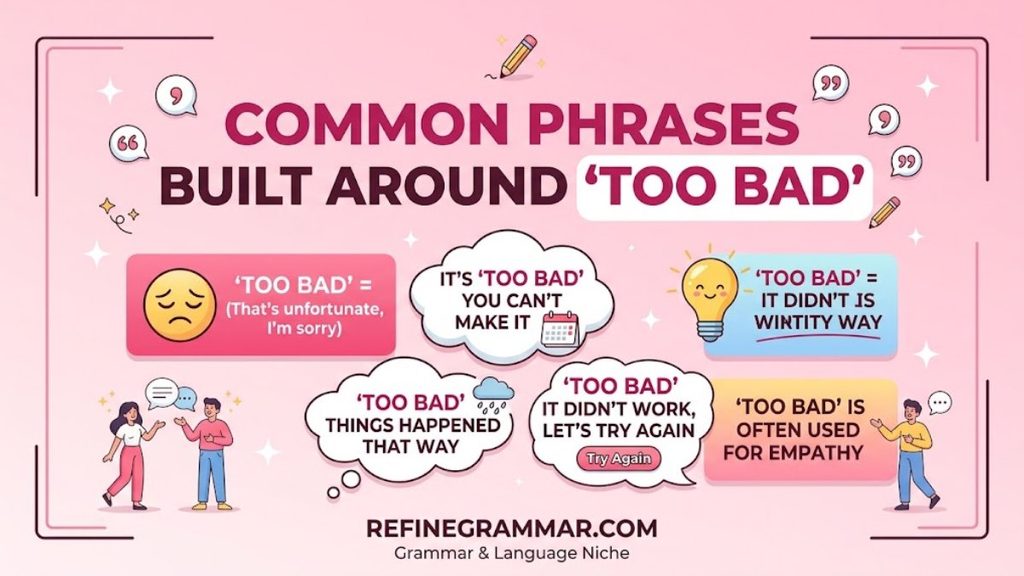
- Too bad, so sad a rhyming, more sarcastic version used when someone shows little sympathy for another person’s problem.
- That’s too bad a gentler, more sincere way of expressing sympathy in response to bad news.
- It’s too bad that… used to introduce a specific regret: It’s too bad that we ran out of time.
- Too bad to… used before a verb to describe something so unfortunate it prevents another action: The roads were too bad to drive on.
Why People Keep Making This Mistake
The confusion almost always comes down to homophones. To and too sound exactly the same when spoken, so the error tends to surface in writing, texting, and typing rather than in speech itself.
Autocorrect doesn’t reliably catch it either, since both words are spelled correctly on their own the mistake is about which word fits the sentence, not spelling accuracy. A spellchecker has no way to know whether you meant also/excessively or toward a destination, so the responsibility falls on the writer, not the tool.
Other To vs Too Mix-Ups to Watch For
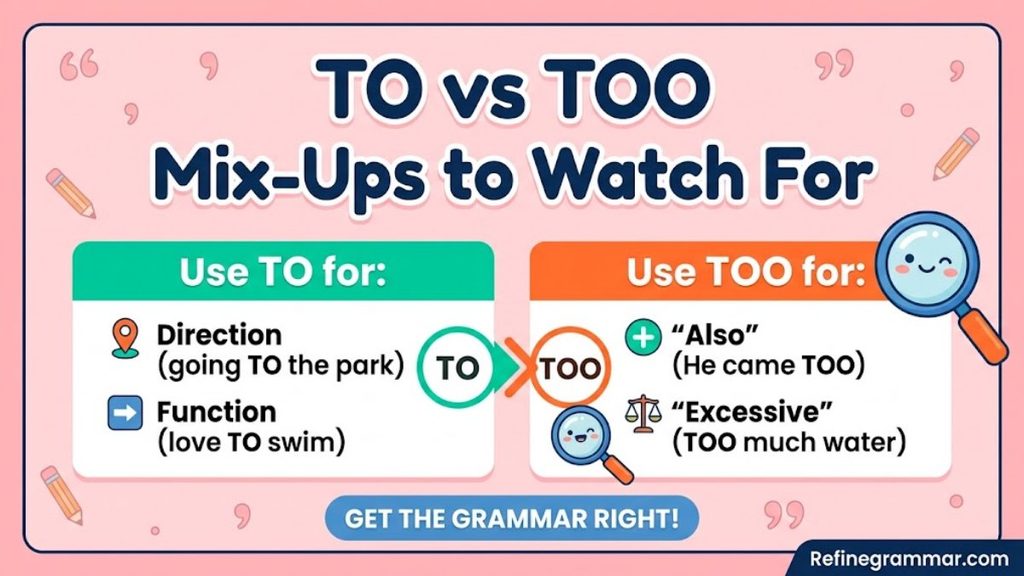
This isn’t an isolated case. The same to/too confusion shows up constantly in other common phrases:
- Too much vs to much
- Too late vs to late
- Too far vs to far
- Too many vs to many
In every one of these pairs, the same pattern holds: if the word is modifying an adjective or adverb to show excess, it’s too. If it’s pointing toward a destination, recipient, or action, it’s to. Learning the rule once means you never have to relearn it for a new phrase.
What Grammar Resources Say
Major dictionaries and style guides consistently draw the same line: to functions as a preposition or infinitive marker, while too is an adverb of degree meaning excessively or as well. Reference dictionaries typically list too bad as a set, idiomatic expression used to convey regret or mild sympathy, which reinforces that it’s a fixed phrase rather than a literal description.
Language educators also flag the to/too mix-up as one of the most frequent homophone errors in English writing, and most recommend the also/excessively substitution test as the fastest way to check which spelling belongs in a sentence.
Tips for Avoiding the To Bad Mistake for Good
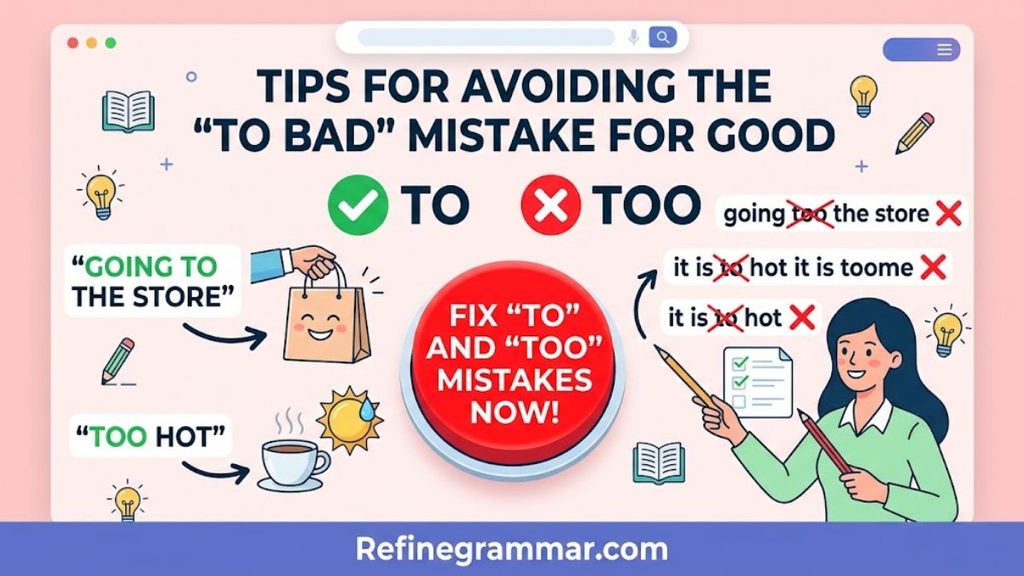
- Read your sentence back and ask whether also fits, or whether you’re describing excess if either applies, use too.
- When typing quickly, do a final scan for to sitting right before an adjective that combination is almost always the giveaway.
- Practice with common phrases like too bad, too much, and too far until the pattern becomes automatic.
- Don’t rely solely on spellcheck it won’t flag this error, since both to and too are valid words on their own.
- Say the sentence out loud and picture the spelling visual memory often catches what the ear misses.
Frequently Asked Questions
Which is correct to bad or too bad?
Too bad is correct. It uses too as an adverb meaning excessively, the only grammatically valid option before the adjective bad.
How do I use too bad in a sentence?
Use it to express regret or sympathy, as in Too bad you couldn’t join us for dinner, or dismissively, as in Too bad the decision’s already made.
What does too bad actually mean?
It generally means unfortunate or regrettable, though in casual speech it can also convey indifference toward someone else’s complaint.
Is it it’s too bad or it’s to bad?
It’s too bad is correct. It’s to bad is a common misspelling caused by to and too sounding identical when spoken.
Is not too bad correct, or should it be not to bad?
Not too bad is correct. It’s an idiom meaning something is actually fairly good, and it follows the same rule as too bad.
Is saying too bad considered rude?
It depends on tone. Said sincerely, it expresses sympathy; said flatly or dismissively, it can come across as indifferent.
Final Thoughts
Too bad is always the correct spelling to bad is never grammatically valid, no matter the context or the sentence around it. The mix-up happens because the two words sound identical, not because the underlying rule is complicated. Once the also/excessively replacement test becomes second nature, you’ll never second-guess too bad again.
