
Transferred vs Transfered is one of the most searched spelling confusions in English, especially among people writing emails, reports, invoices, or social captions. If you’ve ever paused mid-sentence wondering whether to add one r or two, you’re not alone. This guide breaks down the difference in Transferred vs Transfered clearly, with rules, examples, tables, and a quick practice test, so you never second-guess this word again.
Which Is Correct?
This is the central question behind every Transferred vs Transfered search: between transferred and transfered, only transferred is correct. The word transfer becomes transferred by doubling the final r before adding -ed, following a standard English spelling rule for stressed final syllables. Transfered, without the double r, is a spelling error and should never appear in professional or academic writing.
Key Points
- Transferred is the correct past tense and past participle of “transfer.”
- Transfered has no basis in standard English spelling rules.
- The rule applies equally in American and British English.
- Major dictionaries list only transferred, never transfered.
Quick Comparison Table
| Spelling | Status | Example |
| transferred | Correct | The funds were transferred yesterday. |
| transfered | Incorrect | The funds were transfered yesterday. |
Why “Transferred” Has Double
The double r at the heart of Transferred vs Transfered comes from a simple stress rule. English doubles a final consonant when a short verb ends in a single vowel followed by a single consonant, and the stress falls on that final syllable. Transfer follows this exact pattern: it ends in -fer, the stress lands on “fer,” so the r doubles before -ed or -ing. The same stress-based logic explains why some writers also mix up tried or tryed, even though that pair follows a slightly different spelling rule.
Key Points
- The rule is called consonant doubling.
- It applies when stress falls on the last syllable.
- Transfer becomes transferred, prefer becomes preferred, refer becomes referred.
- Words stressed on the first syllable, like offer, do not double the consonant.
Rule Breakdown Table
| Base Word | Stress | Past Tense |
| transfer | Final syllable (fer) | transferred |
| offer | First syllable (of) | offered |
| refer | Final syllable (fer) | referred |
| enter | First syllable (en) | entered |
Why “Transfered” Is a Common Mistake
Transfered is a widespread typo that keeps the Transferred vs Transfered debate alive. Pronunciation doesn’t clearly signal the double r, so many writers instinctively assume adding -ed is enough on its own. Autocorrect tools occasionally miss it during fast typing, and non-native English speakers often apply simpler patterns that skip the doubling step. The confusion is similar to how people mix up weather vs whether or write vendor as vender instead of vendor.
Key Points
- Silent stress patterns hide the doubling rule.
- Fast typing and autocorrect gaps let the error slip through.
- Non-native speakers often apply simplified spelling logic.
- The mistake shows up often in emails, invoices, and social posts.
Common Confusion Table
| Cause | Result |
| Pronunciation doesn’t reveal stress | Writers assume one r is enough |
| Autocorrect inconsistency | The error passes unnoticed |
| Similar short words | The wrong pattern gets applied |
Transferred vs Transfered Difference
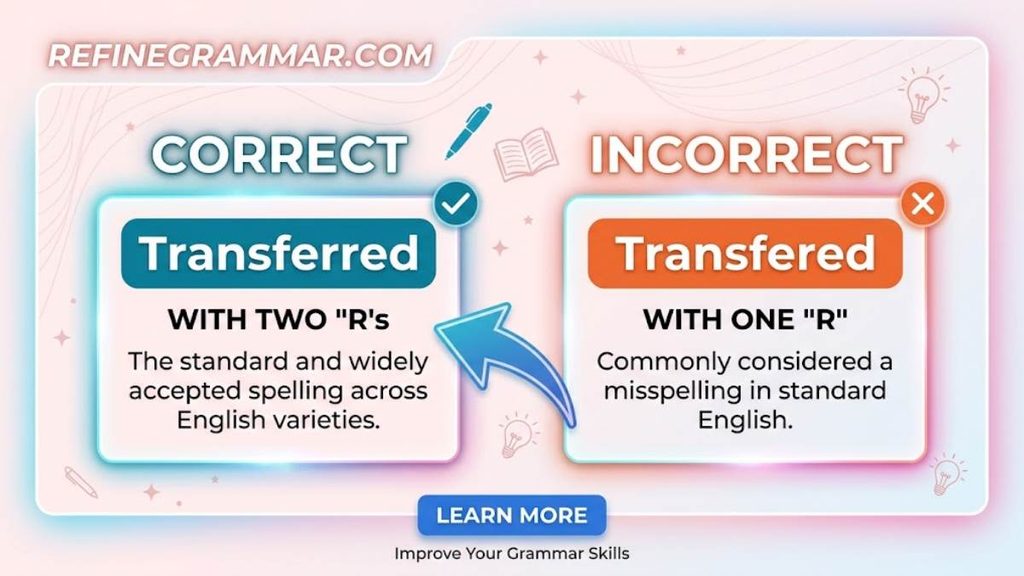
The core difference in Transferred vs Transfered comes down to spelling accuracy, not meaning both would refer to the same action of moving something from one place, person, or account to another. Only one version, transferred, is grammatically valid. Transfered carries no separate meaning of its own; it is simply an incorrect rendering of the same word.
Key Points
- Meaning is identical; only spelling differs.
- Transferred is standard; transfered is nonstandard.
- Style guides, dictionaries, and grammar checkers accept only transferred.
- Using transfered in formal writing can affect credibility.
Side by Side Table
| Feature | Transferred | Transfered |
| Correct spelling | Yes | No |
| Found in dictionaries | Yes | No |
| Accepted in formal writing | Yes | No |
| Common typo | No | Yes |
Transferred Meaning in Real Context
Understanding Transferred vs Transfered starts with meaning, not just spelling. Transferred describes the act of moving something money, data, a person, or a responsibility from one place or party to another. It is the past tense and past participle of transfer, so it fits sentences describing a completed action or a passive event, such as “the patient was transferred” or “ownership was transferred.”
Key Points
- Refers to the movement of money, data, people, or responsibility.
- Works as a completed action (she transferred her files) or a passive form (the files were transferred).
- Common in banking, HR, healthcare, education, and sports writing.
- Always spelled with a double r, regardless of context.
Meaning Table by Context
| Context | Example Sentence |
| Banking | She transferred $500 to her savings account. |
| Employment | He was transferred to the London office. |
| Education | Her school records were transferred electronically. |
| Sports | The midfielder transferred to a new club this season. |
Transferred Money: Correct Spelling and Usage
Money-related searches for Transferred vs Transfered are especially common because banking apps, invoices, and payment confirmations use this word constantly. Whether you’re describing a bank transfer, a digital wallet payment, or an international remittance, the spelling never changes: it is always transferred, never transfered, no matter which currency, platform, or country is involved.
Key Points
- Banking and finance writing must use transferred, not transfered.
- The spelling stays the same across wire transfers, mobile payments, and crypto transactions.
- Invoices and receipts with transfered can look unprofessional to clients.
- Grammar checkers flag transfered automatically in financial documents.
Financial Usage Table
| Transaction Type | Example |
| Bank transfer | The payment was transferred within minutes. |
| Salary | Her salary is transferred on the 1st of each month. |
| International remittance | Funds were transferred overseas through a wire service. |
Examples of Transferred in Sentences
Seeing these Transferred vs Transfered examples used naturally across different situations makes the spelling easier to remember, much like a phrase such as in person vs in-person needs context to make sense.
Key Points
- Works in active voice: I transferred the file.
- Works in passive voice: the file was transferred.
- Appears with helping verbs like has, have, had, was, and were.
- Never drops the second r in any sentence form.
Sentence Comparison Table
| Correct | Incorrect |
| The team transferred the player in July. | The team transfered the player in July. |
| My call was transferred to another agent. | My call was transfered to another agent. |
| We have transferred all the records. | We have transfered all the records. |
Transfer Verb Forms Explained
Every verb form in the Transferred vs Transfered discussion keeps the double r once the base word changes tense. The base verb is transfer, the present participle is transferring, and both the past tense and past participle are transferred there is no separate spelling for each.
Key Points
- Base form: transfer
- s form: transfers
- ing form: transferring
- Past tense and past participle: transferred
Verb Forms Table
| Form | Word |
| Base | transfer |
| -s form | transfers |
| -ing form | transferring |
| Past tense | transferred |
| Past participle | transferred |
Transferred vs Transferring
Transferred vs Transferring is a separate question from Transferred vs Transfered, but the two often get mixed up. Transferred describes a completed action in the past or a passive state, while transferring describes an action still in progress, as in “the system is transferring the files right now.”
Key Points
- Transferred = past tense or past participle (completed action).
- Transferring = present participle (ongoing action).
- Both keep the doubled r from the base spelling rule.
- Mixing up the two changes the tense, not just the spelling.
Comparison Table
| Word | Tense | Example |
| Transferred | Past | The funds were transferred yesterday. |
| Transferring | Present continuous | The bank is transferring the funds now. |
UK vs US Is There Any Difference?
The Transferred vs Transfered rule doesn’t change between UK and US English. Unlike words that shift spelling across the Atlantic, such as enrolment or enrollment, transferred stays exactly the same everywhere. Both UK and US dictionaries list only the double-r spelling, with no regional variation.
Key Points
- No spelling difference between UK and US English.
- Both regions require the doubled r.
- Style guides in both countries reject transfered.
- The word behaves the same in formal and informal writing everywhere.
Regional Comparison Table
| Region | Accepted Spelling |
| United Kingdom | transferred |
| United States | transferred |
| Canada | transferred |
| Australia | transferred |
Transferred or Transfered in Australian English
Australian English answers the Transferred vs Transfered question the same way the UK does. Australian English generally follows British spelling conventions, and transferred is no exception Australian dictionaries, style guides, and news outlets all use the double-r spelling.
Key Points
- Australian English follows the British spelling of transferred.
- No local variant or shortened form exists.
- Government, banking, and media writing in Australia use transferred consistently.
- Transfered remains incorrect in Australian English as well.
Australian Usage Table
| Country | Spelling Style | Word Used |
| Australia | British-based | transferred |
| United Kingdom | British | transferred |
| United States | American | transferred |
Transferred Pronunciation Guide
Pronunciation is actually a shortcut for solving Transferred vs Transfered for good. Transferred is pronounced trans-FURD, with the stress on the second syllable the same stress pattern that causes the consonant to double in the first place. Saying it aloud can help you remember the spelling, since the stressed “fur” sound is exactly where that extra r belongs.
Key Points
- Pronounced trans-FURD.
- Stress falls on the second syllable, not the first.
- The stressed syllable is exactly where the double r appears.
- Saying it slowly reinforces the correct spelling.
Pronunciation Table
| Word | Syllables | Stress |
| Transfer (noun) | TRANS-fer | First syllable |
| Transfer (verb) | trans-FER | Second syllable |
| Transferred | trans-FURD | Second syllable |
Common Mistakes Similar to “Transfered”
Transfered isn’t the only word that trips people up with doubling or irregular spelling. Similar confusion shows up in pairs like feen or fein, you too or you to, and sitted or seated, where writers guess instead of applying the underlying rule.
Key Points
- Consonant-doubling mistakes cluster around stressed final syllables.
- Homophone-style confusion has different roots but a similar impact on writing.
- Irregular verbs create separate spelling traps of their own.
- Reading example sentences helps more than memorizing rules alone.
Similar Words Table
| Correct | Common Mistake |
| Transferred | Transfered |
| Preferred | Prefered |
| Occurred | Occured |
| Referred | Refered |
How to Remember the Correct Spelling
This memory trick settles Transferred vs Transfered every time you hesitate: whenever stress lands hard on the final syllable, double the last consonant before adding -ed. Say “transFERRED” out loud, emphasize the “FER,” and picture two r’s holding that stress in place.
Key Points
- Stress the second syllable out loud before writing the word.
- Compare it to preferred and referred, which follow the same pattern.
- Run it through a grammar checker if you’re unsure.
- Practice with real sentences instead of memorizing rules in isolation.
Memory Trick Table
| Trick | How It Helps |
| Say it with stress | Reveals where the double r belongs |
| Compare to preferred / referred | Confirms the same doubling rule |
| Write it in a full sentence | Builds lasting muscle memory |
Transferred Synonyms and Usage
When transferred feels repetitive in a piece of writing, several synonyms can express the same idea. Words like relocated, transmitted, reassigned, and conveyed work well depending on whether you’re describing people, data, or money similar to how choosing between vendor or vender depends on context and audience.
Key Points
- Common synonyms: relocated, reassigned, conveyed, transmitted, shifted.
- Choose a synonym based on context people, money, or data.
- Synonyms don’t change the spelling rule for transferred itself.
- Varying vocabulary improves readability in longer documents.
Synonym Table
| Context | Synonym for Transferred |
| People | Relocated, reassigned |
| Money | Remitted, sent |
| Data | Transmitted, migrated |
| Ownership | Conveyed, ceded |
Why Transfered Is Always Incorrect
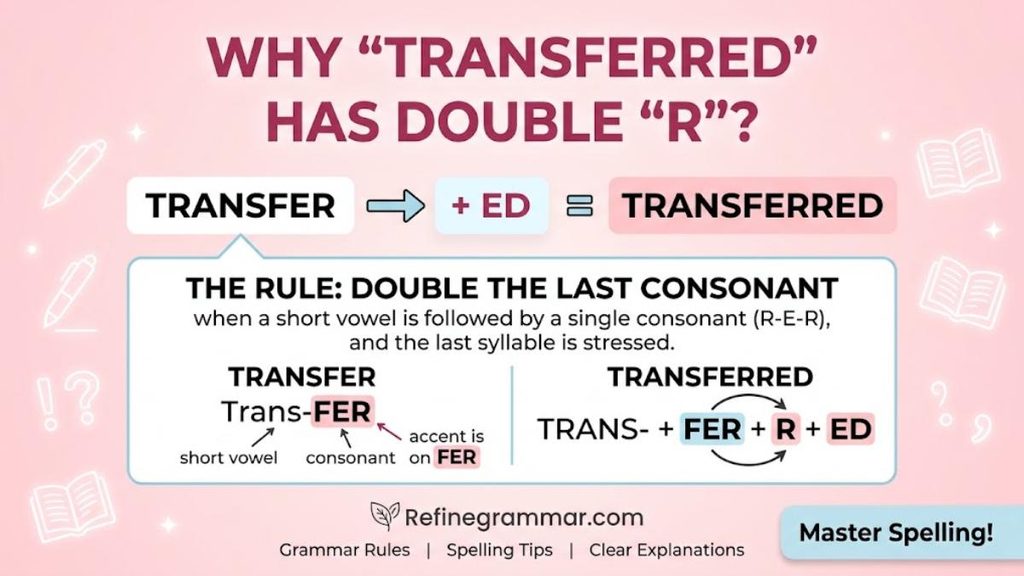
There is no context where the Transferred vs Transfered debate favors transfered. It violates the basic consonant-doubling rule that governs transfer and dozens of similar verbs, and no major dictionary American, British, or Australian lists it as an alternate spelling.
Key Points
- Transfered fails the consonant-doubling rule outright.
- No dictionary recognizes it as a variant spelling.
- Grammar and spell-check tools flag it as an error.
- It has no separate meaning; it is purely a mistake.
Rule Violation Table
| Rule | Transferred | Transfered |
| Doubles final r | Yes | No |
| Matches stress pattern | Yes | No |
| Dictionary-listed | Yes | No |
Practice Exercise
Test what you’ve learned about Transferred vs Transfered with these quick exercises.
A. Fill in the Blanks
1. The funds were ______ (transfer) to the wrong account.
2. She has ______ (transfer) schools twice this year.
3. The system is currently ______ (transfer) the files.
B. Multiple Choice Questions
4. Which spelling is correct?
a) Transfered b) Transferred c) Transferd
5. Which sentence is correct?
a) He transfered the call. b) He transferred the call.
C. True or False
6. Transfered is accepted in British English.
7. Transferred is the past participle of transfer.
D. Sentence Correction
8. “The money was transfered yesterday.”
9. “She is transfering the documents.”
E. Short Answer Questions
10.Why does transfer double its final r before -ed?
11.Name one synonym for transferred.
Key Points
- Practicing with real sentences cements the spelling rule.
- Errors usually involve a missing second r or the wrong verb form.
- Revisit the doubling rule any time you hesitate.
FAQs
Is “transferred” or “transfered” the correct spelling?
Transferred is correct; transfered is a spelling mistake with no accepted use.
What does “transferred” mean?
It means something money, data, a person, or responsibility was moved from one place to another.
How do you use “transferred” in a sentence?
Use it for a completed action, such as “The funds were transferred on Monday.”
Is “transferred” spelled the same in UK and US English?
Yes, both use the identical double-r spelling with no regional variation.
Is “transferred” used the same way in Australian English?
Yes, Australian English follows the same British-based double-r spelling.
What is a synonym for “transferred”?
Common alternatives include relocated, reassigned, conveyed, and transmitted.
Is “transfered” ever considered correct in any context?
No, it’s always a spelling error, regardless of context or region.
How do you spell “transferred” when talking about money or payments?
The same way in every context: transferred, with two r’s.
Why does “transferred” have a double R?
Because English doubles the final consonant when stress falls on the last syllable of a short verb.
What is the difference between “transferred” and “transferring”?
Transferred describes a completed action; transferring describes an action in progress.
Conclusion
Getting Transferred vs Transfered right comes down to one simple rule: double the final r before adding -ed, because the stress falls on that last syllable. Transferred is the only correct spelling across US, UK, and Australian English, in every tense, context, and industry from banking to healthcare to sports. Keep this guide handy, and reference articles like too bad vs to bad whenever another tricky pair trips you up.
