
If you’ve ever hit send on a text or an email and then paused, wondering whether you typed the right word, you’re not alone. The “You Too or You To” mix-up is one of the most common small grammar slips in English, and it trips up native speakers just as often as learners. This guide breaks down exactly when to use each form, why the confusion happens in the first place, and how to get it right every single time with real examples, a comparison table, quizzes, and answers to the questions people ask most.
What Is the Difference Between “You Too” and “You To”?
Quick Answer
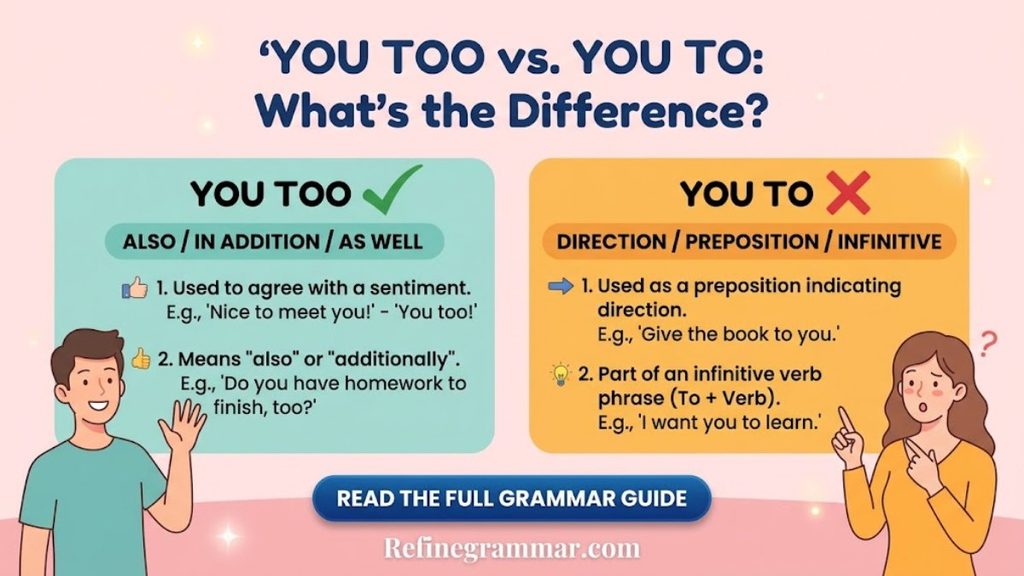
“You too” means “you also” or “the same goes for you” it’s the phrase you want after a compliment, a well-wish, or a shared statement. “You to” only shows up when “to” is working as a preposition or part of an infinitive verb attached to the word “you,” as in “I gave the assignment to you to finish.
” In almost every everyday reply, “You Too or You To” comes down to one simple test: are you agreeing or adding something? Then it’s “too.” Are you connecting an action or a destination? Then it’s “to.”
Examples:
- “Have a safe flight!” “You too!” (also/as well)
- “It’s up to you to decide.” (preposition + infinitive)
- “Good luck today.” “Thanks, you too.”
- “I left it to you to explain.” (action connecting to “you”)
Why “You Too” Is Usually Correct
Statistically, when people search “You Too or You To,” they almost always mean the version with the extra “o.” That’s because “too” as a response word meaning “also” appears far more often in daily conversation than “to you” constructions do.
Examples of “You Too”
- “Happy birthday!” “You too!”
- “Enjoy your weekend.” “You too, thanks!”
- “I really enjoyed that movie.” “Me too, and you too, right?”
- “Merry Christmas!” “Merry Christmas to you too.”
Why It Works
“Too” is an adverb that means “also” or “as well.” When someone offers you a wish, a compliment, or a shared feeling, “you too” simply returns the sentiment. It’s short, it’s polite, and it’s grammatically complete on its own no verb required.
Common Situations
- Responding to greetings (“Good morning!” “You too!”)
- Returning well-wishes (holidays, birthdays, travel)
- Agreeing with a compliment or opinion
- Casual texting and chat replies
When Is “You To” Correct?
This is the half of the “You Too or You To” question that trips people up most. “You to” is correct only when “to” is doing grammatical work either as a preposition linking “you” to an action, or as part of an infinitive verb phrase that follows “you.” On its own, “you to” never stands as a complete reply the way “you too” does.
Examples
- “I want you to succeed.”
- “She asked you to call her back.”
- “It’s your job to lead the team.” (functionally similar structure)
- “The manager assigned the task to you to complete by Friday.”
Structure
The pattern is almost always: [verb] + you + to + [base verb]. Think “want you to,” “need you to,” “ask you to,” “tell you to.” In each case, “to” introduces an infinitive that explains what action is expected.
Important Rule
If you can swap the word for “also,” “as well,” or “excessively” and the sentence still makes sense, you need “too.” If the sentence instead needs a direction, a destination, or a following verb, you need “to.” This single rule solves almost every “You Too or You To” dilemma.
You Too vs You To: Side-by-Side Comparison
Here’s a side-by-side breakdown to settle the “You Too or You To” question at a glance.
| Feature | You Too | You To |
| Part of speech | Adverb (“too” = also/excessively) | Preposition / infinitive marker |
| Typical position | End of a sentence or reply | Middle of a sentence, before a verb |
| Stands alone? | Yes complete reply | No needs the rest of the sentence |
| Substitution test | Can replace with “also” | Can replace with “toward” or link to a verb |
| Example | “Take care!” “You too!” | “I need you to help me.” |
Example Comparison
- Correct: “Nice to meet you too.” Incorrect: “Nice to meet you to.”
- Correct: “He told you to wait.” Incorrect: “He told you too wait.”
- Correct: “I hope you feel better too.” Incorrect: “I hope you feel better to.”
Common Mistakes People Make
Even confident writers slip up on “You Too or You To” from time to time. Here are the three most common patterns to watch for.
Mistake 1: Using “To” Instead of “Too”
Writing “Congratulations to you to!” instead of “Congratulations to you too!” is one of the most frequent slip-ups, especially in fast typing or messaging apps.
Mistake 2: Using “Too” Instead of “To”
The reverse also happens: “I need you too finish this” should be “I need you to finish this.” This mistake is less common but still shows up in rushed writing.
Mistake 3: Auto-Correct Errors
Many phones and keyboards autocorrect “to” and “too” based on frequency, not context, which means autocorrect can silently swap the correct word for the wrong one always proofread before sending.
Read More: Feen or Fein? The Definitive Spelling Guide (2026)
Real-Life Example: How One Small Grammar Mistake Changed a Professional Email
A marketing coordinator once emailed a client: “Looking forward to working with you to on this campaign.” The extra letter changed nothing in meaning, but the client noticed, and it slightly undercut the polished tone the coordinator was going for.
After fixing it to “working with you too,” the follow-up reply came back warm and professional. It’s a small reminder that in business writing, a single “You Too or You To” typo can shape how careful and credible you appear.
Grammar Rule: Understanding “Too”
Definition of Too
“Too” is an adverb with two main jobs: showing addition (“also”) and showing excess (“more than needed”).
Meaning 1: Also
Example: “She’s coming to the party too.” This use adds information someone else is doing the same thing.
Meaning 2: Excessively
Example: “This coffee is too hot to drink.” Here, “too” signals that something has crossed a limit.
Easy Memory Trick
“Too” has an extra “o,” just like it expresses an extra amount or an extra person agreeing. More letters, more meaning.
Grammar Rule: Understanding “To”
Function 1: Showing Direction
Example: “We’re driving to the coast.” Here “to” points toward a place or destination.
Function 2: Forming Infinitives
Example: “I want to learn French.” Here “to” pairs with a base verb to form the infinitive.
Function 3: Connecting Actions
Example: “He asked her to call back.” Here “to” links one person’s request to another person’s expected action the exact pattern behind every correct “you to.”
Read More: Dought vs Doubt: Correct Spelling Explained Simply
2025–2026 Writing Trends and Grammar Statistics
Homophone confusion remains one of the top self-reported writing errors among both students and professionals, and “to/too/two” consistently ranks among the most searched grammar questions online year after year.
With more communication happening through texting, voice-to-text, and AI writing tools in 2025 and 2026, quick typing and autocorrect have made “You Too or You To” mistakes even more common wReal-Life Example How One Small Grammar Mistake Changed a Professional Emailhich is exactly why quick-reference guides like this one continue to see rising search interest.
How to Remember the Difference Every Time
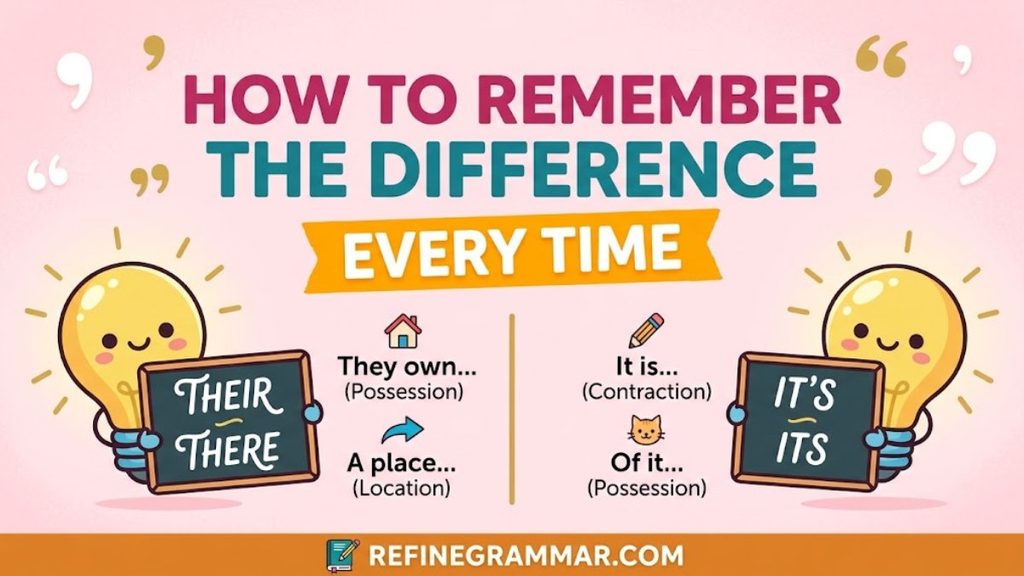
If you only remember one section of this “You Too or You To” guide, make it this one the test below works in almost every situation.
Ask Yourself a Question
Can I replace the word with “also,” “as well,” or “overly”? If yes, use “too.” If the sentence needs a verb or a direction right after, use “to.”
Quick Checklist
- Does it mean “also”? → Use “too.”
- Does it mean “excessively”? → Use “too.”
- Is it followed by a base verb (to go, to help, to finish)? → Use “to.”
- Is it showing direction or destination? → Use “to.”
- Standing alone as a short reply? → Almost always “too.”
Examples in Everyday Situations
Seeing “You Too or You To” used correctly across different settings makes the rule easier to remember than any definition alone.
Text Messages
- “Miss you!” “Miss you too!”
- “Can you call me back?” “Ask her to call you too, maybe she has updates.”
Workplace Emails
- “Thanks for the quick turnaround much appreciated!” “You too, great teamwork.”
- “I’d like you to review this deck before the call.”
School Setting
- “Good luck on the exam!” “You too, study hard!”
- “The teacher asked you to submit the essay by Friday.”
Family Conversation
- “Drive safe!” “You too, see you soon.”
- “Mom told you to clean your room.”
Mini Quiz: You Too or You To
Test what you’ve learned with these ten quick “You Too or You To” challenges.
Mini Quiz 1: Which One Means “Also You”?
Answer: “You too” because “too” means “also.”
Mini Quiz 2: Spot the Correct Reply
“Have a great trip!” Correct reply: “You too!”
Mini Quiz 3: Fill in the Blank
“I need finish this by noon.” Answer: “you to” finish this by noon.
Mini Quiz 4: True or False?
“You too” can stand alone as a complete reply. Answer: True.
Mini Quiz 5: Grammar Challenge
“She wants join the team.” Answer: “you to” join the team.
Mini Quiz 6: Quick Pick
“Good night!” “Good night !” Answer: “too.”
Mini Quiz 7: Everyday English Test
“He asked wait outside.” Answer: “you to” wait outside.
Mini Quiz 8: Find the Mistake
“Nice too meet you.” Answer: Should be “Nice to meet you.”
Mini Quiz 9: One-Word Check
“I hope you win .” Answer: “too.”
Mini Quiz 10: Final Grammar Test
“It’s up decide.” Answer: “you to” decide.
Frequently Asked Questions
Is “I am too” grammatically correct?
Yes. “I am too” is correct when agreeing with a statement, meaning “I am also.”
Which is correct: “I want to” or “I want too”?
“I want to” is correct, since “to” here forms the infinitive before a verb.
Is it “I love you too” or “two”?
It’s “I love you too” “two” is only the number 2 and never fits this phrase.
What is the rule with to and too?
Use “too” for “also” or “excessively”; use “to” for direction or before a base verb.
What is correct, you too or you to?
“You too” for agreeing or replying; “you to” only before a verb, as in “I need you to help.”
Which is correct: “I love you to” or “I love you too”?
“I love you too” is correct when returning the sentiment; “you to” would need a following verb.
Which is correct: “I need to” or “I need too”?
“I need to” is correct, since “to” introduces the infinitive verb that follows.
Which is correct: “to you to” or “to you too”?
“To you too” is correct when it means “also to you,” such as in a reply to a compliment.
When should I say to or too?
Say “too” for “also/excessively”; say “to” for direction or before a verb.
Can I say I miss you too?
Yes, “I miss you too” is correct and means you also miss the other person.
Final Thought
The “You Too or You To” mix-up is small, but it’s an easy one to master once you know the test: if you mean “also,” reach for “too.” If a verb follows “you,” reach for “to.” Keep this guide handy, and you’ll never second-guess the reply again.
