
Ever paused mid-sentence, unsure whether to write “please be sitted” or “please be seated”? You are not alone. This is one of the most searched English usage questions, and the confusion between sitted or seated trips up native speakers and learners alike.
The good news is that the rule is simple once you understand why “sit” behaves the way it does. In this guide, you will learn the correct form, the grammar behind it, real examples, and memory tricks so you never second-guess sitted or seated again.
Quick Answer
“Seated” is the correct word to use. “Sitted” is not a standard English word and should be avoided in speech and writing.
Correct Examples
- Please be seated.
- She was seated near the window.
- We are seated in row twelve.
Incorrect Examples
- Please be sitted.
- She was sitted near the window.
- We are sitted in row twelve.
Sitted or Seated Difference
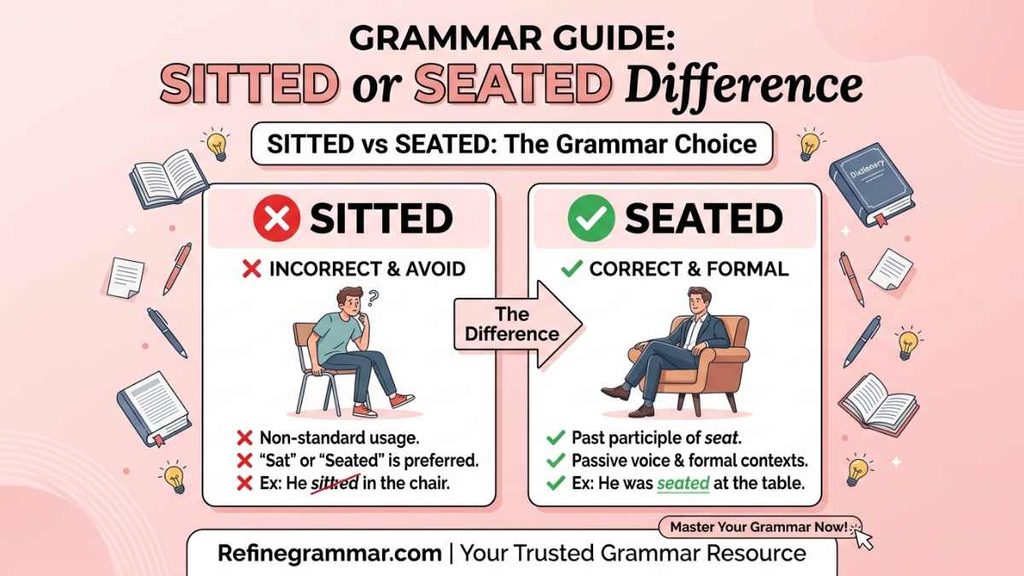
The core difference in the sitted or seated debate comes down to verb tense. “Sit” is an irregular verb, so it does not take the regular “-ed” ending the way words like “walked” or “jumped” do.
Key Rule
The past tense and past participle of “sit” is “sat,” not “sitted.” When you need an adjective describing someone in a sitting position, English uses “seated,” which comes from the related verb “seat.”
What Does Seated Mean
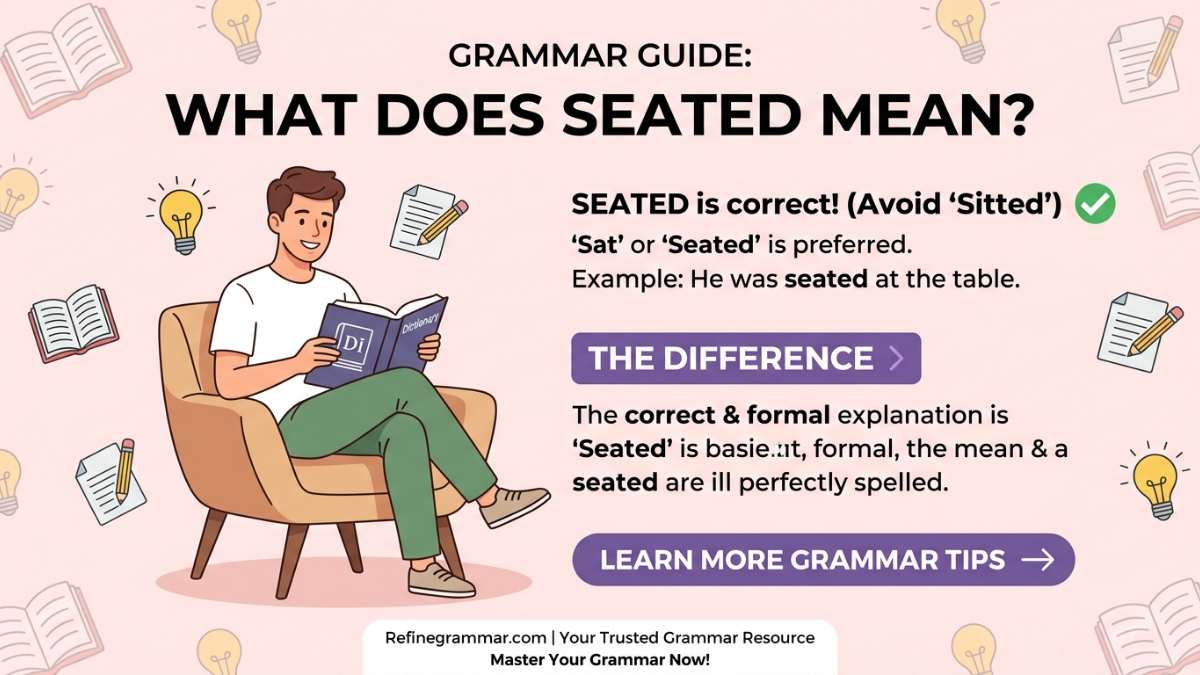
“Seated” describes the state of being in a sitting position, or the act of placing someone in a seat.
Examples
- The host seated us at a corner table.
- He remained seated throughout the ceremony.
Common Uses
“Seated” appears often in formal instructions, event announcements, restaurant service, and workplace communication, which is why it feels more polished than casual alternatives.
What Does Sitted Mean
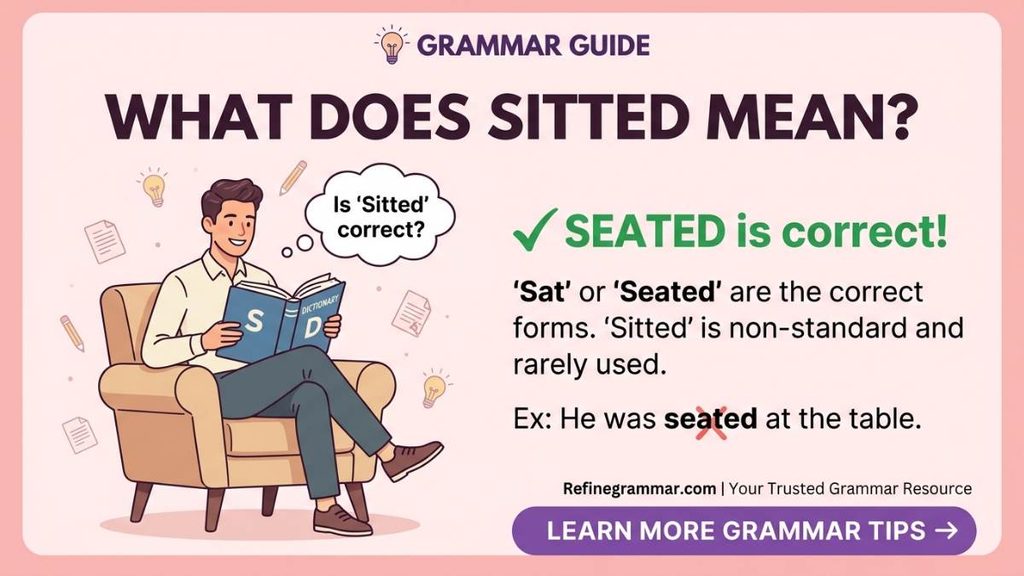
“Sitted” has no accepted meaning in standard English. It looks like it should be the past tense of “sit,” but that form simply does not exist in modern grammar.
Example
- Incorrect: I sitted on the bench for an hour.
- Correct: I sat on the bench for an hour.
How to Pronounce Seated
“Seated” is pronounced SEE-tid, with stress on the first syllable. The double “e” carries the long “ee” sound, and the ending is soft, similar to “heated” or “treated.”
Why People Confuse Sitted and Seated
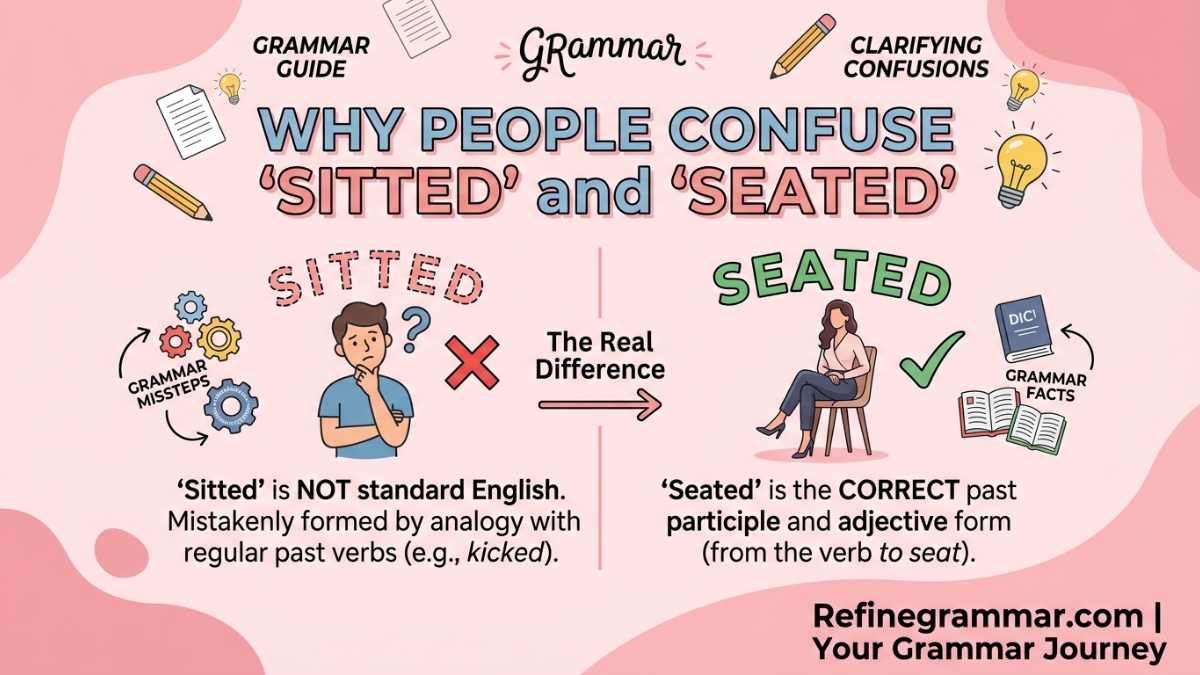
Regular Verb Thinking
Most English verbs form the past tense by adding “-ed,” so it feels instinctive to add it to “sit” as well.
Sit Is Irregular
Because “sit” belongs to a small group of irregular verbs, its past tense breaks the usual pattern entirely, becoming “sat” instead.
Similar Meaning
“Sit” and “seat” are closely related in meaning, which makes it easy to blend their forms and produce the mistaken word “sitted.”
Read More: Feen or Fein? The Definitive Spelling Guide (2026)
Grammar Rule Depth
Verb Forms of Sit
| Form | Word |
| Base form | Sit |
| Past tense | Sat |
| Past participle | Sat |
| Present participle | Sitting |
| Adjective (related word) | Seated |
Where Seated Comes From
“Seated” is not a form of “sit” at all. It is the past participle of the verb “seat,” meaning to place someone in a sitting position, which is why it works as both a verb form and a descriptive adjective.
Why Seated Is More Common
Reasons
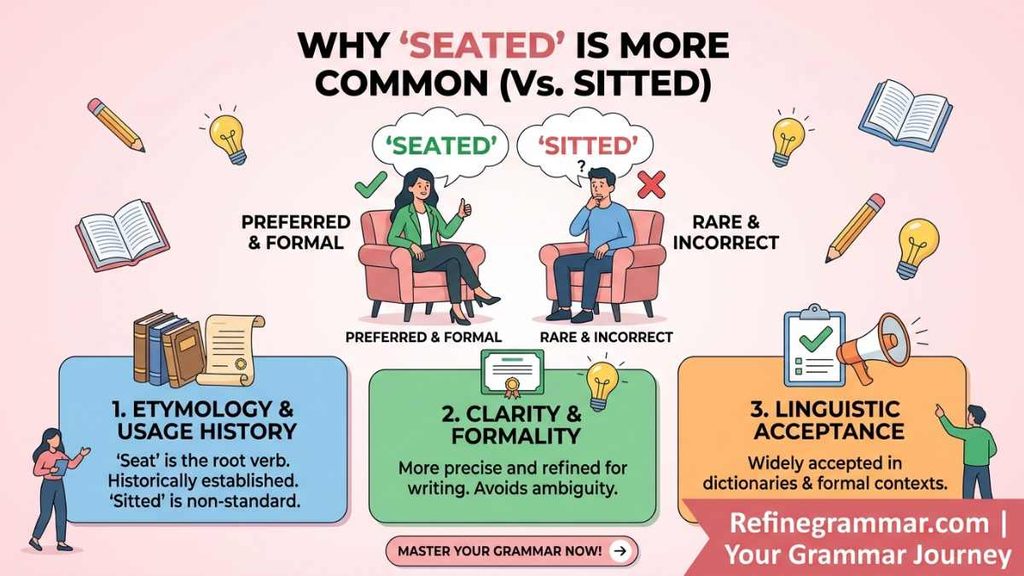
- It works as a clear, professional-sounding adjective.
- It fits formal and semi-formal contexts like weddings, offices, and flights.
- It avoids the awkwardness of using “sat” as a description of someone’s current position.
- It has been standardized in dictionaries, while “sitted” has not.
Is Sitted Ever Correct
No. “Sitted” does not appear in any major dictionary, including Merriam-Webster, Cambridge, or Oxford. In every context where it is used, “sat” or “seated” is the accurate replacement.
The Origin of Sit and Seated
“Sit” traces back to Old English “sittan,” part of a group of Germanic verbs that kept irregular conjugation patterns over centuries. “Seat,” on the other hand, entered English from Old Norse “sæti,” originally meaning a place to sit. Over time, “seated” evolved as the natural adjective form tied to “seat,” while “sit” kept its own irregular past tense, “sat.”
Different Forms Related to Sit
Examples
- Sit (base): I sit here every morning.
- Sat (past): I sat here yesterday.
- Sitting (continuous): I am sitting here now.
- Seated (adjective/participle): I am seated here now.
Real World Usage of Seated
Everyday Conversation
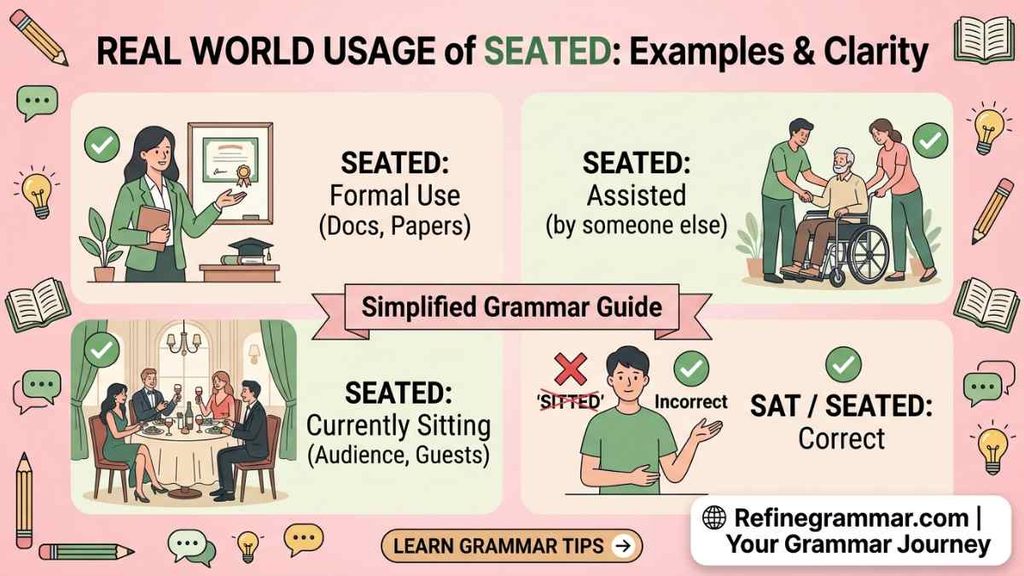
“Take a seat, you can sit here” is common casual phrasing, while “seated” adds a slightly more polite tone in daily speech.
Business Communication
Meeting invites and office memos often use lines like “guests will be seated by 9 a.m.” to sound professional and precise.
Schools
Teachers frequently say “remain seated” to instruct students, since it sounds firmer than “remain sitting.”
Travel
Airlines and train services announce “please remain seated” for safety instructions during takeoff, landing, or sudden stops.
Events
Wedding planners, conference organizers, and theater staff use “seated” on programs and signage to indicate assigned seating arrangements.
Common Phrases: Getting Sitted or Seated Right
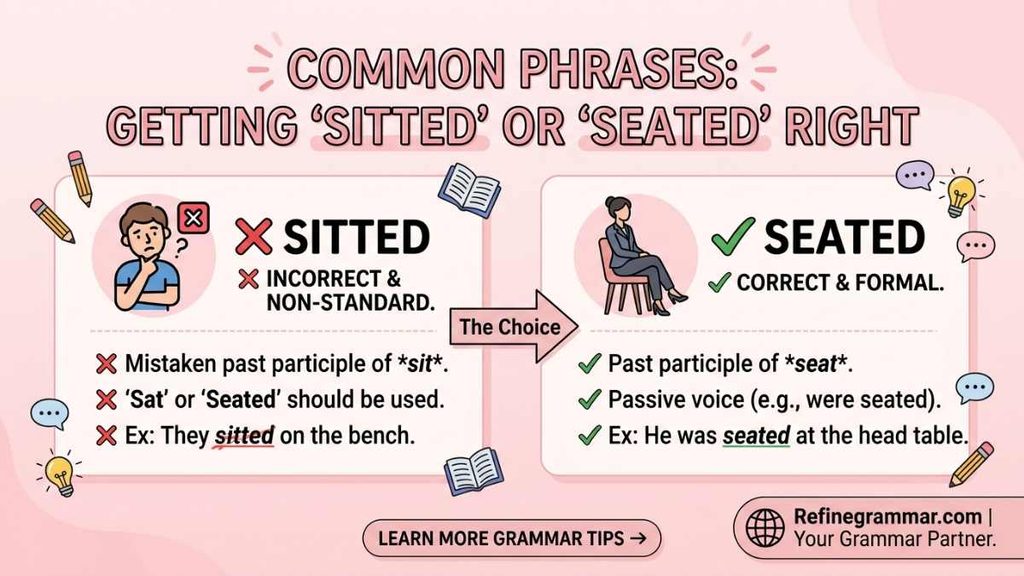
Many people search for specific phrases to check which version is correct. Here is a quick reference table covering the most common ones.
| Phrase People Search | Correct Version |
| Sitted or seated meaning | “Seated” is the real word; “sitted” is not standard |
| Sitted or seated in a sentence | Use “seated”: “She is seated by the door.” |
| Please be sitted or seated | “Please be seated” |
| Where are you sitted or seated | “Where are you seated?” |
| I am sitted or seated | “I am seated” |
| I’m seated or sitted | “I’m seated” |
| Remain sitted or seated | “Remain seated” |
| He was sitted or seated | “He was seated” |
| Do we say sitted or seated | We say “seated,” never “sitted” |
| We are sitted or seated | “We are seated” |
| Stay sitted or seated | “Stay seated” |
| Seated together (not “sitted together”) | “We were seated together” |
Seated in Emails
Professional emails often use phrasing like “you will be seated according to the floor plan” or “guests are kindly requested to remain seated.” This keeps the tone courteous and precise, unlike “sitted,” which reads as an error to any careful recipient.
Seated in Business Writing
Reports, HR documents, and internal memos rely on “seated” for describing arrangements, such as “employees will be seated by department” during a town hall. Using “sitted” in such documents can undermine credibility and professionalism.
Seated in Social Media
Even in casual captions, “seated” performs better than “sitted.” A caption like “seated front row” reads naturally, while “sitted front row” instantly signals a grammar mistake to readers.
Common Mistakes With Sitted or Seated
Mistake 1: Using Sitted as Past Tense
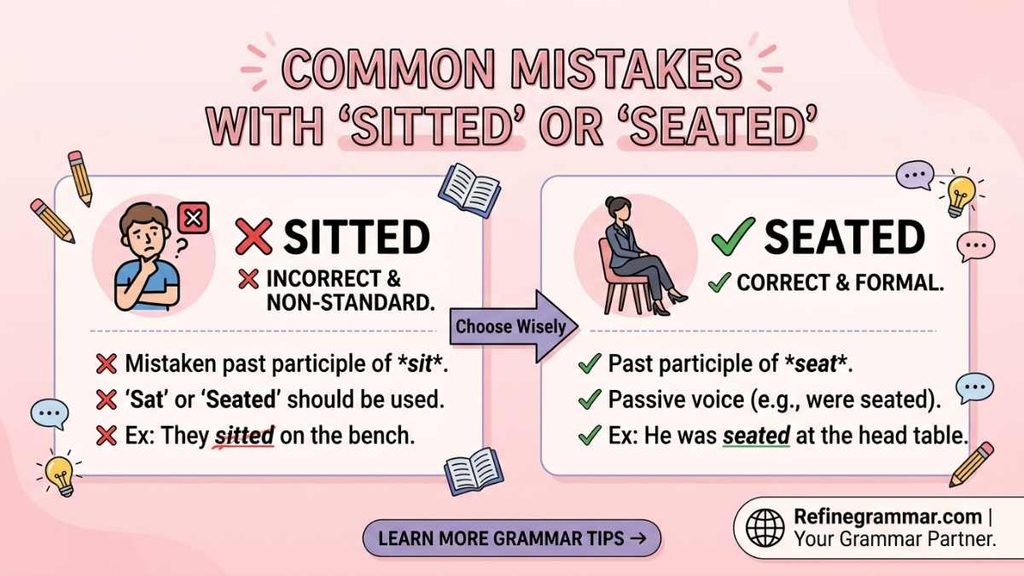
Writers sometimes write “I sitted down” instead of the correct “I sat down.”
Mistake 2: Using Sitted Instead of Seated
Phrases like “please be sitted” should always be “please be seated.”
Mistake 3: Using Sitted Professionally
In resumes, emails, or official announcements, “sitted” can appear careless and reduce trust in the writer’s attention to detail.
Related Words People Confuse With Sitted
Besides sitted or seated, learners often mix up:
- Sit vs. Set (set is used for placing objects, not people)
- Sat vs. Sitten (there is no such word as “sitten”)
- Seat (noun) vs. Seated (adjective/participle)
How Common Is the Mistake Sitted
Search data and online forums show that “sitted” is searched thousands of times monthly, largely by English learners and non-native speakers translating directly from their first language, where regular past-tense patterns may apply more consistently.
Memory Tricks to Remember Seated
Trick 1
Think of “heated” and “treated.” “Seated” rhymes with them and follows the same regular adjective pattern.
Trick 2
Remember: “Sit” becomes “sat,” never “sitted.” If you feel tempted to add “-ed” to sit, stop and swap in “sat” or “seated” instead.
Trick 3
Picture a wedding seating chart. Guests are “seated,” never “sitted,” at their tables.
Trick 4
Associate “seat” (the noun) with “seated” (the adjective) — same root, consistent spelling.
Sitted or Seated: Summary
“Seated” is the grammatically correct word for describing someone in a sitting position or being placed in a seat. “Sitted” is a common but incorrect form that does not exist in standard English. Whenever in doubt between sitted or seated, choose “seated,” and remember that the verb “sit” simply becomes “sat” in the past tense.
Exercise 1: Choose the Correct Word
- Please be ______ (sitted / seated).
- She ______ (sitted / sat) on the bench for an hour.
- We were ______ (sitted / seated) near the stage.
- He ______ (sitted / sat) down quietly.
Exercise 2: Correct the Sentence
- “I sitted at my desk all day.” → I sat at my desk all day.
- “Guests will be sitted by the entrance.” → Guests will be seated by the entrance.
- “Please stay sitted during the flight.” → Please stay seated during the flight.
FAQs
Which Is Correct, Seating or Sitting?
Both are correct but used differently: “seating” refers to arrangements or capacity, while “sitting” describes the action of sitting down.
When to Use Sit and Seat?
Use “sit” for the action a person performs themselves, and “seat” when someone or something places a person in position.
Is There a Word Called Sitted?
No, “sitted” is not a recognized English word in any standard dictionary.
What Is the Difference Between “Sit” and “Seat”?
“Sit” is an action verb for lowering yourself into a position, while “seat” means to place someone in a seat.
Is It Take a Sit or Take a Seat?
The correct phrase is “take a seat,” not “take a sit.”
Is the Word Sitted Correct?
No, “sitted” is incorrect; use “sat” or “seated” instead.
Which Is Correct: “Be Seated” or “Be Sitted”?
“Be seated” is correct and widely used in formal instructions.
Does the Word “Seated” Exist?
Yes, “seated” is a standard English word functioning as both a verb form and an adjective.
Is Sitting Grammatically Correct?
Yes, “sitting” is the correct present participle form of “sit.”
Is It “Sitting Position” or “Seating Position”?
“Sitting position” is the standard phrase used to describe posture.
Final Thought
Choosing between sitted or seated no longer needs to be confusing. Remember that “sit” becomes “sat,” and “seated” is the polished, correct adjective for describing someone in position. With this rule in mind, your writing will stay accurate, professional, and error-free.
