
You typed it fast, and something looked off. Was it lable or label? That small pause is more common than you’d think. English has plenty of words that trick even confident writers, and this pair sits near the top of the list. The Lable or Label mix-up shows up in emails, product packaging, shipping paperwork, and school essays alike. Even careful writers second-guess themselves once they see the word on a page.
Here’s the short version: label is the only correct spelling. Lable isn’t a word in any dictionary, in any English-speaking country. It never appears in style guides, textbooks, or professional writing standards. This guide walks through why the Lable or Label mistake happens, how to use label the right way, and how US and UK spelling rules split once you add a suffix. It also breaks down common questions people search for, from shipping labels to the British spelling of labelled. By the end, you won’t second-guess the Lable or Label question again and you’ll know exactly why the error happens in the first place.
Lable or Label: Which Spelling Is Correct?
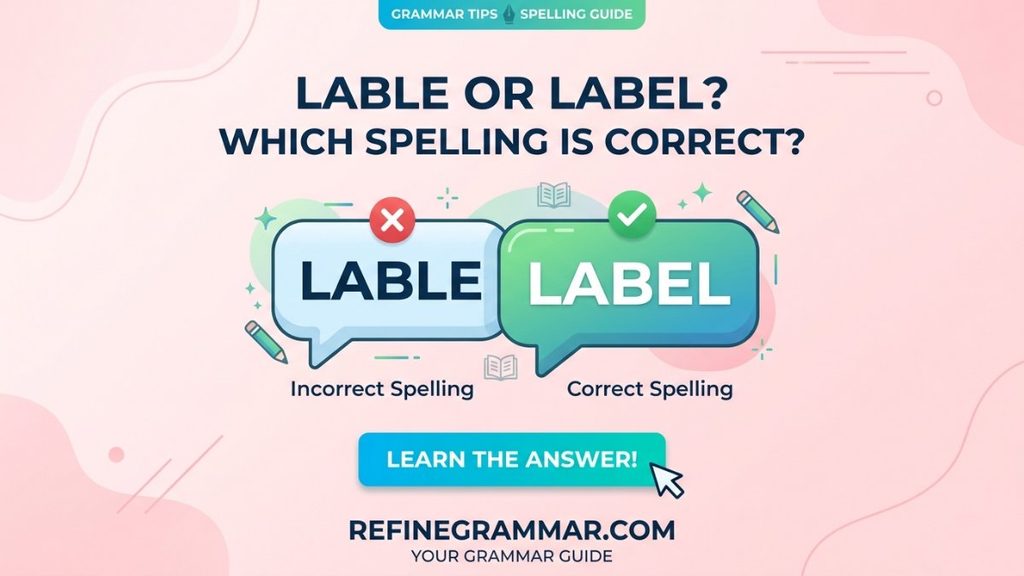
Let’s settle this right away. Label is correct. Lable is a misspelling, full stop. You won’t find it in Merriam-Webster, Cambridge Dictionary, or any other reputable source. People write lable because the word sounds like it rhymes with table, cable, and stablewords that genuinely end in -ble. But label breaks that pattern. It ends in -bel, not -ble. That tiny swap is where the whole Lable or Label confusion starts.
Think of label as a noun first: a small tag or sticker that names or describes something. A jar of jam has a label listing ingredients. A record company is also called a label. As a verb, to label means to attach that tag, or more loosely, to categorize someone or something. Both uses follow the same spelling, and neither one ever becomes lable.
Why Do People Misspell Label as Lable?
Most spelling slips have a logical root, and this one does too. English speakers lean on patterns they already know. Since so many familiar words end in -bletable, cable, stable, fableyour brain quietly assumes label should follow suit. It doesn’t.
A few other reasons feed the Lable or Label mix-up:
- Fast typing. Your fingers swap the b and l without you noticing.
- Autocorrect gaps. Some spell-checkers miss it if lable resembles a name or product term nearby.
- Regional accents. Certain pronunciations blur the middle syllable, making lable sound plausible.
- Rare exposure. If you don’t read the word often, the correct order doesn’t stick.
None of these reasons make lable acceptable. They just explain why the error keeps popping up, even in professional writing.
Label vs Lable: Quick Comparison Table
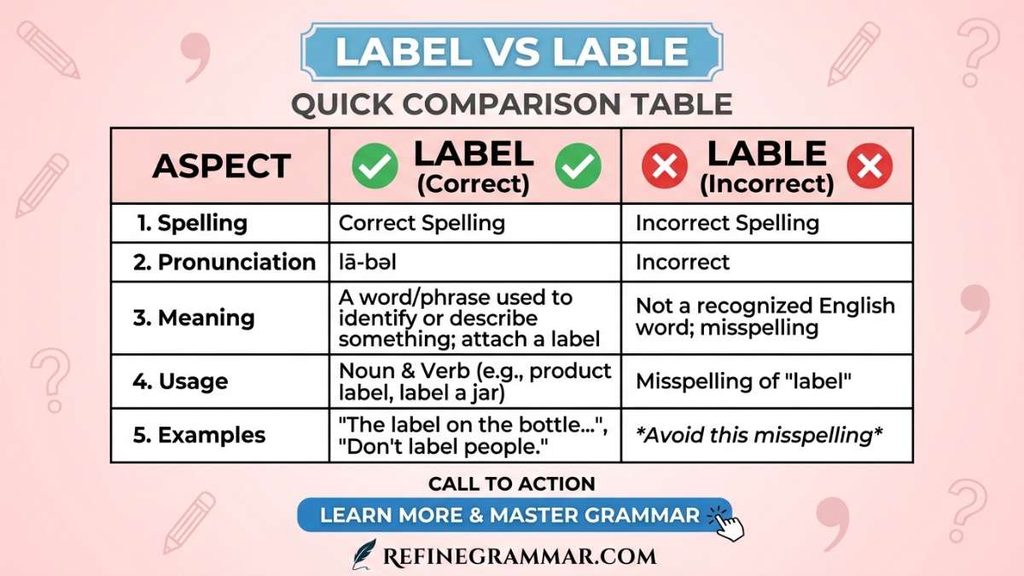
Sometimes a side-by-side view clears things up faster than a paragraph. Here’s a quick snapshot for anyone Googling label or lable on the fly.
| Feature | Label | Lable |
| Correct spelling | Yes | No |
| Found in dictionaries | Yes (Merriam-Webster, Cambridge, Oxford) | No |
| Part of speech | Noun and verb | Not applicable |
| Common in | Packaging, grammar, writing, shipping | Typos and autocorrect slips |
| Recommended use | Always | Never |
Keep this table in mind, and the Lable or Label debate stops being a debate at all.
How to Use Label Correctly
Once you know the spelling, using label well comes down to context. Here’s how it works as both a noun and a verb, with real-world examples for each.
As a noun, label refers to:
- A printed tag on food, clothing, or products (the nutrition label on a cereal box)
- A record company or fashion brand (an independent music label)
- A descriptive term applied to a person or idea (a political label)
As a verb, label means:
- To physically attach a tag (Please label each box before shipping.)
- To classify or describe something, sometimes unfairly (Don’t label him lazy just because he’s quiet.)
- To organize files, folders, or data (Label every spreadsheet column clearly.)
Notice that label stays the same whether you’re talking about packaging or people. The spelling never shifts, and it never needs that extra e swapped for a b. Getting comfortable with these examples makes the Lable or Label mistake far less likely to slip into your own writing.
Learn More: Of Course or Ofcourse: The Correct Spelling Explained
US vs UK Spelling: Labeled or Labelled?
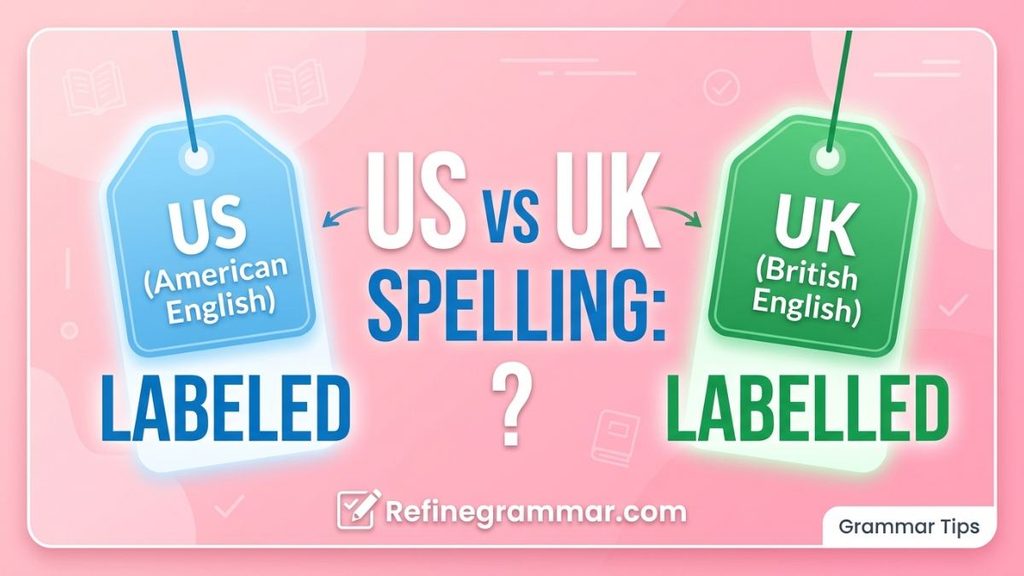
Here’s where things get genuinely interesting, and where label causes a second wave of confusion. While the base word stays fixed everywhere, its extended forms split by region once you add a suffix like -ed or -ing.
American English follows the standard doubling rule: you only double a final consonant when the last syllable carries the stress. Since label stresses the first syllable (LA-bel), Americans keep a single l.
British and Australian English double the l regardless of stress, following an older convention that treats certain verbs differently.
| Region | Past Tense | Present Participle |
| American English | labeled | labeling |
| British English | labelled | labelling |
| Australian English | labelled | labelling |
So if you’re asking whether labelled has two L’s, the answer depends entirely on which side of the Atlantic your reader sits on. Both forms are correct in their own dialect. Neither one touches the original Lable or Label question, since the base spelling (label, never lable) stays identical across every English-speaking country.
Common Mistakes to Avoid With Label
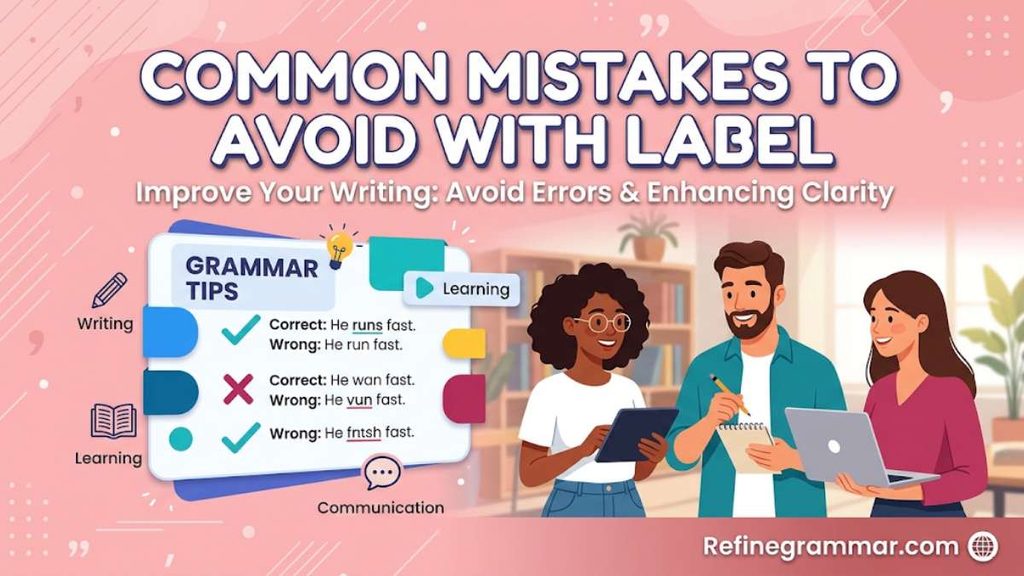
Beyond the core Lable or Label error, a few related slip-ups show up often. Watch for these:
- Writing labled instead of labeled (missing the vowel entirely)
- Mixing US and UK spelling within the same document
- Using label and brand interchangeably in formal writing, when they carry different shades of meaning
- Forgetting the second l in British contexts, or adding it unnecessarily in American ones
- Autocorrecting label to an unrelated word on mobile keyboards
A quick proofread, or a grammar checker built for your target dialect, catches most of these before they reach a reader. Getting the Lable or Label distinction right matters more than it seems. A misspelled label on a product listing, resume, or shipping form can look careless, even when the rest of the writing is sharp. Search engines and readers both notice consistency, so nailing this one word pays off across everything you write.
Why the Lable or Label Mistake Matters in Professional Writing
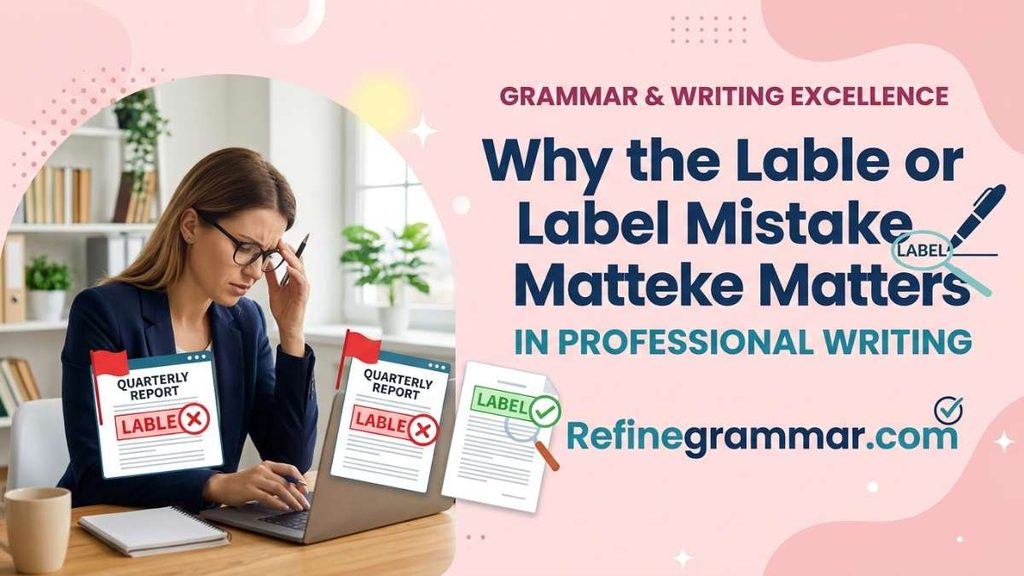
Spelling errors rarely stand alone in a reader’s mind. One slip, like writing lable instead of label, can make an otherwise polished email or product page look rushed. This matters even more in industries built around labeling itself: shipping, retail, food packaging, and pharmaceuticals. A shipping lable typo on an invoice, for instance, can confuse automated systems or delay a package. Getting comfortable with the Lable or Label rule isn’t just a grammar exercise. It’s a small habit that protects your credibility, whether you’re writing a product description or a formal report.
Other Words Related to Label
If you want variety in your writing, several words work as near-synonyms for label, depending on context:
- Tag
- Tab
- Marker
- Sticker
- Name
- Brand
- Classify (as a verb)
- Categorize (as a verb)
Swapping in one of these occasionally keeps your writing from repeating label too often, especially in longer pieces about packaging, branding, or data organization.
Frequently Asked Questions
Is It Label or Lable?
Label is correct. Lable is a common misspelling with no dictionary entry, in either US or UK English.
What Does the Word Lable Mean?
Lable has no meaning. It’s simply a misspelling of label, not a separate word with its own definition.
Is It Label or Lable in the UK?
It’s label in the UK too. British English shares the same base spelling as American English; only suffixed forms like labelled differ.
What Is the Difference Between Label and Lable?
Label is a real, dictionary-recognized word. Lable is an error caused by swapping the letter order near the end.
How Do Americans Spell Label?
Americans spell it label, the same as everyone else. The difference only appears in extended forms like labeled and labeling.
Is It Shipping Label or Lable?
It’s always shipping label. Whether it’s a package, envelope, or crate, label is the correct word every time.
What Is Called a Label?
A label is any tag, sticker, or printed marker that identifies, describes, or categorizes an object, product, or person.
Does Labelled Have Two L’s?
Yes, in British and Australian English. American English uses one l, spelling it labeled instead.
Why Is US Spelling Different From UK Spelling?
US spelling often simplifies older British conventions. Noah Webster’s 19th-century reforms dropped extra letters, including the doubled l in words like label.
What Is Another Word for Label?
Common alternatives include tag, tab, marker, sticker, and, for the verb form, classify or categorize.
Final Thought
The Lable or Label question has one clear answer: label wins, every single time.
Lable never earns a place in formal writing, casual messages, or shipping paperwork.
Keep label in mind, watch for the US-UK split in its longer forms, and you’ll never trip over this word again.
