
Every English learner hits this wall sooner or later: do you say “born in” or “born on”? One tiny preposition, and suddenly a birthdate on a form looks wrong. The good news? The rule behind born in or born on is short, and once it clicks, you’ll never second-guess it again. This guide breaks the born in or born on question into plain examples, a quick comparison table, and a handful of memory tricks you can use the next time you fill out a form.
Quick Answer
Here’s the short version. Use “born in” for years, months, seasons, cities, and countries. Use “born on” for a specific date or a day of the week. That single line settles most born in or born on questions before you even open a dictionary.
| Preposition | When to use it |
| Born in | Years, months, seasons, cities, states, countries |
| Born on | Specific calendar dates and days of the week |
What Does “Born In” Mean?
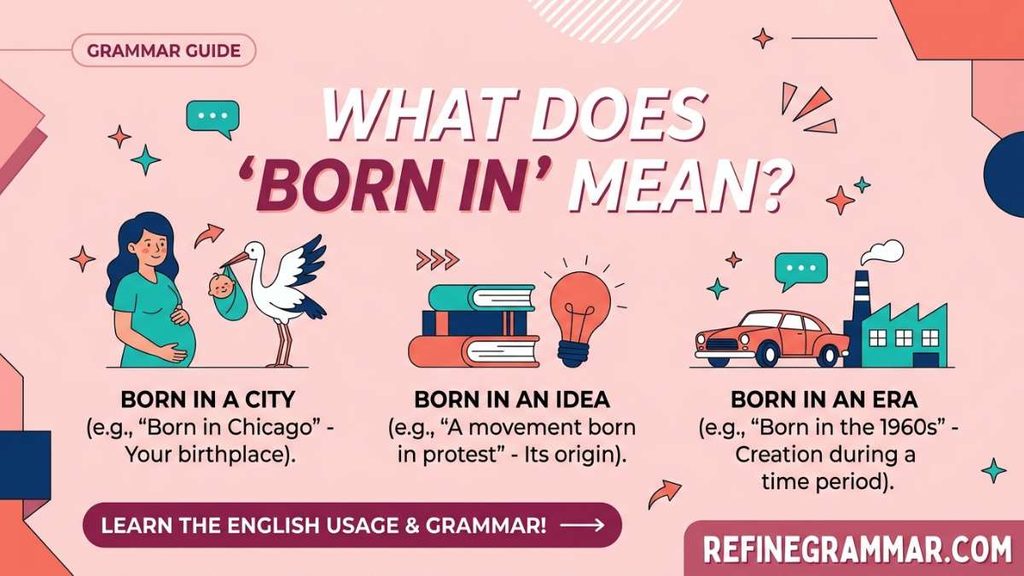
“Born in” marks a broader stretch of time or a place, rather than one exact point. Think of “in” as a container: a year, a month, a season, or a location all hold a birth event inside them without pinning it to a single day. That’s why you’ll hear “born in 1995,” “born in April,” and “born in Chicago” far more often than any date-specific phrasing in casual conversation.
This pattern also covers figurative uses. You might say an idea was “born in” a moment of frustration, or a friendship was “born in” college. The container logic still applies, even when nobody’s talking about an actual birth.
Learn More: High School or Highschool? Correct Spelling Simply Explained
What Does “Born On” Mean?
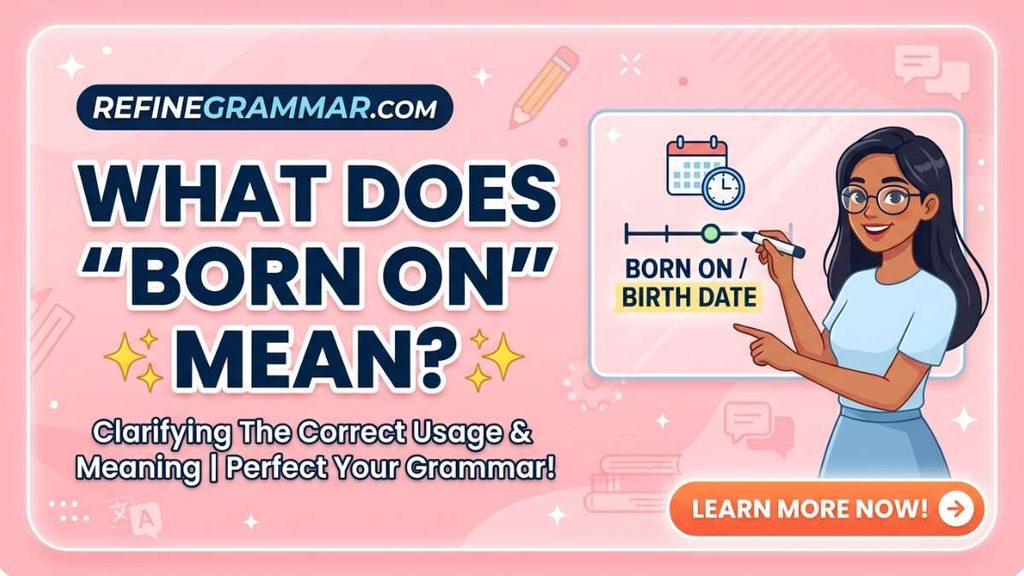
“Born on” locks onto a single point on the calendar. It pairs with exact dates (“born on July 4th”) and days of the week (“born on a Tuesday”). Where “in” describes a container, “on” describes a spot. That distinction is the whole engine behind born in or born on decisions, so it’s worth memorizing before anything else.
Official documents lean on the born in or born on rule constantly. Passports, birth certificates, and visa forms all phrase things as “born on [date],” because that phrasing points to one unambiguous day rather than a broader window.
Born In vs Born On: The Main Difference
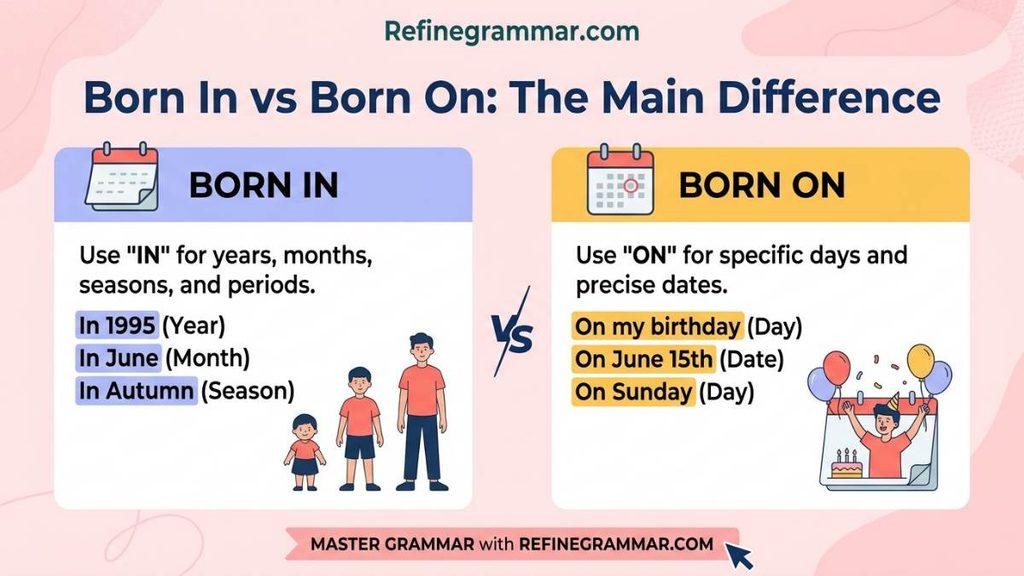
The core difference comes down to specificity. “In” handles broad categories of time and place; “on” handles a single date or day. Swap them, and a sentence starts to sound off to a native speaker’s ear, even if the meaning is technically clear.
| Category | Correct Form | Example |
| Year | born in | She was born in 1988. |
| Month | born in | He was born in October. |
| City / Country | born in | They were born in Karachi. |
| Exact date | born on | I was born on May 9, 1996. |
| Day of the week | born on | We were born on a Sunday. |
Examples of Born In
- I was born in Lahore.
- My brother was born in 2001.
- She was born in December.
- He was born in the spring of that year.
- They were born in the same hospital, a year apart.
- Our grandparents were born in a small village.
Examples of Born On
- I was born on the 14th of August.
- She was born on a rainy Wednesday.
- He was born on New Year’s Day.
- My daughter was born on March 3, 2020.
- They were born on the same date, just years apart.
Common Mistakes People Make

Most born in or born on errors follow a small, predictable pattern:
- Writing “born on 1995” instead of “born in 1995” a year needs “in,” never “on.”
- Writing “born in Monday” instead of “born on Monday” days of the week take “on.”
- Mixing up “born” with “borne” “born” refers to birth; “borne” is the past participle of “bear” in every other sense, like “borne the cost.”
- Dropping “at” for a precise location, like a hospital or a specific address, where “at” actually fits better than “in.”
- Combining prepositions incorrectly, such as “born in on 1990” instead of choosing one and sticking with it.
Why This Grammar Rule Matters
This might look like a minor detail, but the born in or born on rule shows up everywhere: résumés, legal paperwork, school records, and everyday introductions. Get it wrong on an official form, and it can read as careless, even when the underlying fact is accurate. Get it right, and your writing reads as polished without any extra effort.
For non-native speakers, mastering born in or born on also builds a foundation for other time prepositions in English. Once “in” versus “on” clicks for birth dates, the same logic carries over to scheduling meetings, describing events, and writing narratives with clear timelines.
Think about how often a birthdate travels through your life: job applications, bank forms, school enrollment, even dating profiles. Every one of those moments tests whether you’ve internalized the born in or born on distinction. A single slip, such as “born on 1994,” might not change the meaning much, but it does signal a shaky grip on English basics to anyone reading closely. Teachers, recruiters, and immigration officers notice these small slips more than most people expect.
Time Prepositions Related to Birth
A few more prepositions round out the born in or born on topic, and each one has its own narrow lane:
| Preposition | Use case | Example |
| In | Years, months, seasons, cities, countries | born in 1970, born in June |
| On | Exact dates, days of the week | born on July 4, born on Friday |
| At | A precise place or exact clock time | born at St. Mary’s Hospital, born at noon |
American vs British English
The born in or born on rule stays consistent across American and British English, but one related quirk is worth flagging: older British records often use “born at” for a town or village, a usage that has largely faded outside archival documents. Today, both American and British writers default to “born in” for places and “born on” for dates. If you’re reading historical texts, birth records, or old newspaper clippings, don’t be surprised to spot “born at” standing in for what modern English would phrase as “born in.”
So if you’re wondering whether British English swaps the born in or born on pattern for something different, the answer is largely no. A Londoner and a New Yorker will both say “born in 1985” and “born on the 4th of July,” even if their accents make the sentence sound completely different out loud. The one place you’ll still spot real variation is formal genealogical writing, where “born at” survives as a stylistic holdover from earlier centuries.
Tips to Remember the Difference
- Picture “in” as a container: a year, a season, or a city all hold the birth event inside them.
- Picture “on” as a pin stuck into a single square on a calendar: one date, one day.
- If you can swap in “during,” reach for “in.” If you can swap in “that exact day,” reach for “on.”
- Whenever you’re stuck, ask yourself the born in or born on question out loud the answer usually surfaces faster than you’d expect.
- Read your sentence aloud. Native speakers usually catch a born in or born on mismatch by ear before they can explain the rule.
FAQs
Which one is correct, born in or born on?
Born in or born on both are correct, but they fit different contexts: use “born in” for years, months, and places, and “born on” for exact dates and days.
Should I say “I am born on” or “I am born in”?
Neither phrasing with “am” is standard; say “I was born on [date]” or “I was born in [year/place]” instead.
What do you mean by “born on”?
“Born on” means the birth happened on one specific calendar date or day of the week.
What is correct, in or on?
It depends on the noun that follows: “in” fits years, months, and places, while “on” fits dates and days.
Which is right, I was born in or I was born on?
Both can be right, depending on what follows: “I was born in 1990” versus “I was born on May 5, 1990.”
Which is correct, I was born on 1971 or I was born in 1971?
“I was born in 1971” is correct, since a year always pairs with “in,” never “on.”
Is it correct to say “born in” or “born at”?
“Born in” fits cities and countries, while “born at” fits a precise spot, like a hospital name.
What is the meaning of born on?
It signals the exact day someone came into the world, such as “born on October 3.”
Should I say “I was born on” or “I was born in”?
Use “on” before a full date or a weekday, and “in” before a year, month, or place.
Is it correct to say “born in January” or “born on January”?
“Born in January” is correct, because a month alone takes “in,” not “on.”
Final Thought
The born in or born on rule really comes down to one question: are you naming a container of time, or pointing at a single day? Keep that question in mind, and the right preposition will follow almost automatically. Once it becomes a habit, you’ll never have to pause over a birthdate again.
