
Defence or defense which spelling is correct? Both are, but the right one depends entirely on your reader. This guide breaks down the difference between defence and defense, traces the history behind the split, and shows you exactly when to use each spelling so you never second-guess yourself again.By the end, you’ll know the rule, the reasoning, and a quick trick to remember it for good.
What Is the Difference Between Defence and Defense?
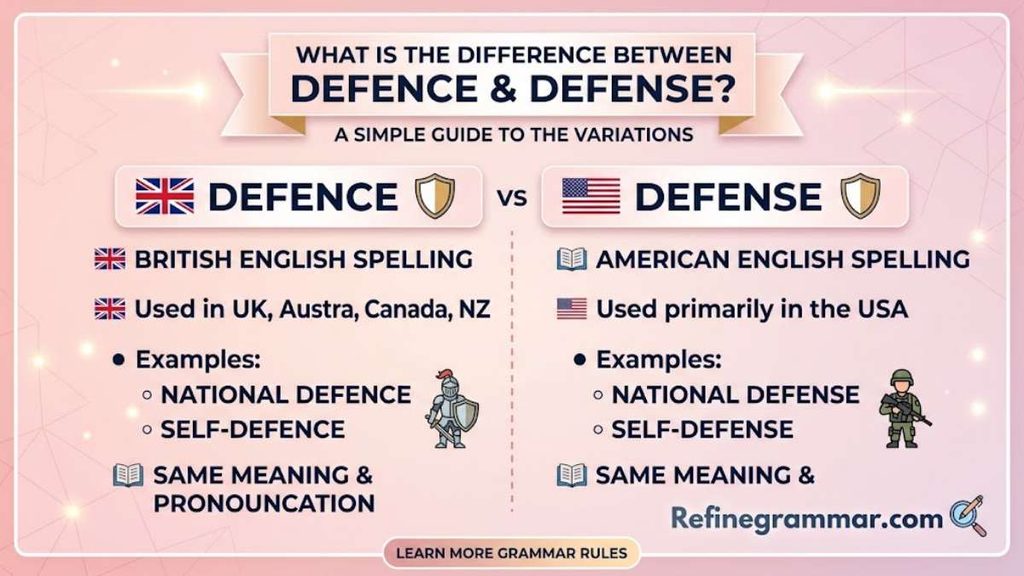
Defence and defense mean the same thing: protection, resistance, or a formal argument against an accusation. The only real difference between defence and defense is spelling, and that comes down to which English dialect you’re writing in.
Defence in British English
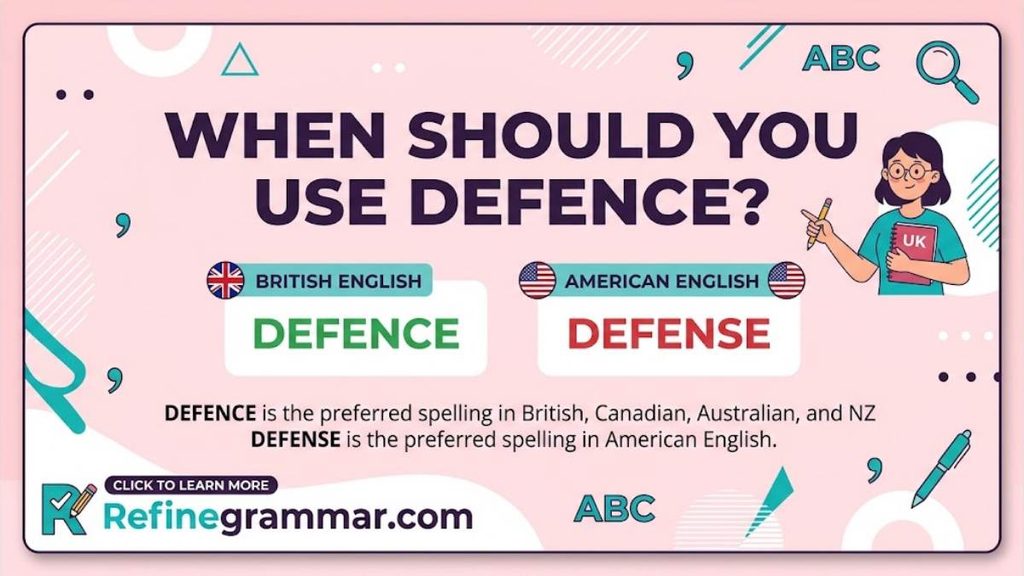
In the UK, Australia, and most Commonwealth countries, defence is the standard spelling. You’ll find it in newspapers, textbooks, and official government paperwork.
Defense in American English
In the United States, defense with an ‘s’ is the accepted spelling. Canadian English tends to lean British here, though American influence has crept in over time.
Why Are Both Correct?
Neither spelling is wrong. They’re simply tied to different regions, the same way colour and color, or organise and organize, split along the same lines. Pick the version that matches your audience and stay consistent.
The History Behind Defence and Defense
Understanding why we ended up with two spellings makes the rule easier to remember.
Origins from Latin and French
Both versions trace back to the Latin defendere, meaning to ward off or protect. The word reached English through Old French defens, which explains why the ‘c’ spelling appeared first.
British Standardization
British English held onto the French-influenced ‘c.’ Early dictionary makers, including Samuel Johnson, helped lock defence into standard British usage during the 1700s.
American Spelling Reform
Noah Webster changed the game for American readers. In his push to simplify English spelling in the early 1800s, he swapped the ‘c’ for an ‘s’ in words like defense, offense, and license.
Learn More: Of Course or Ofcourse: The Correct Spelling Explained
When Should You Use Defence?
Academic Writing in the UK
If you’re writing an essay, dissertation, or research paper for a British university, use defence. UK academic style guides expect it, and switching spellings mid-paper reads as careless.
Government Publications
The UK’s Ministry of Defence spells its own name with a ‘c,’ and most Commonwealth government correspondence follows the same standard.
International Audiences Following UK Standards
Countries like Australia, New Zealand, India, and South Africa generally follow British conventions. If your readers live in one of these regions, defence is the safer choice.
Defence vs Defense in Global Business
International companies based in the UK, or operating primarily across Commonwealth markets, typically use defence in contracts, marketing copy, and internal documents to match what their audience expects.
When Should You Use Defense?
US Academic Writing
American universities and major style guides APA, MLA, and Chicago among them expect defense. Using defence in a US paper will usually get flagged during editing.
Government and Legal Documents
The US Department of Defense spells its name with an ‘s,’ and American courts, law firms, and legal filings follow the same rule.
Digital Marketing for US Audiences
If you’re writing web copy, ads, or emails aimed at American consumers, defense is the spelling readers expect. Anything else feels slightly off to a US eye.
SEO Considerations
Search volume for defense typically outpaces defence in the US market. Targeting the spelling your audience actually types into Google helps your content rank for the queries that matter.
Defence or Defense: Common Examples in Everyday Writing
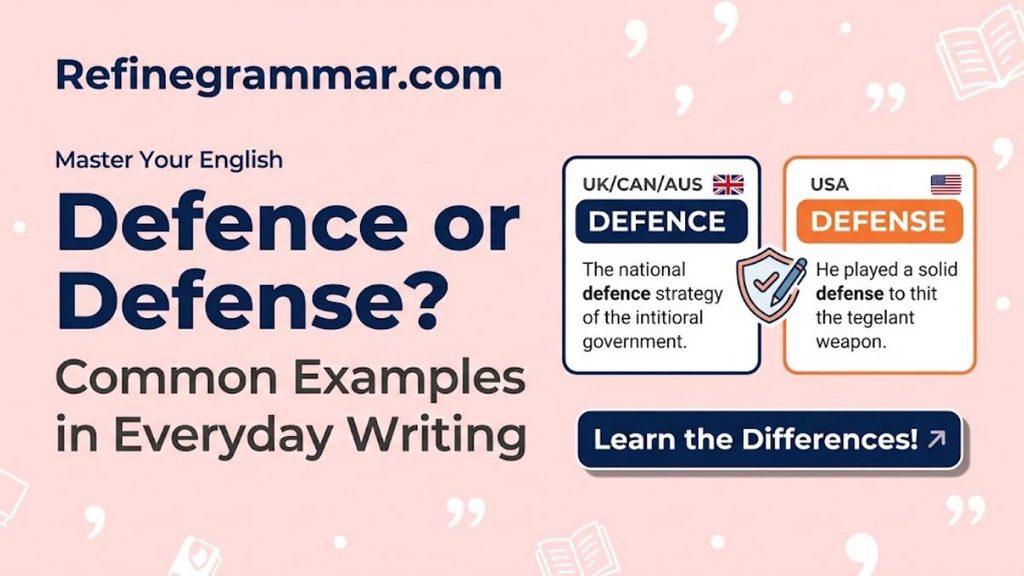
Here’s how the defence or defense split plays out across different contexts:
Military Context
Militaries use both spellings depending on the country the UK’s Ministry of Defence versus the US Department of Defense.
Sports Context
Commentators praise a football team’s defence in Britain and a football team’s defense in America. Same strategy, different letters.
Legal Context
A lawyer might mount a defence in a London courtroom and a defense in a New York one. The legal concept never changes, only the spelling does.
Personal Protection Context
Whether you write self-defence or self-defense, you’re describing the same instinct to protect yourself from harm.
Real-Life Example: How a Global Company Handles Defence vs Defense

Picture a global defense contractor with offices in London and Washington, D.C. Its UK website uses defence consistently, from job postings to press releases. Its US site switches every instance to defense. The company doesn’t treat this as inconsistency it treats it as speaking each audience’s language. That small spelling choice builds trust and signals attention to detail, which matters just as much in branding as it does in grammar.
Defence vs Defense Statistics and Usage Trends (2025–2026)
Key Trends
Language-tool and dictionary-site data consistently show defense outranking defence in raw search volume, largely because the US online market is so much larger. Still, defence holds steady across UK, Australian, Indian, and South African publishers, and neither spelling shows any sign of disappearing.
| Region | Preferred spelling |
| United States | Defense |
| United Kingdom | Defence |
| Canada | Defence (with growing US influence) |
| Australia & New Zealand | Defence |
| India & South Africa | Defence |
What This Means for Writers
If you write for a global audience, expect to toggle between defence and defense depending on the platform, client, or region. Consistency within a single piece of writing matters far more than picking an overall ‘winner.’
How to Remember the Difference
Quick Memory Trick
Try this: America uses an ‘s,’ and so does the word ‘States.’ Britain uses a ‘c,’ and so does the word ‘Crown.’ That small link helps the spelling stick.
Use Your Audience as a Guide
When in doubt, match your spelling to your reader’s location, not your own habits. A UK writer producing content for a US client should switch to defense, and vice versa.
Stay Consistent
Pick one spelling per document and run a quick find-and-replace check before you publish. Mixing defence and defense in the same piece is one of the fastest ways to look careless.
Here’s a side-by-side comparison to keep handy:
| Aspect | Defence (British English) | Defense (American English) |
| Spelling | d-e-f-e-n-c-e | d-e-f-e-n-s-e |
| Used in | UK, Australia, New Zealand, India, South Africa | United States |
| Government example | Ministry of Defence | Department of Defense |
| Related words | defenceless, defenceman* | defenseless, defenseman |
| Words that never change | defensive, defensible, defensively | defensive, defensible, defensively |
Mini Quiz: Test Your Knowledge of Defence vs Defense
Test what you’ve learned with this quick 15-question quiz on defence or defense.
Quiz 1: Quick Choice
Q: Which spelling is standard in the UK defence or defense?
A: Defence.
Quiz 2: Fill in the Blank
Q: The US Department of ___ oversees the American military.
A: Defense.
Quiz 3: True or False
Q: “Defencive” is a correct spelling.
A: False the correct word is always defensive.
Quiz 4: Fill in the Blank
Q: In Britain, a lawyer argues a client’s ___.
A: Defence.
Quiz 5: Quick Choice
Q: Which spelling does Canada mostly follow?
A: British (defence), though US influence is growing.
Quiz 6: Fill in the Blank
Q: An American commentator would praise a strong ___.
A: Defense.
Quiz 7: True or False
Q: Both defence and defense are grammatically correct.
A: True.
Quiz 8: Fill in the Blank
Q: Noah Webster changed defence to ___ in American English.
A: Defense.
Quiz 9: Quick Choice
Q: Which spelling never changes across dialects defensive or defencive?
A: Defensive.
Quiz 10: Fill in the Blank
Q: “In my ___, I was only trying to help.”
A: Defence (UK) or defense (US).
Quiz 11: True or False
Q: The word traces back to the Latin defendere.
A: True.
Quiz 12: Fill in the Blank
Q: Self-___ classes teach practical safety skills.
A: Defence or defense, depending on your dialect.
Quiz 13: Quick Choice
Q: Which spelling do US style guides like APA require?
A: Defense.
Quiz 14: Fill in the Blank
Q: The UK’s military department is called the Ministry of ___.
A: Defence.
Quiz 15: Final Challenge
Q: Rewrite for a US audience: “The team’s defence was outstanding.”
A: “The team’s defense was outstanding.”
Frequently Asked Questions
Is It Defence or Defense in America?
In America, defense is correct. Defence is a British spelling and looks out of place in US writing.
What Is the Meaning of Defence?
Defence means the act of protecting someone or something from attack, criticism, or harm. It also refers to a legal argument in court or a defensive position in sports.
Is Defence Grammatically Correct?
Yes. Defence is fully correct in British, Australian, and most Commonwealth English.
Is It Correct to Say “In Defence” or “In Defense”?
Both are correct. Use “in defence” for British audiences and “in defense” for American ones.
Does Canada Say Defence or Defense?
Canada generally prefers defence, following British convention, though American spelling shows up in some contexts.
Is It Defence or Defense in the USA?
In the USA, defense is always the correct spelling.
What Is the Difference Between Special Defense and Defense?
“Special defense” usually refers to a specific legal argument, like self-defence, while “defense” alone is the broader, general term.
Is Defence Spelled with an S or C?
Defence is spelled with a ‘c’ in British English. The American version, defense, uses an ‘s.’
Is the Correct Spelling “Defencive” or “Defensive”?
Defensive is always correct, in both British and American English. “Defencive” is a spelling error everywhere.
How Do You Spell “Defence” in English?
Spell it d-e-f-e-n-c-e for British English, or d-e-f-e-n-s-e if you’re writing for an American audience.
Final Thought
Defence or defense neither is wrong, but context is everything.
Match your spelling to your audience’s dialect, stay consistent from headline to footer, and you’ll never trip over this one again.
