
If you’ve ever paused mid-sentence wondering whether to write “due to” or “do to,” you’re not alone. The confusion between due to or do to is one of the most common small grammar slips in English writing, and it trips up native speakers just as often as learners. The good news? Once you understand the logic behind each phrase, you’ll never second-guess yourself again.
In this guide, we’ll break down the due to or do to meaning, show real examples, explain the grammar rules in plain language, and give you memory tricks that stick. By the end, you’ll be able to spot the right choice instantly, whether you’re writing an email, an essay, or a professional report.
This confusion belongs to a wider family of near-identical word pairs that quietly derail otherwise polished writing. Just as writers second-guess taken vs. taking or too many vs. to many, the due to or do to pair belongs on that same watch-list — small enough to slip past a quick read, big enough to undermine credibility in a formal document.
Definition: Due To or Do To
Understanding the due to or do to meaning starts with recognizing that these are not interchangeable phrases; they belong to different grammatical categories entirely.
- Due to is a compound preposition that means “caused by” or “because of.” It introduces a reason or cause.
- Do to is simply the verb do followed by the preposition to, used to describe an action performed on someone or something.
A quick due to or do to examples comparison makes this clear: “The delay was due to bad weather” versus “What did you do to your hair?” Notice how the due to verb phrase never appears — due to is not a verb form at all, while do always functions as an action word.
Why “Due To” vs. “Do To” Trips So Many People Up
The confusion mostly comes down to sound. When spoken quickly, “due to” and “do to” can sound almost identical, especially in casual speech. Add to that the fact that both phrases end in the word “to,” and it’s easy to see why writers mix them up under time pressure or autocorrect fatigue.
Another reason is that people mentally treat due to or do to as a single fixed expression rather than two separate grammatical structures. Once you separate the cause-and-effect meaning of “due to” from the action-based meaning of “do to,” the mix-up becomes far less likely.
“Due To” vs. “Do To” — The Core Difference Explained Simply
Here’s the simplest way to remember the due to or do to distinction: if you can replace the phrase with “because of,” use due to. If you can replace it with “perform an action on,” use do to.
For example: “The event was postponed due to rain” (because of rain). Compare that with: “I don’t know what she’ll do to fix it” (perform an action to fix it). This single substitution test resolves almost every instance of confusion.
When To Use “Due To” (With Clear Grammar Logic)
Grammar Breakdown
“Due to” functions as a compound preposition, and it typically modifies a noun rather than a verb. It answers the question “why?” and connects a result to its cause. This is different from a mistake many writers make with taken vs. taking, where confusing the verb form changes the entire sentence structure — with due to, the structure stays fixed as a preposition.
- Correct: “The flight was cancelled due to the storm.”
- Correct: “Her success is due to years of hard work.”
- Incorrect: “She left early due to she was tired.” (Use “because” before a clause, not “due to.”)
Pro Tip
If a full clause with a subject and verb follows, swap due to for “because,” not “because of.” This one rule fixes most due to grammar errors instantly.
When To Use “Do To” (With Real Usage Examples)
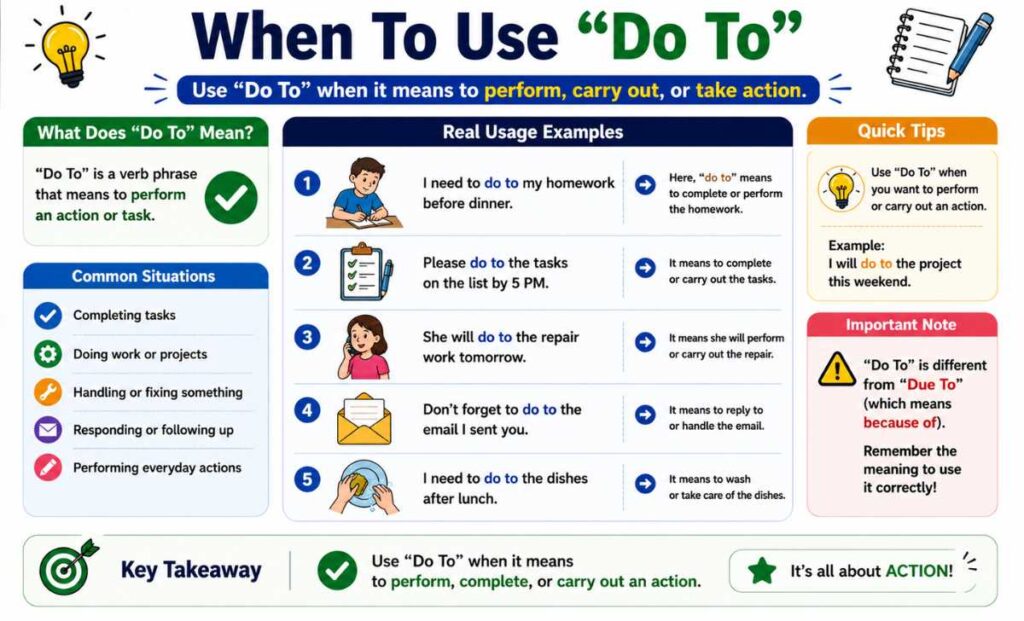
“Do to” shows up whenever the verb do is directly followed by the preposition to. It’s an action phrase, not a cause-and-effect phrase, similar in spirit to how too many vs. to many hinges on correctly identifying the part of speech before choosing the right word.
- “What did the storm do to the roof?”
- “I didn’t mean to do that to you.”
- due or do to the fact is a phrase some writers mistakenly blend together — the correct form is always “due to the fact that,” never “do to the fact that.”
Common Confusion: Why People Mix Them Up
Most mix-ups happen in fast, informal writing — texting, social media captions, or first drafts. Because both phrases are short and end the same way, spell-checkers often miss the error since “do” and “due” are both valid words on their own. This is exactly why understanding meaning, not just spelling, matters so much when choosing between due to or do to.
Learners also struggle because English textbooks rarely dedicate a full lesson to the due to or do to pair specifically — it’s usually mentioned briefly inside a broader lesson on prepositions. That lack of focused explanation is part of why so many writers keep repeating the same due to or do to mistake for years without realizing it.
Side-by-Side Comparison Table
| Feature | Due To | Do To | Example |
| Part of Speech | Compound preposition | Verb + preposition | — |
| Meaning | Because of / caused by | Perform an action on | — |
| Follows With | Noun phrase | Object (person/thing) | — |
| Sample Sentence | Delayed due to rain | What to do to it | — |
Quick Fix Trick: Replace “Due To” With “Because Of”
The fastest way to test any due to or do to sentence is substitution. Swap in “because of” — if the sentence still makes sense, “due to” is correct. If it sounds off, you probably need “do to” instead. This trick works almost every time and takes less than five seconds.
Synonyms & Alternatives for “Due To” (For Writing Variety)
- Because of
- Owing to
- On account of
- As a result of
- Thanks to
Rotating these alternatives keeps your writing fresh, much like varying word choice helps avoid repetitive comparisons such as quieter vs. more quiet, where picking the most natural option improves overall flow.
“Due” vs. “Do” — Understanding Their Root Meanings
Due is an adjective meaning “expected” or “owed,” as in “the rent is due” or “due to arrive.” Do, on the other hand, is a base-form verb meaning “to perform or carry out an action,” as in “do your homework.” Recognizing these roots is the fastest path to mastering due to or do to once and for all.
Memory Connection
Think of “due” like a due date — something expected or owed. Think of “do” like a to-do list — something you actively perform. That single image separates the two words permanently.
Correct and Incorrect Sentence Examples
| Correct | Incorrect |
| The game was cancelled due to weather. | The game was cancelled do to weather. |
| What do you plan to do to improve sales? | What do you plan due to improve sales? |
| Her promotion is due to consistent effort. | Her promotion is do to consistent effort. |
Memory Tricks to Never Confuse Them Again
- due to example trick: if you can say “because of,” it’s due to.
- do vs due examples trick: if an action follows, it’s do to, not due to.
- Picture a
balloonpopping — something happens due to pressure, but you can also choose do to it (like pop it) as an action.
Quick Grammar Quiz — Test What You’ve Learned
1. The trip was cancelled ______ heavy snow.
2. What did they ______ to the old building?
3. His illness was ______ stress and lack of sleep.
4. I don’t know what to ______ about this problem.
Self Assessment Answers
- 1. due to
- 2. do
- 3. due to
- 4. do
How Grammar Tools Flag “Due To” and “Do To”
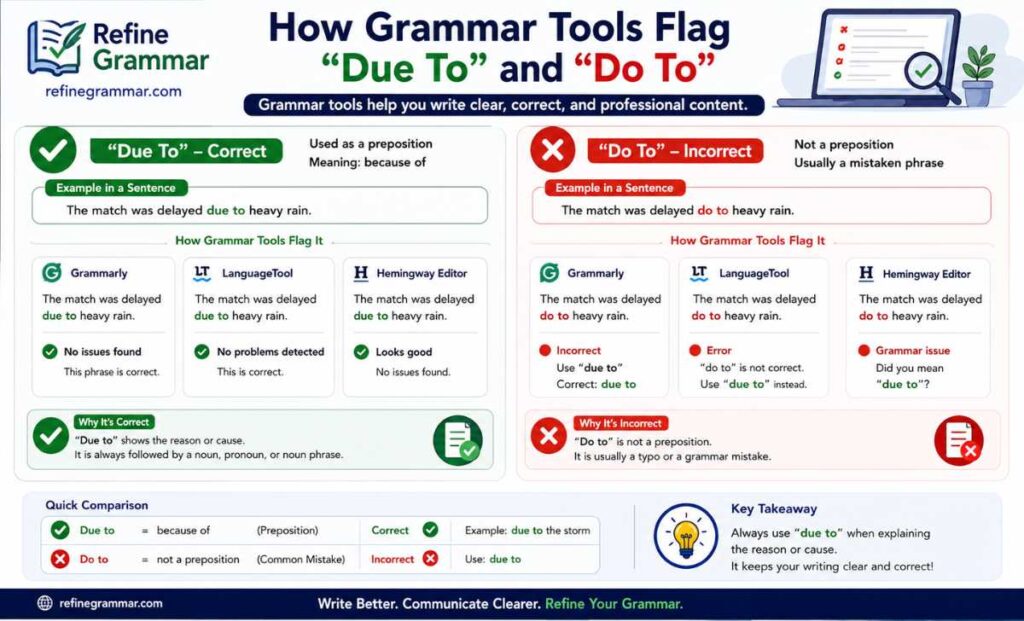
Most modern grammar checkers catch obvious due to or do to errors, but they aren’t perfect. Because both “due” and “do” are correctly spelled words, some checkers only flag the mistake when the surrounding sentence structure is clearly broken, similar to how tools sometimes miss subtler swaps like swap vs. swop in regional spelling variations. Reading your sentence aloud remains one of the most reliable manual checks.
FAQs About “Due To” vs. “Do To”
Below are quick answers to the questions readers ask most often about due to or do to, along with a nod to a related mix-up — quieter vs. more quiet — for anyone building a broader grammar reference list.
Is “due to” formal?
Yes, “due to” is considered standard and appropriate in both formal and everyday writing.
Can “due to” start a sentence?
Yes, as long as it’s followed by a noun phrase, such as “Due to heavy rain, the match was postponed.”
Is “do to” ever correct?
Yes, it’s correct whenever “do” functions as a verb followed by “to,” as in “what to do to fix it.”
What’s the quickest test for due to or do to?
Try substituting “because of”; if it fits, use “due to.”
Do grammar checkers always catch this error?
Not always — both words are spelled correctly, so context-based mistakes can slip through.
Conclusion
Mastering due to or do to comes down to one simple habit: identify whether you’re describing a cause or an action. Use “due to” for reasons and “do to” for actions, apply the “because of” substitution test whenever you’re unsure, and lean on the memory tricks above until the distinction becomes second nature. With a little practice, this once-tricky pair will never slow down your writing again.
