
If you’ve ever paused mid-sentence wondering whether it’s “address” or “adress,” you’re not alone. This is one of the most commonly misspelled words in the English language, and it trips up native speakers and English learners alike. In this guide, we’ll settle the debate for good, explain why the mistake happens so often, and show you exactly how to use the word correctly in every context — from emails to IP addresses to formal writing.
Address or Adress – Quick Answer
The correct spelling is address, with two D’s. “Adress” is simply a misspelling and does not exist as a standard English word in any recognized dictionary, whether British or American.
The confusion usually comes from how the word sounds when spoken quickly, or from mixing it up with words in other languages (like French “adresse,” which has just one D but two S’s).
Examples
- ✅ Please send the package to my home address.
- ❌ Please send the package to my home adress.
- ✅ Can you address the issue during the meeting?
- ❌ Can you adress the issue during the meeting?
Address or Adress: Which Is Correct?
To put it plainly: address is correct, and adress is incorrect in every context — noun or verb, formal or informal. There is no regional variation, no alternate spelling, and no exception where “adress” becomes acceptable. If you’ve seen it written that way somewhere, it was a typo, not a valid spelling.
This is similar to other spelling mix-ups that catch people off guard, like confusing “due to” or “do to” — you can read more about that comparison in our article on due to or do to.
Address or Adress in English
In standard English — both British and American — “address” is built from the prefix “ad-” and the root “dress” (originally meaning to arrange or direct). Because of that double consonant, native speakers sometimes drop a letter when typing fast, which is exactly how “adress” ends up on social media posts, emails, and even business documents.
Address or Adress Meaning
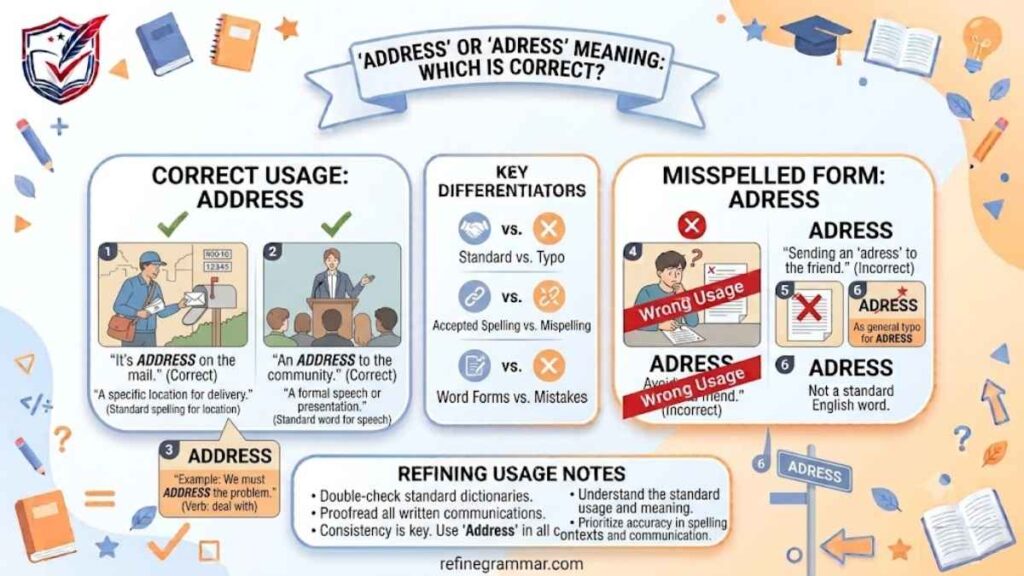
Understanding the meaning helps explain why the spelling matters so much for clarity.
Address Meaning
As a noun, “address” refers to the location where someone lives or where mail is delivered (e.g., “What’s your address?”). It can also mean a formal speech, such as a presidential address.
As a verb, “address” means to speak to someone directly, to label something for delivery, or to deal with a problem — for example, “We need to address this concern.”
The Origin of Address or Adress
The word “address” traces back to Old French “adresser” and Latin roots meaning “to direct” or “to guide straight.” English absorbed the word with its double D and double S structure, and that spelling has remained standard for centuries. “Adress,” by contrast, has never been an accepted English variant — it’s simply a shortened, incorrect version that misses one of the doubled letters.
British English vs American English Spelling
One reassuring fact: this isn’t a British-versus-American spelling debate like “colour” versus “color” or “organise” versus “organize.” Both dialects agree completely on this one.
Comparison Table
| Spelling | British English | American English | Correct? |
| Address | ✅ Used | ✅ Used | ✅ Yes |
| Adress | ❌ Not used | ❌ Not used | ❌ No |
Unlike words such as “inter” versus “intra,” which have genuinely different meanings depending on usage (see our breakdown of inter vs intra), “address” has no legitimate alternate spelling to compare.
Address or Adress UK
In the UK, just as in the US, the correct spelling remains “address.” You’ll see it on postal forms, government websites, and in everyday writing. There is no UK-specific version that uses a single D.
Address or Adress Pronunciation
Part of the confusion comes from pronunciation. “Address” is pronounced as either /əˈdrɛs/ (uh-DRESS) when used as a verb, or sometimes /ˈædrɛs/ (AD-ress) when used as a noun, particularly in American English. Because the stress often falls on the second syllable, people don’t always “hear” the double D, which leads to the dropped letter in writing.
Address or Adress Spelling
Here’s a simple trick to remember the spelling: think of the word “dress” hiding inside “address,” with “ad-” attached to the front. If you can spell “dress” correctly, you already have the second half of “address” locked in — just add the “ad” and double the D.
Which Spelling Should You Use?
Always use address. There is no context — casual texting, professional emails, academic writing, or legal documents — where “adress” is acceptable. Spell checkers will typically flag it automatically, but it’s worth training your muscle memory so you don’t rely on autocorrect every time.
Address or Adress Grammar
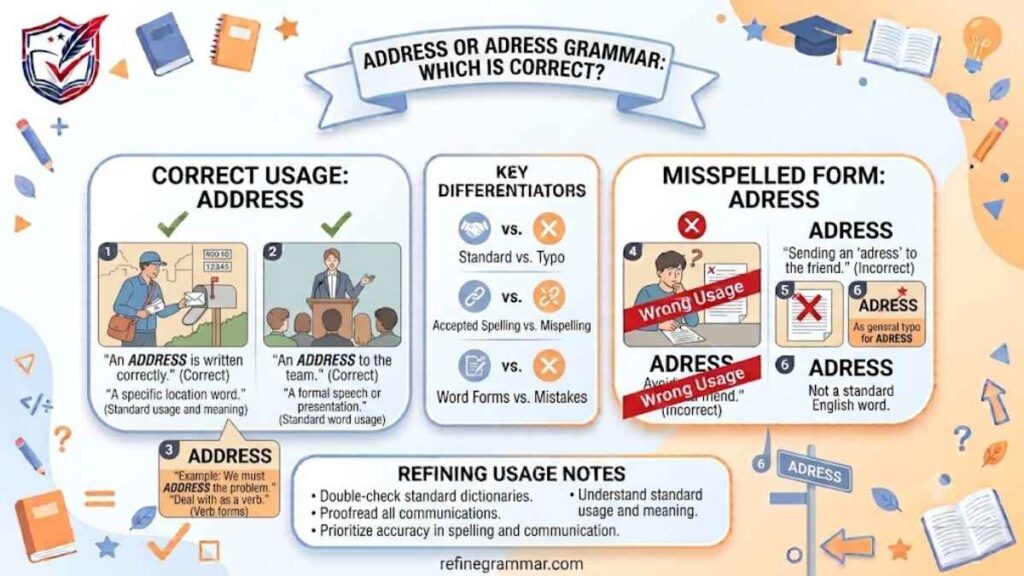
Grammatically, “address” functions as both a noun and a verb, which is part of why it shows up so often in different sentence structures. Getting the spelling right matters regardless of which grammatical role it plays.
Address or Adress Verb
When used as a verb, “address” means to speak to, direct attention to, or formally deal with something. Example: “The manager will address the team’s concerns tomorrow.”
Address Something
“Address something” is a common phrase meaning to tackle or resolve an issue. Example: “We plan to address something the client flagged in the last review.”
Address or Adress the Situation
“Address the situation” is a standard business and everyday phrase meaning to take action on a problem. It’s always spelled with two D’s: “Leadership decided to address the situation immediately.”
Address or Adress Something
Whether you’re addressing a letter, a person, or a problem, the spelling never changes. “Address something” is grammatically correct; “adress something” is not.
Address Example
“She wrote her return address neatly on the envelope before mailing it.”
Address or Adress Examples
- The company will address customer complaints within 48 hours.
- Please update your billing address in your account settings.
- The senator’s address focused on economic recovery.
Adress or Address for Location
When referring to a physical location — like a home, office, or delivery point — “address” is the only correct spelling. This applies to mailing addresses, shipping labels, and GPS entries alike.
Email Address or Email Address
There’s only one correct way to write this: email address, with two D’s. This term shows up constantly in sign-up forms, newsletters, and contact pages, so it’s one of the most important instances to get right.
Home Address or Home Address
Just like “email address,” the correct spelling is always home address — never “home adress.” This phrase is common on official forms, delivery apps, and identification documents.
IP Address to Address
In tech contexts, “IP address” refers to the unique numerical label assigned to a device on a network. It follows the same spelling rule as every other use of the word: always “address,” never “adress.” If you’re troubleshooting network settings or filling out router configuration forms, this is one place a typo can genuinely cause confusion.
Its Address or Adress
When referring to something’s location using the possessive form, the phrase is “its address” (no apostrophe, since “its” here is possessive, not a contraction). Example: “The website updated its address after the migration.”
Address Me or Address Me
If someone asks how to “address” a person formally, the standard phrasing is “How should I address you?” — again, always with the correct double-D spelling, whether in emails, letters, or conversation.
Address or Adresse
You may occasionally see “adresse” — this is the correct spelling in French and German, not English. If you’re writing in English, stick with “address.” Mixing up loanword spellings is a common source of error, much like the confusion between “swap” and “swop.” Our article on swap vs swop covers a similar regional spelling mix-up.
Common Mistakes with Address or Adress
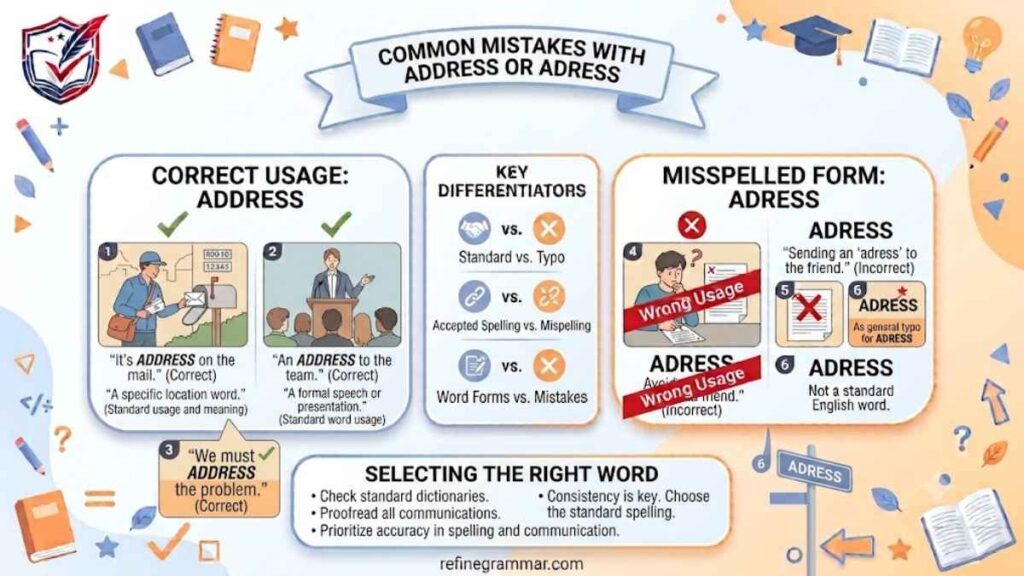
Understanding why the mistake happens can help you avoid it permanently.
Missing a Letter
The most frequent error is simply dropping one of the D’s, turning “address” into “adress” without noticing.
Confusing Pronunciation
Because the double D isn’t strongly emphasized in speech, writers sometimes spell the word the way it sounds rather than the way it’s actually written.
Typing Fast
Quick typing, especially on mobile keyboards, often causes people to skip repeated letters, similar to how numbers get misordered in dates — as seen in our piece on 22th or 22nd.
Auto-correct Errors
Ironically, some auto-correct tools miss “adress” because it resembles a real word closely enough not to trigger a flag, especially in fast typing or voice-to-text apps.
Address or Adress in Everyday Examples
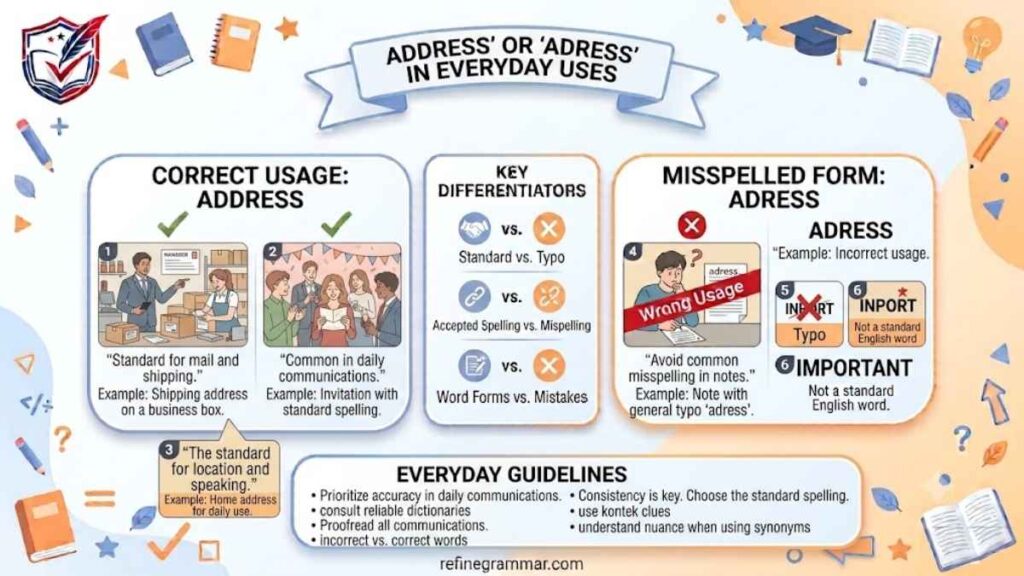
Seeing the word in real-world contexts makes the correct spelling easier to remember.
Emails
“Please confirm your shipping address before we process the order.”
News
“The president’s address to the nation covered new economic policies.”
Social Media
Even influencers and brands occasionally misspell it in captions, but the correct form remains “address” in every post, bio, and caption.
Formal Writing
In résumés, cover letters, and academic papers, “address” must always be spelled correctly, since spelling errors in formal documents can affect credibility — much like errors involving words such as “amount” versus “ammount.” Learn more in our guide to amount or ammount.
Address or Adress – Google Trends & Usage Data
Why do people search this?
People typically search “address or adress” when they’re unsure after typing the word quickly or when autocorrect doesn’t flag “adress” as wrong, leading to self-doubt.
Popular Regions
Search interest for this spelling question tends to come from English-learning regions and countries where English is a second language, where double-letter spelling rules are less intuitive.
Usage Context
Most searches happen in the context of writing emails, filling out forms, or double-checking a word before submitting an application or official document — much like people search for correct usage of “rapport” versus “repore.” Check out our related guide on repore or rapport.
Comparison Table – Address vs Adress
| Feature | Address | Adress |
| Correct Spelling | ✅ Yes | ❌ No |
| Used in Dictionaries | ✅ Yes | ❌ No |
| Accepted in British English | ✅ Yes | ❌ No |
| Accepted in American English | ✅ Yes | ❌ No |
| Common in Casual Typing Errors | — | ✅ Frequently |
If you found this comparison useful, you may also want to check similar spelling clarifications like knaw or gnaw or inportant or important, both of which follow the same pattern of a commonly dropped or misplaced letter.
FAQs
1. How do you spell address or adress correctly?
The correct spelling is “address,” with two D’s, in both British and American English.
2. Which is correct: address or adress?
Address” is correct; “adress” is always a misspelling.
3. Is address spelled with one D or two?
It’s spelled with two D’s — a-d-d-r-e-s-s.
4. What does address mean in English?
It refers to a location for mail delivery, or as a verb, to speak to someone or deal with an issue.
5. How do you pronounce address correctly?
It’s pronounced uh-DRESS as a verb, and sometimes AD-ress as a noun in American English.
6. What is the difference between address and adress?
“Address” is the correct English spelling; “adress” is simply an incorrect variant with a missing letter.
7. Can address be used as both a noun and a verb?
Yes, it works as a noun (a location) and a verb (to speak to or resolve).
8. How do you use address in a sentence?
Example: “Please update your address before the shipment is sent.”
9. Is “adress” ever a correct English spelling?
No, it is never correct in standard English, though it is valid in French and German.
10. How do British and American English spell address?
Both dialects spell it identically: “address,” with two D’s.
Conclusion
The takeaway is simple: address is always correct, and adress is always a mistake. Whether you’re writing a home address, an email address, or addressing a problem at work, remembering the double D will keep your writing polished and professional. Once you internalize the “dress” hiding inside “address,” you’ll never second-guess this spelling again.
