
If you’ve ever paused mid-sentence wondering whether to type “well-being,” “wellbeing,” or “well being,” you’re not alone. This Well-Being vs. Wellbeing question trips up students, marketers, HR professionals, and even seasoned editors. The good news is that the answer isn’t complicated once you understand the rule behind it and this guide walks you through every angle, from dictionary rulings to regional preferences to the psychology terms that often get mixed up along the way.
Quick Answer
When it comes to Well-Being vs. Wellbeing, well-being (with a hyphen) is the standard, dictionary-preferred spelling in both American and British English. Wellbeing (one word) is a widely accepted variant, especially in the UK, in health and wellness branding, and in casual digital writing. Well being (two separate words) is grammatically incorrect as a noun and should be avoided except in rare sentences where “well” functions as an adverb before the verb “being.”
| Form | Status | Where It’s Common |
| Well-being | Correct, most widely accepted | Dictionaries, academic writing, US formal writing |
| Wellbeing | Accepted variant | UK English, wellness brands, casual content |
| Well being | Incorrect as a noun | Rare, specific sentence structures only |
The Rule Explained
The core of the Well-Being vs. Wellbeing debate comes down to how compound nouns behave in English. “Well” is an adverb or adjective meaning “in a good or satisfactory way,” and “being” functions here as a noun referring to a state of existence. When you fuse an adverb-like modifier with a noun to create a new, single concept, English typically uses a hyphen at least until the combination becomes so common that it fuses into one word entirely (think “email,” which used to be “e-mail”).
In the Well-Being vs. Wellbeing comparison, well-being hasn’t fully made that jump yet, which is why the hyphenated form remains the safest, most broadly recognized choice. Style guides and major dictionaries still list it first, even though “wellbeing” appears constantly in everyday writing.
Well Being vs Wellbeing Examples
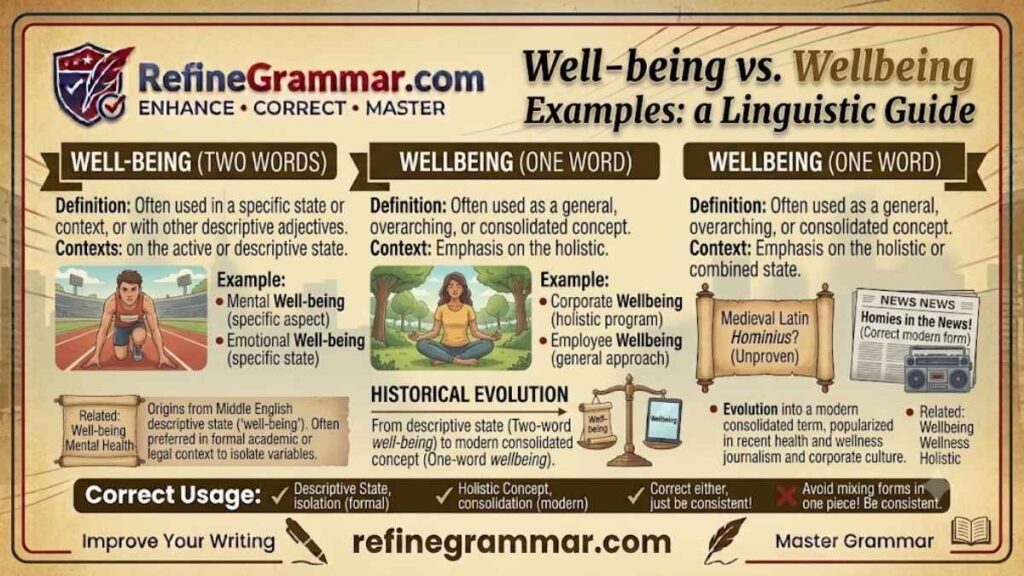
Seeing the Well-Being vs. Wellbeing forms in context makes the distinction click faster than any rule ever could.
- Correct: “The company invests heavily in employee well-being programs.”
- Also accepted: “The company invests heavily in employee wellbeing programs.”
- Incorrect as a noun: “The company invests heavily in employee well being programs.”
- Rare valid use of “well being”: “He did well being a substitute teacher for the week” (here “well” modifies “being a substitute teacher,” not forming a compound noun).
Just like other tricky English pairs for example the confusion between rapport and its common misspelling the Well-Being vs. Wellbeing pair is less about meaning and more about which spelling convention has stuck.
How Compound Words Evolve Why This Debate Exists
Understanding Well-Being vs. Wellbeing starts with understanding compound words in general. English compound words typically pass through three stages: two separate words, a hyphenated form, and finally a single fused word. “Well-being” is currently parked in stage two, and has been for centuries, which is unusually stable for a compound. Words like “database” or “website” completed the journey to a single word decades ago, but “well-being” has resisted that final merge, largely because dictionaries and editorial boards have kept reinforcing the hyphen.
This is similar to how people still misspell everyday words simply out of habit, the same way some writers confuse gnaw with its incorrect spelling or mix up important with a common typo version. Familiarity with a word doesn’t always guarantee we spell it the way the dictionary intends.
American English vs British English
Both American and British English list “well-being” as the primary spelling in the Well-Being vs. Wellbeing comparison, but usage habits diverge in practice.
| Region | Preferred Form | Notes |
| American English | Well-being | AP Style and most US publishers hyphenate consistently |
| British English | Well-being (formal) / Wellbeing (common) | Government and health bodies frequently drop the hyphen |
Wellbeing vs Well-Being UK
In the UK, you’ll see both forms depending on the publisher. The NHS and several public health campaigns often use “wellbeing” as one word, which has helped normalize it in everyday British writing. Academic journals and traditional style guides, however, still lean toward “well-being.” If you’re writing for a UK audience and want to stay safely aligned with dictionaries, hyphenate it but don’t be surprised to see “wellbeing” everywhere from workplace policies to wellness apps.
Wellbeing vs Well Being Australia
Australian English generally mirrors British conventions here. “Well-being” remains the dictionary-listed spelling, but “wellbeing” shows up frequently in government health resources and corporate wellness materials. The plain two-word “well being” is not considered correct in either formal or informal Australian writing, so it’s best avoided regardless of context.
Wellbeing vs Well-Being Canada
Canadian English tends to follow a blend of British and American conventions, and the Well-Being vs. Wellbeing question is no exception. Canadian style guides and government publications typically hyphenate “well-being,” matching the US preference, while some healthcare and lifestyle content uses “wellbeing” as a stylistic choice rather than a rule. Sticking with the hyphenated form is the safer bet for professional Canadian writing.
What the Style Guides Say
Major style guides largely agree on Well-Being vs. Wellbeing, even if everyday usage doesn’t always follow their lead.
| Style Guide | Recommended Form |
| AP Style | Well-being |
| Oxford Dictionary | Well-being (primary), wellbeing (listed variant) |
| Merriam-Webster | Well-being |
| Chicago Manual of Style | Well-being |
Well Being vs Wellbeing AP Style
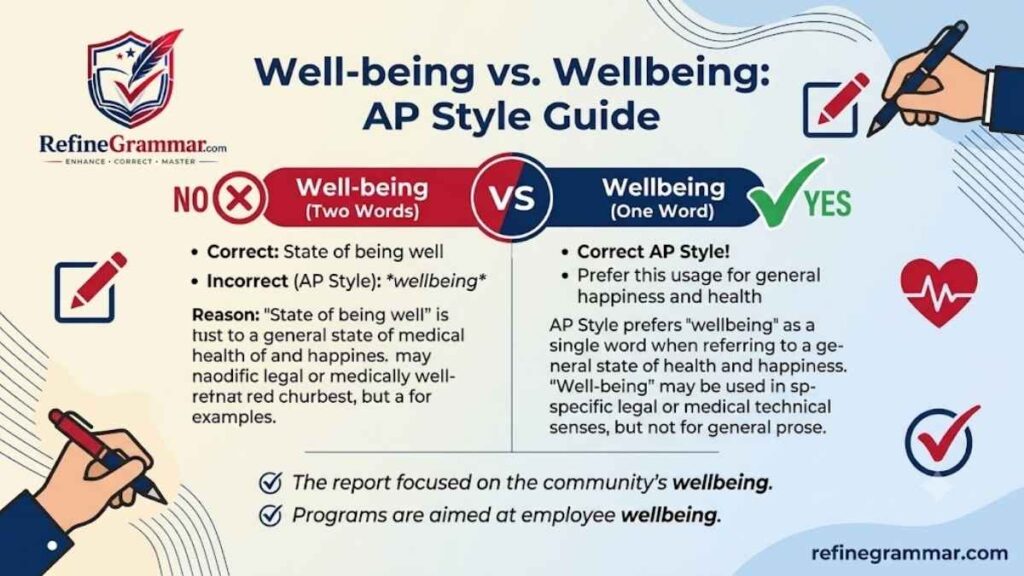
The Associated Press Stylebook is explicit: hyphenate well-being when using it as a noun meaning happiness and good health. This places AP firmly on the side of the hyphenated form, consistent with how AP handles other “well” compounds like “well-known” and “well-dressed.”
Wellbeing or Well Being Oxford Dictionary
Oxford lists “well-being” as the headword, with “wellbeing” noted as an accepted one-word variant that’s gained traction, particularly in British usage. Oxford does not recognize “well being” written as two separate words as a standard noun form.
Wellbeing or Well Being Merriam Webster
Merriam-Webster’s entry defines the noun as “well-being,” describing it as the state of being healthy, happy, or prosperous. The dictionary does not list “well being” as an alternate spelling, reinforcing that the hyphen is the standard American choice.
Wellbeing or Well Being Chicago Style
The Chicago Manual of Style follows Merriam-Webster’s lead for spelling questions and therefore recommends “well-being” in professional, academic, and publishing contexts. Chicago-style writers rarely have reason to deviate from the hyphenated form.
Which Should You Use?
Deciding between Well-Being vs. Wellbeing usually comes down to context. For nearly all formal, academic, journalistic, or business writing, well-being is the safest and most broadly correct choice. If you’re writing casual blog content, UK-focused wellness material, or matching an established brand voice that already uses “wellbeing,” the one-word form is acceptable and won’t confuse readers. What you should avoid in almost every situation is the two-word “well being” used as a noun, since virtually no dictionary or style guide endorses it that way.
When to Use Wellbeing vs Well-Being
- Use well-being for academic papers, resumes, legal documents, and anything following AP, Chicago, or APA style.
- Use wellbeing when writing for a UK audience, a wellness brand that has already adopted the spelling, or informal digital content where brevity matters.
- Avoid well being as a noun entirely; reserve it only for the rare sentence where “well” describes how someone is “being” something, similar to how address is often mistyped without its double letter purely out of habit rather than grammar logic.
Common Mistakes People Make
Even careful writers slip up on Well-Being vs. Wellbeing. The most frequent errors include:
- Treating “well being” as interchangeable with “well-being” in formal writing.
- Switching between “well-being” and “wellbeing” inconsistently within the same document.
- Assuming AP and Chicago disagree on this word, when in fact both recommend the hyphen.
- Confusing the everyday term with technical psychology terms like “subjective well-being,” which follow the same spelling rule but carry a distinct meaning.
- Assuming casual spelling shortcuts are always acceptable, the same way people mistakenly assume homie is just a casual spelling of homey rather than a separate word.
Subjective Well Being vs Wellbeing
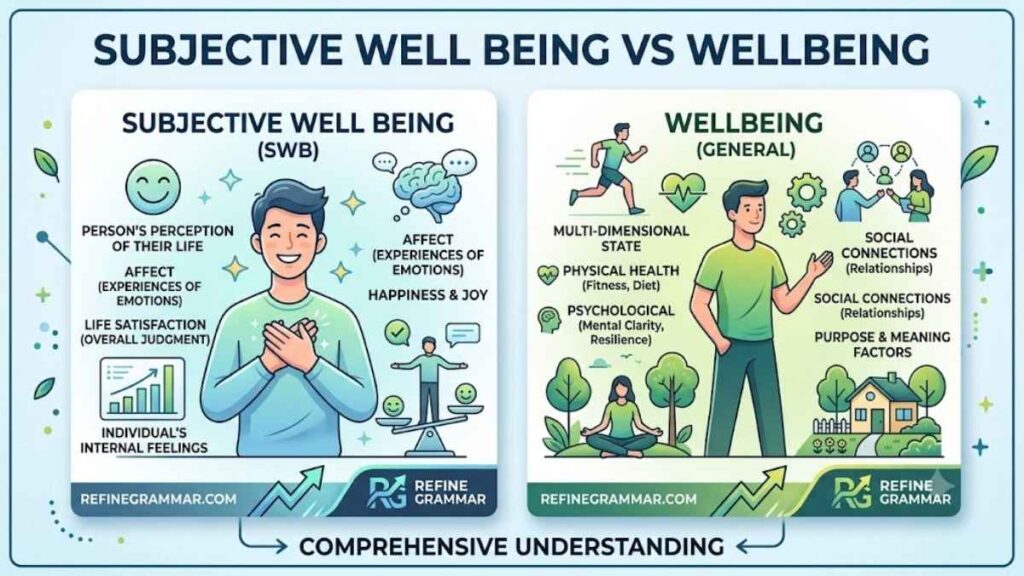
Subjective well-being is a specific psychological concept, popularized by researcher Ed Diener, referring to how people evaluate their own lives combining life satisfaction, positive emotions, and low negative affect. It’s a research term, not a stylistic variant, so the phrase is almost always hyphenated in academic literature: “subjective well-being,” not “subjective wellbeing.”
Psychological Well Being vs Wellbeing
Psychological well-being is a separate academic framework, most associated with psychologist Carol Ryff, focused on dimensions like autonomy, personal growth, purpose in life, and self-acceptance. It differs from general “wellbeing” in that it’s a structured model with measurable components, rather than an umbrella term for feeling good.
Psychological Well Being vs Subjective Wellbeing
While both terms overlap, psychological well-being emphasizes functioning well and realizing one’s potential, whereas subjective well-being emphasizes how a person feels and judges their own happiness. One is about thriving; the other is about self-reported satisfaction. Researchers often measure both together to get a fuller picture of a person’s overall state.
Psychological Well Being vs Emotional Wellbeing
Emotional wellbeing is a narrower concept, focused specifically on managing emotions, resilience, and mood stability. Psychological well-being is broader, encompassing purpose, relationships, and personal growth alongside emotional regulation. In everyday writing, emotional wellbeing is often used more loosely than the clinical term.
Well Being Examples
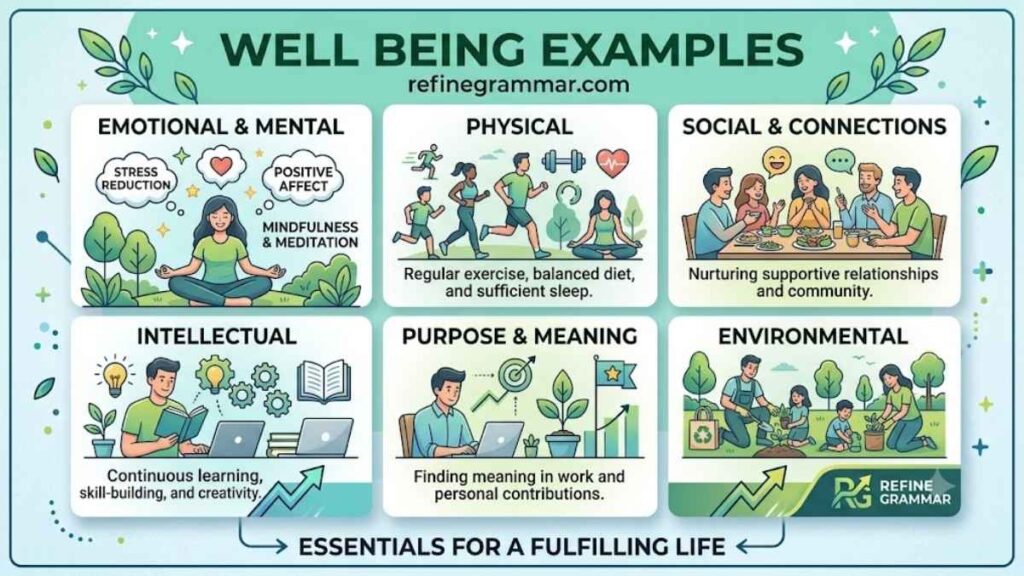
These real-world sentences show how Well-Being vs. Wellbeing plays out across different writing styles.
- “Employers are prioritizing mental well-being through flexible schedules.”
- “The wellness retreat focuses on physical wellbeing and mindfulness.”
- “Financial well-being is just as important as physical health.”
- “Community wellbeing initiatives have grown since 2020.”
FAQs
Is it well-being or wellbeing?
Both are used, but well-being (hyphenated) is the standard spelling in dictionaries and style guides.
Which is correct: well being, well-being, or wellbeing?
Well-being is correct; wellbeing is an accepted variant; well being as a noun is incorrect.
What does the Oxford Dictionary say about wellbeing?
Oxford lists well-being as the primary spelling, with wellbeing noted as an accepted variant.
Does AP Style use wellbeing or well-being?
AP Style hyphenates it as well-being when used as a noun.
Which spelling does Chicago Style recommend?
Chicago Manual of Style recommends well-being, following Merriam-Webster.
Is wellbeing one word in the UK?
Yes, “wellbeing” is common in UK health and government writing, though “well-being” remains the formal standard.
Is well-being or wellbeing used in Canada?
Canadian style guides generally prefer well-being, matching American conventions.
What is the difference between subjective well-being and psychological wellbeing?
Subjective well-being measures self-reported happiness and life satisfaction, while psychological well-being measures functioning, growth, and purpose.
What is the difference between psychological well-being and emotional wellbeing?
Psychological well-being covers a broad range of life dimensions, while emotional wellbeing focuses specifically on mood and emotional resilience.
When should you use wellbeing instead of well-being?
Use wellbeing for UK audiences, established wellness brands, or casual content where the one-word form is already standard.
Conclusion
The Well-Being vs. Wellbeing debate isn’t really a battle it’s a spelling preference with a clear favorite. Well-being, hyphenated, remains the dictionary standard and the safest choice across nearly every style guide and region. Wellbeing works well in casual or UK-leaning contexts, while the two-word “well being” should stay out of your writing as a noun altogether. Much like getting comfortable with commonly confused pairs such as winner versus its frequent misspelling, or the phrase time flies versus its incorrect version, a little awareness goes a long way toward writing with confidence. When in doubt, hyphenate your readers, your editor, and your spell-checker will thank you.
