
If you’ve seen Fein or Fien in a caption, a text, or a song title and paused mid-scroll, you’re not alone. Neither spelling is in a standard dictionary, which is exactly why this pair confuses even confident writers. This guide covers where the term comes from, what it means in slang, how it differs from the business abbreviation FEIN, and when if ever to use it.
Quick Answer
“Fein” (short for feening or fiending) is the spelling you’ll see most, describing an intense craving. “Fien” is a rarer variant of the same idea. “Feen” is the older British and Irish form, historically meaning “man” or “guy,” though it now carries the craving sense too. None are standard English words, so there’s no single official spelling in formal writing, skip the slang and use “craving” or “eager” instead.
Quick Comparison Table
| Spelling | Context / Region | Meaning | Formality |
| Fein | US internet slang (most common) | Craving something intensely | Informal |
| Fien | Rare variant spelling | Same as “fein” | Informal |
| Feen | UK / Irish slang | A man or guy; also “craving” in newer use | Informal |
| FEIN | US business / tax | Federal Employer Identification Number | Formal |
What Does Fein or Fien Mean?
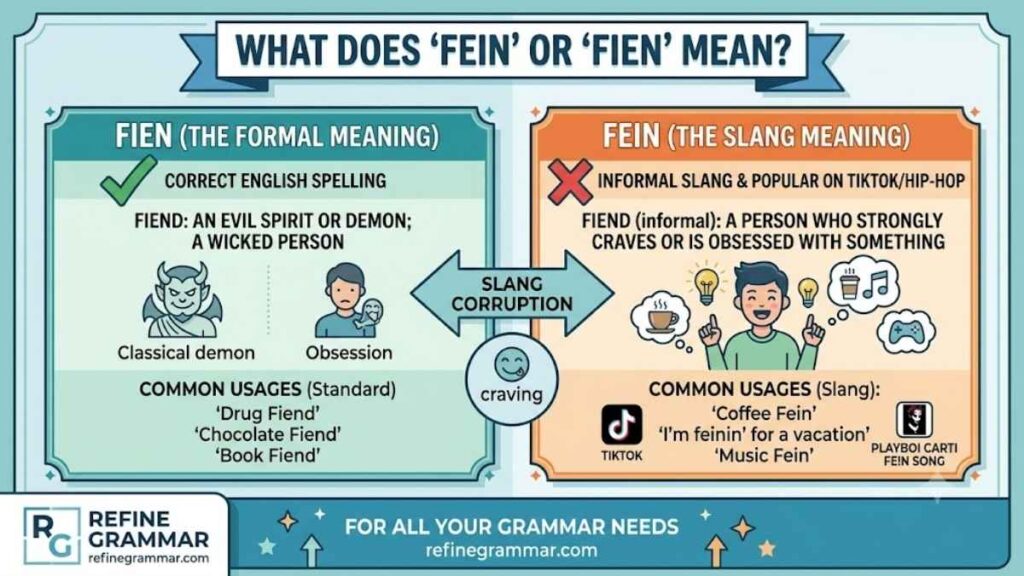
Meaning
Wanting something so badly it feels like an obsession craving coffee, missing a partner, or wanting one song on repeat all day.
Usage
Mostly seen in captions and texting, almost always as the verb feening or fiending: “I’m fein for tacos rn.”
Fein Meaning
On its own, “fein” has three unrelated meanings: slang for feening, a German-origin surname (the power-tool brand Fein is named after founder Wilhelm Emil Fein), and, in caps, the business abbreviation FEIN. Context and capitalization tell you which applies.
Fein or Fien Meaning
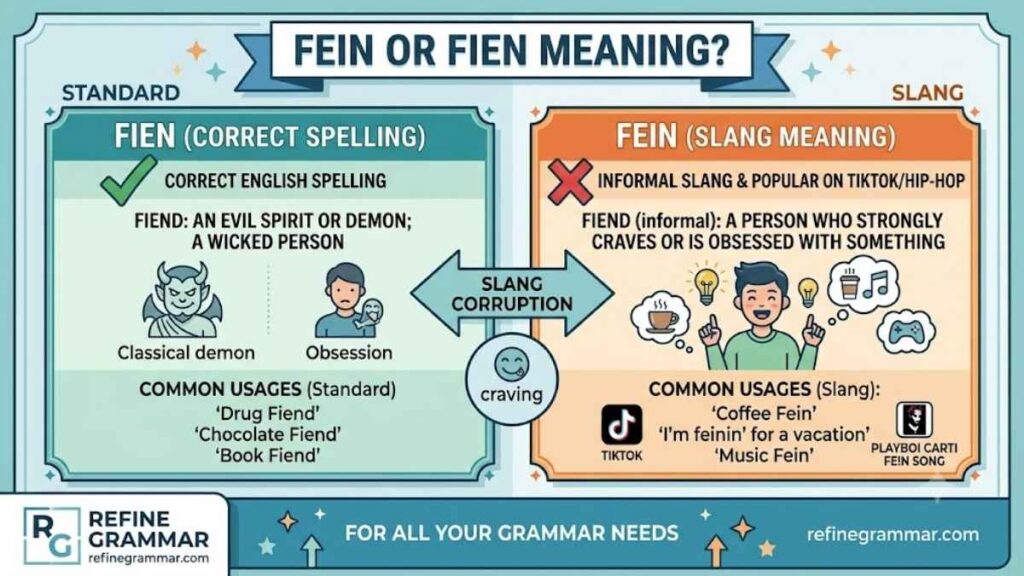
Searchers are almost always after the slang sense an urgent desire for food, attention, a person, or an experience. It works like “dying for,” just with more internet edge.
Is It Spelled Fien or Fein?
“Fein” is by far the more common spelling, since it mirrors pronunciation. “Fien” shows up occasionally from writers matching the vowel pattern in “fiend,” the word this slang ultimately comes from.
Are Both Spellings Correct?
Neither is “correct” in the dictionary sense, since no style guide has standardized the term. Both are fine casually, because slang spelling follows popular usage, not fixed rules.
Why People Confuse These Words
- Fein and fien sound identical spoken aloud, with no audio cue to guide the spelling.
- Autocorrect often “fixes” either into “fine.”
- Most people learn the word by ear from social media, not by reading it.
- It resembles other look-alike pairs, like knaw or gnaw or the common misspelling inportant instead of important.
Grammar Rule Behind the Difference
The “i before e, except after c” guideline doesn’t apply here, since this isn’t a dictionary word slang spelling follows sound, not orthography. For a pair where one spelling actually is wrong, see address or adress.
Fein or Fien Slang
As slang, it’s shorthand for feening or fiending craving something intensely, whether that’s food, a person, or an experience like a concert.
Fein or Fien Urban Dictionary
Crowdsourced entries for both spellings agree on the “intense craving” meaning while disagreeing on which looks more “correct.” Useful for gauging popular usage, not an authoritative source.
Fein or Fien or Feen
Add “feen” and it gets more layered: the older spelling, rooted in British and Irish slang, originally meant simply “a man” or “a stranger.” The related verb “to feen” later merged into today’s online spelling through US street slang.
Feen, Fein or Fien
For UK or Irish readers, “feen” meaning “guy” may still register. For everyone else, especially US audiences, the craving sense is the one people recognize.
Fien or Fein Origin
“Feen” traces to Shelta, a language historically used by Irish Travellers and drawing on Irish Gaelic, where a similar word means “man.” The craving sense, separately, developed in American street slang from “fiending,” itself from “fiend.” These two threads collided online, which is why the spelling never settled.
Fein or Fiend
“Fiend” is the root word behind the whole spelling family someone with an extreme enthusiasm or compulsion for something, predating the slang clipping by decades.
Fein or Fiend Meaning
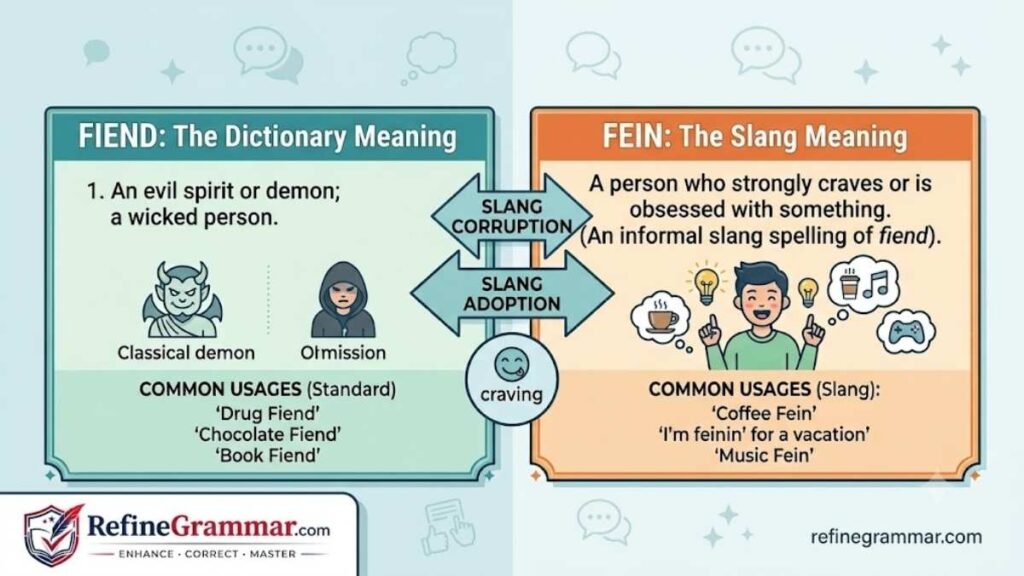
Formally, a fiend can mean an evil spirit or, more commonly today, someone intensely enthusiastic about a specific thing a “chocolate fiend.” The slang verb borrows from this lighter sense.
Fein or Fiend Urban Dictionary
Crowdsourced definitions for “fiend” track the dictionary meaning closely someone consumed by a craving and most link it directly to the clipped slang verb.
Dope Fiend or Fein
“Dope fiend” was historically a phrase for drug dependency, and that’s part of the word’s history. The modern, clipped spelling has broadened well beyond that context and is now used casually for cravings of any kind, with most current usage carrying no drug-related meaning at all.
Meaning of FE!N Travis Scott
The stylized title “FE!N,” a 2024 track by Travis Scott featuring Playboi Carti, nods to the same slang meaning, with the exclamation point standing in for “I.” The song’s popularity is a major reason searches for Fein or Fien spiked.
What Does Fein Mean in the Bible?
“Fein” doesn’t appear in any major Bible translation. The confusion usually comes from “feign” (to pretend), which does appear in older translations describing false prophecy.
Is Fein a Bad Word?
No. It’s informal slang, not profanity casual rather than offensive, though still too informal for professional writing.
Is Fein a Cuss?
No, Fein or Fien isn’t a swear word or slur it simply describes craving something.
What Is Fein in Business?
FEIN stands for Federal Employer Identification Number, the nine-digit number the IRS assigns businesses for tax purposes. It’s functionally identical to an EIN; “FEIN” is just the older, fuller name still used on some forms.
Where Can I Find the FEIN?
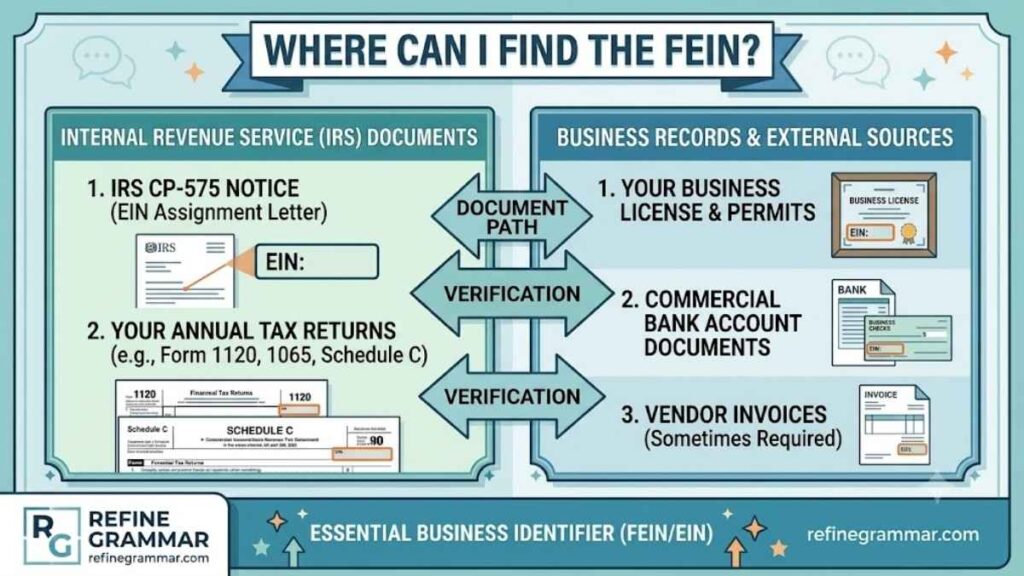
- The IRS confirmation letter (Form CP 575)
- Prior years’ business tax returns
- Business bank account or loan paperwork
- State business registration documents
- Payroll records, including W-2 or 1099 forms
Can I Look Up My FEIN?
Yes. For your own business, the IRS Business & Specialty Tax Line can retrieve a lost FEIN. For public companies, FEINs often appear in SEC filings. There’s no public lookup tool for private businesses, mainly for privacy and fraud-prevention reasons.
Fein SP
“Fein SP” isn’t an established term in either sense covered here it doesn’t appear in dictionaries or common usage data. If you saw it as a brand name or username, that meaning is local to that source.
British English vs American English
American slang favors “fein”; British and Irish English is more likely to keep “feen,” carrying both its older “man/guy” sense and the newer craving sense. “Fien” has no strong regional home it’s more a spelling variant than a dialect marker.
Which One Should You Use?
US Audience
Use “fein” the version most US readers already recognize.
UK Audience
“Feen” reads more naturally, especially with older readers.
International Writing
Skip the slang for readers outside English-speaking slang circles; use “craving” instead.
Academic Writing
Avoid it entirely. Use “strong desire” or “craving.”
Professional Writing
Reserve “FEIN” for its business meaning only.
Real-World Usage Examples
Fein or Fien in a Sentence
“Honestly, I’m fein for a slice of pizza right now.”
Emails
Slang has no place in email; write “I’m really looking forward to next week’s meeting” instead.
Business Writing
“Please include your FEIN on the attached W-9 form.”
Academic Writing
“Participants reported a strong craving for the reward stimulus” never the slang form.
Social Media
“Not me fein for tacos at 2am again 😭”
Everyday Conversations
“Ugh, I’m fein for my bed after that shift.”
Common Mistakes to Avoid
1. Using the slang in formal writing or client communication.
2. Mixing it up with the business abbreviation FEIN.
3. Assuming there’s one “correct” spelling.
4. Confusing “fein” with “fine” or “feign.”
5. Overusing the slang until it reads as forced.
Usage Trends
Interest in Fein or Fien has climbed since 2024, driven largely by the Travis Scott track and short-form video. The slang spelling consistently outpaces “fien” and “feen” in day-to-day use, especially among younger US audiences.
Fein or Fien Reddit
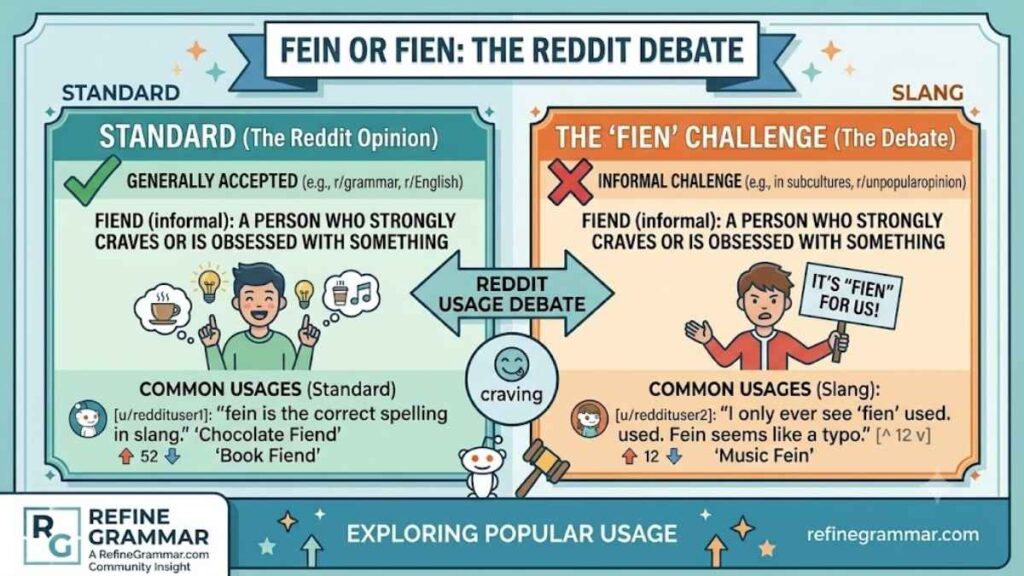
Reddit threads echo the same debate: most agree on the craving meaning but disagree on which spelling looks “right,” with some pointing to “fiend” as proof neither is technically accurate.
Related Words Readers May Also Confuse
This isn’t the only pair that trips people up. Readers also often search the difference between repore and rapport, whether it’s winner or winer, the correct form of homey or homie, and whether the saying goes time flies or time flys. Knowing pairs like the homey vs. homie spelling debate makes it easier to spot informal spelling patterns like this one.
FAQs
Is fein or fien correct spelling?
Neither is officially “correct” since both are informal slang, but “fein” is far more common.
How do you spell drug fein?
The older, drug-specific phrase is typically spelled “dope fiend.”
What does fein mean?
As slang, craving something intensely; in business, FEIN is a Federal Employer Identification Number.
Is fein a real word?
Not a standalone dictionary entry it’s a slang clipping of “feening/fiending,” from “fiend.”
Is fein a bad word?
No, it’s informal slang, not profanity.
Is fein a cuss?
No, it isn’t a curse word or slur.
What does fein mean in slang?
An intense craving or obsession, like saying you’re “dying for” something.
Why is FE!N popular?
Travis Scott’s 2024 song “FE!N” brought the slang term to a much wider audience.
What does FEIN mean in business?
Federal Employer Identification Number, the IRS-issued tax ID for businesses.
Can I use fein in formal writing?
No use “craving” or “eager” instead.
Conclusion
Fein or Fien isn’t a spelling error waiting to be corrected it’s living slang with a genuinely interesting backstory, tangled up with British and Irish roots, American street slang, and a 2024 hit song. Use “fein” for the version most readers recognize, save “feen” for UK and Irish audiences, and keep the slang out of anything formal, where FEIN should only ever mean a business tax number.
