
If you have ever typed a sentence and then stopped to wonder whether it should be long term or longterm, you are in good company. This exact question long term or longterm shows up in business emails, investment reports, school essays, and healthcare documents every single day.
The good news is that the rule is not complicated once you see it clearly. In this guide, you will learn the correct spelling, the grammar reason behind it, real-world examples, and the mistakes to avoid so you never second-guess long term or longterm again.
What Is the Correct Spelling: Long Term or Longterm?
Quick Answer
The short answer to long term or longterm is this: “long term” (two words) and “long-term” (hyphenated) are both correct, depending on how the phrase is used in a sentence. “Longterm” as a single word is not considered standard English by any major dictionary or style guide.
Why the Confusion Exists
The long term or longterm debate exists because English often merges common phrases into single words over time think “online” or “nowadays.” Writers assume the same pattern applies here, but “long term” has not made that shift. Search engines also show a mix of correct and incorrect spellings, which adds to the confusion.
Dictionary Consensus
Every major English dictionary agrees on the long term or longterm question: the one-word spelling is What Is the Correct Spelling Long Term or Longterm
listed as an accepted entry. Instead, dictionaries list “long-term” as an adjective and treat “long term” as a two-word noun phrase describing a period of time.
Understanding the Difference Between Long Term and Long-Term
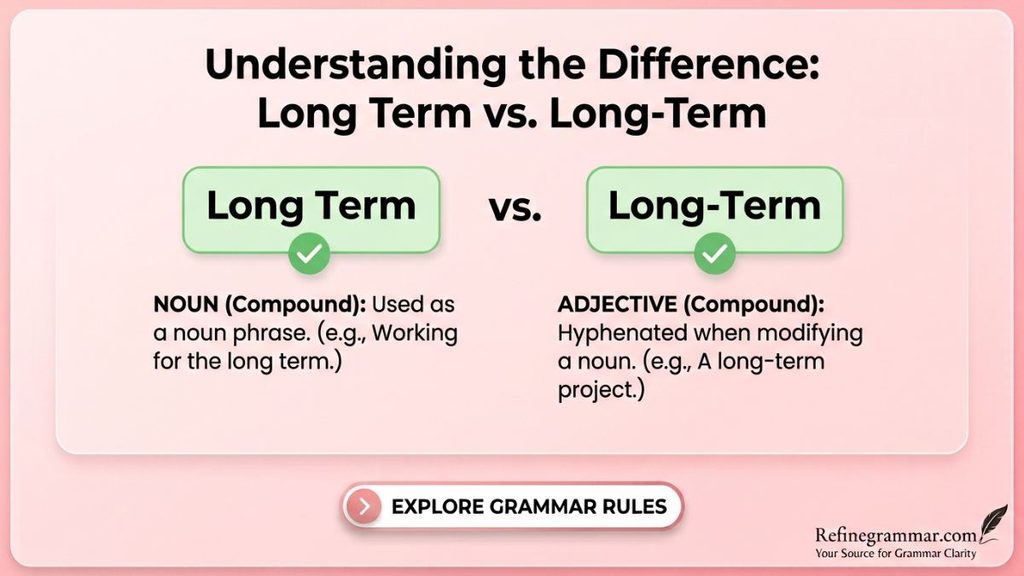
Long Term as a Noun Phrase
When “long term” refers to a stretch of time rather than describing something, it stays open as two words. Example: “This strategy will pay off in the long term.” Here, the phrase behaves like a noun and follows a preposition such as “in” or “for.”
Long-Term as a Compound Adjective
When the phrase sits directly before a noun and describes it, it becomes “long-term” with a hyphen. Example: “She has a long-term goal.” The hyphen tells the reader that “long-term” is working as one descriptive unit, not two separate words.
Easy Rule to Remember
If a noun comes right after the phrase, hyphenate it. If the phrase stands on its own, leave it open. This one rule solves almost every long term or longterm question you will ever run into.
Why Longterm Is Usually Incorrect
The Internet Does Not Always Follow Grammar Rules
Casual writing on social media and forums often merges words for speed, which is why “longterm” appears online more than it should. This informal habit is a major reason the long term or longterm confusion keeps spreading.
Professional Writing Standards
In business reports, academic papers, resumes, and healthcare documentation, editors and style guides consistently reject the closed form. If you want your writing to look polished, treat the long term or longterm choice as settled: never use the single-word version in formal contexts.
When Might You See Longterm?
You may occasionally spot “longterm” as a brand name, a domain name, or informal shorthand in texting. Outside of these narrow cases, it has no place in standard writing.
Long Term vs Long-Term: Real Examples
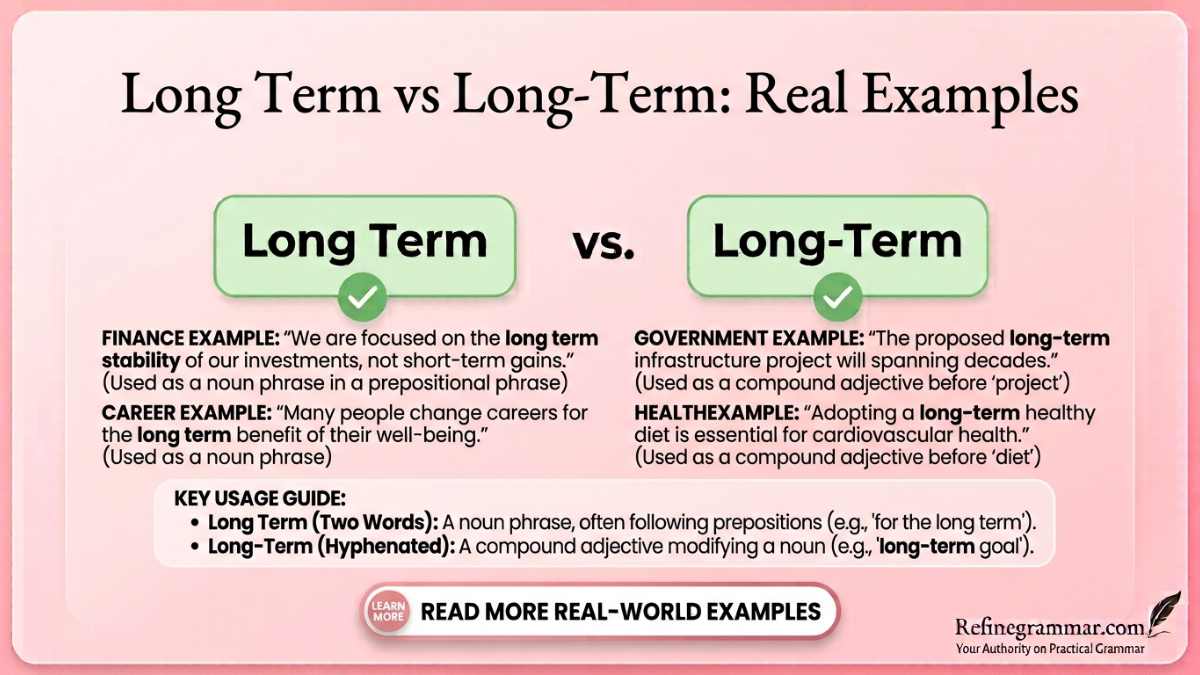
Seeing the long term or longterm rule applied across different fields makes it easier to remember. Below are examples from four common writing contexts.
Example 1: Business Writing
Correct: “Our company is building a long-term partnership with this vendor.”
Example 2: Investment Discussion
Correct: “Investors who think in the long term usually see steadier returns.”
Example 3: Education
Correct: “The scholarship supports long-term academic success.”
Example 4: Healthcare
Correct: “She was moved into long-term care after surgery.”
| Sentence Position | Correct Form | Example |
| Before a noun (adjective) | long-term | a long-term investment |
| After a verb or preposition (noun phrase) | long term | plan for the long term |
| As a single fused word | longterm (avoid) | not accepted in formal writing |
A Simple Step-by-Step Method to Choose the Correct Form
Step 1: Find the Phrase
Locate where “long term” appears in your sentence.
Step 2: Check What Comes Next
Ask whether a noun immediately follows the phrase.
Step 3: Use a Hyphen If Needed
If a noun follows, write “long-term” with a hyphen.
Step 4: Leave It Open If It Stands Alone
If no noun follows, keep it as two separate words: “long term.”
Step 5: Avoid Longterm
Never fuse the words into one the long term or longterm choice never favors the closed form.
Case Study: How a Small Business Improved Its Professional Writing
A mid-sized marketing agency noticed that client proposals mixed “longterm,” “long term,” and “long-term” inconsistently across the same document.
After training staff on the long term or longterm rule and adding a quick style check before sending proposals, client feedback on “professionalism” improved, and the agency reported fewer requests for revisions related to tone and polish. The fix cost nothing it simply required consistent attention to one small grammar rule.
Read More: Complaint vs Complain: The Complete Guide (With Examples)
Grammar Trends and Language Data in 2025–2026
Growth of Compound Words
English does gradually close some compound phrases over decades. However, language-usage tracking tools still show “long-term” and “long term” dominating written English, while the closed form remains a minor, informal variant.
What Current Usage Shows
Recent usage data through 2025 and into 2026 confirms that “long-term” is far more common in edited, published text than “longterm,” reinforcing that the long term or longterm debate is settled in favor of the hyphenated and open forms.
What This Means for Writers
Following current usage data protects your credibility. Readers and editors alike associate the correct long term or longterm spelling with careful, trustworthy writing.
Read More: Optimisation or Optimization? Correct Spelling Explained
Common Mistakes Writers Make
Mistake 1: Omitting the Hyphen
Writing “long term goals” instead of “long-term goals” before a noun.
Mistake 2: Adding an Unnecessary Hyphen
Writing “in the long-term” when the phrase should stay open as “in the long term.”
Mistake 3: Writing Longterm as One Word
Fusing the phrase entirely, which no major dictionary accepts.
Mistake 4: Switching Between Forms
Using different spellings inconsistently within the same document.
Mini Quiz: Long Term or Longterm
Test yourself with these quick checks. Each answer follows the rule you just learned about long term or longterm.
Mini Quiz 1: Spot the Correct Form
“A lease.” Answer: long-term (before a noun).
Mini Quiz 2: Add the Hyphen?
“We plan for the.” Answer: long term (no hyphen).
Mini Quiz 3: Quick Grammar Check
“Her vision guided the company.” Answer: long-term.
Mini Quiz 4: True or False
“Longterm” is dictionary-approved. Answer: False.
Mini Quiz 5: Choose the Winner
long term vs longterm as a noun. Answer: long term.
Mini Quiz 6: Fill in the Blank
“This is a solution.” Answer: long-term.
Mini Quiz 7: Hyphen Hero
“Success in the takes patience.” Answer: long term.
Mini Quiz 8: Fast Choice
long-term care vs longterm care. Answer: long-term care.
Mini Quiz 9: True or False
A hyphen is used before a noun. Answer: True.
Mini Quiz 10: Find the Correct Sentence
“They think long term.” Answer: Correct as written.
Mini Quiz 11: One Word or Two?
long term is always… Answer: two words, never one.
Mini Quiz 12: Grammar Challenge
“A employee.” Answer: long-term.
Mini Quiz 13: Easy Pick
long-term growth vs longterm growth. Answer: long-term growth.
Mini Quiz 14: Quick Knowledge Test
Which form do dictionaries reject? Answer: longterm.
Mini Quiz 15: Final Grammar Check
“In the, prices usually rise.” Answer: long term.
Frequently Asked Questions
Is “longterm” or “long term” the correct spelling?
“Long term” or “long-term” is correct; “longterm” is not standard English.
Is longterm one word or two words?
It should be two words (“long term”) or hyphenated (“long-term”), never fused into one.
Should “long term” be hyphenated or written as one word?
Hyphenate it only before a noun; otherwise keep it as two separate words.
Does “long term” require a hyphen (dash)?
Only when it directly modifies a noun that follows it.
When should I use a hyphen in “long term”?
Use a hyphen when the phrase acts as an adjective, such as “long-term plan.”
What does “long term” mean?
It refers to something that continues or matters over an extended period of time.
What is considered long term?
Context decides this, but it usually means several years or more, depending on the field.
Does long term mean forever?
No, it means an extended period, not necessarily permanent or unending.
How many months or years is considered long term?
It varies by industry, but finance and health fields often define it as five years or more.
How do you correctly spell “long term”?
Spell it as two words for a noun phrase, or hyphenated as “long-term” before a noun.
Related Word Confusions You Might Also Want to Check
The long term or longterm mix-up is just one of many spelling puzzles English writers face. If you enjoyed clearing this one up, these related guides tackle other commonly confused words and phrases:
Final Thought
The long term or longterm question always comes down to one simple test: check whether a noun follows the phrase. Use “long-term” before a noun, keep “long term” open everywhere else, and leave “longterm” out of your writing entirely. Master this one rule, and you will never hesitate over long term or longterm again.
