
English is full of word pairs that look almost identical but mean completely different things, and paster or pastor is one of the most searched examples. One word belongs in a church bulletin. The other belongs in a printing shop.
Mix them up and your sentence sends the wrong message entirely. This guide breaks down the paster or pastor confusion in plain language, with definitions, origins, comparison tables, and real examples so you never second-guess the spelling again.
Paster or Pastor: Quick Answer ✅⚡
Main Difference:
A pastor is a religious leader who guides a church congregation. A paster is a rare word for a person or machine that applies paste, glue, or adhesive labels. When people ask whether it’s paster or pastor, they almost always mean the church leader that word is pastor.
Examples:
- Our new pastor delivered his first sermon on Sunday.
- The factory hired a paster to operate the labeling machine.
- She has served as pastor of this church for ten years.
Definitions with Examples 📖✍️
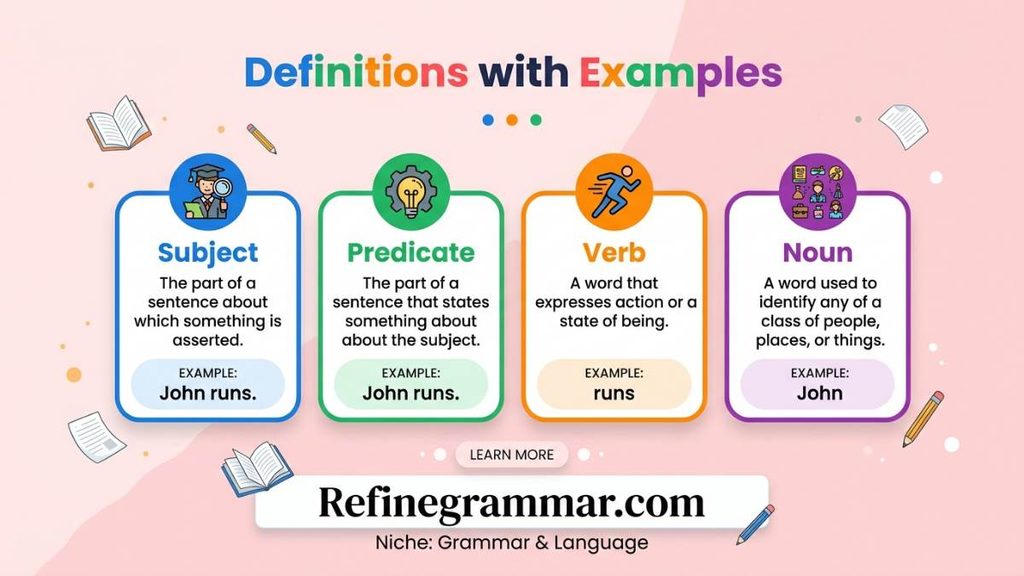
Pastor (Definition)
Pastor is a noun that describes a Christian minister or spiritual leader responsible for teaching, counseling, and guiding a congregation. It is the far more common of the two words in everyday English, appearing in speech, church bulletins, news articles, and social media.
Examples:
- The pastor welcomed new members after the service.
- My grandfather was a pastor for over thirty years.
- The community thanked the pastor for his guidance.
Paster (Definition)
Paster is a noun that refers to someone, or something such as a machine, that pastes or sticks materials together think labels, posters, or packaging seals. It is a technical or occupational term and rarely shows up outside manufacturing, printing, and crafts.
Examples:
- The box paster machine sealed each carton automatically.
- He worked as a wallpaper paster before switching careers.
- A poster paster is responsible for hanging notices around the city.
Simple Meaning
Pastor preaches. Paster pastes. That one-line memory trick is the fastest way to settle the paster or pastor debate whenever you’re unsure which spelling fits your sentence.
The Origin of Pastor and Paster 📜⏳
Pastor Origin
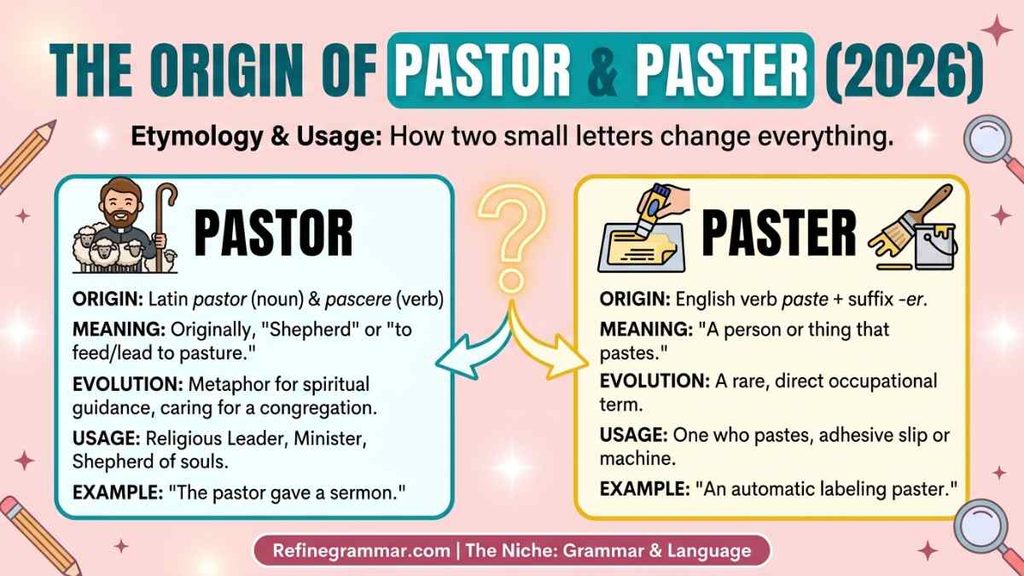
Pastor comes from the Latin word pastor, meaning “shepherd.” The metaphor carried into English through religious tradition, where a pastor is seen as someone who “shepherds” or cares for a flock of believers, much the way a mentor guides and protects those under their care.
Paster Origin
Paster is formed from the verb paste plus the agent suffix -er, meaning “one who pastes.” Paste itself traces back to the Latin pasta, referring to a soft, sticky substance. So a paster is simply someone or something that applies that substance to join materials together.
British English vs American English Spelling 🌍��������
Key Point:
Both British and American English spell these words identically. There is no regional variation here the paster or pastor question is about meaning, not dialect. British writers may also use vicar, minister, or priest depending on denomination, but pastor itself is spelled the same on both sides of the Atlantic.
Comparison Table:
| Region | Word Used for Church Leader | Spelling of “Paster” |
| American English | Pastor | Paster (unchanged) |
| British English | Pastor / Vicar / Minister | Paster (unchanged) |
Paster vs Pastor: Key Difference Explained 📊⚖️
Comparison Table:
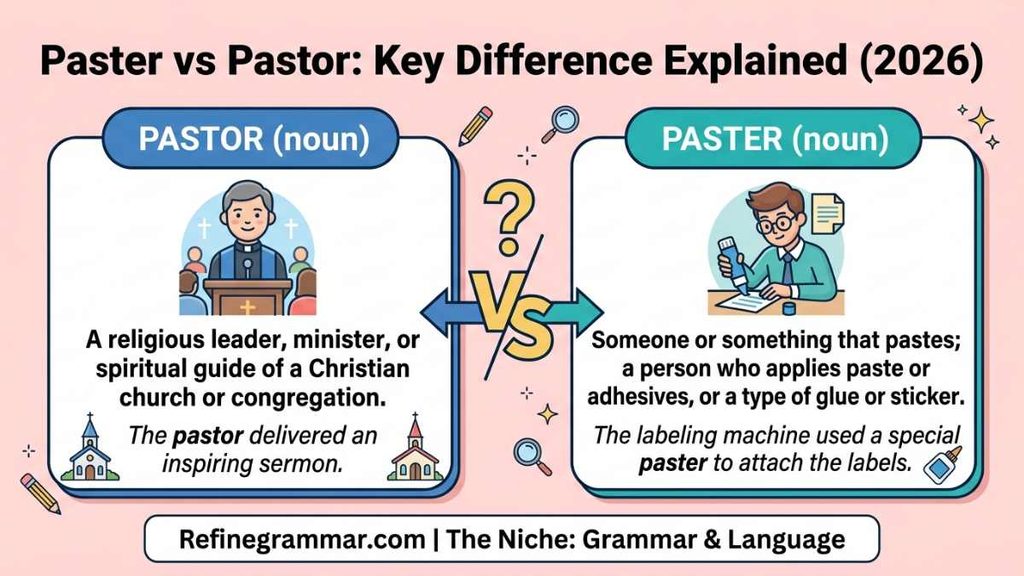
| Feature | Pastor | Paster |
| Meaning | Church or spiritual leader | Person/tool that applies paste |
| Word Origin | Latin “pastor” (shepherd) | Verb “paste” + “-er” |
| Common Usage | Very common | Rare, mostly technical |
| Typical Context | Religion, ministry, sermons | Printing, packaging, crafts |
| Part of Speech | Noun | Noun |
Example:
Incorrect: “The paster gave a moving sermon.” Correct: “The pastor gave a moving sermon.” Swapping just one letter completely changes who or what the sentence is describing.
Which Spelling Should You Use? 🎯📝
Use Pastor When:
- You’re writing about a church, ministry, or religious leader
- The subject teaches, preaches, or counsels a congregation
- You’re describing a job title in a Christian denomination
Use Paster When:
- You’re describing someone who applies glue, paste, or labels
- You’re referring to industrial or craft equipment, like a box paster
- The context involves printing, packaging, or poster installation
Easy Tip
If the sentence could involve a sermon, a congregation, or a church, choose pastor. If it could involve glue, labels, or posters, choose paster. This quick filter resolves almost every paster or pastor mix-up instantly.
Usage Tip (Very Important) 🧠✨
Spell-check tools often miss this error because both paster and pastor are technically valid English words neither one gets flagged as a typo. That’s exactly why the pastor or paster confusion slips through so often, even in printed church bulletins and professional emails. Always proofread by reading the sentence aloud and asking which meaning actually fits.
Examples:
- Spell-check accepted: “The paster blessed the congregation.” (Still wrong should be pastor.)
- Correct after proofreading: “The pastor blessed the congregation.”
Common Mistakes with Paster or Pastor ❌⚠️
1. Mixing Meanings
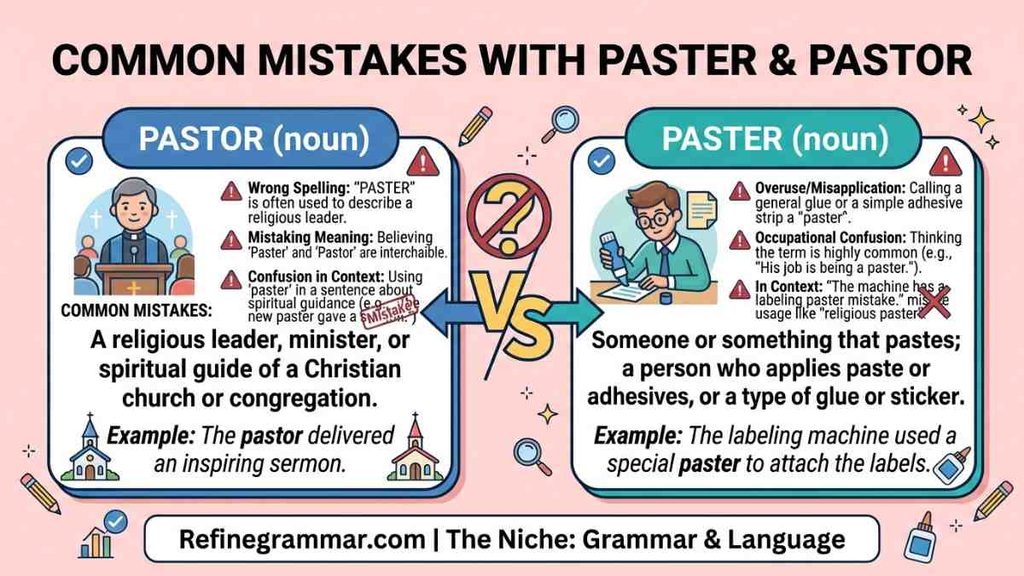
Writers sometimes assume paster is just an alternate spelling of pastor. It isn’t the two words describe entirely different roles, one spiritual and one mechanical.
2. Spelling Confusion
This kind of mix-up isn’t unique to paster or pastor. Similar look-alike pairs trip people up constantly, including career or carrer spelling confusion, cocoon or cacoon spelling mistakes, and sponser vs sponsor errors. Recognizing the pattern helps you catch these mistakes faster in your own writing.
3. Using Wrong Context
Context is everything. Just as people confuse emersion vs immersion or mix up encorporate vs incorporate, using paster where pastor belongs (or the reverse) changes the entire meaning of a sentence rather than just its spelling.
4. Typing Errors
Fast typing and autocorrect are common culprits. The same happens with meating vs meeting typos, grately vs greatly typing slips, and ladle vs ladel spelling mix-ups. A quick second read before hitting send catches most of these errors.
Pastor and Paster in Everyday Examples 💬📱
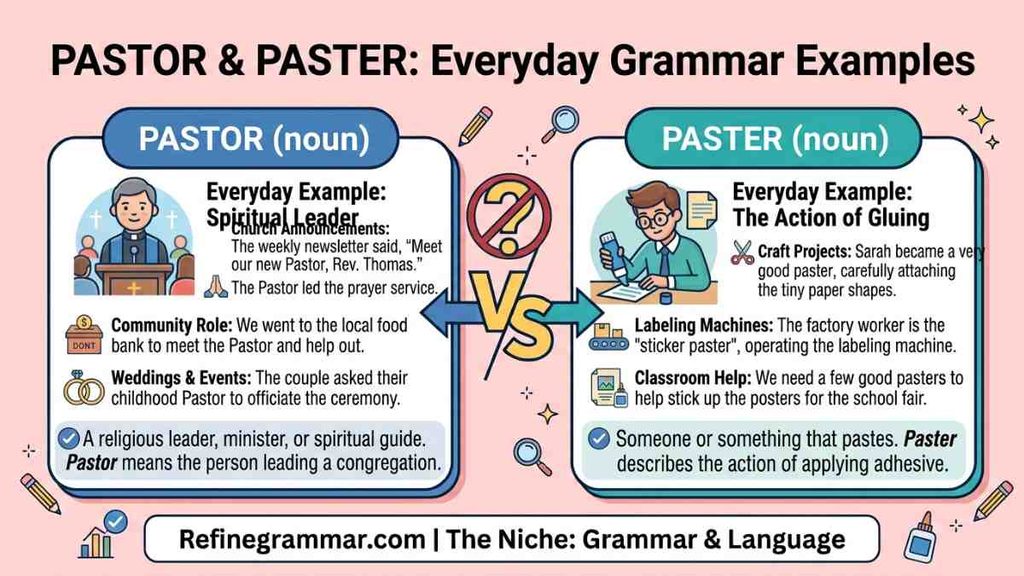
Religion
- The pastor led the congregation in prayer.
- She was ordained as a pastor last spring.
Work
- The paster operates the sealing machine on the packaging line.
- His job title is officially listed as “box paster.”
Social Media
- “Just heard the best sermon from our pastor today! 🙏”
- “Looking for a paster job in the printing industry.”
Daily Use
- We invited the pastor over for dinner after church.
- He used a handheld paster to fix the torn wallpaper.
Read Moee: Long Term or Longterm? The Correct Spelling Explained (2026)
Pastor vs Paster: Google Trends & Usage Data 📊📈
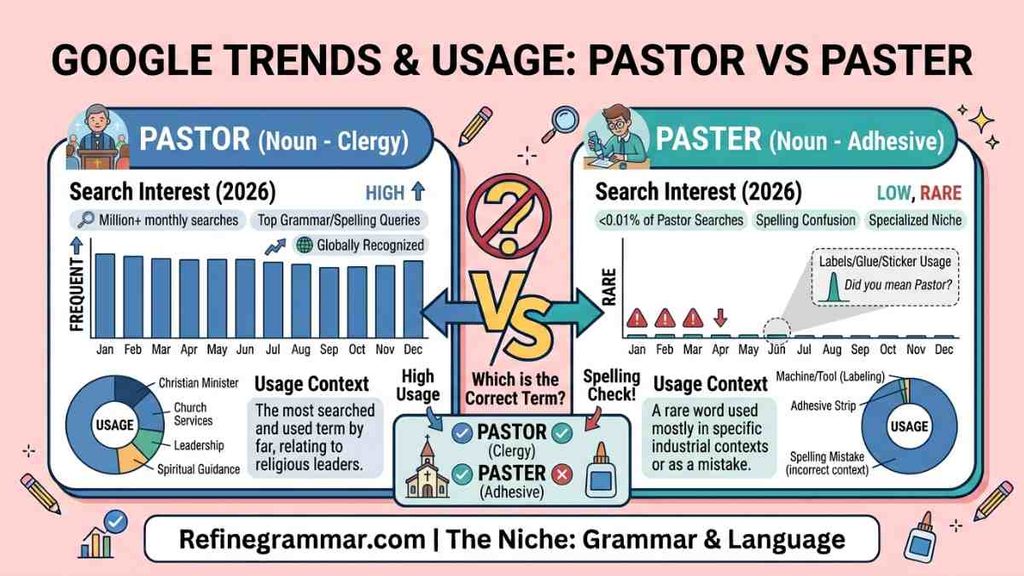
Trends:
Search interest heavily favors pastor over paster, since religious leadership is a far more common topic than adhesive equipment. Even so, the paster or pastor comparison itself draws steady search traffic from writers, students, and ESL learners trying to avoid a spelling slip.
Region Table:
| Region | Preferred Word | Common Alternate Titles |
| United States | Pastor | Reverend, Minister |
| United Kingdom | Pastor / Vicar | Priest, Chaplain |
| Global (English) | Pastor | Preacher, Shepherd (informal) |
Top 10 Searches:
- paster or pastor
- pastor or paster which is correct
- pastor meaning
- paster meaning
- is paster a word
- pastor vs paster pronunciation
- female pastor title
- pastor sentence examples
- box paster machine
- difference between pastor and paster
Comparison Table 📋⚖️
| Word | Definition | Example Sentence |
| Pastor | A religious leader who guides a congregation | The pastor prayed with the family. |
| Paster | A person or machine that applies paste or adhesive | The paster sealed every box on the line. |
Frequently Asked Questions
How do you spell pastor in church?
It’s spelled “pastor” the correct term for a church’s spiritual leader.
Is it spelled pastor or paster?
For a church leader, it’s “pastor.” “Paster” only applies to someone who pastes or glues materials.
What does paster mean?
A paster is a person or tool that applies paste, glue, or adhesive labels, often in printing or packaging.
What is the meaning of “pasteur”?
Pasteur is typically a proper noun, most famously linked to scientist Louis Pasteur; it isn’t a common English noun like pastor or paster.
What’s the difference between a pastor and a paster?
A pastor leads a congregation spiritually; a paster applies paste or adhesive in technical or industrial work.
Who is called a pastor?
Anyone ordained or appointed to lead, teach, and care for a Christian congregation is called a pastor.
What is a female pastor called?
A female pastor is still called “pastor”; the title is gender-neutral in most denominations.
What do Christians call their pastor?
Most call them “pastor,” while some traditions use “reverend,” “minister,” or “preacher.”
What is a slang term for “pastor”?
Informally, people sometimes say “preacher” or “shepherd” as friendly stand-ins for pastor.
What is a nickname for a pastor?
Common nicknames include “Pastor [First Name],” “Rev,” or simply “Preacher.”
Final Thought
The paster or pastor mix-up comes down to one letter with two very different meanings. Remember: pastor preaches, paster pastes. Keep that trick in mind, and you’ll never misspell it again.
