
If you’ve ever paused mid-sentence wondering whether to write cocoon or cacoon, you’re dealing with one of English’s sneakiest spelling traps. The two words look almost identical and sound nearly the same when spoken aloud, yet only one belongs in standard writing. This guide settles the cocoon or cacoon debate once and for all, walking through the correct spelling, the real meaning behind the word, and why the mix-up happens so often. Whether you’re writing a school essay, a blog post, or a professional email, getting cocoon or cacoon right protects your credibility and keeps your writing polished.
Try Our Free Grammar Checker Tool
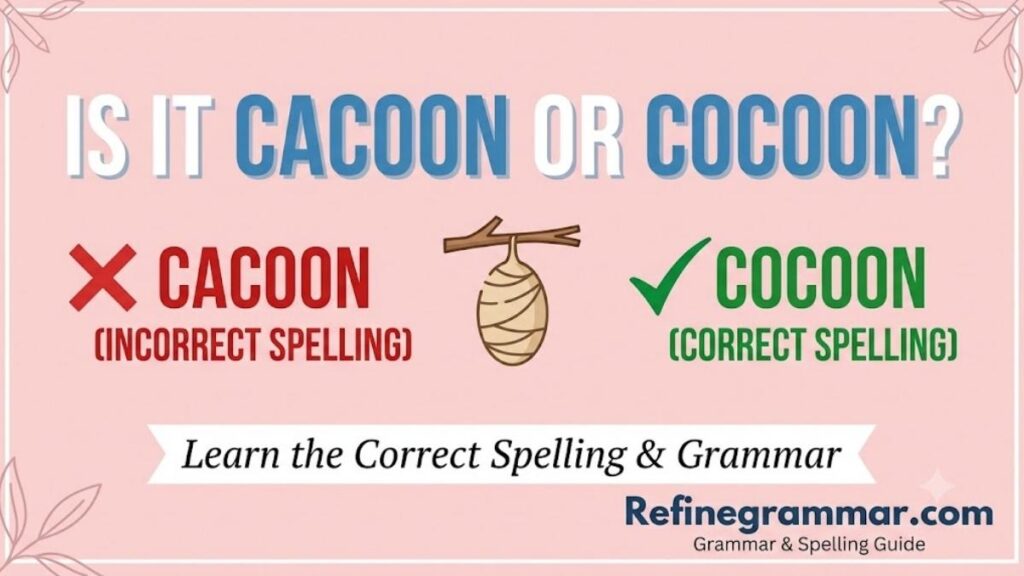
What Is the Correct Spelling: Cacoon or Cocoon?
Quick Answer
The correct spelling is cocoon. When it comes to cocoon or cacoon, dictionaries, encyclopedias, and grammar authorities all agree that cocoon is the only standard English spelling for the silky casing insects spin around themselves.
What Does Cocoon Mean?
A cocoon is the protective silk covering that caterpillars and other insect larvae spin around themselves before transforming into their adult form. It is also used figuratively to describe a safe, enclosed space where someone feels sheltered from the outside world.
Why Do People Write “Cacoon”?
The cacoon spelling shows up because the word sounds almost identical to cocoon when spoken quickly, and English is full of double-o words like balloon and spoon that make the extra “a” feel plausible. Fast typing, unfamiliarity with the word, and gaps in autocorrect do the rest.
Understanding the Meaning of Cocoon
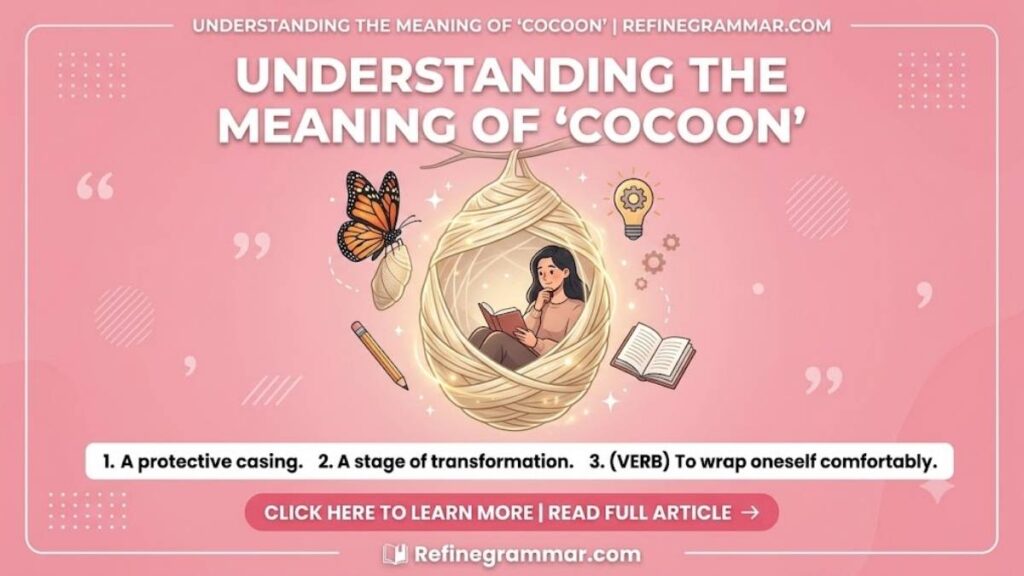
Literal Meaning
In biology, a cocoon is a silk case spun by an insect larva, particularly moths, to protect itself during metamorphosis. The structure shields the developing insect from predators and harsh weather.
Figurative Meaning
Beyond insects, cocoon describes any situation where a person wraps themselves in comfort or isolation, such as staying in on a rainy day or retreating from a stressful week.
Business and Lifestyle Usage
Brands increasingly use cocoon-inspired language to describe spa retreats, cozy home decor, and self-care routines that promise comfort and protection from everyday stress.
Cocoon or Cacoon: Meaning Explained
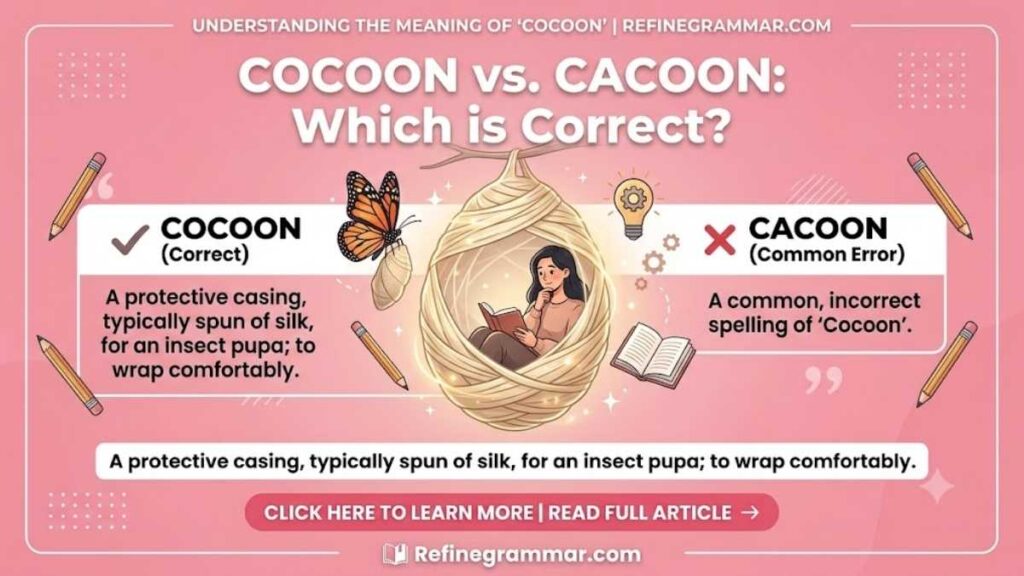
When people search cocoon or cacoon, they usually want a plain answer: cocoon is correct in virtually every everyday and scientific context. Cacoon exists only as a specialized botanical term for a tropical vine, a usage most writers will never actually need in day-to-day content.
Cocoon or Cacoon: Pronunciation Guide
Both words are pronounced the same way, roughly “kuh-KOON.” Since pronunciation offers no real clue for cocoon or cacoon, the spelling has to be memorized rather than sounded out.
What Animal Makes a Cocoon?
Moths are the most famous cocoon spinners, using silk glands to build a protective shell before pupating. Silkworms, certain beetles, and some spiders also create similar protective wrappings, though the term cocoon is used most often for moths.
Cocoon and Butterfly: How They’re Connected
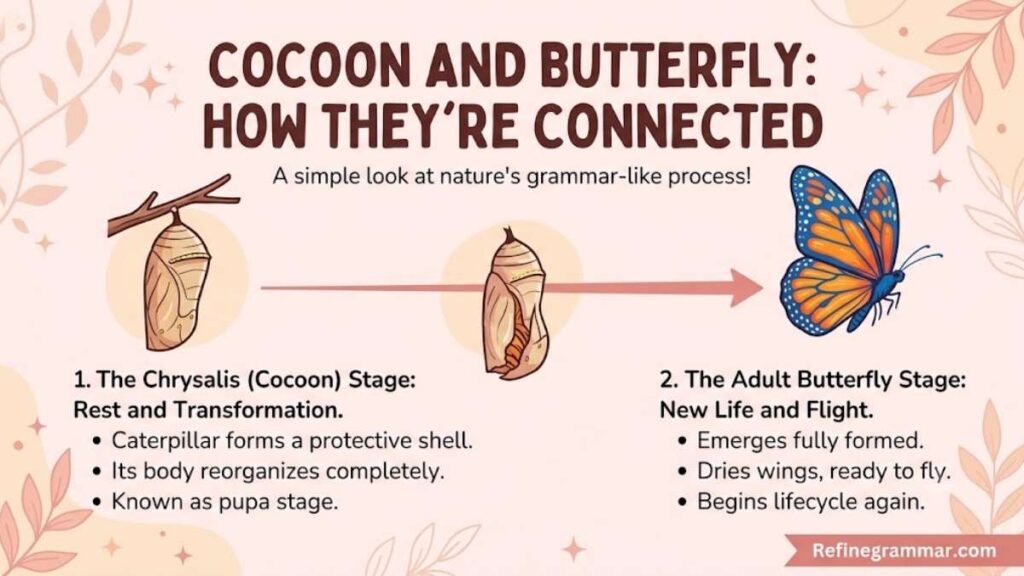
Butterflies are often pictured emerging from a cocoon, but technically most butterflies form a chrysalis, not a cocoon. Cocoons are mainly associated with moths, and this related insect fact often gets tangled up with the cocoon or cacoon spelling question.
Cocoon vs Chrysalis vs Pupa: What’s the Difference?
These three terms are often used interchangeably, but each means something different:
| Term | What It Is | Associated Insect |
| Cocoon | Silk case spun by the larva for protection | Moths, silkworms |
| Chrysalis | Hardened outer skin of the pupa itself | Butterflies |
| Pupa | General life stage between larva and adult | Both moths and butterflies |
Cocoon Synonym: Other Words You Can Use
If you want to vary your wording, several synonyms work well depending on context. Just be careful with informal shortenings too, since casual variants like favs or faves follow the same logic as cocoon or cacoon: only one form is standard.
Why the Spelling Confusion Happens
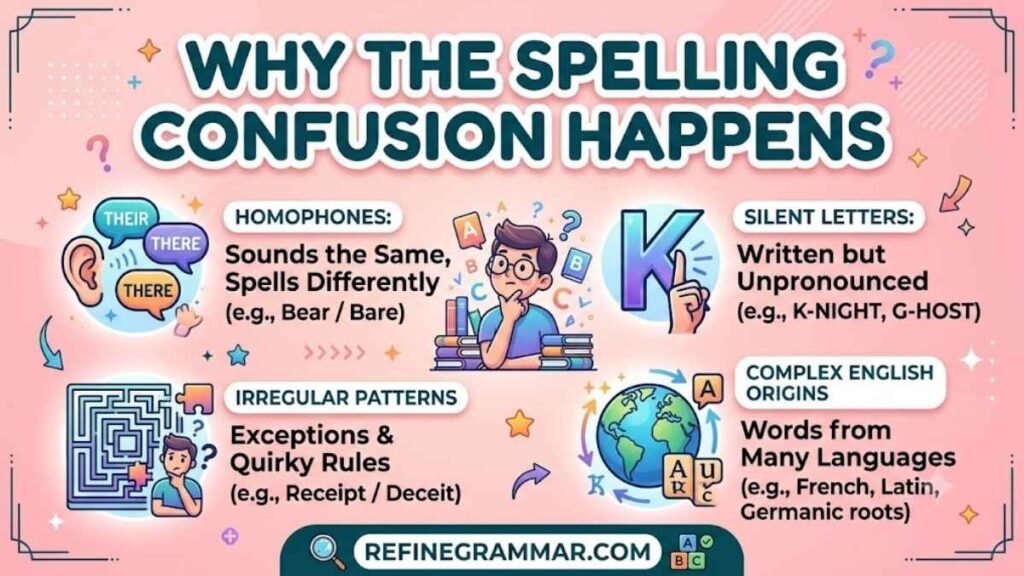
The cocoon or cacoon mix-up isn’t random, and this kind of confusion can linger over a long timeframe or time frame before a writer finally corrects it. A few predictable factors explain why so many writers stumble over it.
Similar Sound Patterns
Because cocoon and cacoon are spoken identically, the ear offers no help distinguishing them.
Influence of Regional Accents
Certain accents flatten vowel sounds, making the first ‘o’ in cocoon sound closer to an ‘a,’ which reinforces the cacoon typo.
Auto-Correct Doesn’t Always Help
Autocorrect tools sometimes miss cacoon because it resembles a real, though rare, botanical word, so it isn’t always flagged as an error.
Cacoon vs Cocoon: Side-by-Side Comparison
| Feature | Cocoon | Cacoon |
| Standard spelling | Yes | No |
| Dictionary listed | Yes, as the primary entry | Only as a rare botanical term |
| Common usage | Everyday writing and science | Almost never used |
| Recommended for writing | Always | Avoid unless naming the tropical plant |
Dictionary Recognition
Major dictionaries list cocoon as the standard entry, while cacoon appears only in specialized botanical references describing a tropical vine.
Writing Recommendation
For blogs, essays, and professional writing, always choose cocoon. Reserve cacoon exclusively for discussions of the tropical Fevillea cordifolia vine, where it is technically accurate.
Real-Life Example: How a Small Spelling Error Can Affect Professional Writing
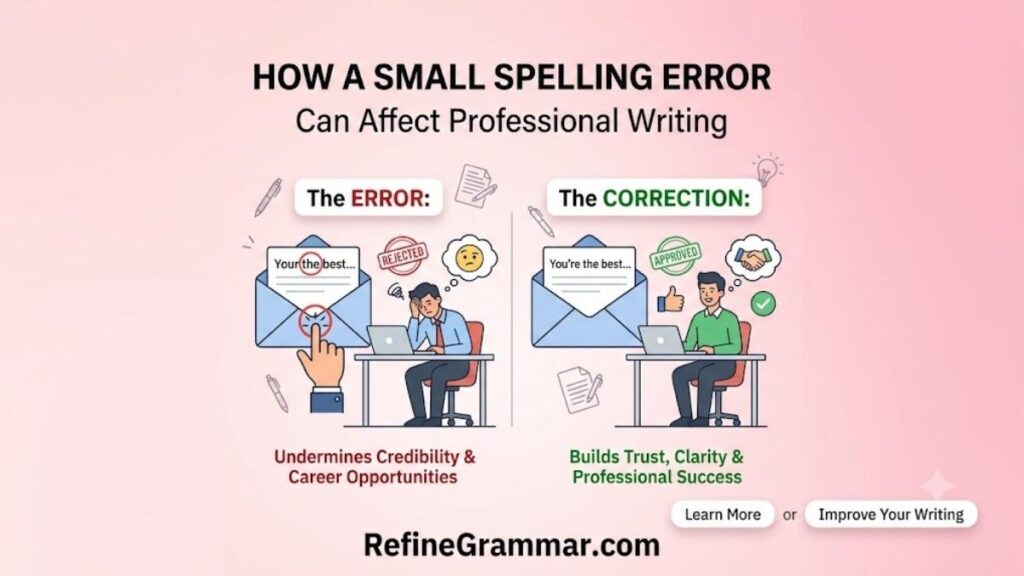
Imagine a marketing email describing a “cacoon-like retreat” at a wellness resort. Readers may interpret it as a careless typo rather than a stylistic choice, which quietly undermines trust.
The cocoon or cacoon mistake is small, but in professional writing, small errors add up and shape how credible your content feels, much like the confusion around laid out or layed out can distract readers from your actual message.
Language and Search Trends: Why Correct Spelling Matters in 2025–2026
Key Trends
Search data shows steady, recurring interest in cocoon or cacoon queries year after year, reflecting how often writers second-guess this word. The same is true for small formatting questions, like whether is it 26 or 26th in a date. Search engines increasingly reward pages that answer this kind of question clearly and directly.
What This Means for Writers
Accurate spelling now directly supports both SEO performance and reader trust, especially as AI-assisted writing tools become common and readers expect polished, error-free content.
How to Remember the Correct Spelling of Cocoon
Trick 1: Think of Two O’s for Protection
Picture two round “O”s forming a snug protective shell. Cocoon has two Os, just like the rounded shape of the casing itself.
Trick 2: Associate It with Common Words
Link cocoon to other double-o comfort words like “cozy” and “room” to reinforce the correct spelling pattern.
Trick 3: Visual Memory
Imagine a caterpillar curled up inside two round “o” shapes. This simple mental image makes the correct spelling easy to recall.
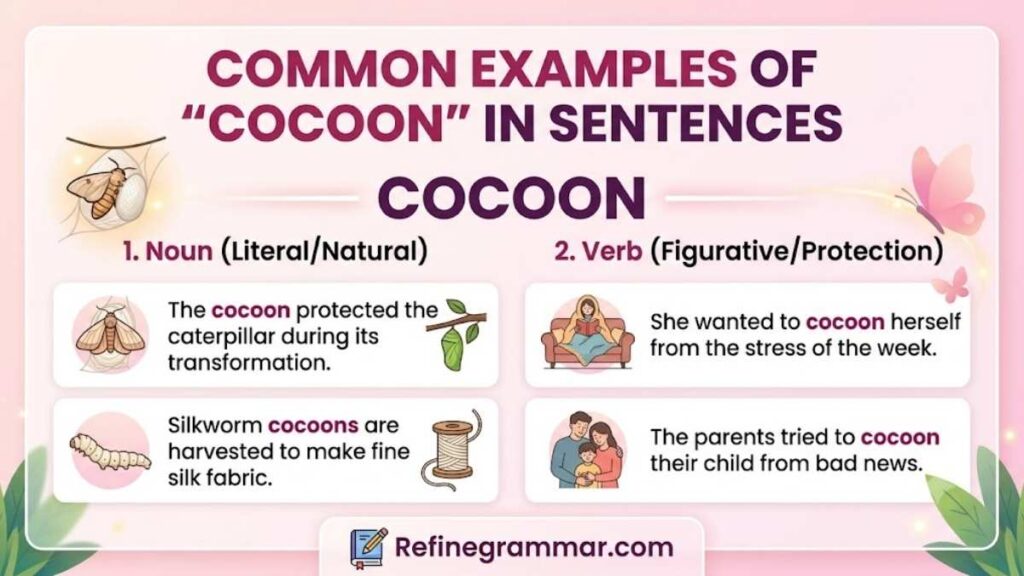
Common Examples of Cocoon in Sentences
Biological Usage
The caterpillar spent two weeks inside its cocoon before emerging as a moth.
Everyday Usage
She wrapped herself in a blanket, cocooning on the sofa all weekend.
Professional Writing
The spa’s cocoon-style treatment room was designed for total relaxation.
Common Mistakes to Avoid
A handful of small, repeatable errors cause most cocoon or cacoon mistakes, in the same way writers keep mixing up to small or too small. Watch for these three patterns in particular.
Mistake 1: Writing Cacoon
Using cacoon instead of cocoon is the single most common error tied to this word.
Mistake 2: Using Spellings Based on Pronunciation
Because cocoon or cacoon sound alike, relying on pronunciation alone leads writers astray, similar to the confusion many people feel around atleast or at least.
Mistake 3: Ignoring Spell Check Suggestions
Many writers dismiss spell-check flags out of habit, letting the cacoon typo slip through unnoticed.
Cocoon (Movie): Is It Spelled Cacoon or Cocoon?
The 1985 film is titled “Cocoon,” using the standard spelling. Any version you see written with “cacoon” in the title is simply a misspelling, not an alternate title.
Mini Quiz: Cocoon or Cacoon
Test yourself with these quick questions, then check your answers below.
| Question | Answer |
| Quiz 1: Which spelling is correct? | Cocoon |
| Quiz 2: Fill in the blank — The moth built a silk _____. | Cocoon |
| Quiz 3: What is the wrong spelling? | Cacoon |
| Quiz 4: Fill in the blank — She loves to _____ under a blanket. | Cocoon |
| Quiz 5: Meaning check — A cocoon is made of what material? | Silk |
| Quiz 6: Fill in the blank — The caterpillar spins a _____ before becoming a moth. | Cocoon |
| Quiz 7: True or False — Cacoon is a standard English spelling. | False |
| Quiz 8: Fill in the blank — A butterfly typically forms a _____, not a cocoon. | Chrysalis |
| Quiz 9: Choose the correct option — cacoon / cocoon (insect casing) | Cocoon |
| Quiz 10: Fill in the blank — The spa offered a _____-style retreat room. | Cocoon |
| Quiz 11: Spelling test — Correct the word: ‘cacoon’ | Cocoon |
| Quiz 12: Fill in the blank — Silkworms spin their _____ from thread. | Cocoon |
| Quiz 13: Quick understanding — Which word refers to a rare tropical vine? | Cacoon |
Frequently Asked Questions
Is “Cocoon” or “Cacoon” the Correct Spelling?
Cocoon is correct. Cacoon is a misspelling in nearly every context except one rare botanical term.
What Is the Definition of a Cocoon?
A cocoon is a silky protective casing that an insect larva, especially a moth, spins around itself during metamorphosis.
What Does “Cocoon” Mean in Slang?
In casual speech, to cocoon means to stay home and avoid the outside world for comfort or rest.
What Does It Mean to Cocoon Someone?
It means to protect or shelter someone closely, keeping them safe from outside stress or harm.
Is a Butterfly a Cocoon or a Chrysalis?
A butterfly forms a chrysalis. Cocoons are mainly associated with moths, not butterflies.
Is a Cocoon Only for a Moth?
Mostly, yes, though a few other insects and spiders spin similar silk casings for protection.
What’s Another Name for a Cocoon?
Common alternatives include shell, casing, wrapping, and husk, depending on context.
What Does It Mean for a Person to “Cocoon”?
It describes withdrawing into a cozy, private space to relax or recharge away from others.
What Does Cocoon Mean for Kids?
For kids, a cocoon is simply explained as a caterpillar’s protective wrap before it becomes a moth or butterfly.
What Is a Fancy Name for a Cocoon?
A more formal or scientific term is “pupal case” or “silk case.”
Conclusion
The cocoon or cacoon debate has a simple resolution: cocoon is correct nearly everywhere, from science textbooks to casual conversation, while cacoon belongs almost exclusively to a rare tropical plant. Keeping this distinction straight, along with other easily mixed-up terms like carrer or career, helps your writing stay polished and credible. Next time you’re unsure about cocoon or cacoon, remember the two protective Os and you’ll never second-guess the spelling again.
