Favs or faveswhich spelling is actually correct? If you’ve ever paused mid-sentence wondering whether to type “my favs” or “my faves,” you’re in good company. It’s the same kind of everyday spelling puzzle as getting date formats right or picking the correct verb ending when you’re not sure which letter to double. This guide gives you a fast, clear answer, explains where these short forms came from, compares British and American usage, and shows you exactly when each short form fits your writing.
Favs or Faves – Quick Answer
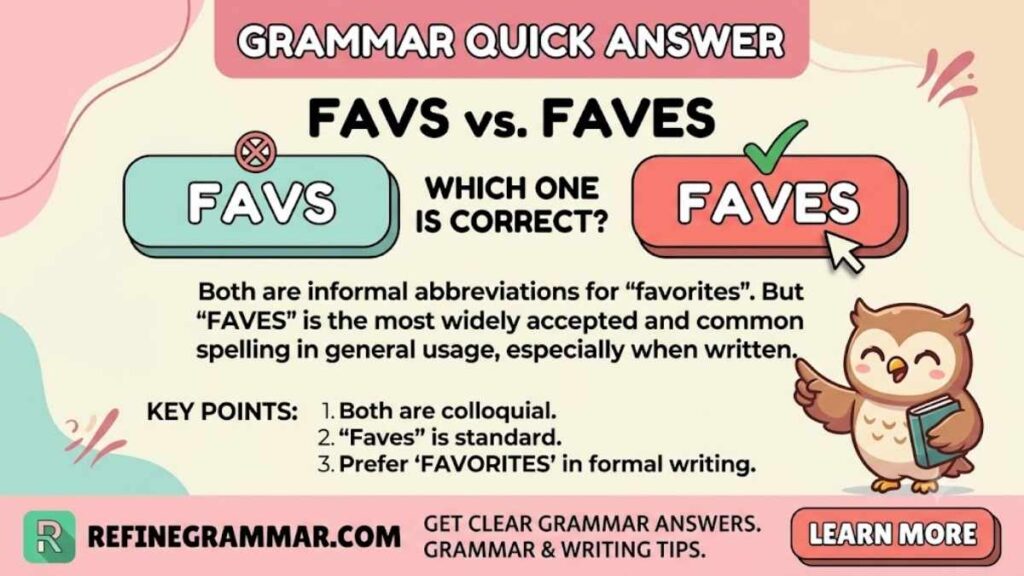
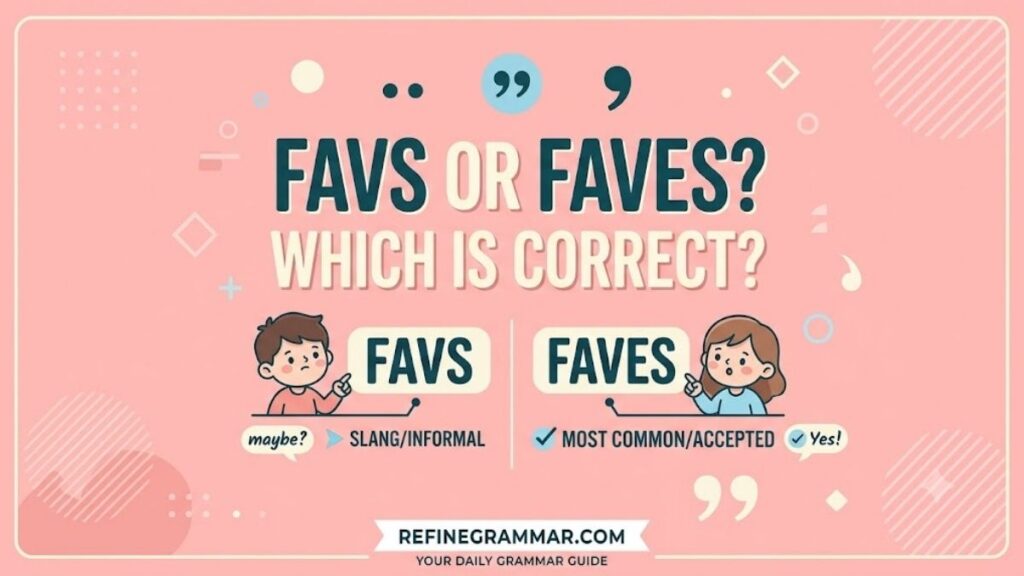
Both favs and faves are correct. They’re informal short forms of favorite (or favourite in British English), and neither spelling is grammatically wrong. The real difference between favs or faves comes down to tone, context, and personal style rather than any official rule.
Favs
Favs is the leaner, no-extra-letter version. It drops the silent “e” entirely, which makes it a popular choice for hashtags, app buttons, and interface labels where every character counts.
Faves
Faves keeps that final “e,” which mirrors how the word is actually pronounced (“fayvz”). Many writers find faves reads more naturally inside a full sentence, which is why it shows up often in blog posts and social captions.
Simple rule:
If you need something short for a button, tag, or hashtag, use favs. If you’re writing a complete sentence and want it to sound natural, use faves. When in doubt about the favs or faves choice, faves is generally the safer, more readable option.
Examples:
- “Tap the heart to save your favs.” (short UI label)
- “These four cafes are my absolute faves in the city.” (natural sentence)
- “Share your faves from this year’s playlist.” (casual, conversational)
Short Form of Favorite or Favourite (Fav, Fave, Favs, Faves)
Before choosing between favs or faves, it helps to see the full family of short forms. Favorite (or favourite) has four common abbreviations, and each one serves a slightly different purpose depending on whether you’re talking about one item or several.
Common Short Forms:
| Short Form | Full Word | Typical Use |
| Fav | Favorite (singular) | Casual labels, quick notes |
| Fave | Favorite (singular) | Natural-sounding sentences |
| Favs | Favorites (plural) | Buttons, tags, hashtags |
| Faves | Favorites (plural) | Blog posts, captions, everyday writing |
Examples:
- “Coffee is my fav way to start the morning.”
- “This song became an instant fave.”
- “Save it to your favs for later.”
- “Here are my top five faves from the album.”
Which One Should You Use?
The choice mostly depends on audience and format, much like choosing between similar-looking word forms in everyday writing. For a single item, fav or fave both work; for multiple items, favs or faves is the correct plural shape. Match your spelling to the tone of the piece and keep it consistent throughout.
Related Search Queries Explained:
- “Fav or fave”refers to the singular short form, not the plural.
- “Short form of favourite”usually points people toward fave, the British-friendly spelling.
- “Favorite in short form”the general search intent behind this whole spelling debate.
- “Is faves a word”not in most standard dictionaries, but it’s widely recognized informal usage.
The Origin of Favs or Faves
The base word: Favorite / Favourite
Favorite traces back to the Old French favorit and, further, to the Latin favor. American English dropped the “u” to give us favorite, while British English kept it as favourite. That single letter is the root of every spelling choice that follows, including how fav, fave, favs, and faves are written today.
How the short forms developed
Clipped forms of favorite are older than you might think. Fav appeared in horse-racing writing as early as the 1930s, and fave showed up in show-business publications around the same decade. Texting, instant messaging, and later Twitter’s “favoriting” feature accelerated the trend, the same way informal internet spelling has reshaped other word pairs, including patterns tied to doubled consonants. By the time social media went mainstream, these short forms had already settled in as everyday shorthand.
Why two spellings exist
Neither favs nor faves is an official dictionary headword, so there was never a governing body to pick a winner. Some writers dropped the “e” for speed; others kept it to preserve pronunciation. That same organic drift shows up in other informal internet spellings, where convenience and phonetics compete for the “correct” form.
British English vs American English Spelling
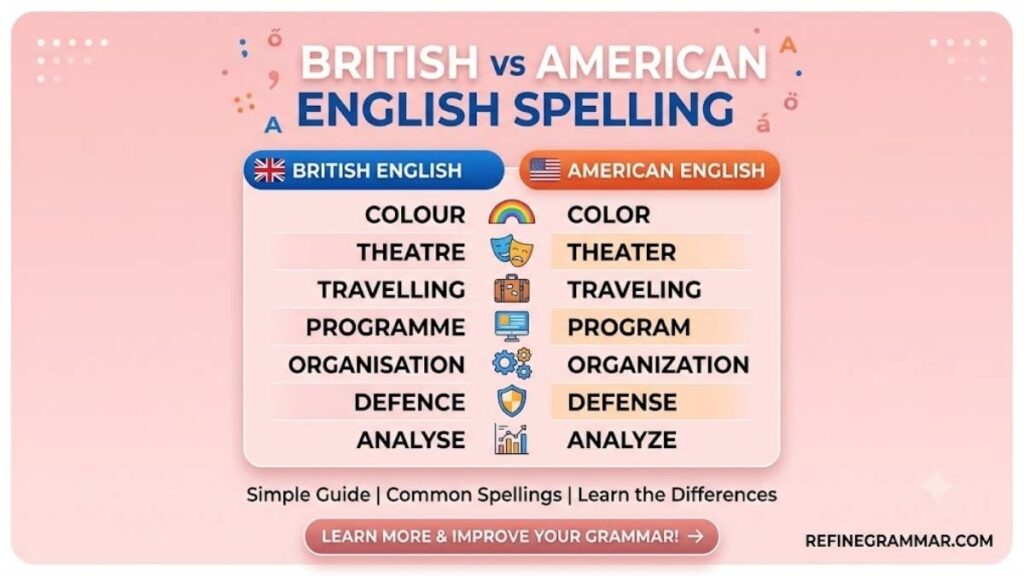
American English
American English uses favorite as the standard spelling. Both favs and faves appear informally across the US, especially in social media captions, texting, and casual blog content.
British English
British English uses favourite as the standard spelling, but the short forms favs and faves are borrowed the same waythe extra “u” from favourite disappears entirely once the word is clipped.
Comparison Table
| Feature | American English | British English |
| Full word | Favorite | Favourite |
| Informal short forms | Fav / Fave / Favs / Faves | Fav / Fave / Favs / Faves |
| Formal writing | Favorites | Favourites |
Interestingly, favs or faves isn’t a strict US-versus-UK issue. Both spellings are informal, and both are used globally, especially online, regardless of which side of the Atlantic the writer is on.
Which Spelling Should You Use?
Use faves if:
- You’re writing a full sentence and want it to sound natural.
- You’re publishing a blog post, newsletter, or long-form social caption.
- Your audience skews toward conversational, everyday English.
Use favs if:
- You’re working with a character limit, like a hashtag or button label.
- You want something visually compact for app or website interfaces.
- Brevity matters more than how the word sounds when read aloud.
Avoid both if:
You’re writing anything formalresumes, business emails, academic work, or legal documents. In those settings, the standardized spelling always wins, the same way technical writing favors one accepted term over a common variant. Stick with favorites or favourites instead of the shortened forms.
Audience-based advice
Younger, social-first audiences are generally comfortable with either favs or faves. Professional or older audiences tend to read informal abbreviations as careless, so lean toward the full word unless the context is clearly casual.
Common Mistakes with Favs or Faves
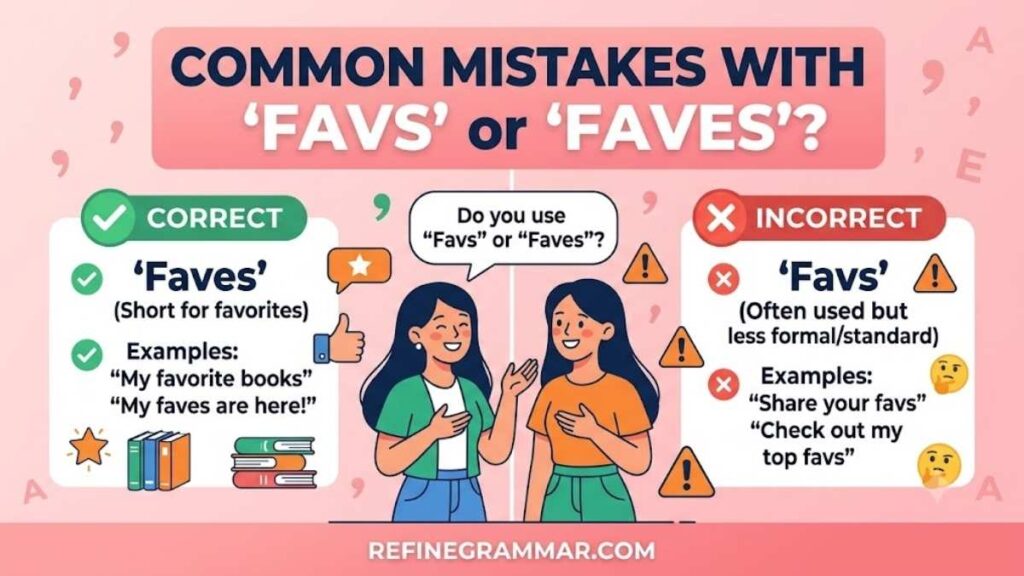
1. Using them in formal writing
“Our faves include several policy options” reads as unprofessional. Formal writing should always use favorites or favourites, never the shortened forms.
2. Mixing tone
Switching between favs and faves within the same piece looks inconsistent, much like inconsistent spelling choices in other word pairs can distract a reader. Pick one spelling and use it throughout a single piece of content.
3. Incorrect apostrophes
Plural short forms never need an apostrophe. “Fav’s” and “Fave’s” are both incorrect; the plurals are simply favs and faves.
4. Overusing slang
Leaning on either short form in every sentence can feel gimmicky. Professional writing delivered within a set project timeframe should reserve slang for genuinely casual moments, not every mention of the word.
Favs vs Faves Meaning, Usage, and Common Questions
✔ Meaning of Favs and Faves
Both words mean the same thing: favorite items, people, places, or choices. The favs or faves distinction is entirely about spelling and tone, not meaning.
✔ Common Usage Questions:
- Is it “my favs” or “my faves”? Both are acceptable; faves is slightly more common in natural sentences.
- Can these plurals be used in the singular? Nothe singular forms are fav and fave.
- Are they considered slang? Yes, both are informal, internet-influenced abbreviations.
✔ Common Mistake (Apostrophe Issue)
Remember: favs and faves are plain plurals. No apostrophe is needed before or after the “s.”
✔ Extra Clarifications from Search Queries:
- “Favs meaning”simply refers to a person’s favorite things.
- “Faves vs favorites”faves is the informal version of the same word.
- “Is faves a real word”recognized informally, though not standard in every dictionary.
Favs or Faves in Everyday Examples
Emails
Emails, especially professional ones, should generally avoid favs or faves. Use favorites or favourites unless the message is genuinely casual, like a note to a close colleague or friend.
News & Media
Headlines occasionally use faves for a lighter, conversational tone, particularly in entertainment or lifestyle sections, but hard news coverage usually sticks with favorites.
Social Media
Social captions are where favs or faves shows up most. “Share your faves in the comments” and “Tap to save your favs” are both common, natural phrasing choices.
Apps & Websites
Interface design favors favs for its compact sizethink heart icons, saved-item tabs, and short button labels where space is limited.
Formal Writing
Reports, cover letters, and academic papers should avoid both short forms entirely. Use the full word favorites or favourites to maintain a professional tone.
Favs or Faves – Google Trends & Usage Data
What Google Trends shows
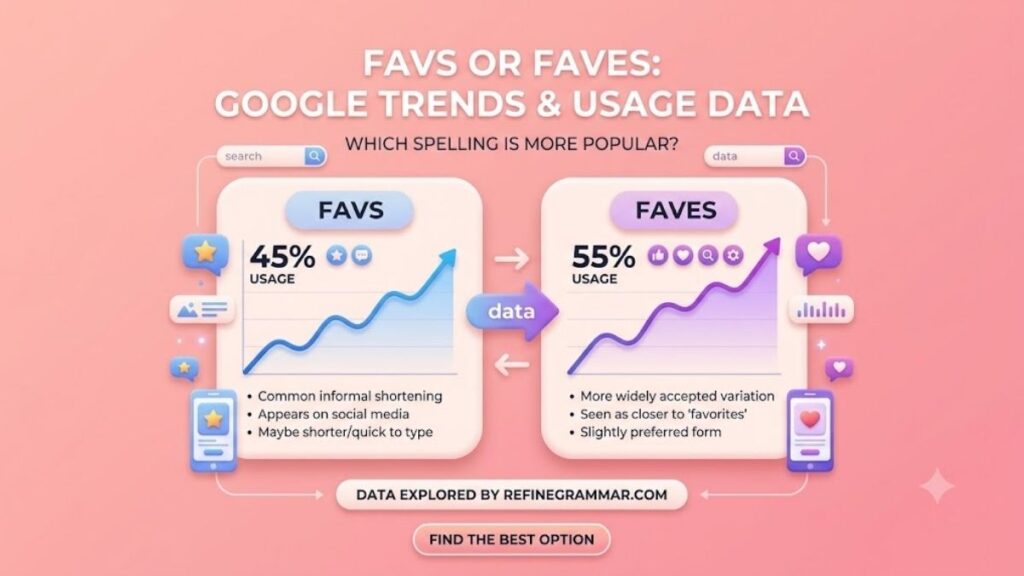
Search interest in favs or faves tends to track closely with the rise of social platforms and mobile apps, since both terms are tied to casual, fast-typed digital communication rather than formal writing.
By region
Usage isn’t split neatly along national lines. English speakers in the US, UK, Australia, and beyond use both favs and faves informally, making the choice more about style than region.
Context matters
Platform, audience, and word count all shape which spelling feels right in the moment. A hashtag favors favs; a heartfelt caption often favors faves.
Comparison Table: Keyword Variations
| Term | Type | Best Used For |
| Fav | Singular short form | Quick, casual references |
| Fave | Singular short form | Natural-sounding sentences |
| Favs | Plural short form | Tags, buttons, hashtags |
| Faves | Plural short form | Blogs, captions, conversation |
| Favorite(s) | Standard American spelling | Formal and general writing |
| Favourite(s) | Standard British spelling | Formal and general writing (UK) |
FAQs
Is it my faves or my favs?
Both are correct. Faves sounds slightly more natural in a sentence, while favs is more common in short, compact labels.
What is the difference between favs and faves?
There’s no difference in meaningonly in spelling and tone. Favs feels more compact; faves feels more conversational.
Do you say favs or faves?
Most people pronounce both the same way: “fayvz.” The spoken form doesn’t actually distinguish between favs or faves.
What does “my favs” mean?
It simply means “my favorites”the things, people, or items someone likes most.
How do you spell “favs”?
F-A-V-S, with no apostrophe and no extra “e.” It’s the plural of fav.
Is faves a real word?
It’s a widely recognized informal abbreviation, though it isn’t treated as a formal dictionary headword in most style guides.
Is it favs or faves slang?
Yes, both are informal, internet-era abbreviations of favorites, not standard formal English.
What does “favs” mean in text?
In texting or social media, favs refers to a person’s favorite items, saved posts, or preferred choices.
Is it one of my faves or fave?
“One of my faves” is correct since “faves” works as a plural noun here, referring to a group of favorites.
Is favorite shortened to fav or fave?
Both are valid shortenings. Fav drops the final “e”; fave keeps it for a more phonetic spelling.
Conclusion
At the end of the day, the favs or faves debate doesn’t have a single official winnerboth spellings are correct, informal, and widely understood. Use favs when space is tight, faves when you want a sentence to flow naturally, and the full word favorites (or favourites) whenever the setting calls for formal English. Once you understand the small, practical differences between the two, choosing the right one becomes second nature. For more everyday spelling clarity, browse other quick guides like commonly confused word pairs on RefineGrammar.
