
If you’ve ever paused mid-sentence wondering about Convertor or Converter, you’re not alone. Thousands of writers search this exact phrase every month because both spellings appear across websites, product manuals, and even textbooks. This guide settles the debate for good, explains where each spelling comes from, and shows you exactly which one to use in every situation.
Convertor
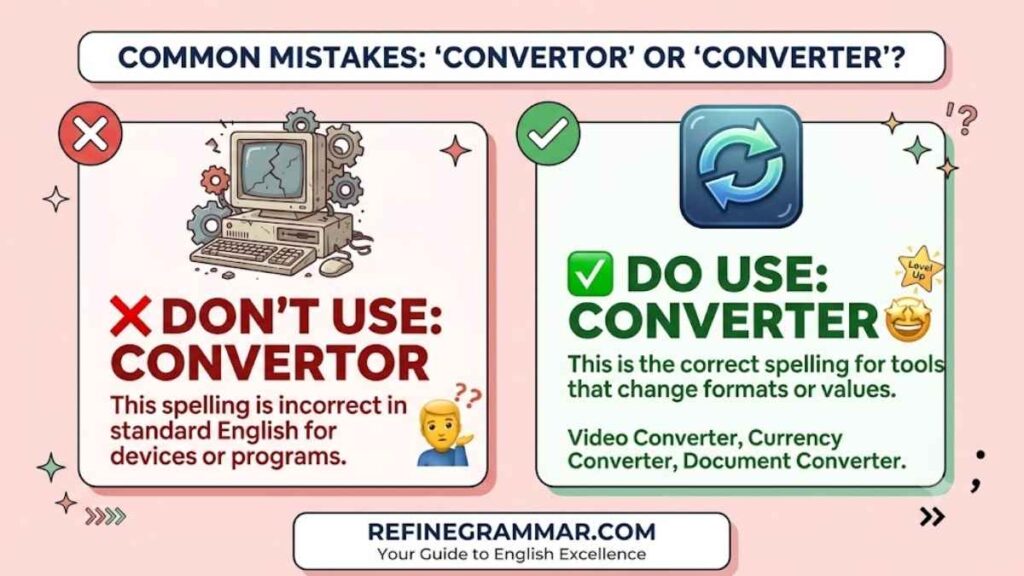
Convertor is the less common spelling. It shows up occasionally in older technical writing, engineering documents, and some legacy texts, but it isn’t the standard form recommended by major dictionaries.
Converter
Converter is the standard, dictionary-approved spelling used across American and British English alike. It’s the version you’ll see in software, electronics, automotive terms, and everyday writing.
Convertor or Converter: Quick Answer
Main Difference:
The main difference between convertor or converter comes down to frequency and acceptance. Converter is the dominant, widely accepted spelling; convertor is a rare variant that survives mostly in specialized or historical contexts.
Examples:
- The technician replaced the converter. ✅ Standard
- The technician replaced the convertor. Understood, but not standard
Definitions with Examples
Converter (Definition)
A converter is a device, tool, or person that changes something from one form into another. This applies to electrical devices, digital file tools, currency exchange, and more.
Examples:
- The video converter changed the file format instantly.
- We need a voltage converter for this appliance.
- The currency converter showed today’s exchange rate.
Convertor (Definition)
A convertor carries the exact same meaning as converter. It’s simply an alternate spelling that a few technical or engineering fields still use out of habit.
Examples:
- The old manual referred to the machine as a convertor.
- Engineers sometimes labeled the part a convertor in legacy blueprints.
Simple Meaning
In plain terms, both words describe something that changes one form into another energy, currency, files, or units. The meaning never shifts; only the spelling does.
The Origin of Converter

Formation Rule:
Converter follows English’s most common noun-formation pattern: verb + -er, as in teach → teacher, write → writer, and convert → converter. This is why converter feels natural and modern to native speakers.
This same -or versus -er pattern fuels debate elsewhere too, such as the ongoing protestors and protesters spelling question.
Meaning:
At its core, converter means “one that converts” nothing more complicated than that. The suffix -er signals an agent noun, just like it does in hundreds of other English words.
British English vs American English Spelling 🇬🇧🇺🇸
Key Point:
Both British and American English prefer converter. Unlike words such as colour/color or organise/organize, this isn’t a true regional split it’s simply about which spelling has become the accepted global standard.
Comparison Table:
| Region | Preferred Spelling | Notes |
| US English | Converter | Standard in all writing |
| UK English | Converter | Standard; convertor is rare |
| Technical / Engineering | Convertor (occasional) | Mostly in older manuals |
converter or convertor uk
Even in the UK, converter remains the standard choice. Convertor occasionally surfaces in specialized British engineering texts, similar to how some British spelling habits linger in words like focusses or focuses but for converter, there’s no genuine regional divide.
Convertor vs Converter: Key Difference Explained
Comparison Table:
| Feature | Converter | Convertor |
| Standard spelling | Yes | No |
| Dictionary preferred | Yes | Rare / alternate entry |
| Common in modern writing | Yes | No |
| Found in technical or legacy texts | Occasionally | Yes |
Example:
Compare: “The converter improved efficiency by 20%” versus “The convertor improved efficiency by 20%.” Both sentences are grammatically fine, but only the first matches modern style guides.
Which Spelling Should You Use?
Always Prefer:
Always prefer converter in emails, blog posts, resumes, technical documentation, and academic writing. It’s the safe, professional, universally recognized choice.
When You May See Convertor:
You may still encounter convertor in older engineering manuals, some European technical documents, or historical texts. Recognize it when you see it, but don’t imitate it in your own writing.
In Exams
In exams, always write converter. Examiners follow standard dictionaries, and converter is the accepted spelling on every major English-language test.
Easy Tip
Easy tip: think of “converter” the same way you’d think of “teacher” or “writer” words that end in -er, not -or. This simple mental shortcut prevents the mistake almost every time.
converter meaning
The converter meaning stays constant across every spelling variant: a device, tool, or person that changes something into a new form.
Usage Tip (Very Important)
Examples:
When adding suffixes to convert, remember the doubling and spelling rules that trip up many writers the same rules behind confusion in words like stopping or stoping and refer or reffer. Converter, however, doesn’t double any letters it’s simply convert + er.
Common Mistakes with Convertor or Converter
1. Using Convertor Everywhere
Some writers default to convertor out of habit or because they spotted it once in a manual. Doing this consistently can make your writing look outdated or less professional.
2. Thinking Both Are Equal
While convertor is technically recognized, treating it as equally correct to converter is misleading one is standard, the other is a rare exception, much like the mix-up between maintained and maintenanced.
3. Copying Old Text
Copying phrasing from outdated manuals or legacy documents can reintroduce convertor into modern writing, the same way outdated ordinal spellings like 31st or 31th persist in old files. Always update terminology to match current standards.
4. Spelling Confusion
Convertor or converter isn’t the only pair that confuses writers. Similar mix-ups appear in number spellings such as fourteen or forteen, and in casual typing mistakes like misclick or missclick. Recognizing these patterns helps you avoid mistakes across the board.
Converter in Everyday Examples
Technology
Software converters change file formats PDF to Word, image to text, video to audio.
Vehicles
Catalytic converters reduce harmful emissions in cars and trucks.
Apps
Mobile apps use converters for currency, measurement units, and time zones.
Work
Offices rely on document converters to switch between file types for reports and presentations.
Daily Use
From cooking measurements to travel currency, converters simplify everyday tasks.
currency converter
A currency converter calculates exchange rates instantly between two or more currencies.
electric converter
An electric converter changes voltage or current type, such as AC to DC.
unit converter
A unit converter switches between measurement systems, like miles to kilometers.
catalytic converter
A catalytic converter reduces toxic emissions from a vehicle’s exhaust system.
converter calculator
A converter calculator combines conversion logic with instant calculation, useful for currency, units, or measurements.
Convertor or Converter Related Search Terms
convertor or converter spelling
Converter is the correct spelling in nearly all modern contexts.
convertor or converter units
Unit converter is the standard term used in apps and tools.
convertor or converter length
Length converter is the correct phrase for measurement tools.
convertor or converter area
Area converter follows the same standard er spelling.
convertor or converter currency
Currency converter is the universally accepted term.
convertor or converter money
Money converter tools also use the standard converter spelling.
convertor or converter table
Comparison tables almost always list converter as the correct form.
convertor or converter to inches
Length-to-inches converters use the standard converter spelling as well.
Converter: Google Trends & Usage Data

Trends:
Search data consistently shows converter receiving significantly more search volume than convertor across English-speaking regions.
Region Table:
| Region | Search Preference |
| United States | Converter dominant |
| United Kingdom | Converter dominant |
| India | Converter dominant; convertor used occasionally |
| Europe (technical fields) | Convertor used occasionally |
Top 10 Searches:
- currency converter
- PDF converter
- unit converter
- YouTube converter
- video converter
- file converter
- catalytic converter
- voltage converter
- converter calculator
- image converter
Comparison Table
| Aspect | Converter | Convertor |
| Correctness | Standard | Rare / alternate |
| Usage | Universal | Limited / technical |
| Dictionary status | Preferred entry | Secondary variant |
| Recommended for writing | Yes | No |
FAQs About Convertor or Converter
Is it convertor or converter?
Converter is correct; convertor is a rare, mostly outdated variant.
Which spelling, convertor or converter, is correct?
Converter is correct in virtually all modern writing situations.
What is the meaning of the word “converter”?
A device, tool, or person that changes one form into another.
What is another word for converter?
Transformer, adapter, or changer, depending on context.
What are the two types of converters?
Broadly, analog and digital converters, or AC and DC converters in electrical contexts.
What is a converter used for?
Converters change currency, file formats, units, or electrical signals from one form to another.
What is the correct spelling of conversion?
Conversion is the only accepted spelling; there’s no competing variant.
How do you spell converter box?
As two words, “converter box,” using the standard -er spelling.
How does a convertor work?
A convertor (same as converter) transforms input energy, data, or units into a different output form.
What is a converter in business?
In business, a converter can mean software that changes file formats, or a company that processes raw materials into finished goods.
Fainalthoust
When it comes to convertor or converter, the answer is clear: converter is the correct, standard spelling for nearly every situation, while convertor remains a rare, mostly outdated variant. Whether you’re writing a blog post, filling out a resume, or double-checking a technical manual, converter is always the safer choice. Keep this guide handy, and you’ll never second-guess this spelling again.
