
If you have ever paused mid-sentence wondering whether to type “focusses” or “focuses,” you are not alone. This is one of the most common spelling mix-ups in English, and it trips up native speakers and learners alike. The short version: focuses or focuses debates almost always end the same way, with “focuses” winning as the modern, globally accepted spelling. This guide breaks down the meaning, origin, regional differences, and real-world usage of focusses or focuses so you never have to second-guess it again.
Focusses or Focuses: Quick Answer
“Focuses” is the correct and standard spelling in virtually all modern English, whether American, British, Australian, or Canadian. “Focusses” is an older, less common variant that once appeared in British English but has largely fallen out of everyday use.
- Focuses = standard, preferred, works everywhere
- Focusses = older variant, rarely used today, mostly historical or regional
- Both are pronounced the same and mean exactly the same thing
Focusses or Focuses Meaning
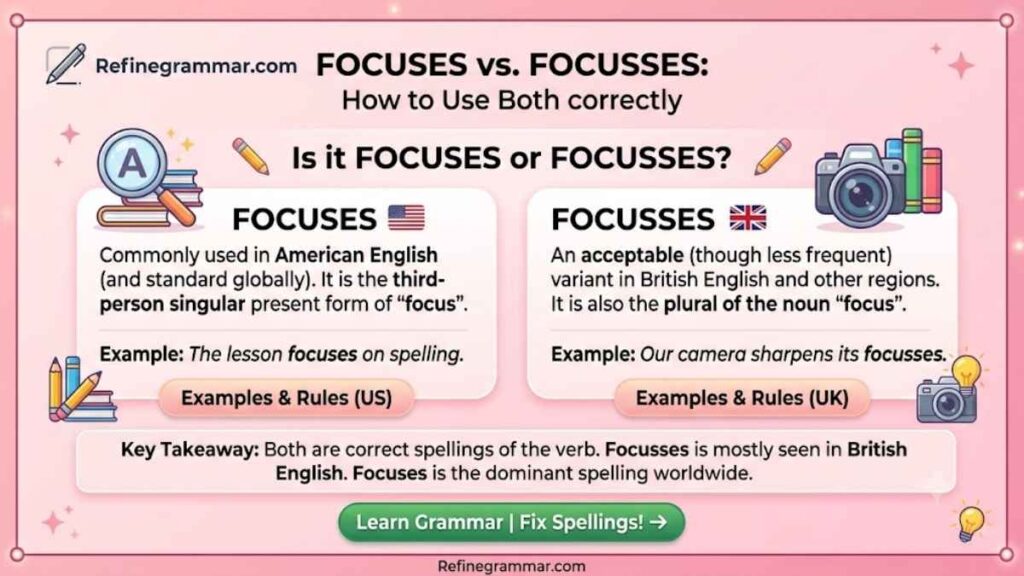
Both spellings serve the same grammatical purpose: the third-person singular present-tense form of the verb “to focus” (as in “she focuses on her goals”), and occasionally the plural of the noun “focus.” Neither spelling changes the meaning of the word. The only difference is stylistic, tied to which side of the consonant-doubling debate a writer or publisher follows.
Focusses or Focuses: Which Is Correct?
Technically, both spellings have appeared in reputable dictionaries at some point, so neither is a flat-out grammatical error. In practice, though, “focuses” is correct for essentially every audience today. If you are writing for school, work, publishing, or the web, “focuses” is the safer and more widely recognized choice.
The Origin of Focusses or Focuses
The word “focus” comes from Latin, where it originally referred to a hearth or fireplace, later extended metaphorically to mean a central point of attention. When English speakers began forming verb tenses from “focus,” some writers doubled the final “s” before adding “-es,” producing “focusses,” while others treated it like a regular verb and simply added “-es,” producing “focuses.” Over the twentieth century, the simpler, non-doubled spelling became dominant across nearly every English-speaking region.
British English vs American English Spelling
Consonant doubling is a recurring theme in British versus American spelling. British English has historically doubled a final consonant before adding a suffix more often than American English does, which is why you may also see debates around words like traveled versus travelled. The same logic once applied to focus, giving rise to focussed and focussing in older British texts. If similar doubling questions interest you, our guide on
British English has historically doubled a final consonant before a suffix more often than American English, a pattern you can see explored further in our guide on refer or reffer spelling rules, which covers the same consonant-doubling logic behind many commonly misspelled verbs.
Focusses or Focuses UK
In the United Kingdom, “focusses” was once an accepted alternative, particularly in older or more formal texts. However, contemporary British publishers, newspapers, and universities overwhelmingly use “focuses” today, mirroring the shift seen in American English.
Focusses or Focuses British English
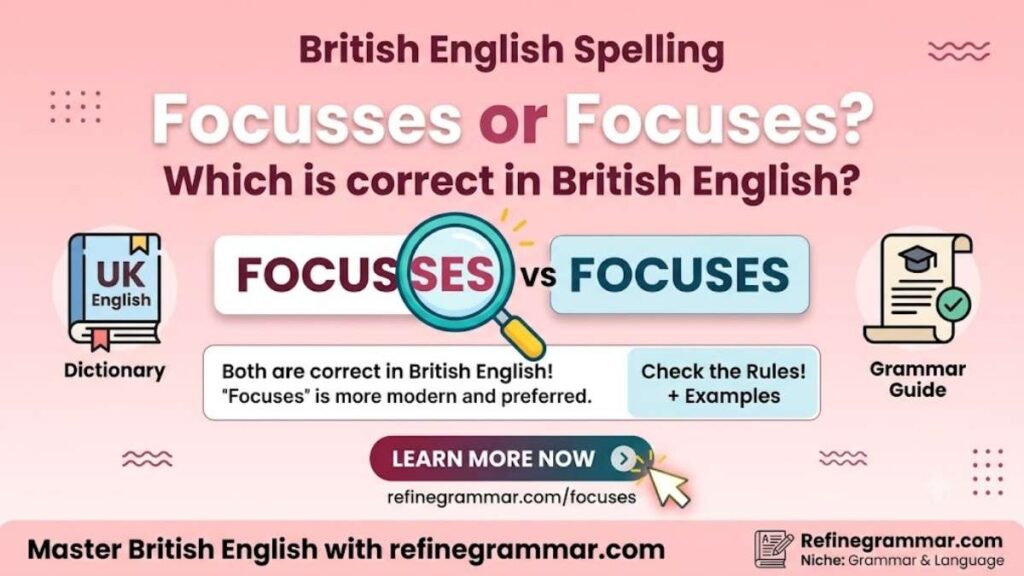
British English technically still permits “focusses” as a documented variant, but it now reads as old-fashioned. Modern British style guides, including those followed by major UK newspapers, favor “focuses” for consistency with international audiences.
Focusses or Focuses UK English
If you are writing for a UK audience specifically, “focuses” remains the safest choice for formal writing, business communication, and academic work. “Focusses” will not confuse readers, but it may look dated or inconsistent next to modern British spelling conventions.
Focusses or Focuses UK Oxford Dictionary
Oxford dictionaries list “focuses” as the preferred modern spelling while noting “focussed” and “focussing” as older, less frequent variants. Oxford’s own usage notes point out that the doubled-consonant form is now considered irregular rather than standard, which is a strong signal for anyone unsure which spelling to trust.
Focusses or Focuses Australia
Australian English generally follows British spelling conventions, but even in Australia, “focuses” has become the dominant form in news media, education, and government writing. “Focusses” appears occasionally but is not the recommended standard.
Focusses or Focuses Canada

Canadian English blends American and British influences, and spelling here can go either way depending on the publication. Even so, “focuses” is far more common in Canadian newspapers, business writing, and academic papers than “focusses.”
Focusses or Focuses NZ
New Zealand English, much like Australian English, traditionally leaned British. Today, however, “focuses” is the spelling most New Zealand style guides and publishers recommend, with “focusses” considered an outdated alternative.
Focusses or Focuses US
American English has never widely accepted “focusses.” In the United States, “focuses” is the only spelling recognized by major style guides such as AP and Chicago, and “focusses” would be flagged as a spelling mistake in virtually any US context.
Which Spelling Should You Use?
As a simple rule: default to “focuses” unless you have a specific style guide or publisher instructing you otherwise. It works for American, British, Australian, Canadian, and New Zealand audiences alike, and it will never look out of place.
- Writing for a global or online audience: use “focuses”
- Following a specific older British style guide: “focusses” may still appear, but confirm with the guide
- Academic or professional writing: “focuses” is the safer, more modern option
He Focusses or Focuses
“He focuses on his career” is the standard, widely accepted phrasing. “He focusses on his career” is grammatically understandable but reads as an older or regional variant. For everyday writing, emails, and professional documents, “he focuses” is the correct choice.
Spelling Focusses or Focuses

The spelling rule that would normally justify doubling a consonant, doubling before a suffix when the stress falls on the final syllable of a short word, does not clearly apply to “focus,” since the stress falls on the first syllable. That is part of why “focuses,” without the extra “s,” has become the logical and dominant modern spelling.
Plural of Focus
The noun “focus” has two accepted plural forms: “focuses,” the regularized English plural, and “foci,” the traditional Latin plural. “Focusses” is not used as a noun plural at all; it only ever appears, when it appears, as a verb form. Confusing the plural noun with the verb form is one of the more common mistakes people make with this word.
📌 Focuses vs Focusses and Related Forms (Complete Usage Guide)
| Base Word | Standard Modern Form | Older/Regional Variant |
| Focus (verb, 3rd person) | focuses | focusses |
| Focus (past tense) | focused | focussed |
| Focus (-ing form) | focusing | focussing |
| Focus (plural noun) | focuses / foci | not applicable |
Focussed or Focused Oxford English Dictionary
The Oxford English Dictionary treats “focused” as the standard modern spelling and describes the double-“s” form, “focussed,” as an irregular, older variant. Both are technically documented, but Oxford’s own usage guidance now favors the single-“s” form for contemporary writing.
Focussed or Focused US
In American English, “focused” is the only spelling in regular use. “Focussed” almost never appears in US publications and would generally be marked as incorrect by American spell-checkers and style guides.
Focussed or Focused Synonyms
If you want to vary your word choice, several synonyms capture the same idea as “focused”:
- Concentrated
- Attentive
- Engaged
- Absorbed
- Dedicated
- Committed
Focusses or Focuses Synonym
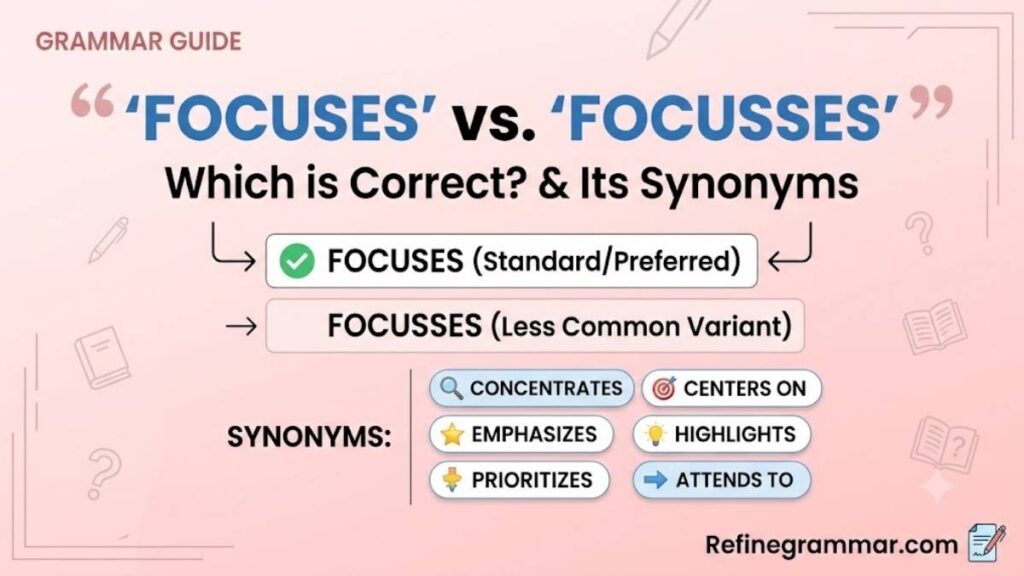
For the verb form, common alternatives to “focuses” include “concentrates,” “centers on,” “zeroes in on,” and “homes in on.” These can help you avoid repeating “focuses” too often in longer pieces of writing.
Common Mistakes with Focusses or Focuses
Spelling confusion around focusses or focuses is common because English has several similar doubling and word-choice traps. A few frequent mistakes include:
- Using “focusses” in American writing, where it is considered nonstandard
- Confusing the plural noun “foci” with the verb form “focuses”
- Mixing up other easily confused word pairs, such as protestors or protesters, which follows a similar pattern of two accepted but unevenly used spellings
- Misapplying consonant-doubling rules elsewhere, similar to confusion around maintained or maintenanced
- Getting tripped up by ordinal number spelling, much like the common mix-up between 31st or 31th
⚠️ Common Search Confusions About Focuses and Focusses
Many people searching for focusses or focuses are really asking one of a few underlying questions: which spelling is correct, whether both are real words, or whether the spelling changes based on country. In every case, the answer is the same: both exist, but “focuses” is the modern standard almost everywhere.
This kind of search confusion is not unique to “focus.” Similar patterns show up with number spellings like fourteen or forteen, and with everyday idioms such as bear with me vs bare with me, where one spelling is simply far more common and correct than the other.
Focusses or Focuses Examples
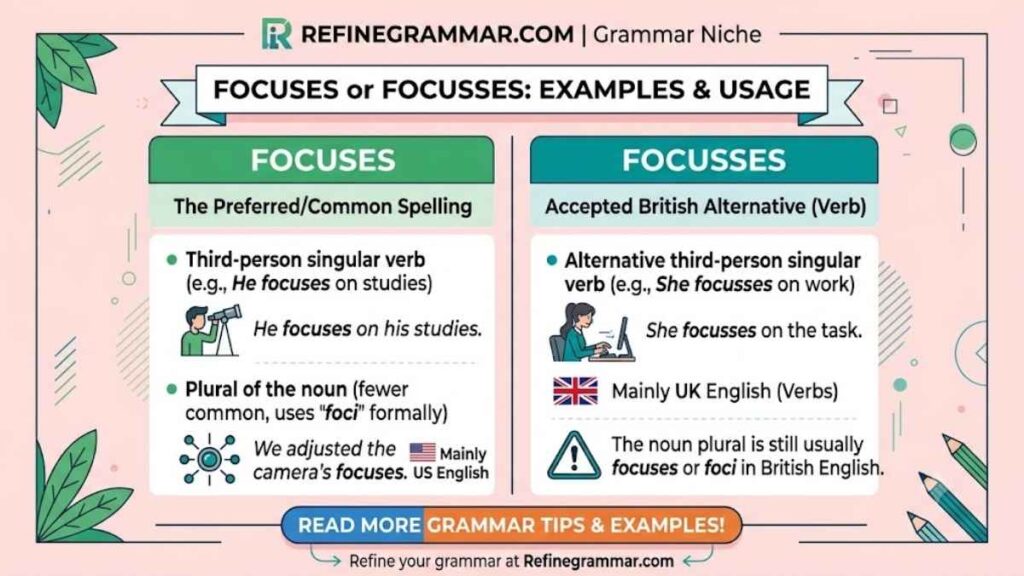
Here are a few example sentences showing the standard, recommended spelling in context:
- She focuses on her studies every evening.
- The report focuses on three key areas of growth.
- Our team focuses heavily on customer experience.
- He focuses better with fewer distractions around him.
Focusses or Focuses in Everyday Examples
You will most often encounter this word in workplace emails, academic essays, marketing copy, and everyday conversation. In all of these contexts, “focuses” is the spelling readers expect, and using it consistently signals polished, professional writing.
Focusses or Focuses Reddit
Online communities such as Reddit frequently debate spelling questions like this one, and threads about focusses or focuses generally reach the same conclusion as major dictionaries: “focuses” is the standard spelling, while “focusses” is seen as outdated, regional, or simply incorrect by most modern readers.
Focusses or Focuses: Google Trends & Usage Data
Search and usage data consistently show “focuses” appearing far more often than “focusses” across books, news articles, and web content published in the last few decades. This growing gap reflects a broader shift toward simplified, non-doubled spellings across English-speaking regions, including the UK.
Comparison Table: Focusses vs Focuses
| Region | Preferred Spelling | Status of Alternative | Example |
| United States | focuses | focusses not used | She focuses on writing. |
| United Kingdom | focuses | focusses rare, dated | He focuses on his role. |
| Australia | focuses | focusses uncommon | It focuses on results. |
| Canada | focuses | focusses occasional | They focus on growth. |
| New Zealand | focuses | focusses rare | The plan focuses ahead. |
FAQs
Is it correct to say “focuses”?
Yes. “Focuses” is grammatically correct and is the standard spelling across American, British, Australian, and Canadian English.
Which is correct, focusses or focuses?
“Focuses” is correct in modern usage. “Focusses” is an older, less common variant.
Can we say focuses?
Yes, “focuses” is a fully standard word, used as both a verb form and a plural noun.
Is focuses or foci correct?
Both can be correct as the plural of the noun “focus,” though “foci” is more formal and “focuses” is more common in everyday writing.
When to use focus vs focuses?
Use “focus” with I, you, we, or they; use “focuses” with he, she, or it, following standard subject-verb agreement.
What is the difference between focused and focussed?
There is no difference in meaning; “focused” is the modern standard spelling, while “focussed” is an older British variant.
Does focussed have two S’s?
Yes, “focussed” doubles the “s,” while the more common modern spelling “focused” uses just one.
How do Americans spell focussed?
Americans spell it “focused,” with a single “s.” “Focussed” is not standard in American English.
What does “focussed” mean?
It means the same as “focused”: giving full attention or concentration to something.
What is the plural of focus?
The plural of the noun “focus” is “focuses” or, more formally, “foci.”
Conclusion
When it comes to focusses or focuses, the modern answer is clear: “focuses” is the standard, widely accepted spelling across nearly every English-speaking region, while “focusses” survives only as an older, regional variant. Choosing “focuses” keeps your writing consistent, professional, and easy to read for any audience, whether you are writing an email, an essay, or a full report. When in doubt, stick with “focuses,” and your spelling will always be on solid ground.
