
Every day, thousands of emails, texts, and social posts get this wrong. The debate over Bear With Me vs Bare With Me isn’t just a grammar nitpick — it’s one of the most common English mix-ups, and getting it wrong in a professional email can quietly hurt your credibility. This guide breaks down the real meaning, the history, the pronunciation, and every situation where the confusion trips people up, so you never have to second-guess it again.
Bear With Me Meaning Explained
“Bear with me” means “please be patient with me.” The verb “bear” here means to tolerate, carry, or endure something. When someone says it, they’re asking you to stay patient while they finish a thought, fix a problem, or catch up. This is the only version that works in the Bear With Me vs Bare With Me comparison when your intent is to ask for patience.
Bare With Me in English
“Bare with me” is grammatically incorrect in this context. “Bare” is an adjective or verb meaning naked, uncovered, or to reveal something. Written this way, the sentence technically asks someone to undress alongside you — clearly not the intended meaning in a work email or customer support chat.
What Does “Bear” Actually Mean?
As a verb, “bear” means to carry, support, or endure. Phrases like “bear a burden,” “bear witness,” and “bear with me” all rely on this same root meaning of carrying or tolerating something difficult.
Bear With Me Pronunciation
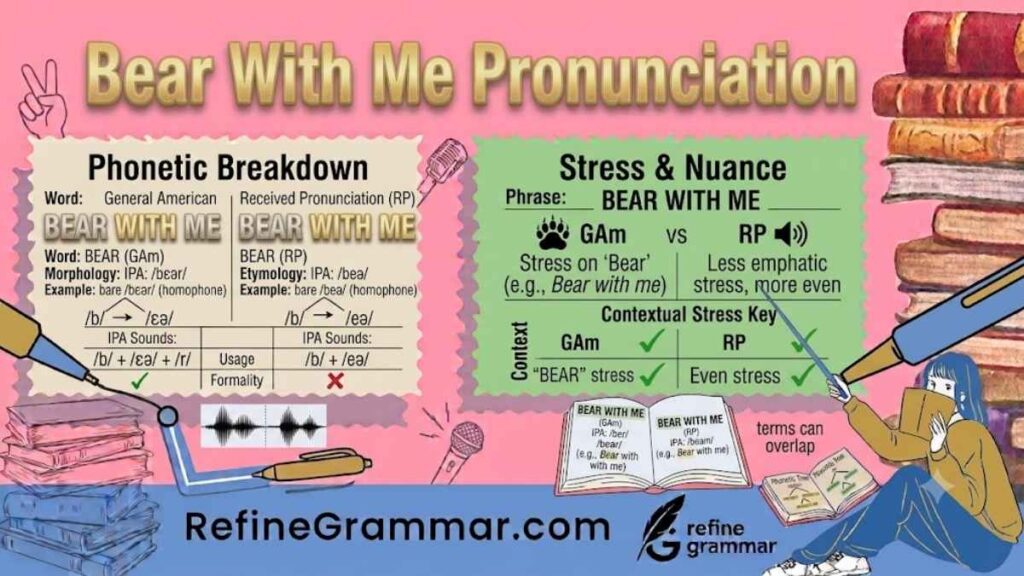
Both “bear” and “bare” are pronounced identically: /bɛr/. This shared pronunciation is the single biggest reason people mix up Bear With Me vs Bare With Me — your ears simply can’t tell them apart, so your eyes have to do the work instead.
Why “Bare With Me” Usually Sounds Wrong
Native readers instantly notice “bare with me” in writing because it implies nudity or exposure, which almost never fits the context of patience or waiting. In formal writing, this small slip can look careless or unpolished, much like other common spelling slips such as nosey or nosy.
Why People Confuse Bear and Bare
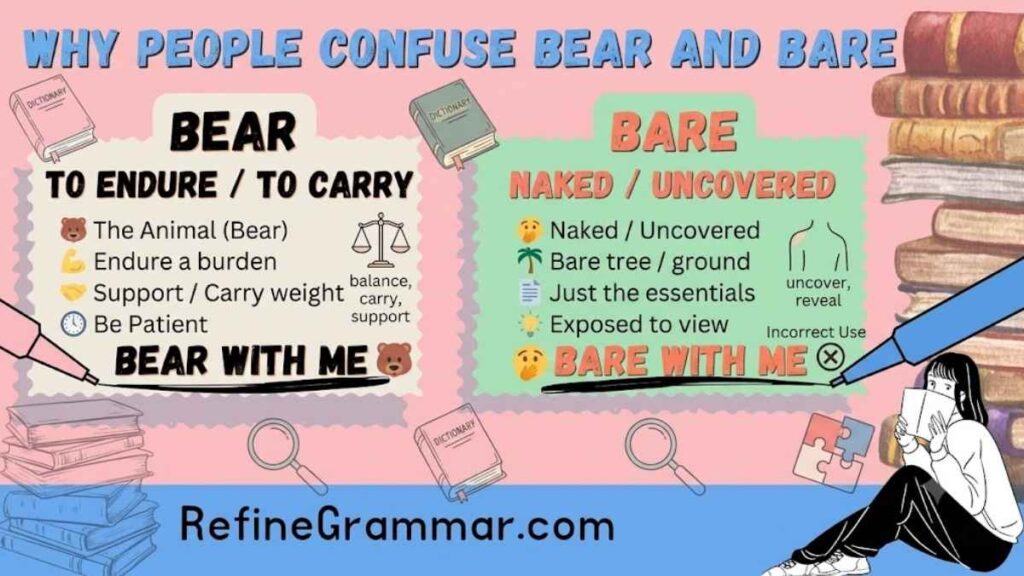
They Sound Exactly the Same
Since both words are homophones, spelling has to carry the entire burden of meaning. Without that visual cue, many writers default to whichever spelling looks more familiar.
People Learn the Phrase by Hearing It
Most people hear “bear with me” spoken long before they ever see it written down, so they guess at the spelling later — and often guess wrong.
Autocorrect Doesn’t Always Catch It
Because “bare” is a real, correctly spelled word, spellcheckers rarely flag it. Grammar tools that check meaning, not just spelling, are needed to catch this mistake reliably.
Is “Bear With Me” Grammatically Correct?
Yes, when it comes to Bear With Me vs Bare With Me, “bear with me” is the only grammatically and semantically correct version. It has been used this way in English for centuries, and every major dictionary confirms this spelling when the meaning is “be patient.”
Bear With Me Past Tense
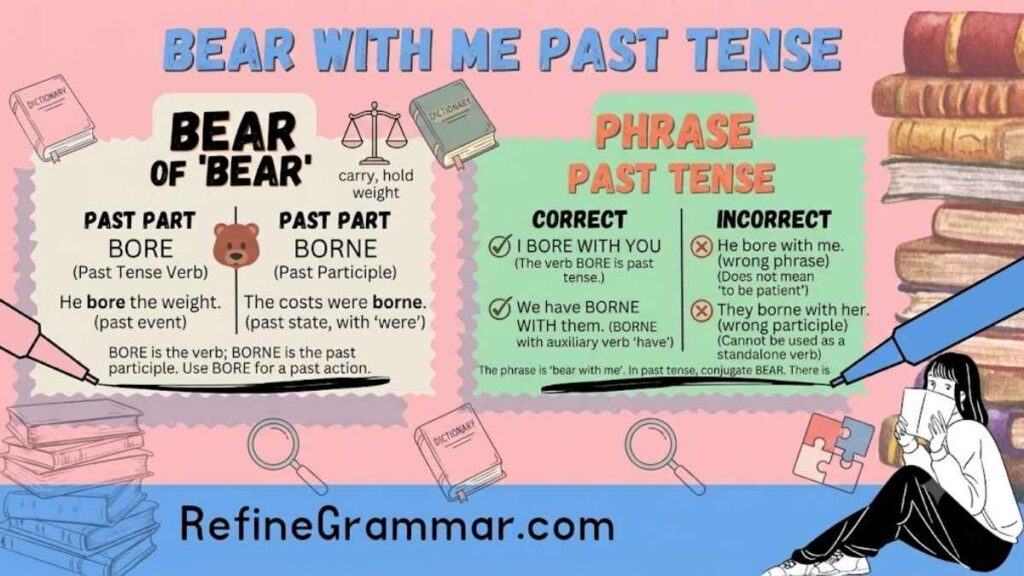
The past tense is “bore with me,” as in “I bore with him through the whole delay.” In everyday speech, people more often use “was patient with” or “put up with” instead, since “bore with” can sound slightly formal or old-fashioned.
Examples of Correct Usage
These real-world examples make the Bear With Me vs Bare With Me distinction easy to apply in daily writing.
Please Bare With Me in a Sentence
This spelling should never appear in a sentence asking for patience. The correct version is always “please bear with me,” as in: “Please bear with me while I pull up your account details.”
Workplace Communication
“Bear with me, I’m just finishing this report” is a natural, professional way to ask a colleague for a moment.
Online Meetings
“Bear with me, my connection is a little slow today” keeps a video call polite during technical hiccups.
Everyday Conversation
“Bear with me, I’m still learning how this app works” fits casual conversations between friends or family.
Funny Examples of Incorrect Usage
Signs and emails that read “Please bare with us during renovations” have gone viral for accidentally implying a clothing-optional experience. These slip-ups are a favorite among grammar meme accounts precisely because the Bear With Me vs Bare With Me error changes the meaning so drastically.
The History Behind “Bear With Me”

Bear With Me Origin
The verb “bear,” meaning to endure or tolerate, traces back to Old English “beran,” related to the idea of carrying weight. Over centuries, “bear with” evolved into an idiom asking someone to patiently carry through a delay alongside you.
Bear vs Bare: Side-by-Side Comparison
| Word | Part of Speech | Meaning | Example |
| Bear | Verb / Noun | To endure, tolerate, or carry; also a large animal | “Please bear with me.” |
| Bare | Adjective / Verb | Naked, uncovered, or to reveal | “The room was completely bare.” |
Quick Memory Trick
Think “bEAR” has an ear, and you use your ear to listen and be patient. “Bare” starts like “bare skin” — nothing hidden, nothing added. This small trick settles the Bear With Me vs Bare With Me debate in seconds, no matter how many times you’ve mixed it up before.
Email Example One
“Hi team, bear with me as I gather the final numbers for tomorrow’s presentation — I’ll send an update by 3 PM.”
Email Example Two
“Thanks for your patience — please bear with me while our system finishes processing your refund request.”
Common Situations Where People Use “Bear With Me”
Bear With Me for a Moment
Used when someone needs just a few seconds, such as searching for a file or looking up information.
Customer Support
Agents frequently say “bear with me” while checking account details or escalating a ticket, similar to how support teams handle other tricky word choices like protestors or protesters in written reports.
Teaching and Training
Instructors use it when troubleshooting equipment or re-explaining a concept mid-lesson.
Parenting
Parents ask children — or other adults — to “bear with me” during hectic mornings or meltdowns.
Healthcare Settings
Receptionists and nurses often say it while pulling up records or waiting on test results.
Read More: Protestors or Protesters: The Definitive Answer (Don’t Get It Wrong)
Alternatives to “Bear With Me”
If you’d rather sidestep the Bear With Me vs Bare With Me question entirely, these alternatives work just as well.
Bear With Me Synonym
Common synonyms include “hang on,” “give me a moment,” and “thanks for your patience.”
Professional Alternatives
“I appreciate your patience,” “Please allow me a moment,” and “Thank you for waiting.”
Please Bear With Me Professional
For formal emails, try: “I appreciate your patience while I finalize these details.”
Casual Alternatives
“Hang tight,” “One sec,” and “Give me a minute.”
Friendly Alternatives
“Stick with me here,” “Just a sec,” and “Thanks for hanging in there.”
When “Bare With Me” Could Technically Be Correct
There is exactly one scenario: if you’re literally asking someone to be naked with you, such as at a nude beach or a medical exam. Outside that narrow context, “bare with me” is always a mistake.
Social Media Made the Confusion Worse
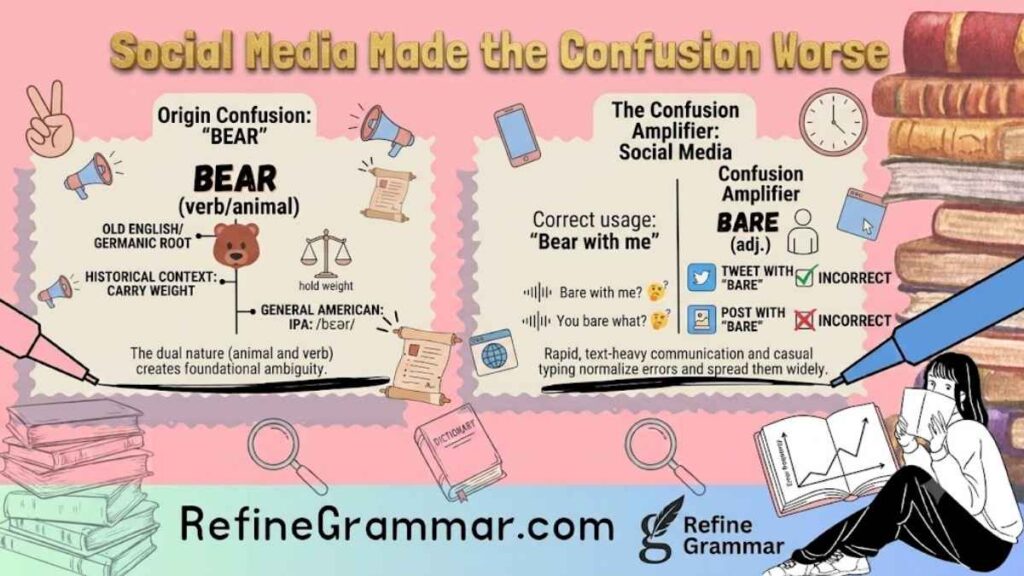
Fast typing on phones is a major reason the Bear With Me vs Bare With Me mistake keeps spreading online. Captions, comments, and quick typing on phones spread “bare with me” widely, and repetition made the incorrect spelling feel normal to casual readers, much like other viral spelling slips such as fein or fien.
Common Homophone Mistakes Similar to Bear vs Bare
English is full of these traps. Comparisons like time flies or time flys, homey or homie, and sempai or senpai show how easily spelling gets tangled with sound, especially in fast, informal writing.
Easy Ways to Remember the Correct Phrase
Think About Bears Surviving Winters
Bears endure — or “bear” — harsh winters. Connect that image to patience, and the correct spelling sticks.
Remember Bare Means Naked
If the sentence could describe someone undressing, you’ve used the wrong word.
Use the “Patience Test”
Ask yourself: “Am I asking someone to be patient?” If yes, the answer is always “bear.”
Website Notices
“Please bear with us while we update our website” is the standard, correct phrasing used across countless business sites.
Airline Announcements
“We ask that you bear with us as we prepare the aircraft for boarding” is a common, correctly written example from the travel industry.
Tech Support Messages
“Bear with me while I check your system logs” is standard phrasing in IT and tech support conversations.
Why Native Speakers Still Make This Mistake
Even fluent speakers rely on memory rather than spelling rules, and because both words sound identical, muscle memory sometimes chooses the more visually familiar “bare.” This is one reason the Bear With Me vs Bare With Me error appears even in professional writing.
The Psychology Behind Polite Language
Asking someone to “bear with you” is an act of social vulnerability — you’re admitting a delay or limitation and asking for grace. Choosing the correct wording reinforces that politeness rather than undermining it with an accidental, awkward meaning.
Examples of Correct and Incorrect Sentences
Correct Examples
- “Bear with me while I finish this call.”
- “Please bear with us during the transition.”
- “I know this is frustrating — bear with me.”
Incorrect Examples
- “Bare with me while I finish this call.”
- “Please bare with us during the transition.”
- “I know this is frustrating — bare with me.”
How Search Engines and Grammar Tools Treat the Phrase
Modern grammar checkers and search engines increasingly flag “bare with me” as a likely error, since context-aware AI models can detect the mismatch between intended meaning and literal wording. This makes it easier than ever to catch the mistake before hitting send.
Bear With Me in Pop Culture and Memes
The phrase shows up constantly in memes joking about accidental nudity references, and comedians and writers often use the mix-up deliberately for humor — proof that the Bear With Me vs Bare With Me confusion has become part of everyday internet culture, right alongside other spelling debates like dwarfs or dwarves.
Quick Cheat Sheet
Bookmark this quick-reference guide to settle Bear With Me vs Bare With Me at a glance.
- Asking for patience → “bear with me”
- Talking about nakedness or exposure → “bare”
- Past tense of the patience phrase → “bore with me”
- Pronunciation → identical for both words
- Safest choice when unsure → “bear with me”
FAQs
Here are the most common questions readers ask about Bear With Me vs Bare With Me.
Is It “Bear With Me” or “Bare With Me”?
“Bear with me” is correct when asking for patience; “bare with me” is a common misspelling.
Which Is Correct, Bear or Bare With Me?
“Bear” is correct — it means to tolerate or endure a delay.
Why Do People Say “Bare With Me”?
Because “bear” and “bare” sound identical, and many people never see the phrase written correctly.
How Do I Professionally Say “Bear With Me”?
Try “I appreciate your patience” or “Please allow me a moment” in formal settings.
What to Say Instead of “Bear With Me”?
Options include “hang on,” “give me a moment,” or “thank you for waiting.”
Is “Bear With Me” Rude?
No, it’s a polite, widely accepted request for patience in both casual and professional settings.
How Do I Respond to “Bear With Me”?
A simple “Of course, take your time” or “No problem at all” works well.
What Does It Mean If Someone Says “Bear With Me”?
It means they’re asking you to be patient while they finish a task or explain something.
Do You Say “Please Bear With Me” or “Please Bare With Me”?
Always “please bear with me” — “bare” is incorrect in this context.
What Are the Two Meanings of “Bare”?
“Bare” can mean naked or uncovered, or it can be a verb meaning to reveal or expose something.
Conclusion
The Bear With Me vs Bare With Me mix-up is easy to make and just as easy to fix once you know the trick: “bear” means to endure, and it’s always the right choice when you’re asking for patience. Keep the memory tricks in mind, double-check before you hit send, and you’ll never let this common homophone slip past you again.
