
If you have ever paused mid-sentence wondering whether to write “protestors” or “protesters,” you are not alone. The protestors or protesters question is one of the most common spelling mix-ups in modern English, and the confusion makes sense because both forms genuinely appear in print. This guide settles the debate for good, explains the grammar behind it, and shows you exactly which spelling to use in journalism, academic writing, business communication, and everyday emails.
By the end, you will know which spelling dictionaries and style guides recommend, why the alternative spelling still exists, how regional English varieties treat the word, and how to avoid the mistakes that trip up even experienced writers when the topic is protestors or protesters.
Protesters vs. Protestors at a Glance
Before the deep dive, here is a quick snapshot of the protestors or protesters debate:
| Aspect | Protester | Protestor |
| Preferred spelling | Yes the standard modern form | No treated as a variant |
| Dictionary status | Primary headword | Listed as a secondary variant |
| Journalism / AP Style | Standard choice | Rarely used |
| Where it appears | News, blogs, academic writing, business copy | Legal texts, older documents, some house styles |
| Word-formation pattern | English “-er” agent-noun pattern (teacher, writer) | Latin-influenced “-or” pattern (actor, sponsor) |
What Does “Protester” Mean?
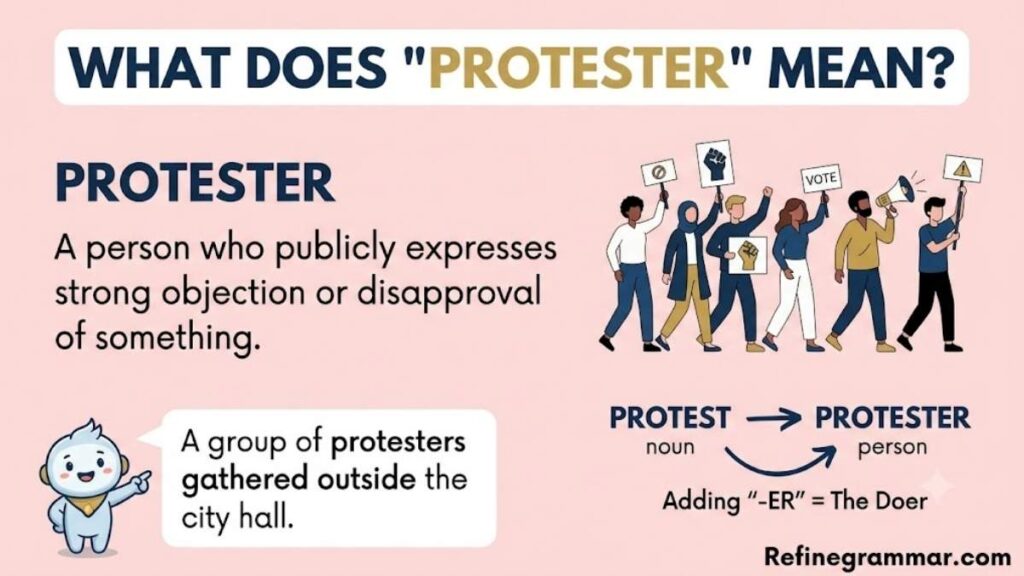
A protester is a person who publicly voices disagreement or objection to an action, policy, or decision, typically as part of an organized march, rally, sit-in, or demonstration. The word is the standard agent noun formed from the verb “protest” plus the common English suffix “-er,” the same pattern found in “teacher,” “writer,” and “speaker.”
Examples
- Hundreds of protesters gathered outside the courthouse to demand a fair verdict.
- The protester held a handmade sign above the crowd for hours.
- Local police worked to keep the protesters on the designated sidewalk.
What Does “Protestor” Mean?
A protestor carries the exact same meaning as “protester” someone who protests. The only difference is the spelling. This variant follows an older, Latin-style agent-noun pattern using “-or” instead of “-er,” similar to words like “actor,” “sponsor,” or “inventor.” It is not incorrect, but it is far less common in contemporary usage.
Examples
- The court document referred to the defendant as a protestor.
- Older newspaper archives sometimes spell it protestor instead of protester.
- Some legal filings still use the term protestor by convention.
Protestor Synonym Other Words for “Protester” and “Protestor”
Whether you spell it with an “-er” or an “-or,” the word describes the same role. Here are useful synonyms and related terms you can use to add variety to your writing:
- Demonstrator
- Objector
- Picketer
- Rally participant
- Activist
- Dissenter
- Marcher
If you are also searching for a “protest against synonym,” common alternatives include oppose, object to, speak out against, campaign against, and rally against. Choosing the right synonym helps you avoid repeating “protestors or protesters” too often within a single piece of content.
Protester Pronunciation How to Say It Correctly
Both spellings are pronounced the same way: pruh-TEST-er (IPA: /prəˈtɛstər/). The stress falls on the second syllable, “test.” Regardless of whether you write “protester” or “protestor,” the spoken word does not change the spelling difference is purely visual, which is part of why so many writers assume either version of protestors or protesters is acceptable.
Protestors or Protesters: Which Spelling Is Correct?
In short: “protester” is the correct and preferred spelling in modern American and British English alike. “Protestor” is not a misspelling in the strictest sense it is a recognized variant but it is far less frequent, less recommended by style guides, and less consistent with how English typically forms agent nouns. When people ask whether it is protestors or protesters, the safest and most widely accepted answer for everyday, professional, and journalistic writing is “protesters.”
Why “Protesters” Became the Preferred Spelling
Readers Process Familiar Patterns Faster
English readers are used to seeing “-er” at the end of agent nouns. Words like “reader,” “leader,” and “worker” train the eye to expect that pattern. Because “protester” matches this familiar shape, it reads more naturally and processes faster, which matters for readability and for search engines that reward clear, expected language.
Consistency Matters
Style consistency builds trust with readers. Major dictionaries, news outlets, and editorial style guides have converged on “protester” as the standard form, which reinforces its dominance. Once a spelling becomes the consistent choice across major publications, it becomes the de facto correct answer to the protestors or protesters question.
Why Does “Protestor” Exist?
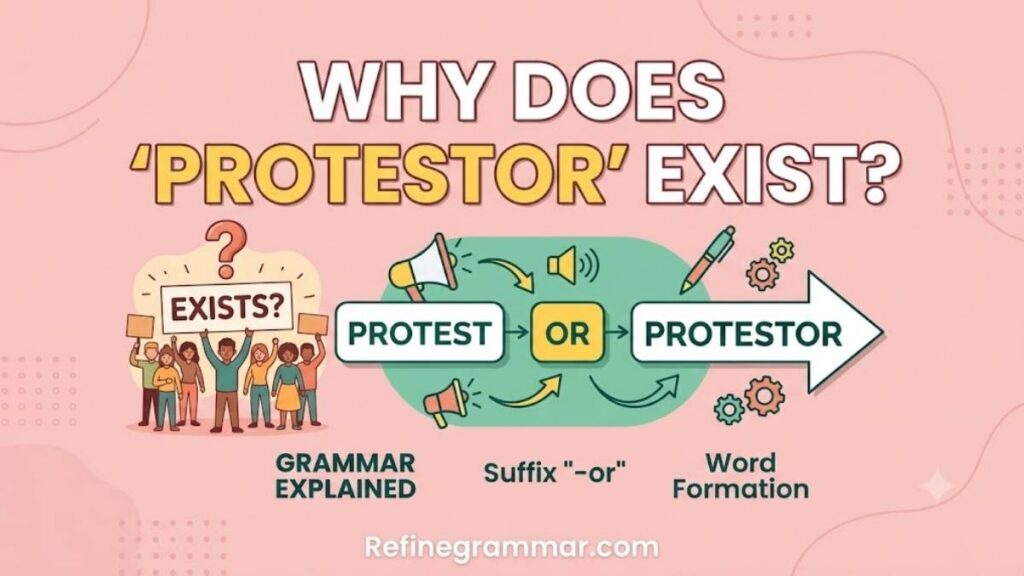
The Influence of Latin
English borrowed many agent nouns from Latin, where “-or” was the standard ending (as in “actor” or “doctor”). “Protestor” reflects that Latin-influenced pattern rather than the native English “-er” ending, which is why it still appears in formal, legal, and historical texts.
Language Changes Through Usage
Spelling conventions shift as language evolves through popular usage rather than fixed rules. “Protestor” was more common decades ago, and traces of that older usage persist in legal writing, some international publications, and informal contexts where writers may not be aware of current standards.
Does That Mean Protestor Is Outdated?
Not outdated exactly, but it is increasingly uncommon. “Protestor” has not disappeared, but its usage has steadily declined compared to “protester,” especially in journalism and everyday digital content.
Why Most Editors Recommend “Protester”
Editors favor “protester” because it aligns with dictionary guidance, matches AP Style, and keeps writing consistent with what most readers expect to see. Choosing the standard spelling also reduces the risk of a document looking inconsistent or dated.
A Simple Way to Remember
Think of “protester” the same way you think of “tester” or “tweeter” the “-er” ending is the everyday English default. If in doubt about protestors or protesters, default to “protester.”
Protesters or Protestors in American and British English
American English
American style guides, including AP Style, consistently favor “protester.” It is the dominant spelling across U.S. news outlets, government communications, and academic publishing.
British English
British publications also favor “protester,” though “protestor” occasionally appears in UK legal and governmental documents, reflecting the lingering Latin-style influence in formal British writing.
Australian English
Australian media generally follows the same pattern as American and British English, with “protester” appearing far more frequently across news sites and official communications than “protestor.” Searches for “protestors or protesters Australia” consistently point back to “protester” as the standard choice.
Regional Usage Comparison
Wherever you write from, the regional data on protestors or protesters tells the same story: “protester” wins across every major English-speaking market.
| Region | Preferred Spelling | Notes |
| United States | Protester | Standard across AP Style and major outlets |
| United Kingdom | Protester | “Protestor” occasionally used in legal contexts |
| Australia | Protester | Matches US/UK standard usage |
| Canada | Protester | Follows North American convention |
How Major Dictionaries Treat Protesters and Protestors
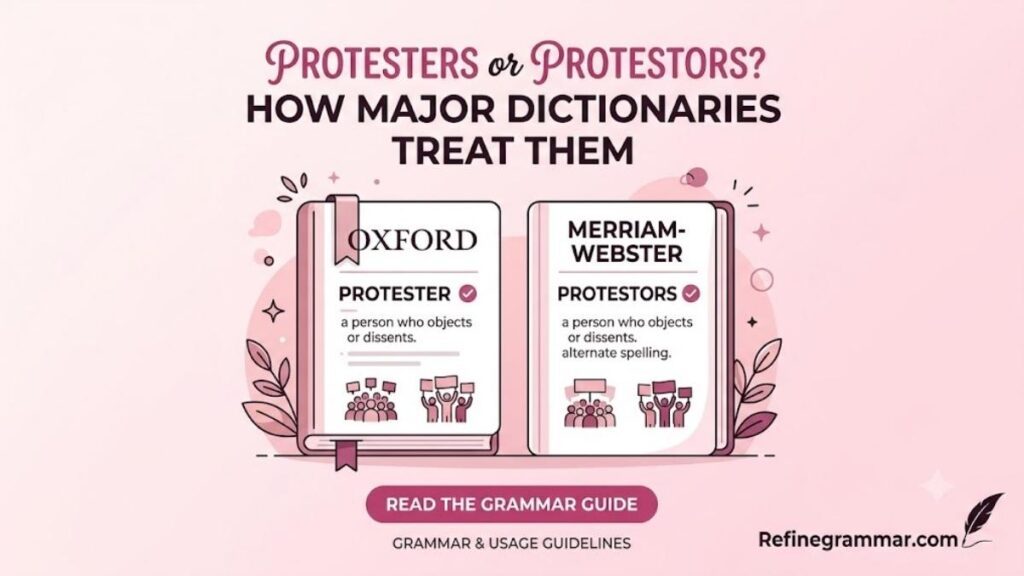
Dictionary treatment is one of the clearest signals in the protestors or protesters debate. Most major English dictionaries list “protester” as the primary headword and “protestor” as a secondary or alternative spelling.
Dictionary Comparison
| Dictionary | Primary Spelling | Variant Listed? |
| Merriam-Webster | Protester | Yes, protestor noted as a variant |
| Cambridge Dictionary | Protester | Occasionally cross-referenced |
| Oxford Learner’s Dictionaries | Protester | Protestor rarely featured |
| Collins Dictionary | Protester | Protestor listed as less common |
How News Organizations Spell It
Why Journalists Prefer Protester
News organizations prioritize clarity, consistency, and readability, all of which favor “protester.” Because journalism reaches massive daily audiences, it plays a major role in shaping which spelling the public perceives as standard.
AP Style Guidelines
The Associated Press Stylebook, the reference most U.S. newsrooms follow, uses “protester” rather than “protestor.” Because so many publications base their house style on AP guidance, this single style decision has had an outsized effect on settling the protestors or protesters question across the media landscape.
Google Usage Trends: Which Spelling Do People Use More?
Search and usage data consistently show “protester” appearing far more often online than “protestor,” even though both terms are searched by curious writers trying to confirm the correct form.
Why This Matters
For SEO and content writing, matching the dominant, dictionary-approved spelling helps content align with reader expectations and established editorial norms, which supports clarity and trustworthiness.
What Online Communities and Reddit Say
Discussions around “protestors or protesters Reddit” threads generally reach the same conclusion as style guides: most contributors agree “protester” is the modern standard, while acknowledging “protestor” as an older or regional variant rather than an error.
The Grammar Behind the Spelling
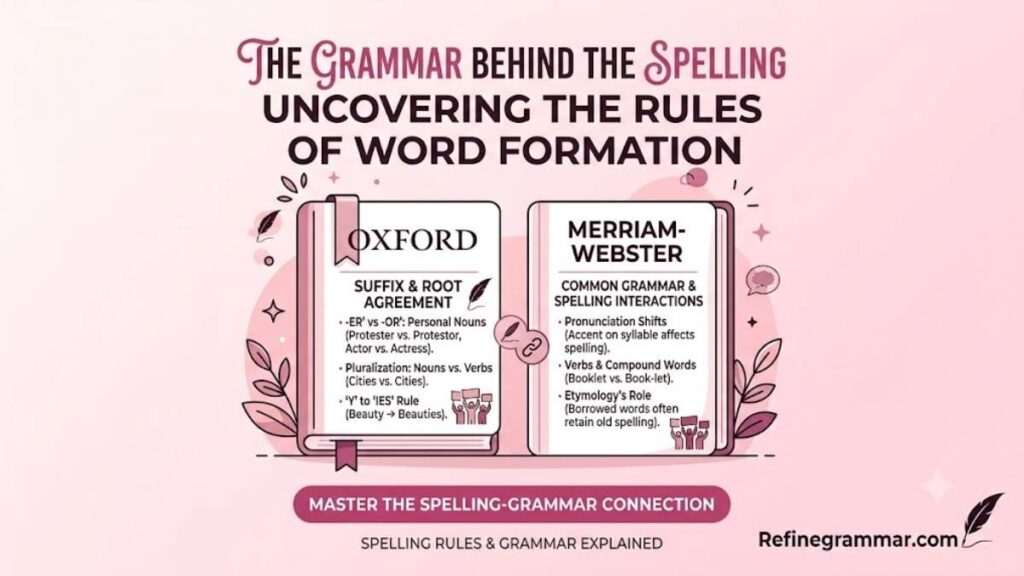
Agent nouns in English are typically formed by adding “-er” to a verb to describe someone who performs that action: protest becomes protester, teach becomes teacher, write becomes writer. The “-or” ending is more commonly reserved for words with direct Latin roots, such as “director” or “inspector.” Since “protest” entered English through French rather than directly through Latin agent-noun formation, the native “-er” pattern is the grammatically expected default.
Are There Exceptions?
Yes. English is full of inconsistent agent nouns (compare “advisor”/”adviser” or “editor” with no “-er” equivalent), so no single rule applies universally. “Protester” simply happens to be the form that usage and style guides have settled on when it comes to protestors or protesters.
Understanding related phrasing rounds out the full protestors or protesters picture, including the closely related expression “protest against.”
What Does “Protest Against” Mean?
“Protest against” means to actively object to or oppose something, often through public demonstration, formal complaint, or organized resistance. For example: “Residents protested against the new zoning law.”
Synonyms for “Protest Against”
- Oppose
- Object to
- Speak out against
- Campaign against
- Resist
- Rally against
Protesters vs. Protestors in Real Sentences
Examples Using “Protester”
- The protester chained herself to the gate in silent defiance.
- Dozens of protesters marched through downtown before sunset.
- A single protester can sometimes spark national attention.
Examples Using “Protestor”
- The historical record lists him as a lone protestor outside city hall.
- The legal brief referred to each protestor by name.
- Older textbooks occasionally use protestor without inconsistency being flagged.
Common Mistakes Writers Make
Assuming Protestor Is Wrong
“Protestor” is not incorrect it is simply less common. Treating it as a flat error overstates the case; it is a legitimate but secondary variant.
Thinking Both Spellings Are Equally Common
They are not. “Protester” appears far more frequently across dictionaries, journalism, and everyday writing, making it the safer default choice.
Mixing Both Spellings in One Article
Switching between “protester” and “protestor” within the same piece looks inconsistent and unpolished. Pick one spelling and use it throughout, the same way you would stay consistent with other commonly confused pairs, such as dwarfs or dwarves or nosey or nosy.
Ignoring Your Style Guide
If you write for a publication or company with an established style guide, always defer to it, even if it differs slightly from the general recommendation here.
Choosing a Spelling Based on Pronunciation
Because both spellings sound identical, pronunciation offers no clue about which form to use much like other pairs that sound similar but are spelled differently, such as fein or fien.
Assuming Older Sources Reflect Current Usage
Older newspapers, textbooks, or legal archives may favor “protestor,” but that does not reflect current editorial standards. Usage evolves, much like the shifting standard behind time flies or time flys.
When Should You Use “Protester”?
Use Protester When Writing:
- News articles, blog posts, or web content
- Academic papers and essays
- Business communications and reports
- Social media posts and marketing copy
- Any content intended for a general modern audience
Why It Matters
Using the standard spelling keeps your writing polished, consistent with reader expectations, and aligned with the conventions used by trusted publications the same principle that applies when choosing between other commonly confused terms like homey or homie or sempai or senpai.
When Might “Protestor” Be Appropriate?
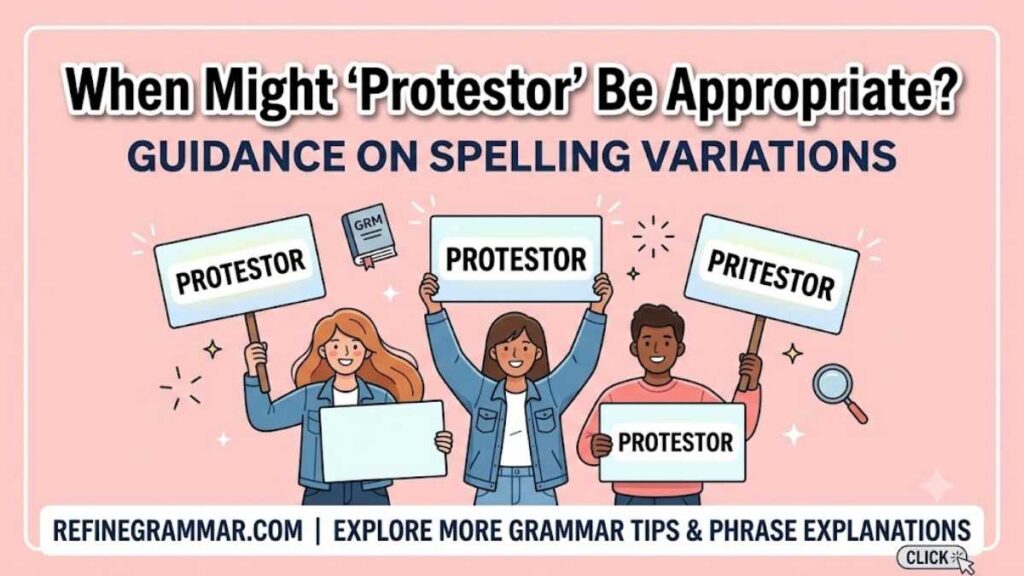
Even though “protester” wins the protestors or protesters debate overall, a handful of contexts still call for the older spelling.
Quoting Historical Sources
If you are directly quoting a historical document or older text that used “protestor,” preserve the original spelling within the quotation.
Following a Publication’s House Style
Some publications or organizations may specifically require “protestor” as part of their house style. In that case, consistency with the guide takes priority.
Reproducing Legal or Official Documents
Legal filings sometimes use “protestor” by convention. When reproducing or referencing such documents verbatim, match the original spelling.
Academic Discussions About Language
Linguistic or etymological discussions comparing the two forms may reasonably use “protestor” when specifically analyzing that variant.
Protesters vs. Protestors: Quick Comparison
Here is a fast-reference recap of everything covered above regarding protestors or protesters:
| Question | Answer |
| Which spelling is correct? | Protester (preferred); protestor is an accepted variant |
| Which spelling do dictionaries list first? | Protester |
| Which spelling does AP Style use? | Protester |
| Do they mean the same thing? | Yes, identical meaning |
| Are they pronounced differently? | No, pronunciation is identical |
A Simple Memory Trick
Easy Mnemonic
Remember: “protester” rhymes with “tester,” and testers, like protesters, are everyday English “-er” words. If you can picture a tester, you can spell protester.
FAQs
Is it spelled protester or protestor?
“Protester” is the preferred, standard spelling; “protestor” is an accepted but less common variant.
What is the meaning of protestors or protesters?
Both spellings refer to a person who publicly objects to or demonstrates against something.
What are protestors called?
They may also be called demonstrators, activists, picketers, or dissenters, depending on context.
What is the difference between protestors and rioters?
Protesters demonstrate peacefully to voice objection, while rioters engage in violent or destructive behavior; the terms are not interchangeable.
Is protester or protestor correct?
Both are technically correct, but “protester” is the widely preferred, dictionary-first spelling.
What is another word for protester?
Common alternatives include demonstrator, activist, objector, and picketer.
What do you call a group of protesters?
A group is often called a crowd, rally, demonstration, or protest movement.
How do you use protesters in a sentence?
Example: “Protesters filled the square, chanting for policy change.”
How do you say protester? (pronunciation)
It is pronounced pruh-TEST-er, with stress on the second syllable.
What is the definition of protest?
To protest means to formally or publicly express strong objection to something.
Final Thoughts
When it comes down to protestors or protesters, the modern, dictionary-approved, journalist-preferred answer is clear: use “protester.” Save “protestor” for direct quotations, legal documents, or house-style exceptions.
Getting small spelling decisions right the same way you would with bear with me vs. bare with me or maintained or maintenanced is part of what makes writing feel professional and trustworthy. For a closer side-by-side look at how these two forms compare, see this protestors or protesters spelling comparison.
