
Refer is correct. Reffer isn’t a recognized word in standard English, even though it feels natural to double the “f” when you say it out loud.
The refer or reffer confusion makes sense. The middle sound almost begs for that extra letter, but English spelling doesn’t always follow pronunciation, and this word is a clear example. Get it wrong in a resume or business email, and it can make your writing look careless.
This guide breaks down where the refer or reffer mix-up comes from, how the word changes when you add endings like -red or -ring, and a few related terms people often stumble over too.
Refer
Refer is a verb meaning to direct someone’s attention to something, to mention a source, or to send a person to another place or professional for help. It is the only correct spelling in standard English, used the same way in formal writing, casual conversation, and professional communication.
Reffer
Reffer is not a real word. It’s a common misspelling of refer, usually caused by the way the word sounds when spoken aloud. No dictionary, style guide, or grammar authority recognizes reffer as valid, so it should never appear in professional or academic writing.
Refer or Reffer: Quick Answer
The quick answer to refer or reffer is simple: refer is correct, and reffer is always wrong. No dialect, region, or context changes this rule. Whether you’re writing a business email in the United States or a formal letter in the United Kingdom, refer is the spelling you need.
The Origin of Refer or Reffer
The word refer traces back to the Latin verb referre, formed from re- (meaning “back”) and ferre (meaning “to carry”). Together, the roots convey the idea of carrying attention or information back to a source. English adopted the word during the late Middle Ages, and its single-f spelling has stayed consistent ever since. The reffer spelling has no historical basis at all — it’s simply a modern typing error, not a variant that developed naturally over time.
British English vs American English Spelling
Refer or reffer isn’t a British-versus-American spelling debate the way “colour” and “color” are. Both British and American English use the exact same spelling: refer. Neither dialect recognizes reffer as an accepted variant. This is one of the rare spelling questions in English where both major dialects agree completely, which makes the correct choice even easier to remember.
Which Spelling Should You Use?
Always use refer. Whether you’re writing a cover letter, a school assignment, a customer support message, or a text to a friend, refer is the only spelling that will read as correct. Getting it wrong, much like mixing up nosey or nosy, signals a lack of attention to detail and can quietly undercut your credibility.
Refer or Reffer Meaning

The meaning behind the refer or reffer confusion comes down to one legitimate word carrying several related senses: directing someone to a source, mentioning something in passing, sending a person elsewhere for help or consultation, or pointing to a fact as evidence. Reffer carries no meaning at all, because it simply isn’t a word.
Refer or Reffer Spelling
The spelling puzzle behind refer or reffer disappears once you remember one rule: refer has a single f and a single r in its base form. Much like the confusion around dwarfs or dwarves, the doubling that trips people up only shows up later — in words like referred and referring — and even then, only the r doubles, never the f.
How to Spell “Refer” Correctly (Common Search Questions)
People type dozens of variations into search engines trying to nail down this word: “how do you spell refer,” “is it refer or reffer,” “one f or two in refer.” The answer to all of them is the same. Refer has one f, one r, and no double letters anywhere in its base spelling.
What about “refers”?
Refers is simply the third-person singular present-tense form of refer, used with he, she, or it — for example, “she refers to her notes often.” It follows the same single-f, single-r spelling as the base word, with only an added s.
Refer or Reffer: Which Is Correct?
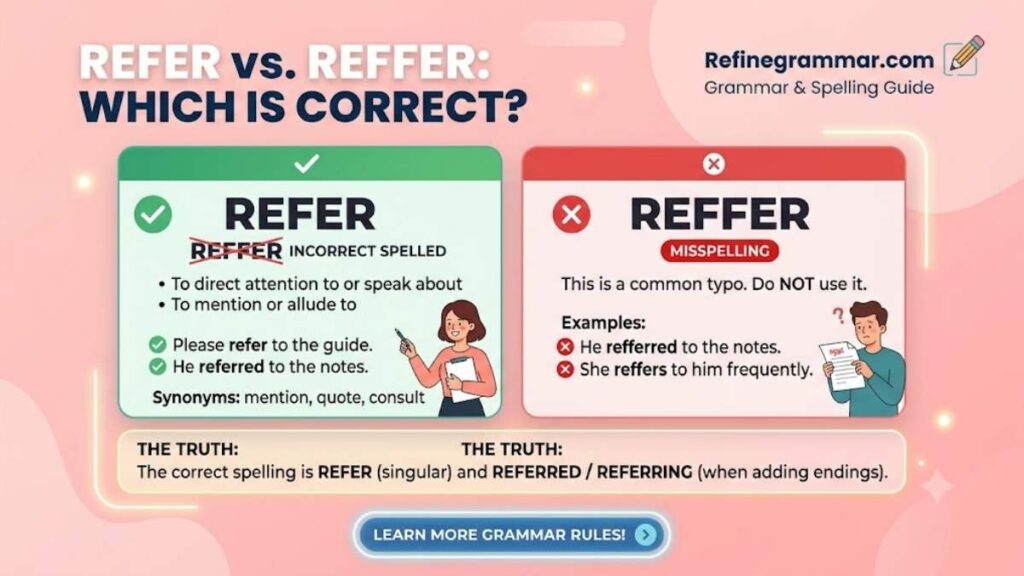
To settle refer or reffer once and for all: refer is correct, reffer is incorrect. This holds true in every tense, every dialect, and every writing context, from casual texting to formal academic papers.
Common Mistakes with Refer
- Doubling the f (writing “reffer” instead of “refer”)
- Forgetting to double the r in “referred” and “referring”
- Confusing refer with referral or reference
Mixing up refer with other tricky word pairs, such as protestors or protesters, where a single letter changes the whole word
- Using refer where “relate” or “connect” would actually fit the sentence better
Referred or Reffered
Referred is the correct past-tense form of refer. Reffered is incorrect and actually combines two mistakes at once: it drops the necessary double r and adds an unnecessary double f. This is similar to the confusion around protestors and protesters, where small spelling shifts change the word entirely. Remember: refer doubles the r — not the f — when forming referred and referring.
Refer in Everyday Examples
- “My doctor will refer me to a specialist next week.”
- “Please refer to page twelve for the full instructions.”
- “The report refers to data collected last year.”
- “He referred his friend for the open position.”
Refer or Reffer in a Sentence
Correct: “I will refer you to the right department.”
Incorrect: “I will reffer you to the right department.” ❌
Seeing refer or reffer side by side in real sentences makes the choice obvious — the double-f version simply looks and reads wrong once you know the rule.
Refer: Google Trends & Usage Data
Search interest in refer or reffer tends to rise whenever people are drafting professional documents, résumés, or referral program copy, since “refer a friend” campaigns are common in marketing. Exact search volume varies by region and season, but the pattern is consistent: far more people search to confirm that reffer is wrong than to confirm it’s right, which suggests most writers already suspect the double-f spelling looks off before they check.
Keyword Variations Comparison Table
| Term | Correct? | Notes |
| Refer | ✅ Yes | Base verb form, single f, single r |
| Reffer | ❌ No | Common misspelling; not a word |
| Referred | ✅ Yes | Past tense; doubles the r |
| Reffered | ❌ No | Doubles the wrong letter |
| Referring | ✅ Yes | Present participle; doubles the r |
| Reffering | ❌ No | Incorrect double f |
| Referral | ✅ Yes | Noun form; two r’s, one f |
Refer, Referring, or Referred: Spelling Rules Explained
English doubles a final consonant when adding “-ed” or “-ing” if the word ends in a single vowel followed by a single consonant, and the stress falls on that final syllable. Refer fits this pattern exactly, which is why the r doubles in referred and referring, while the f never changes.
Correct Forms:
- refer, refers, referred, referring, referral, referee, reference
Incorrect Forms:
reffer, reffered, reffering, refered (single r), refering (single r)
Why does the spelling change?
The doubling exists to preserve the short vowel sound in the second syllable. Without it, “refering” would visually suggest a different pronunciation than the one English speakers actually use.
Common search variations covered:
- “refer or reffer”
- “referred or reffered”
- “refering or referring”
- “is reffer a word”
- “one f or two f in refer”
Refer or Reffer Synonym
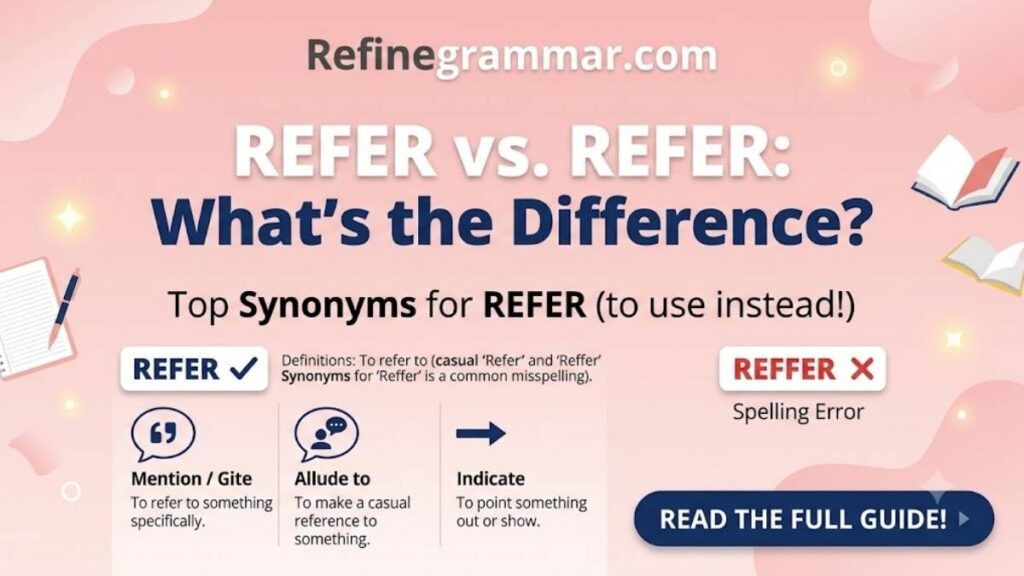
Common synonyms for refer include mention, cite, direct, point to, consult, and forward. There is no synonym for reffer, since it isn’t a recognized word in any dictionary.
Refer Slang
Refer doesn’t carry a widely recognized slang meaning of its own, though people sometimes casually shorten related words in speech, like “ref” for referee in sports. It’s easy to see how spellings drift informally online, the same way people argue over loanwords like sempai or senpai, even though only one spelling is considered standard.
Refer Noun
Refer is primarily a verb, not a noun. The related noun forms are reference (a source or citation) and referral (the act of directing someone elsewhere) — not “a refer.”
Refer Means
To refer means to direct attention, to mention, or to send someone to another source or professional. Context determines which specific sense applies in a given sentence.
I Will Refer Meaning

“I will refer” means the speaker intends to direct someone toward a resource, mention something later, or send a person elsewhere for help — for example, a doctor saying, “I will refer you to a cardiologist.”
Read More: 31st or 31th: The Definitive Guide to Using It Correctly
Referral or Refer
Referral and refer are related but distinct: refer is the verb describing the action, while referral is the noun describing the result of that action, or the person or case being sent onward. “I will refer you” describes the act; “your referral has been received” describes the outcome.
Refer or Reffer Reddit
Threads on spelling and grammar forums occasionally surface the refer or reffer debate, usually started by ESL learners or people proofreading business documents. The consensus in these discussions consistently matches every major dictionary: refer is correct, and reffer is not.
Please Refer or Reffer
“Please refer to” is the correct professional phrase used in emails, manuals, and instructions, as in “please refer to the attached file.” “Please reffer to” is a spelling error that should be corrected before sending any formal communication, similar to catching a typo like maintained or maintenanced before it goes out the door.
Refer or Reefer Weed
Refer is also sometimes confused with reefer, a completely different word used informally for marijuana or for a refrigerated shipping container. Reefer is spelled with a double e, not a double f, and has no real connection to the verb refer beyond sounding similar out loud.
Reffer or Refer Meaning in Bengali / Hindi

In Hindi, refer is often translated as संदर्भ देना (sandarbh dena) or रेफर करना (refer karna), while in Bengali it’s commonly rendered as রেফার করা (rephar kôra). In both languages, only the “refer” spelling is transliterated and used; “reffer” has no recognized translation, because it isn’t a real English word to begin with.
Conclusion
The refer or reffer question has one clear, unchanging answer: refer is correct in every dialect, tense, and context, while reffer is simply a misspelling with no grammatical or historical support. Once you remember that refer doubles its r — not its f — in forms like referred and referring, you won’t second-guess this word again. For more help with tricky spelling and word-choice pairs, from bear with me vs bare with me
to fourteen or forteen, learning the pattern behind English spelling rules makes every future mix-up easier to catch.
FAQs
What does “refer” mean?
Refer means to direct attention to something, mention a source, or send someone to another person or place for help.
How do you use “refer” in a sentence?
Example: “Please refer to the manual for setup instructions.”
What does “referred” mean?
Referred is the past tense of refer, describing an action of direction or mention that already happened.
What is a better word for “refer”?
“Consult,” “mention,” “direct,” or “recommend” — depends on context.
How do you use “refer”?
As a verb: “Refer to the manual,” “She referred him to a specialist,” or “Let’s refer back to that point.”
What does “refer to someone” mean?
It means pointing that person toward help — like a teacher referring a student to a tutor.
Is “refer to” correct?
Yes. “Refer to” is the correct, standard phrasing.
What is “reffer”?
A common misspelling of “refer.” Correct spelling has one “f”: r-e-f-e-r.
What does “refer” mean?
To direct attention toward something or someone a document, a person, or an idea.
