
If you have ever typed a sentence and paused, unsure whether to write as well or aswell, you are not alone. This exact question as well or aswell is one of the most searched spelling doubts in English, and it trips up native speakers just as often as learners.
The short answer is simple: as well is always correct, and aswell is always wrong. But knowing the rule is only half the job. This guide breaks down the meaning, the history of the mistake, real examples, and quick tricks so you never second-guess as well or aswell again.
Free Grammar Checker
What Does “As Well” Mean?
“As well” means “also,” “too,” or “in addition.” It is used to add extra information to a sentence without repeating what was already said. When people debate as well or aswell, they are really asking how to correctly write a phrase that simply tacks on an additional point.
For example, if someone says, “I ordered coffee, and I got a muffin as well,” the phrase signals that the muffin is an addition to the coffee, not a replacement for it.
Examples of “As Well”
- She speaks French and Spanish as well.
- We visited the museum, and we saw the gardens as well.
- He finished the report early, and he reviewed the budget as well.
- They enjoyed the movie, and the soundtrack impressed them as well.
Is “Aswell” a Real Word?
No. “Aswell” is not a recognized English word. It does not appear in any major dictionary, and no style guide accepts it as a valid spelling. Whenever the debate of as well or aswell comes up, dictionaries side firmly with the two-word form.
Why People Write “Aswell”
The mistake usually happens because of pronunciation. When spoken quickly, “as well” blends together and sounds like a single word. This is the same reason people confuse atleast or at least the spoken rhythm hides the space between the words.
Quick Answer
As well is correct. Aswell is incorrect. That is the entire rule, and it never changes based on context, tone, or formality.
“As Well” in Oxford Dictionary
Oxford Dictionaries, along with Merriam-Webster and Cambridge Dictionary, list “as well” as a standard two-word adverbial phrase meaning “also” or “too.” None of these authoritative sources list “aswell” as an alternate spelling or informal variant. When it comes to settling as well or aswell for good, dictionary entries are the strongest evidence available.
As Well vs Aswell: The Main Difference
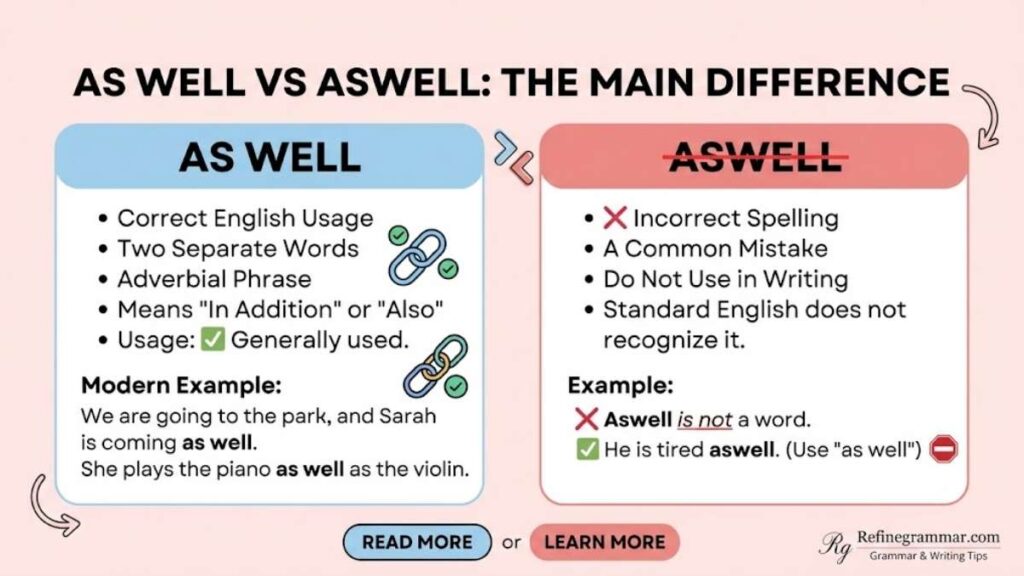
The core difference in as well or aswell is spelling, not meaning. “As well” is a legitimate phrase built from two separate words, each carrying its own grammatical role. “Aswell” is simply those two words merged incorrectly, with no dictionary standing behind it.
Why “As Well” Stays Separate
Unlike words such as “altogether” or “already,” which evolved into single compound words over time, “as well” never made that shift. Grammar authorities have kept it as two words for centuries, and there is no sign that will change.
Common Sentence Comparison
| Incorrect (Aswell) | Correct (As Well) |
| I like tea aswell. | I like tea as well. |
| She can dance aswell. | She can dance as well. |
| We should leave aswell. | We should leave as well. |
| He wants pizza aswell. | He wants pizza as well. |
Synonyms for “As Well”
If you want to avoid repeating “as well” too often in a paragraph, several synonyms work just as well:
- Also
- Too
- In addition
- Additionally
- Along with that
- Furthermore
How to Use “As Well” Correctly in Sentences
Once you know that as well or aswell has only one right answer, the next step is learning where to place the phrase for natural, correct sentences.
Use “As Well” at the End
“As well” almost always sits at the end of a clause or sentence. Example: “I finished the assignment, and I checked it twice as well.”
Use “As Well” in Formal Writing
“As well” is fully acceptable in formal, academic, and business writing, unlike some casual fillers. It works well in reports, emails, and professional documents, similar to how laid out or layed out needs the correct form in polished writing.
Avoid Overusing It
Repeating “as well” in every sentence can feel repetitive. Mix it with synonyms like “also” or “too” to keep writing varied and readable, the same way varying number formats helps in guides like is it 26 or 26.
Common Grammar Mistakes Related to “As Well”
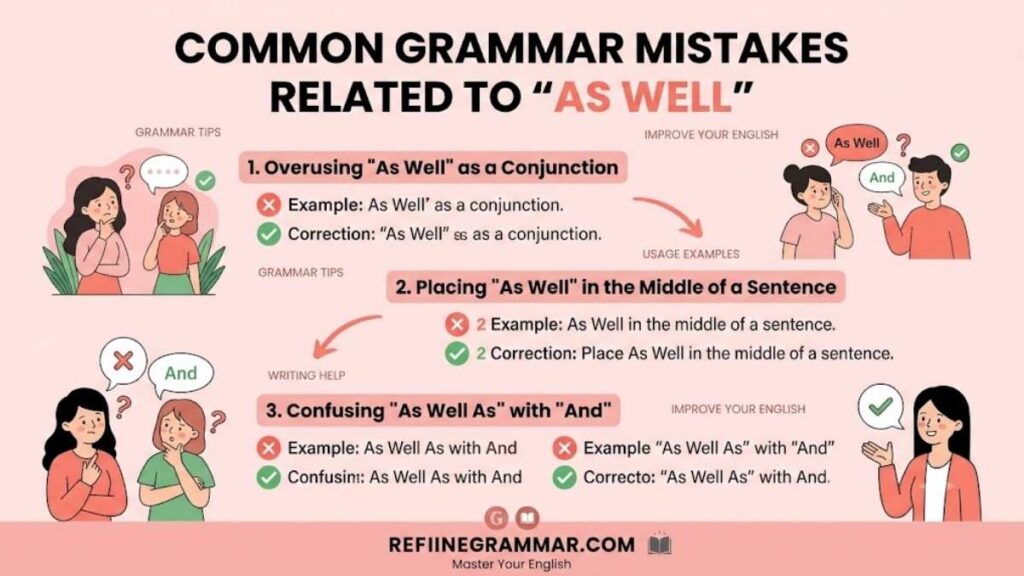
The as well or aswell confusion is only one of several common mistakes people make with this phrase.
Writing It as One Word
Merging “as” and “well” into “aswell” is the single most common error, and spell-checkers usually catch it but not always, especially in fast typing or messaging apps.
Wrong Placement in Sentences
Placing “as well” in the middle of a sentence where it does not belong can confuse readers. Example of a mistake: “I like pizza as well I like pasta.” Correct version: “I like pizza. I like pasta as well.”
Confusing It With “Also” and “Too”
“As well,” “also,” and “too” share the same meaning but have slightly different placement rules. “Also” typically appears at the start or middle of a sentence, while “as well” and “too” usually appear at the end.
“As Well” in British vs American English
Good news for anyone worried about regional spelling differences: the as well or aswell rule does not change across English varieties.
British English
British English uses “as well” exactly the same way as other varieties, with no regional spelling exception.
American English
American English also treats “as well” as the only correct form. There is no accepted “aswell” spelling on either side of the Atlantic.
Common Phrases With “As Well” (Thank You, May As Well, Might As Well)
Several everyday expressions rely on the correct “as well” spelling:
- Thank you as well a polite response when someone thanks you first.
- May as well used when there is little reason not to do something.
- Might as well similar to “may as well,” suggesting an action makes sense given the circumstances.
- Just as well meaning something turned out to be fortunate.
What Reddit Users Say About “As Well or Aswell”
On grammar and writing forums, including threads on Reddit, the consensus mirrors what dictionaries say: “aswell” is a typo, not a valid variant. Many commenters note that they only notice the mistake when reading it, since it sounds identical to “as well” when spoken. This lines up with confusion around similar phrases, such as the debate over favs or faves, where pronunciation drives the spelling error more than genuine uncertainty about meaning.
Real-Life Example: How One Small Grammar Mistake Affected Professional Writing
A freelance content writer once submitted an article to a business client with “aswell” used throughout instead of “as well.” The client flagged it immediately, treating the repeated error as a sign of careless editing. The piece required a full revision before it was approved, and the writer later admitted the habit came from years of fast, informal texting.
The lesson is simple: in professional and SEO writing, getting as well or aswell right is not just a grammar preference it directly affects how credible your writing appears to readers and clients.
Why Correct Grammar Still Matters in 2026
With AI writing tools and quick messaging apps everywhere, small errors like aswell spread faster than ever. Getting the as well or aswell distinction right signals attention to detail, which readers and search engines both reward.
Why Search Engines Care About Readability
Search engines increasingly prioritize content that is clear, correct, and genuinely helpful. Spelling accuracy, including small details like as well or aswell, contributes to the overall trustworthiness signal that ranking systems evaluate.
Easy Trick to Remember the Correct Form
If you ever hesitate between as well or aswell again, use this simple mental shortcut.
If “well” means “also,” keep it separate.
Whenever “well” is standing in for “also” or “too,” it needs its own space. Only combine words when they form an actual compound word recognized by dictionaries and “aswell” is not one of them.
Quick Memory Formula
Think: AS + WELL = two words, two jobs. “As” sets up the comparison, and “well” adds the meaning of “also.” Keeping them apart keeps the grammar correct.
As Well vs Also vs Too
“As well,” “also,” and “too” all mean roughly the same thing, but they are not always interchangeable in placement.
Which One Should You Use?
| Word/Phrase | Typical Position | Example |
| Also | Start or middle of sentence | She also enjoys hiking. |
| Too | End of sentence | She enjoys hiking too. |
| As well | End of sentence | She enjoys hiking as well. |
Best Writing Tips to Avoid Grammar Mistakes
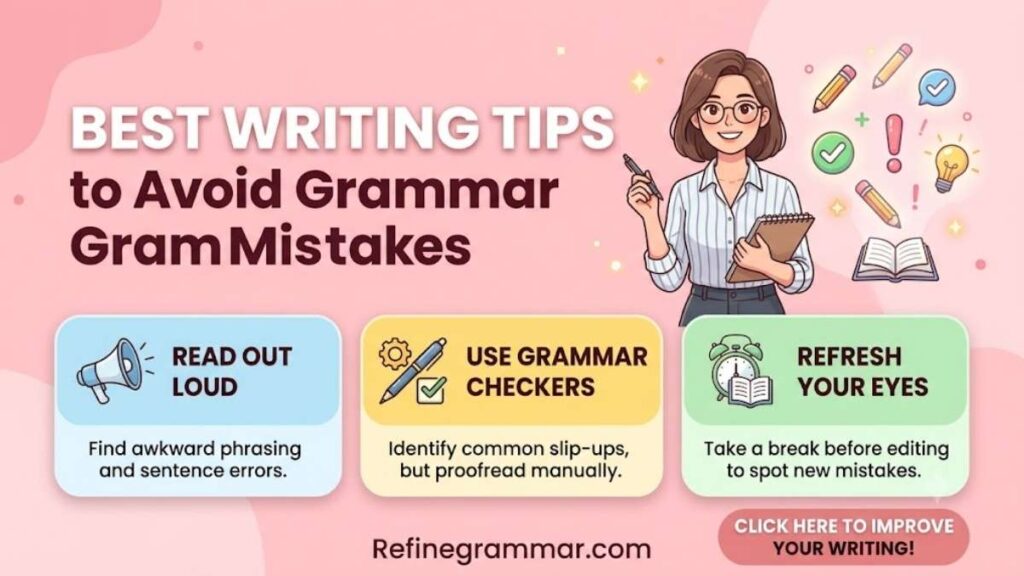
Beyond the as well or aswell rule, a few habits help you avoid similar spelling slips across your writing.
Proofread Slowly
Reading your work slowly, or out loud, helps catch merged words like “aswell” that spell-check sometimes misses.
Use Grammar Tools
Grammar checkers can flag “aswell” automatically, but they are not perfect, so a manual review still matters the same way double-checking numbers like is it 26 or 26 avoids small but costly errors.
Read Professional Content
Reading well-edited books, articles, and professional websites trains your eye to notice when a phrase looks wrong, including as well or aswell mistakes.
Mini Quiz: As Well or Aswell
Quiz 1: Which One Is Correct?
“I want to come ___.” (as well / aswell) Answer: as well.
Quiz 2: Spot the Mistake
“He can swim aswell as run.” Mistake: aswell should be as well.
Quiz 3: What Does “As Well” Mean?
It means “also” or “too,” adding extra information to a statement.
Quiz 4: Formal or Informal?
“As well” is appropriate in both formal and informal writing.
Quiz 5: Fill in the Blank
“She ordered soup, and she wanted salad ___.” Answer: as well.
Quiz 6: Grammar Check
“They visited Paris aswell.” Correction: They visited Paris as well.
Quiz 7: Quick Choice
Choose the correct spelling: as well ✔ or aswell ✘.
Quiz 8: Similar Meaning
Which word means the same as “as well”? Answer: also, too, additionally.
Quiz 9: Sentence Position
Where does “as well” usually go in a sentence? Answer: at the end.
Quiz 10: True or False
“Aswell” is accepted in British English. False, it is never correct.
Quiz 11: Final Challenge
Rewrite correctly: “We packed snacks aswell.” Answer: We packed snacks as well.
Frequently Asked Questions
What does “as well” mean?
It means “also” or “too,” used to add extra information to a sentence.
Is “aswell” a real word?
No, “aswell” is not a recognized word in any major dictionary.
What is a synonym for “as well”?
Common synonyms include “also,” “too,” and “additionally.”
Is “as well” the same as “too”?
Yes, they share the same meaning, though placement in a sentence can differ slightly.
What does the Oxford Dictionary say about “aswell”?
Oxford Dictionaries does not list “aswell” as a valid word or spelling.
Is “as well” used differently in UK English than US English?
No, both British and American English use “as well” the same way.
How do you spell “as well” correctly one word or two?
It is always spelled as two separate words: as well.
When should you use “as well” in a sentence?
Use it at the end of a sentence to add extra information or agreement.
Is it correct to say “thank you as well” or “thank you aswell”?
“Thank you as well” is correct; “thank you aswell” is a spelling mistake.
Is “may as well” written as one word or two?
It is written as three separate words: may as well.
Conclusion
The debate over as well or aswell has a clear, permanent answer: “as well” is correct, and “aswell” is always a mistake. Whether you are writing a casual message, a professional email, or SEO content, sticking to the two-word form keeps your writing accurate and credible.
Now that you understand the rule, the reasoning behind it, and how to place it correctly in a sentence, you can move past the as well or aswell confusion for good and if you want to sharpen more everyday spelling habits, guides like timeframe or time frame, to small or too small, and carrer or career are great places to continue.
