
If you’ve ever typed a sentence and then stared at it, wondering whether you should write “laid out” or “layed out,” you’re in good company. This mix-up shows up in emails, blog posts, resumes, and even published articles.
The good news is that the rule is simple once you see it clearly, and by the end of this guide you’ll never second-guess Laid Out or Layed Out again.
Laid Out vs. Layed Out — Quick Answer You Can Trust
“Laid out” is correct. “Layed out” is not a recognized spelling in standard English, and you won’t find it in any major dictionary. The verb lay is irregular, and its past tense and past participle are both laid, never layed. So whenever you’re deciding between Laid Out or Layed Out, the safe, dictionary-approved choice is always laid out.
Example
Correct: She laid out her notes before the meeting.
Incorrect: She layed out her notes before the meeting.
Why “Laid Out vs. Layed Out” Confuses So Many People
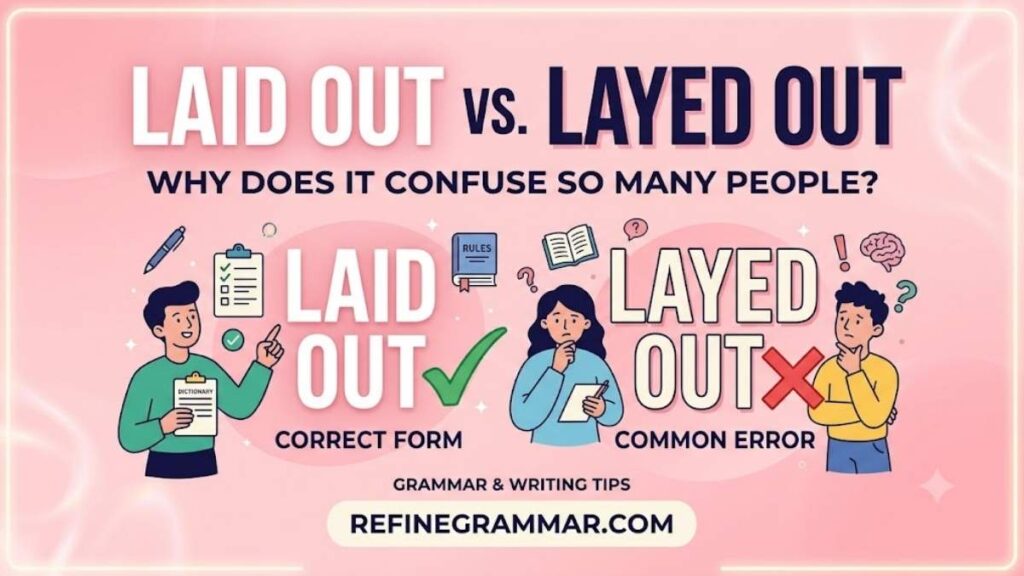
The Laid Out or Layed Out debate keeps coming up because English past-tense rules aren’t always consistent, and this particular verb breaks the pattern most people expect.
Sound-Based Spelling Habits
Many regular verbs simply add -ed to form the past tense, such as play becoming played or stay becoming stayed. Writers unconsciously apply that same pattern to lay, which produces the incorrect layed. This is similar to how people slip up with other -ed endings, the same way some writers hesitate over stopping or stoping when doubling a final consonant.
The Real Culprit: Lay vs. Lie Confusion
A second source of the error is the constant tangle between lay (to place something down) and lie (to recline). Because these two verbs share overlapping forms, people borrow spellings from one and misapply them to the other, which fuels the Laid Out or Layed Out mix-up even further.
Social Media Makes It Worse
Casual writing on social platforms rarely gets proofread, so incorrect spellings like layed circulate widely and start to look normal. Repeated exposure trains the eye to accept an error, much like other informal shortcuts such as favs or faves spread through casual posts before slowing down and settling on one accepted form.
The Grammar Behind “Laid Out” (Made Clear and Simple)
Core Rule
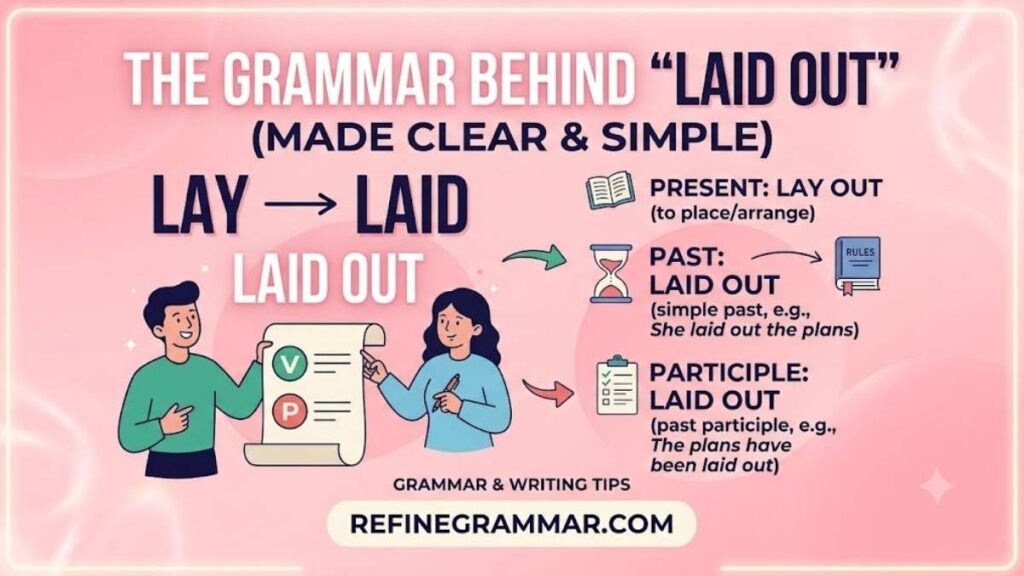
Lay is an irregular transitive verb, meaning it always takes a direct object and does not follow the standard -ed pattern. Its principal parts are lay, laid, laid, and that’s the entire rule behind the Laid Out or Layed Out question.
Verb Forms You Actually Need
| Base Form | Past Tense | Past Participle | Present Participle |
| Lay (to place) | Laid | Laid | Laying |
| Lie (to recline) | Lay | Lain | Lying |
Why “Laid Out” Works
Laid out follows the irregular past-tense pattern of lay and matches every major dictionary and style guide, which is why it reads as correct and professional in any context.
Why “Layed Out” Fails
Layed out applies a regular -ed ending to an irregular verb, a mistake similar to how some writers second-guess whether it’s focusses or focuses. It simply isn’t a standard word, no matter how natural it sounds when spoken quickly.
Laid Out or Layed Out: Past Tense Explained
When you’re describing something that already happened, past tense is where Laid Out or Layed Out questions surface most often. The rule stays constant regardless of subject or tense: I laid, you laid, she laid, they laid never layed, in any form.
What “Laid Out” Really Means in Everyday English
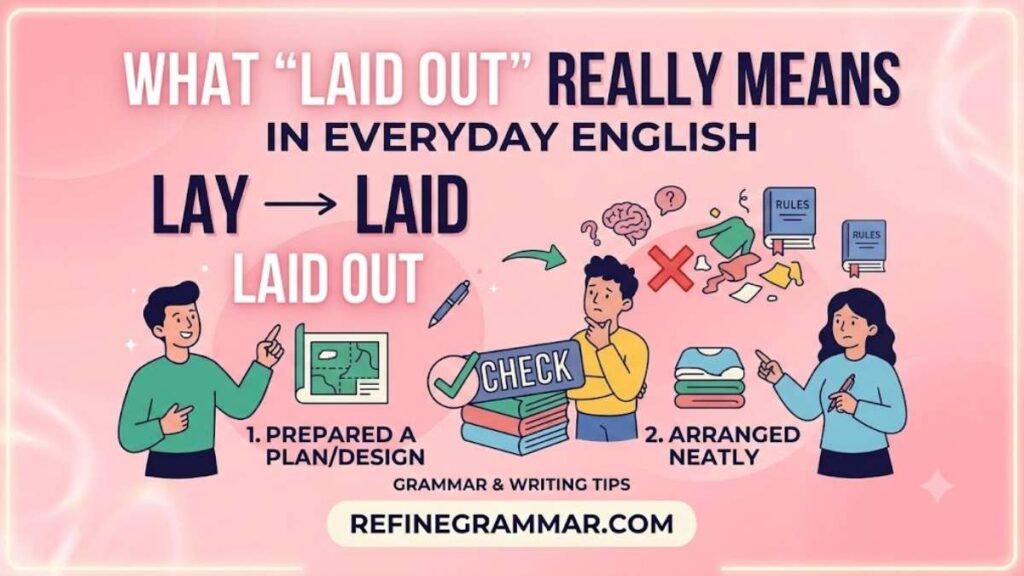
Laid out is flexible and carries several distinct meanings depending on context.
Meaning 1: Arrange or Organize
Example: The team laid out the conference room before the event.
Meaning 2: Explain Clearly
Example: The manager laid out the new policy in plain terms.
Meaning 3: Spend Money
Example: We laid out a lot of cash for the renovation.
Meaning 4: Knock Someone Down (Informal)
Example: One punch laid him out cold.
Meaning 5: Prepare Something in Advance
Example: She laid out her clothes for the interview the night before.
Synonyms for “Laid Out”
Depending on the meaning you intend, useful alternatives include:
- Arranged, organized, or spread out (for physical arrangement)
- Explained, outlined, or detailed (for presenting information)
- Spent, paid out, or shelled out (for money)
- Planned or mapped out (for scheduling or design)
Read More: To Small or Too Small? The Simple Grammar Rule Explained (With Examples)
Where You’ll See “Laid Out” Most Often
Professional Writing
Business reports, project plans, and emails regularly use laid out to describe how information or timelines are arranged.
Content Marketing and Blogging
Bloggers use laid out to describe article structure, much like debates over timeframe or time frame styling show up when writers plan content calendars.
Academic Writing
Research papers use laid out to describe how an argument or methodology is presented step by step.
Everyday Communication
In casual conversation, laid out often describes a relaxing afternoon in the sun or a table full of food at a gathering.
Laid Out or Layed Out: In the Sun, By the Pool, and Other Everyday Scenes
A very common real-world use of Laid Out or Layed Out involves relaxing outdoors. The correct sentence is always “She laid out in the sun” or “He laid out by the pool all afternoon,” describing someone stretched out to sunbathe. Layed out in either scenario remains incorrect, no matter how frequently it appears in casual captions.
Common Mistakes You Should Avoid (With Fixes)
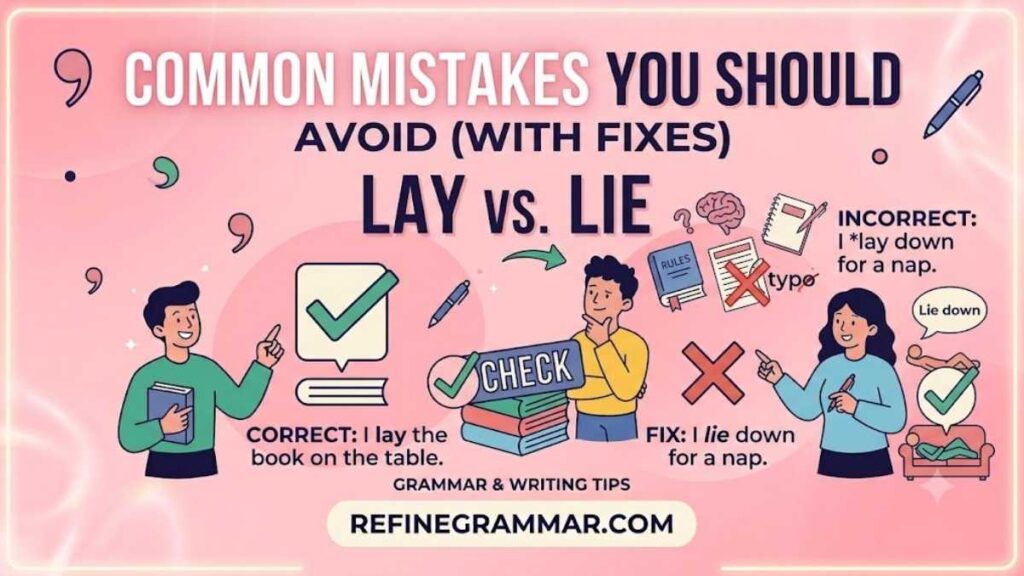
Mistake 1: Writing “Layed” Instead of “Laid”
Fix: Remember that lay is irregular. Swap in “placed” mentally if placed fits, laid is correct.
Mistake 2: Mixing Up “Lay” and “Lie”
Fix: Ask whether the verb needs an object. If yes, use lay/laid. If no, use lie/lay/lain. This is a similar logic check to spotting errors like misclick or missclick, where knowing the base word prevents the wrong spelling.
Mistake 3: Overcorrecting Everything
Fix: Don’t swap every instance of lay for lie out of caution. Check the object rule each time instead of guessing.
Quick Correction Table
| Incorrect | Correct | Why |
| I layed the keys down. | I laid the keys down. | Lay is irregular; past tense is laid. |
| She layed out the plan. | She laid out the plan. | Layed is not a standard word. |
| He has layed out the tools. | He has laid out the tools. | Past participle is also laid. |
A Memory Trick That Actually Sticks
Replace lay with place in your sentence. If “placed” sounds natural, laid is the word you need, and layed is never an option. This one substitution test resolves almost every Laid Out or Layed Out doubt instantly.
Examples
“She placed out the documents” sounds natural, so “She laid out the documents” is correct.
“He placed out cold” still works informally, confirming “He laid out cold” is correct.
Side-by-Side Sentence Comparison
Seeing correct and incorrect versions next to each other, across topics like clothes, plans, and well-organized documents, makes the Laid Out or Layed Out pattern easier to internalize, the same way comparing refer or reffer side by side clarifies a doubled-consonant rule.
Correct vs Incorrect
| Context | Correct | Incorrect |
| Clothes | I laid out my clothes for tomorrow. | I layed out my clothes for tomorrow. |
| A plan | They laid out a detailed plan. | They layed out a detailed plan. |
| Report format | The report is well laid out. | The report is well layed out. |
Laid Out or Lain Out: What’s the Difference?
Lain is the past participle of lie, not lay, so “lain out” isn’t standard phrasing for arranging something. If you mean someone stretched out to rest, you’d say “He has lain on the sofa all day,” not “lain out.” For arranging, presenting, or spending, laid out remains the correct choice every time.
Is “Layed” Ever Correct? Let’s Settle This
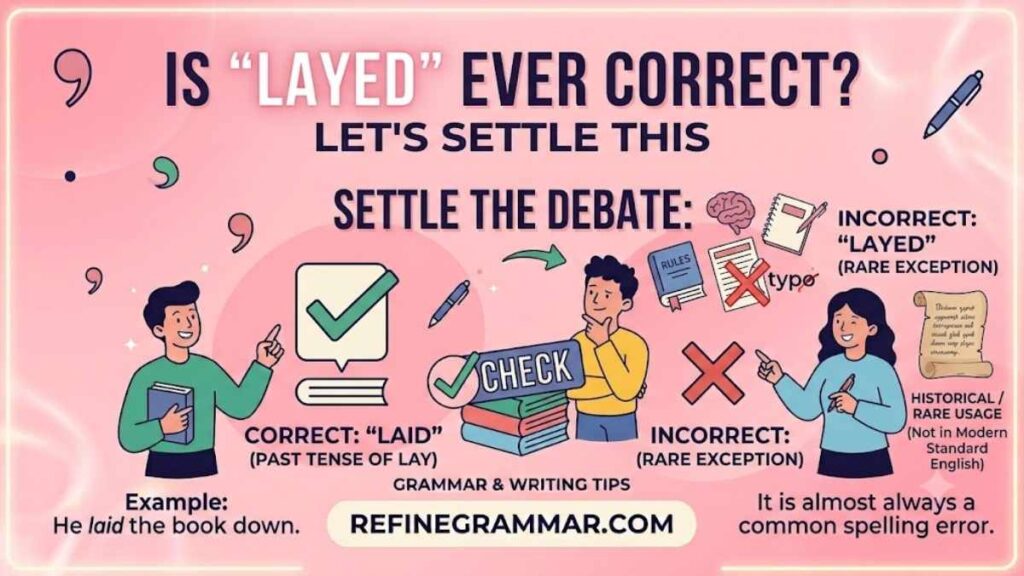
What About Historical Usage?
Older texts occasionally show layed as a variant spelling, but modern dictionaries have never treated it as standard, and it has no place in contemporary formal writing.
In 2026, Here’s the Reality
Every major dictionary and style guide in use today confirms laid out as the only accepted spelling. Choosing between Laid Out or Layed Out in 2026 isn’t really a debate it’s simply a matter of using the dictionary-correct form.
Laid Out or Layed Out UK vs. US Usage
There’s no regional split here. Both American and British English treat laid out as the correct form, and layed out is considered a spelling error on either side of the Atlantic. Unlike spelling pairs that genuinely differ by region, such as convertor or converter, this one has a single universal answer.
Case Study: How One Small Mistake Impacts Credibility

Consider two job applicants submitting nearly identical cover letters.
Candidate A Writes
“I have layed out a full project timeline for your review.”
Candidate B Writes
“I have laid out a full project timeline for your review.”
Candidate B reads as polished and detail-oriented, while Candidate A’s small slip can quietly undercut an otherwise strong application. A single wrong word choice, like the wrong side of Laid Out or Layed Out, can shape a hiring manager’s first impression.
Quick Self-Test: Lock It In
Fill in the blanks
1. She ___ out the picnic blanket under the tree.
2. They have ___ out the new store layout.
3. He ___ out on the beach for hours yesterday.
4. We ___ out a fair amount of money on repairs.
Answers
1. laid 2. laid 3. laid 4. laid — laid is correct in every sentence.
FAQs
Is it “laid out” or “layed out”?
“Laid out” is correct. “Layed out” is a common misspelling with no standing in standard English.
What does “laid out” mean?
It means to arrange, present, spend, or, informally, to knock someone down or unconscious.
What is the past tense of “lay out”?
The past tense and past participle are both laid out; lay is irregular and never becomes layed.
Is “layed” ever a correct spelling in English?
No. Layed does not appear in standard dictionaries at any point in modern usage.
What’s a good synonym for “laid out”?
Arranged, organized, outlined, or explained, depending on the sentence’s meaning.
Is it “laid out in the sun” or “layed out in the sun”?
It’s laid out in the sun; layed out is incorrect in this context and every other.
Is it correct to say “is laid out” or “is layed out”?
“Is laid out” is correct, since laid is the only valid past participle of lay.
What’s the difference between “laid out” and “lain out”?
Lain comes from lie, not lay, so “lain out” isn’t standard; laid out is what you want.
Do UK and US English spell it differently — “laid out” or “layed out”?
No, both varieties of English use laid out; there’s no regional exception.
Is it “clearly laid out” or “clearly layed out”?
It’s clearly laid out; layed is not a recognized word in either informal or formal writing.
Conclusion
The next time you hesitate over Laid Out or Layed Out, remember the rule: lay is irregular, and its past tense is always laid, never layed. Whether you’re describing a well laid out report, clothes laid out for the morning, or plans laid out for a project, laid out is the spelling that keeps your writing accurate and professional. Small grammar habits like this one, similar to getting 31st or 31th right, add up to writing that readers and search engines both trust.
