
Few grammar mix-ups appear as often in emails, product reviews, and text messages as the To Small or Too Small confusion. Because “to” and “too” sound identical when spoken, it’s easy to type the wrong one without noticing until it’s too late.
This guide breaks down the To Small or Too Small debate in plain English, explains exactly why “too small” is the only correct form, and gives you memory tricks, examples, and a quick-reference table so the rule sticks for good.
Understanding the Core Difference Between ‘To’ and ‘Too’
The short answer to To Small or Too Small is simple: “too small” is always correct, and “to small” is always wrong. “To” is a preposition or infinitive marker it points toward a place, a person, or an action, as in “I’m going to the market” or “She wants to learn.”
“Too,” on the other hand, is an adverb that means “excessively” or “also.” Because “small” is an adjective, only an adverb like “too” can modify it. That’s the entire grammar rule behind To Small or Too Small in one sentence: adjectives need adverbs, not prepositions, to describe their degree.
This same logic applies to every adjective, not just “small.” You’d never say “to tall,” “to loud,” or “to expensive” the same rule that governs To Small or Too Small governs all of them. Once you internalize that “too” pairs with adjectives and adverbs while “to” pairs with nouns, verbs, and places, the confusion disappears for good.
Homophones in English: Why ‘To’ and ‘Too’ Trip Us Up
“To” and “too” belong to a large family of English homophones words that sound alike but carry different spellings and meanings. This is exactly why the To Small or Too Small mix-up happens so often: your ear can’t tell the difference, so your fingers have to know the rule instead.
Similar confusion shows up in other commonly searched word pairs, such as whether to write refer or reffer or focusses or focuses. Once you understand that homophones are told apart by function rather than sound, spotting the right word becomes second nature.
The Many Roles of ‘To’ in English
“To” shows up in several everyday grammatical roles:
- Direction: “We drove to the beach.”
- Infinitive marker: “I want to sleep.”
- Recipient: “Give the form to your manager.”
- Purpose: “She saved money to buy a car.”
Notice that none of these situations involve modifying an adjective which is exactly why “to small” can never be grammatically correct, no matter the context.
The Power of ‘Too’: Emphasizing Excess or Addition
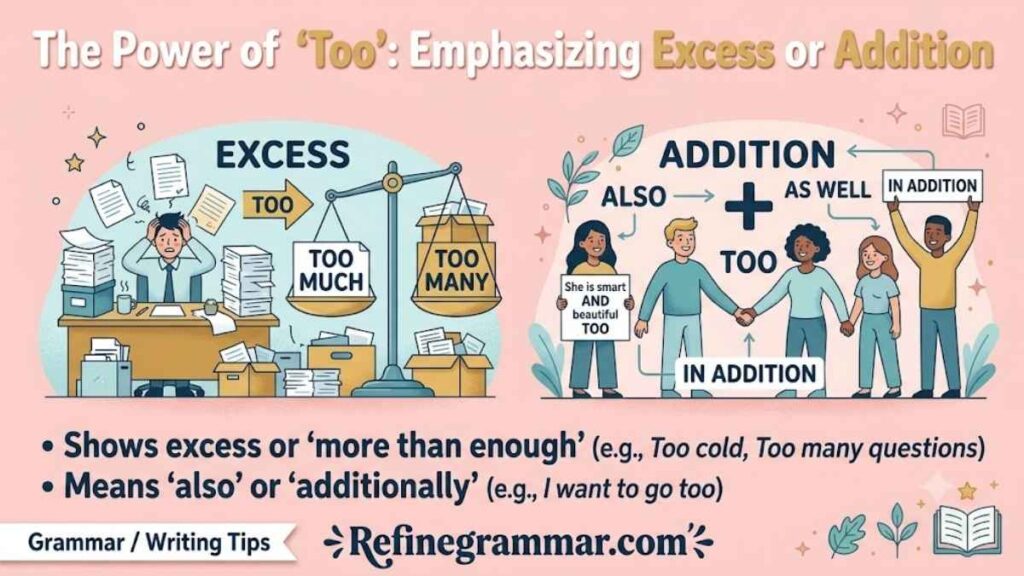
“Too” carries two main jobs: showing excess (“too hot,” “too loud”) and showing addition, meaning “also” (“I want to come too”). When people search To Small or Too Small, they’re almost always asking about the excess meaning something is smaller than it should be for a specific purpose.
Table: ‘Too’ in Different Contexts
| Context | Example | Meaning |
| Excess (size) | The jacket is too small. | Not big enough |
| Excess (degree) | The coffee is too hot. | Beyond a comfortable level |
| Addition | I’m coming too. | Also, as well |
| Excess + infinitive | The box is too small to hold the books. | Not sufficient for a task |
Emphasizing Excess Effectively with ‘Too’
You can strengthen “too small” with intensifiers for extra emphasis: far too small, way too small, and much too small all work depending on tone. Formal writing usually favors “far too small” or simply “too small,” while casual writing leans on “way too small.”
Whichever version you choose, the To Small or Too Small rule stays exactly the same only “too” is grammatically valid.
Correct Usage: ‘Too Small’ in Context
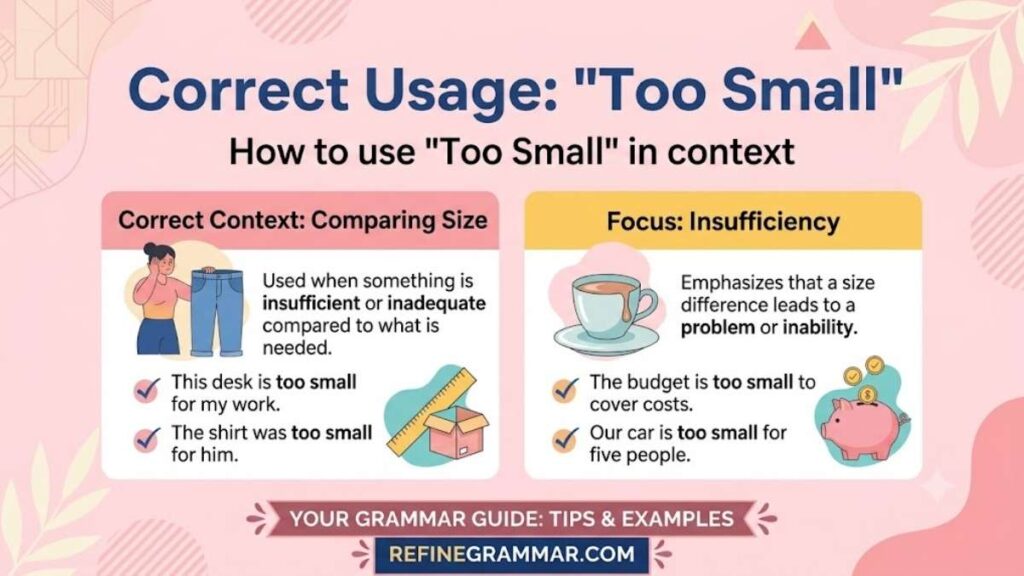
“Too small” describes something that falls short of a required size, capacity, or fit. A few examples:
- “These shoes are too small for my feet.”
- “The font on this website is too small to read comfortably.”
- “Our current apartment is too small for a growing family.”
Every one of these sentences answers the To Small or Too Small question the same way: “too small” is the only phrase that makes grammatical sense, because “small” needs an adverb, not a preposition, to show degree.
Synonyms for “Too Small”
If you want to avoid repeating the same phrase, try one of these alternatives:
- Tiny
- Cramped
- Undersized
- Insufficient
- Miniature
- Snug
- Minuscule
- Inadequate
Swapping in a synonym can help you avoid repeating “too small” too many times in the same paragraph, especially in product descriptions or reviews. Whichever synonym you pick, it should still answer the same underlying To Small or Too Small question: is the item smaller than what’s actually needed?
Practical Sentences You Can Use Today
- “This pot is too small for the amount of rice I’m cooking.”
- “The screen is too small to watch movies comfortably.”
- “My old jeans are too small now.”
- “The parking spot was too small for an SUV.”
- “This font size is too small for the elderly to read.”
- “The suitcase is too small to fit a week’s worth of clothes.”
Visualizing Grammar: When ‘Small’ Just Isn’t Enough
Picture a room stuffed with furniture that barely fits through the door that mental image is a handy shortcut for remembering To Small or Too Small correctly. The extra “o” in “too” mirrors the idea of “extra” or “excess,” so every time you picture something exceeding its limit, picture the extra letter along with it.
Visual mnemonics like this make grammar rules stick far longer than memorizing a definition alone.
Spotting Common Misuses of ‘To’ and ‘Too’
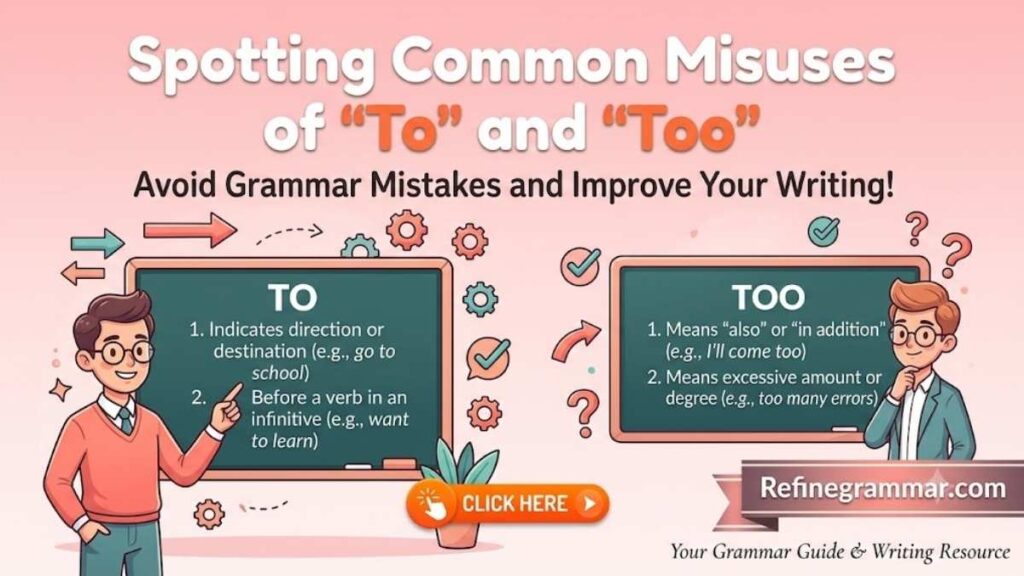
Even confident writers slip up under To Small or Too Small pressure, especially while typing quickly. Common mistakes include:
- Writing “to small” instead of “too small” in captions and comments
- Confusing “to” with “too” after intensifiers, e.g., “very to small” (should be “too small”)
- Mixing up similar high-frequency word pairs, such as misclick or missclick and stopping or stoping
Slowing down for a two-second proofread before hitting “send” or “publish” prevents almost all of these errors.
Autocorrect tools don’t always catch a To Small or Too Small error either, since “to” is a valid word on its own spell-check has no way of knowing you meant the adverb. Reading your sentence back slowly, or reading it out loud, remains the most reliable way to catch the mistake before it goes public.
Too…To and So…That: Related Constructions
English pairs “too” with an infinitive to show a result: “The box is too small to hold the books” means the box’s size prevents it from holding the books. A close cousin is the “so…that” construction: “The box is so small that it can’t hold the books.”
Both patterns express the same idea, but “too…to” is more compact, which is why writers researching To Small or Too Small often see it recommended for concise writing.
Guidelines to Choose the Right Word: ‘To’ vs ‘Too’
1. If the word after it is a noun, verb, or place, use “to.”
2. If the word after it is an adjective or adverb, use “too.”
3. If you can replace it with “also” and the sentence still makes sense, use “too.”
4. If you can replace it with “toward” and the sentence still makes sense, use “to.”
5. When in doubt, read your sentence aloud slowly your ear won’t help with To Small or Too Small, but your eye will catch it on the page.
For more commonly confused word pairs, see our guides on timeframe or time frame, favs or faves, atleast or at least, and 31st or 31th.
FAQs
Which is correct, “to small” or “too small”?
“Too small” is correct. “To small” is grammatically wrong because “to” cannot modify an adjective.
When should I use “to” or “too”?
Use “to” for direction, purpose, or infinitives, and “too” for excess or “also.”
What is the meaning of “too small”?
It means something is smaller than required or appropriate for a specific purpose.
Is “too small” proper grammar?
Yes. “Too small” is the grammatically correct phrase; “to small” is not.
What is another word for “too small”?
Common alternatives include tiny, cramped, undersized, and insufficient.
How do you say “very small”?
You can say “very small,” “tiny,” “minuscule,” or “too small,” depending on context.
What are common mistakes with using “too”?
Common errors include writing “to” instead of “too” after intensifiers and confusing it with the preposition “to.”
Is “I am too” grammatically correct?
Yes, when it means “also,” as in “I want to go, and I am too.”
What is the rule of “too”?
“Too” modifies adjectives and adverbs to show excess, or means “also” when added at the end of a sentence.
Which is correct, “you to” or “you too”?
“You too” is correct; “you to” is not a standard English phrase.
Conclusion
The To Small or Too Small debate really comes down to one simple grammar rule: “too” is an adverb that modifies adjectives like “small,” while “to” is a preposition or infinitive marker that never does.
Once that distinction clicks, you’ll never second-guess yourself again whether you’re writing a text message, a product review, or a professional email. Bookmark this guide, remember the extra “o” for “extra,” and the To Small or Too Small question will never trip you up again.
