
If you have ever paused mid-sentence wondering whether to write “dysregulated” or “disregulated,” you are not alone. The dysregulated vs disregulated question shows up constantly in psychology essays, health blogs, and everyday conversations about emotions and behavior. This guide settles the confusion for good, explains the correct spelling, and shows you exactly when and how to use the term with confidence.
The Core Difference You Need to Know
In the dysregulated vs disregulated debate, only one spelling is standard English: dysregulated. “Disregulated” is a common misspelling that borrows the wrong prefix. Understanding this one distinction instantly clears up most of the confusion people run into when discussing emotional health, biology, or behavior.
What Does Dysregulated Mean? A Clear, Practical Definition
Plain-English Definition
Dysregulated describes a system, emotion, or process that is not being controlled or balanced properly. It does not mean the system has no regulation at all; it means the regulation is impaired or malfunctioning. A dysregulated nervous system still functions, just not the way it should.
Understanding the Prefix: Why “Dys” Changes Everything
Prefix Breakdown
The prefix “dys-” comes from Greek and means bad, difficult, or impaired, the same root found in dysfunction and dyslexia. “Dis-” comes from Latin and typically means “not” or “the opposite of,” as in disagree or disorganized. That single letter is why the dysregulated vs disregulated mix-up keeps happening.
Why “Disregulated” Keeps Showing Up (Even Though It’s Wrong)
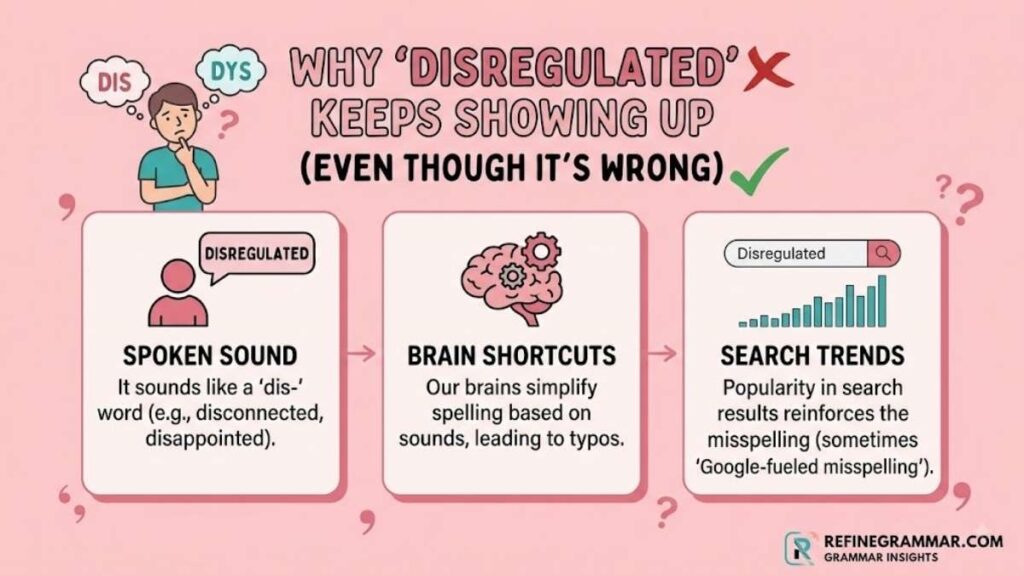
Common Reasons People Use “Disregulated”
- Familiarity with “dis-” words like disorganized and disorder
- Autocorrect and spellcheck tools missing clinical vocabulary
- Fast typing on social platforms where mistakes spread quickly
- Assuming a pattern that simply does not apply here
Reality Check: Is “Disregulated” a Word? (Detailed Breakdown)
“Disregulated” is not recognized in standard dictionaries or accepted in academic, medical, or professional writing. It may appear informally online, but in any dysregulated vs disregulated comparison, only dysregulated holds up as correct.
Why “Disregulated” Feels Right (But Isn’t)
The Real Reason Behind the Confusion
English speakers naturally reach for the more familiar prefix. Because “dis-” appears in so many everyday words, the brain assumes it fits here too. This is a classic case where instinct and correctness disagree.
Why “Dysregulated” Is the Correct Term
Prefix Meaning Matters
Dysregulation describes impaired functioning, not the total absence of regulation. Since “dys-” specifically conveys “impaired,” it matches the intended meaning far more precisely than “dis-” ever could.
Key Insight
Whenever you’re unsure in a dysregulated vs disregulated situation, remember: the system is still trying to work, just poorly. That single idea is the fastest way to pick the right word.
What Happens If You Use “Disregulated”?
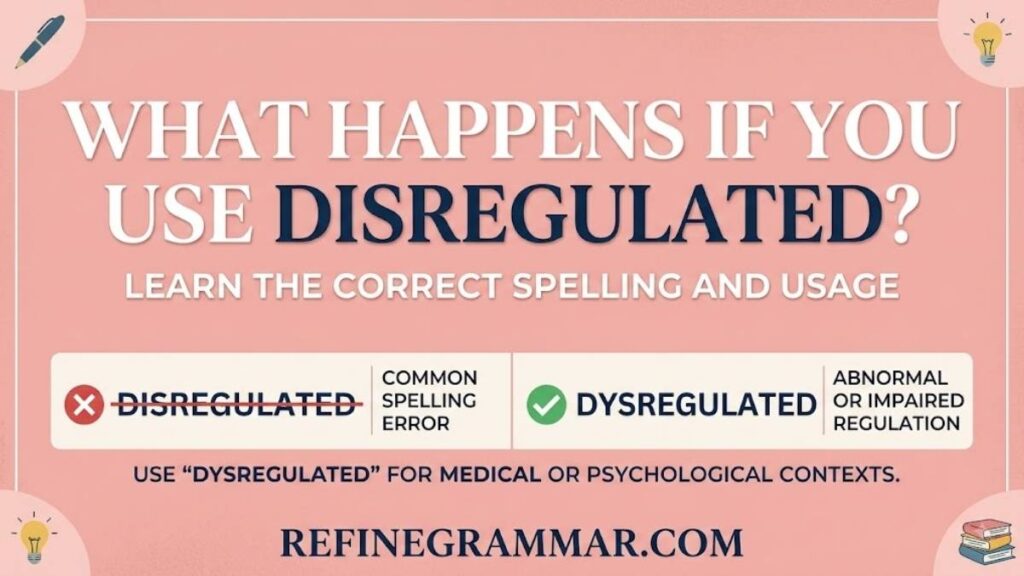
In Professional Writing
Using the wrong spelling in reports, resumes, or client communication can quietly undercut your credibility, even if the reader can’t quite say why the sentence feels off.
In Academic or Medical Contexts
Instructors, editors, and clinicians expect precise terminology. “Disregulated” in a paper or clinical note reads as an error, not a stylistic choice.
Online Content
For bloggers and SEO writers, getting the dysregulated vs disregulated spelling wrong can hurt both accuracy and search rankings, since search engines increasingly reward well-edited, expert-reviewed content.
Spot the Difference
❌ Incorrect:
“Her emotions became disregulated after the stressful meeting.”
✅ Correct:
“Her emotions became dysregulated after the stressful meeting.”
Why You Won’t Find “Disregulated” in Dictionaries
Here’s What You’ll Notice
Merriam-Webster, Cambridge, and Oxford all list dysregulated (or dysregulation) as the standard entry. None of them list “disregulated” as an accepted alternative spelling, which settles most dysregulated vs disregulated debates instantly.
When People Accidentally Use It
Most people who type “disregulated” are not trying to invent a new word; they’re simply typing fast, relying on autocorrect, or mirroring something they saw online without double-checking it.
Quick Fix Strategy
Simple Rule to Remember
If the sentence describes something malfunctioning or working poorly, the word is dysregulated. If you’re tempted to write “disregulated,” swap the “i” for a “y” before you hit publish.
Memory Trick That Actually Works
Think: “dysfunction leads to dysregulation.” Both words share the same “dys-” prefix and the same idea of something not working correctly. Anchoring dysregulated to dysfunction makes the dysregulated vs disregulated choice almost automatic.
Don’t Let a Small Mistake Undermine You
A single misspelled word rarely ruins a whole piece of writing, but in professional or academic settings, small errors add up. Getting the dysregulated vs disregulated spelling right is a quick, low-effort way to protect your credibility.
Dysregulated vs Deregulated (PAS – new)
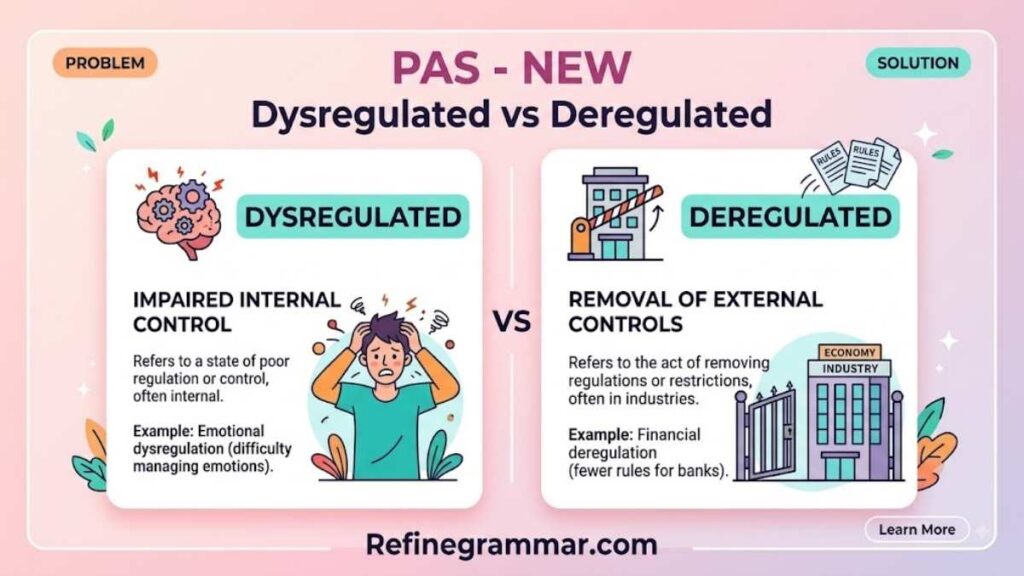
Deregulated refers to the removal of rules or government controls, most often in economics or industry, such as a deregulated airline market. Dysregulated, by contrast, refers to impaired internal functioning in a biological or emotional system. The two words are not interchangeable despite looking similar.
Dysregulated vs Unregulated (PAS – new)
Unregulated means no rules or oversight exist at all, as in an unregulated market with no governing body. Dysregulated means regulation exists but isn’t working properly. One describes absence; the other describes malfunction.
Difference Between dysregulated vs disregulated
| Term | Meaning | Status |
| Dysregulated | Impaired or abnormal regulation of a system, emotion, or process | Standard, dictionary-recognized |
| Disregulated | Commonly intended to mean the same as dysregulated | Non-standard, not in dictionaries |
Once you’ve internalized the dysregulated vs disregulated rule, applying it in psychology, medicine, and everyday writing becomes second nature.
Dysregulated Meaning in Psychology: Where It Matters Most
Dysregulated Definition Psychology
In psychology, dysregulated describes difficulty managing thoughts, emotions, or behaviors in a way that fits the situation. It’s a core concept in therapy, especially around trauma, anxiety, and mood disorders.
Emotional Dysregulation Meaning
Emotional dysregulation means struggling to control the intensity or duration of emotional reactions, leading to responses that feel disproportionate to the trigger.
What Emotional Dysregulation Looks Like in Real Life
Dysregulated Behavior Examples
- Sudden outbursts over minor frustrations
- Difficulty calming down after stress
- Rapid mood shifts within short time frames
- Overwhelming anxiety in low-stakes situations
Short Scenario
A student bursts into tears over a small grading error, then struggles to focus for the rest of the day. This is a textbook example of dysregulated emotional response, not simple sensitivity.
Dysregulated Emotions vs Normal Emotional Responses
Normal emotional responses match the size of the trigger and fade with time. Dysregulated emotions are disproportionate, hard to control, and can disrupt daily functioning.
Dysregulated Nervous System
Signs of a Dysregulated Nervous System
- Constant feeling of being “on edge”
- Trouble sleeping or staying asleep
- Exaggerated startle response
- Digestive or muscle tension issues tied to stress
What’s Going On Inside
A dysregulated nervous system often means the body’s stress response stays activated longer than needed, keeping someone stuck between fight-or-flight and full recovery.
Dysregulation in Biology: More Than Just Emotions
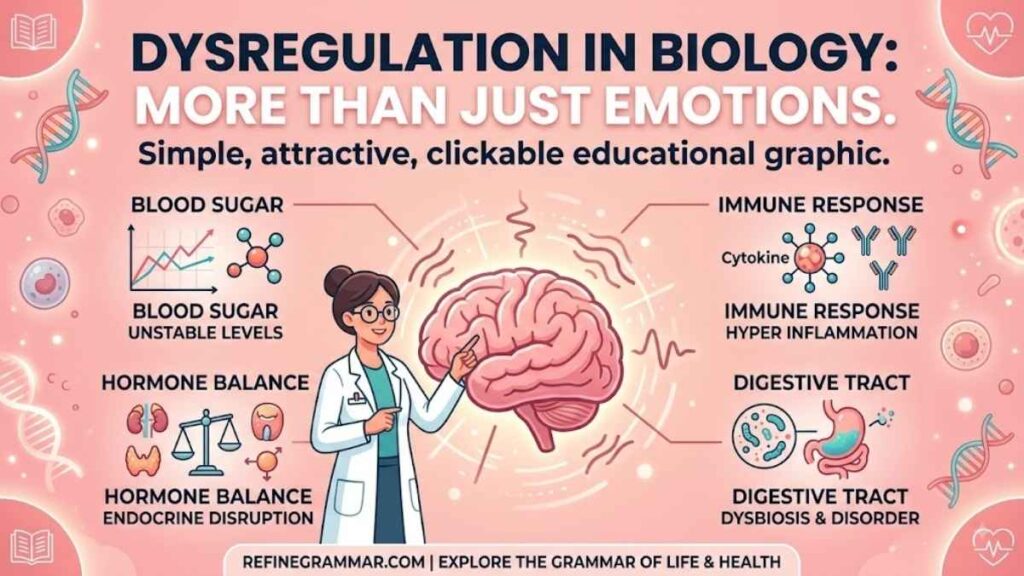
Scientific Examples
Doctors describe dysregulated blood sugar, dysregulated hormones, and dysregulated immune responses. In each case, a natural process has stopped working within its normal range.
Core Concept
Across biology, dysregulation always points back to the same idea: a control system that exists but is no longer keeping things balanced.
A Common Mix-Up
Quick Analogy
Think of a thermostat that’s still wired and powered but keeps setting the wrong temperature. That’s dysregulation. A thermostat that’s been completely removed would be closer to “unregulated,” not dysregulated.
Mental Health Dysregulation: Conditions Linked to It
Common Conditions
ADHD
- Borderline personality disorder
- Post-traumatic stress disorder
- Anxiety and mood disorders
- Autism spectrum-related sensory overload
Dysregulated vs Disregulated ADHD (PAS – new)
People often search “dysregulated vs disregulated ADHD,” but only dysregulated is accurate here. Emotional dysregulation is widely recognized as a core feature of ADHD, affecting focus, impulse control, and mood stability.
Dysregulated vs Disregulated Child (PAS – new)
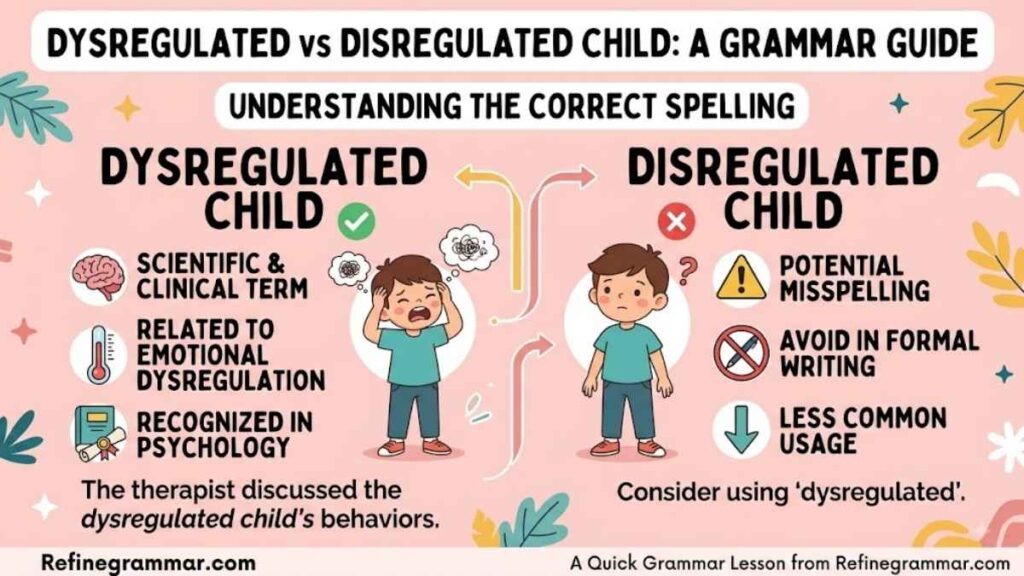
A “dysregulated child” is the correct clinical phrase used by therapists, teachers, and pediatricians to describe kids who struggle to manage big emotions. “Disregulated child” is simply the misspelled version of the same idea.
Dysregulated Child Symptoms and Treatment
Symptoms
- Frequent meltdowns disproportionate to the trigger
- Difficulty transitioning between activities
- Trouble self-soothing after upset
Treatment Approaches
1. Consistent routines and predictable structure
2. Co-regulation support from caregivers
3. Age-appropriate coping strategies, like breathing exercises
4. Professional support such as play therapy or counseling when needed
The dysregulated vs disregulated distinction is not just academic trivia; it shapes how clearly a workplace conversation about stress and burnout is understood.
Workplace Emotional Dysregulation
Analysis
At work, a dysregulated employee may overreact to feedback, struggle with deadline pressure, or find it hard to reset after a stressful meeting. Recognizing this early helps managers respond with support rather than frustration.
How to Fix Emotional Dysregulation (Actionable Steps)
Practical Strategies
1. Practice slow, deliberate breathing during stress spikes
2. Name the emotion out loud to reduce its intensity
3. Build predictable daily routines
4. Limit stimulants like excess caffeine
5. Seek professional support for persistent patterns
Quick Tip
Small, consistent habits usually outperform occasional big efforts when it comes to calming a dysregulated nervous system.
Dys vs Dis Words: Why This Confusion Keeps Happening
Comparison Table
| Word | Meaning Pattern |
| Dysfunction | Impaired functioning |
| Dyslexia | Impaired reading ability |
| Disorder | Lack of order |
| Disagree | Opposite of agree |
Signs of a Dysregulated Nervous System You Shouldn’t Ignore
- Persistent fatigue despite adequate rest
- Frequent irritability with no clear cause
- Racing thoughts at bedtime
- Physical tension that doesn’t ease with rest
Quick Practice dysregulated vs disregulated
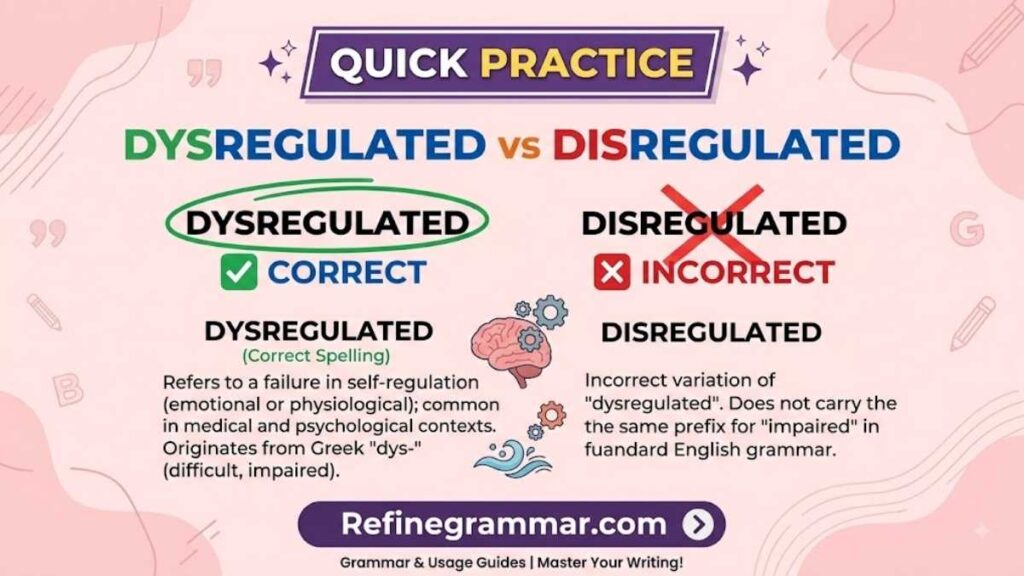
Fill in the Blank
“After the argument, his emotions felt completely ______.” (Answer: dysregulated)
Fix the Sentence
Incorrect: “The child’s behavior seemed disregulated.” Correct: “The child’s behavior seemed dysregulated.”
Bonus Challenge (Try This One)
Try rewriting three sentences from your own notes or messages, replacing any instance of “disregulated” with the correct dysregulated vs disregulated answer: dysregulated.
Pro Tip
When editing, use your word processor’s find-and-replace tool to catch every accidental “disregulated” in a long document at once.
Key Takeaways You’ll Actually Remember
- Dysregulated is correct; disregulated is not standard English
- The prefix “dys-” means impaired, matching the intended meaning
- Dysregulated applies to emotions, biology, and behavior
- Deregulated and unregulated are different concepts entirely
- Getting the dysregulated vs disregulated spelling right protects your credibility
Reference Cambridge Dictionary Definitions
According to Cambridge Dictionary, dysregulation refers to a failure to regulate a system’s functioning properly, reinforcing that dysregulated, not disregulated, is the accepted term across professional and academic writing.
FAQs
Is “dysregulated” or “disregulated” the correct spelling?
Dysregulated is the correct spelling. Disregulated is a common misspelling not recognized in standard dictionaries.
What does dysregulated mean in psychology?
It describes difficulty managing thoughts, emotions, or behaviors appropriately for a given situation.
What is the difference between dysregulated and unregulated?
Dysregulated means regulation exists but isn’t working well; unregulated means no regulation exists at all.
What does a dysregulated nervous system feel like?
It often feels like constant tension, poor sleep, and an exaggerated stress response that doesn’t settle easily.
How is emotional dysregulation different from ADHD symptoms?
Emotional dysregulation is one specific feature commonly seen within ADHD, alongside impulsivity and inattention.
What causes a dysregulated child’s behavior?
Triggers include stress, sensory overload, fatigue, and difficulty processing big emotions appropriately.
Is disregulated a real word in dictionaries?
No. Major dictionaries only list dysregulated and dysregulation as standard entries.
What are common signs of emotional dysregulation?
Sudden outbursts, rapid mood swings, and reactions that feel disproportionate to the situation.
How is dysregulated different from deregulated?
Deregulated refers to removing rules or controls, typically in economics; dysregulated refers to impaired internal functioning.
How can you fix or manage emotional dysregulation?
Breathing techniques, consistent routines, naming emotions, and professional support all help over time.
Conclusion
The dysregulated vs disregulated debate has a clear winner: dysregulated is the correct, dictionary-recognized term, while disregulated is simply a common misspelling. Whether you’re writing about emotions, biology, or behavior, remembering that “dys-” means impaired, not absent, will keep your writing accurate and credible every time.
Related Reading
If precise word choice matters to you, you may also want to clear up other common mix-ups, like timeframe versus time frame, favs versus faves, and atleast versus at least. These guides follow the same approach used here: breaking down prefixes, roots, and real usage so you never second-guess your writing again.
Similar confusion shows up with to small versus too small and laid out versus layed out, where a small spelling slip changes how professional your writing looks. If numbers trip you up too, our guide on formatting 26 correctly and our breakdown of carrer versus career cover the same kind of everyday mistakes.
