
English is full of near-twin words that trip up even confident writers, and Emersion vs Immersion is one of the trickiest pairs of all. The two words look almost identical, share the same Latin root, and even sound alike when read quickly yet they point in opposite directions. One describes going in. The other describes coming out.
If you have ever paused mid-sentence wondering which word fits much like deciding between “to small” or “too small” this guide clears up the confusion for good. By the end, you will know exactly when to use each word, how they apply in science, education, psychology, technology, and religion, and how to remember the difference permanently.
Emersion vs Immersion: A Quick Comparison
Before diving into the details, here is a side-by-side snapshot of Emersion vs Immersion so you can see the core contrast at a glance.
| Feature | Emersion | Immersion |
| Core Meaning | Coming out or becoming visible | Going in or being fully absorbed |
| Direction | Outward / upward | Inward / downward |
| Common Fields | Astronomy, marine biology, environmental science | Education, technology, psychology, religion |
| Frequency | Rare, mostly technical | Very common, everyday usage |
| Example | The moon’s emersion from Earth’s shadow | Total immersion in a new language |
Emersion Meaning, Definition and Scientific Context
Emersion Definition
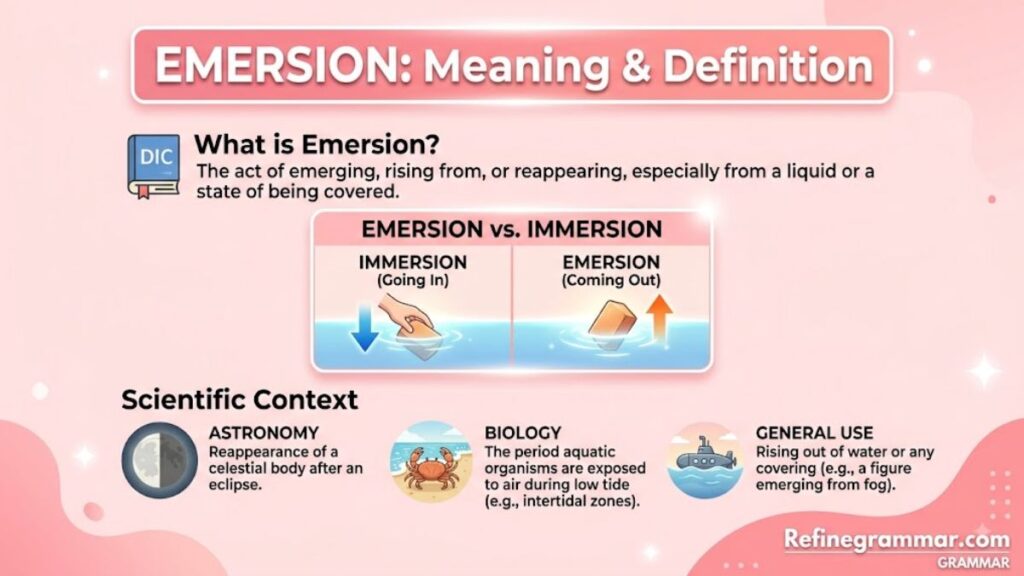
Emersion is the act of emerging rising out of a liquid, a shadow, or any state of being hidden or covered. Where immersion pulls something in, emersion lets something out. It is the less common half of the Emersion vs Immersion pair, and it survives almost entirely in technical and scientific writing rather than daily conversation.
Scientific Fields Where Emersion Is Used
Emersion shows up consistently across three disciplines, each using it in a slightly different but related sense.
Marine Biology
In marine biology, emersion describes what happens to coastal organisms barnacles, mussels, and tide-pool creatures when the tide goes out and exposes them to open air. Researchers study emersion tolerance to understand how species survive temperature swings and moisture loss between tides.
Astronomy
In astronomy, emersion marks the precise moment a star, moon, or planet reappears after an eclipse, transit, or occultation. It is the direct counterpart to immersion, which marks the moment the same body disappears from view. Astronomers timing an occultation record both events with equal precision.
Environmental Science
Environmental scientists use emersion when describing wetlands, riverbanks, and floodplains that alternate between being submerged and exposed as water levels change across a season or a set timeframe. Tracking these emersion cycles helps predict how rising sea levels will reshape coastal habitats.
Origin and Etymology of Emersion
Emersion comes from the Latin emergere, meaning “to rise out of” the same root that gives English the word “emerge.” Getting the spelling right matters just as much here as it does with other commonly mixed-up words, such as whether it is spelled career or carrer.
Emersion in Literature and Metaphorical Use
Writers occasionally borrow emersion metaphorically to describe a person rising out of hardship, obscurity, or grief an emersion from struggle into clarity. It is a deliberate, literary choice, and using it well signals genuine command of vocabulary rather than a typo for immersion.
Immersion Definition and Meaning
Immersion Definition
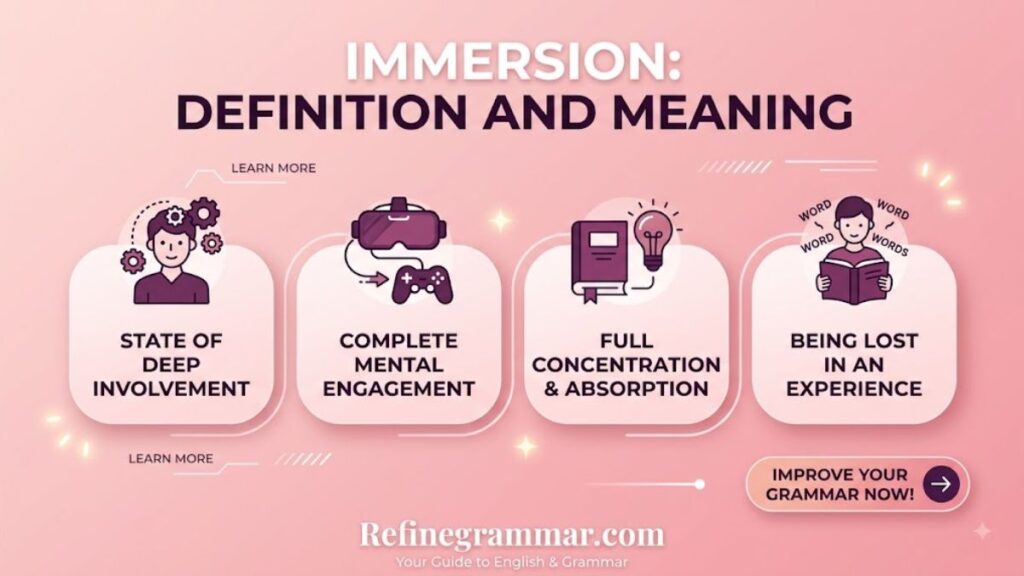
Immersion is the state of being fully plunged into something a liquid, an activity, or an environment. It comes from the Latin immersionem, “to plunge into,” and it is by far the more common word in the Emersion vs Immersion pair, appearing constantly in everyday speech, marketing, and academic writing.
Physical Immersion
Physical immersion is the literal sense: an object or body submerged in liquid, such as a diver’s immersion in the ocean or a component’s immersion in a cooling tank.
Psychological Immersion
Psychological immersion describes a mental state of total absorption, where someone becomes so engaged in an experience a book, a film, a task that outside distractions fade away.
Immersion in Technology and Digital Environments
Modern technology has given immersion an entirely new life, especially in fields designed to simulate presence and engagement.
Virtual Reality
VR headsets aim to deliver total sensory immersion, replacing real-world input with a convincing simulated environment so the brain reacts as if it were really there.
Gaming and Entertainment
Game designers chase immersion through sound design, narrative pacing, and responsive controls, all built to keep players absorbed for as long as at least a few hours at a stretch.
Immersion Blender: What Does It Mean?
An immersion blender gets its name because the blending head is immersed directly into a pot or bowl, letting you blend soups and sauces without transferring them to a separate jug.
Immersion Heater Meaning
An immersion heater is an electric heating element immersed directly in a tank of water, warming it from within rather than heating it externally.
Emersion vs Immersion: Key Differences
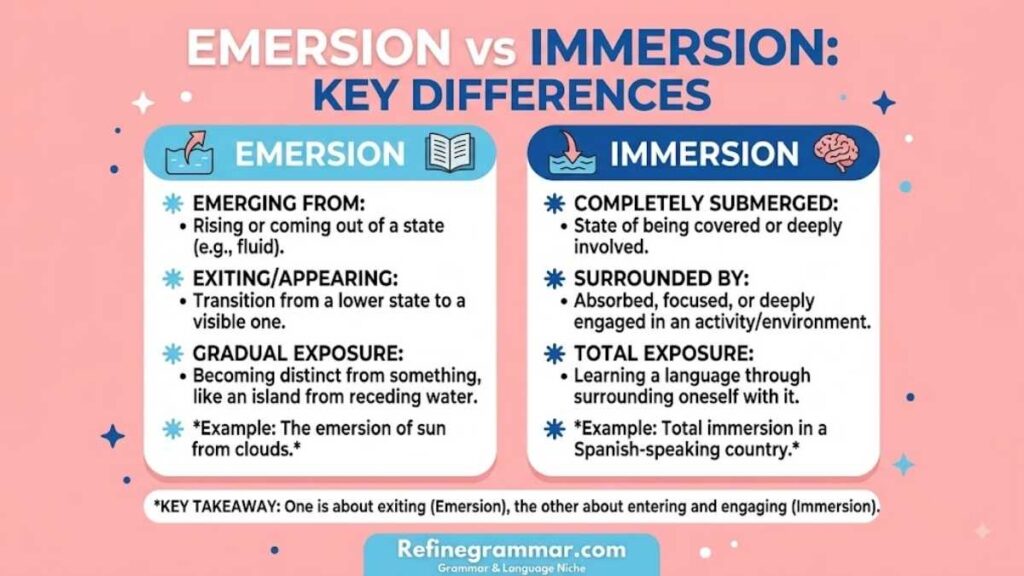
Once you see the pattern, Emersion vs Immersion becomes easy to sort out. The differences come down to three factors.
Direction of Experience
Immersion moves inward into water, into a culture, into a story. Emersion moves outward out of water, out of shadow, out of hiding.
Stage of Experience
Immersion marks the beginning or the ongoing state of being submerged or absorbed. Emersion marks the ending the moment of surfacing or becoming visible again.
Frequency of Use
Immersion appears constantly across education, business, and pop culture. Emersion is a specialist’s word, reserved mostly for science writing, which is exactly why so many people misuse it or avoid it altogether.
Emersion vs Immersion in Education
Immersion Learning Programs
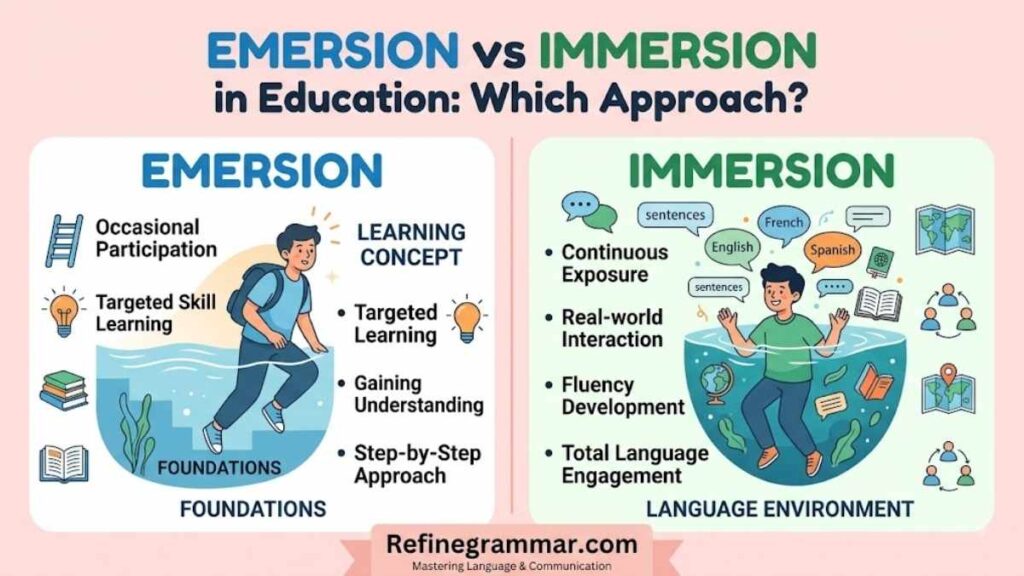
Immersion programs place students directly inside an environment where they must engage fully with the subject, rather than studying it from a distance.
Benefits of Immersive Learning
- Faster real-world skill retention
- Higher engagement than lecture-based formats
- Stronger long-term memory of material learned through direct experience
- Practical confidence built over even a short timeframe
Emersion vs Immersion in School
Schools almost never use “emersion” the correct term for full-engagement teaching is always immersion. If you see “emersion program” in a school brochure, it is a spelling slip, not an alternate term.
Emersion vs Immersion in Language Learning
Immersion Phase
The immersion phase of language learning is when a student is surrounded by the target language constantly, absorbing vocabulary and rhythm through exposure rather than memorization.
Emersion Phase
There is no recognized “emersion phase” in language learning; this is simply a common misspelling of immersion. Some learners insist a program can help you go from beginner to conversational in as little as 26 weeks, though outcomes vary widely by method and effort.
Immersion vs Submersion in Language Learning
Submersion, a related but distinct term, describes older-style programs that place students in a second language with no support in their native tongue at all. Immersion, by contrast, usually includes structured guidance alongside full-language exposure.
Emersion vs Immersion Psychology
Psychological Immersion
In psychology, immersion refers to flow-like absorption a state where attention narrows entirely onto one task or experience, often linked to peak performance and enjoyment.
Emersion Reflection in Psychology
Emersion appears far less often in psychology, typically as a metaphor for someone “emerging” from a difficult mental or emotional period into renewed clarity, rather than as a clinical term.
Immersion vs Emersion in Baptism
Baptism by full-body submersion in water is called immersion baptism. Emersion is never the correct term here, though it technically describes the moment the person rises back out of the water at the end of the rite.
Immersion vs Submersion
Immersion means being covered or plunged in; submersion specifically emphasizes being placed completely underwater or underground, with no part left exposed.
Immersion Therapy
Immersion therapy, used in treating phobias, gradually or fully exposes a person to a feared stimulus in a controlled setting so their anxiety response weakens over repeated exposure.
Emersion vs Immersion Examples
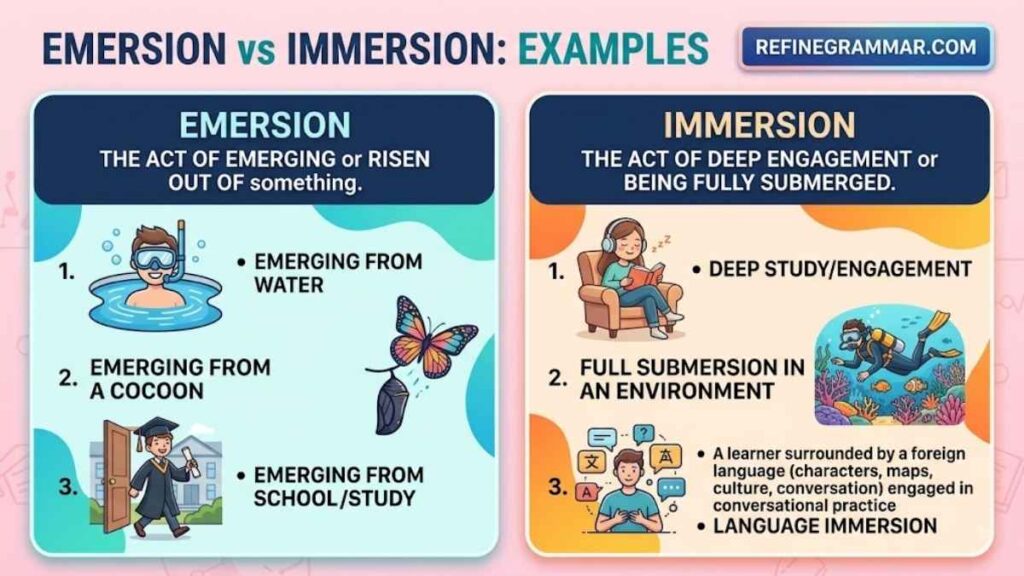
Examples of Emersion
- The astronaut’s telescope captured the satellite’s emersion from behind the planet.
- Marine biologists timed the crab’s emersion at low tide.
- Her emersion from months of self-doubt felt like stepping into daylight.
Examples of Immersion
- Total immersion in Spanish culture accelerated her fluency.
- The VR headset offered striking visual immersion.
- The engineer measured the metal sample’s immersion time in the acid bath.
Cultural Immersion Through Travel
Travelers often describe living abroad, eating local food daily, and speaking only the local language as cultural immersion a deliberate, full-engagement version of the psychological sense of the word.
What Reddit Says About Emersion vs Immersion
Across language and grammar forums, the recurring theme is the same: most commenters have simply never encountered “emersion” outside a science class, and several admit they assumed it was a typo the first time they saw it. Regular posters in astronomy and diving communities, however, use the word correctly and often note how satisfying it is once the emersion vs immersion distinction finally clicks.
Common Mistakes Writers Make
Mistake: Using Immersion When Emersion Is Correct
Because immersion is so much more familiar, writers often reach for it even when describing a celestial body reappearing, the exact situation emersion is built for.
Mistake: Assuming the Words Mean the Same Thing
Emersion and immersion are opposites, not synonyms a distinction easy to lose track of, the same way writers sometimes lay out or “layed out” a plan incorrectly simply because the wrong version sounds familiar.
Memory Trick for Emersion vs Immersion
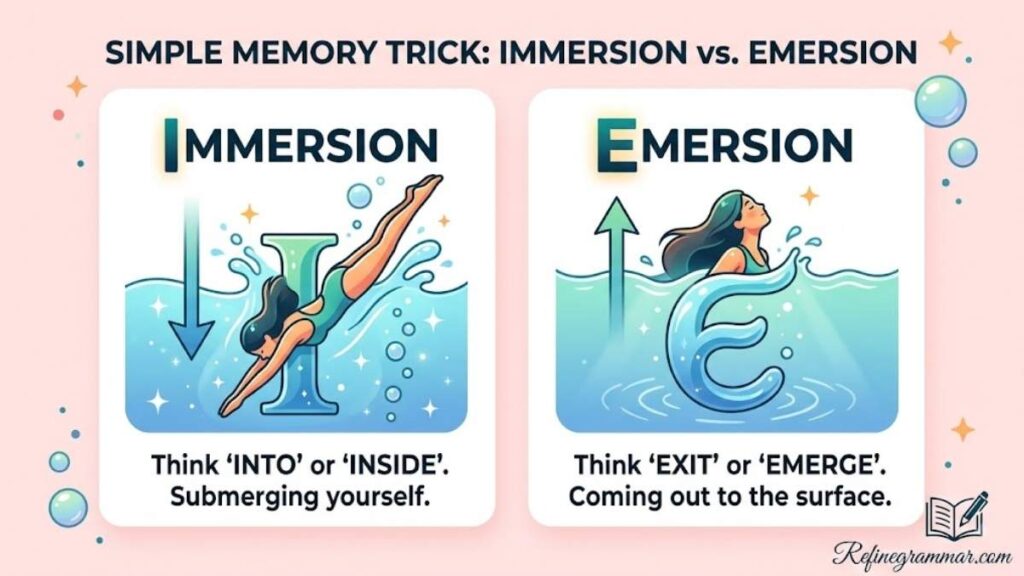
Picture the letter “E” in emersion standing for “Exit” or “Emerge,” and the letter “I” in immersion standing for “In.” If the sentence describes something going in at at least one part of the process reach for immersion. If it describes something coming out or becoming visible again, reach for emersion.
Key Takeaways
Emersion
- Means emerging, surfacing, or becoming visible again
- Used mainly in astronomy, marine biology, and environmental science
- Rare in everyday conversation
Immersion
- Means being fully plunged into or absorbed by something
- Used across education, technology, psychology, and religion
- Common in daily conversation and marketing language
Reference: Cambridge Dictionary Definitions

Cambridge Dictionary defines immersion as the action of putting something or someone into liquid, or the state of being completely involved in something. It defines emersion as the act of coming out of something, especially water a definition that lines up precisely with the Emersion vs Immersion contrast covered throughout this guide.
FAQs
What is the exact difference between emersion and immersion?
Immersion means going into or being absorbed by something; emersion means coming out of or becoming visible after being hidden.
Is emersion an actual English word or a common misspelling?
It is a real, dictionary-recognized word just far less common than immersion, similar to how some spellings, like favs or faves, both circulate but one is far more standard.
What does immersion mean in psychology versus emersion?
Immersion describes deep mental absorption in an activity; emersion is rarely used clinically and mostly appears as a metaphor for emerging from hardship.
What is emersion used for in astronomy?
It marks the exact moment a star, moon, or planet reappears after an eclipse or occultation.
Is “language immersion” or “language emersion” the correct term?
Language immersion is correct; “language emersion” is a spelling error with no established meaning in education.
Is Christian baptism called immersion or emersion?
It is called immersion baptism, referring to being fully submerged in water during the rite.
What is the difference between immersion and submersion?
Immersion means being plunged into something; submersion specifically means being placed entirely underwater with nothing exposed.
Why is it called an immersion blender and not an emersion blender?
Because the blending head is immersed into the food, not emerging out of it immersion accurately describes the action.
Can emersion be used in a metaphorical or emotional sense?
Yes, writers sometimes use it to describe a person emerging from hardship, obscurity, or grief into clarity.
How can you remember the difference between emersion and immersion?
Link the “E” in emersion to “exit” and the “I” in immersion to “in” a simple cue that captures the entire Emersion vs Immersion distinction.
Final Thoughts
The Emersion vs Immersion debate really comes down to direction: one word plunges you in, the other lifts you back out. Immersion will cover almost every situation you write about, from language learning to virtual reality to baptism. Save emersion for the specific, technical moments an eclipse ending, a tide receding, a shape breaking the surface and you will use both words with total confidence, even within a tight timeframe for finishing your next piece of writing.
