
If you’ve ever paused mid-email wondering whether it’s “meating” or “meeting,” you’re dealing with one of the most common typing slips in English. The Meating vs Meeting confusion pops up everywhere calendar invites, Slack messages, school assignments, even resumes because the two words differ by a single letter and sound nearly identical when spoken quickly.
This guide breaks down the Meating vs Meeting debate once and for all: what each word actually means, why only one belongs in everyday writing, and how to make sure you never send an awkward typo to a client again.
By the end of this article, you’ll know exactly when to use meeting, when (if ever) “meating” applies, and how to avoid mixing them up with lookalikes like meting and meat. We’ll also cover real sentence examples, a quick practice session, and answers to the questions people search most about Meating vs Meeting.
Free Grammar Checker
Origins and Meanings of Meeting and Meating
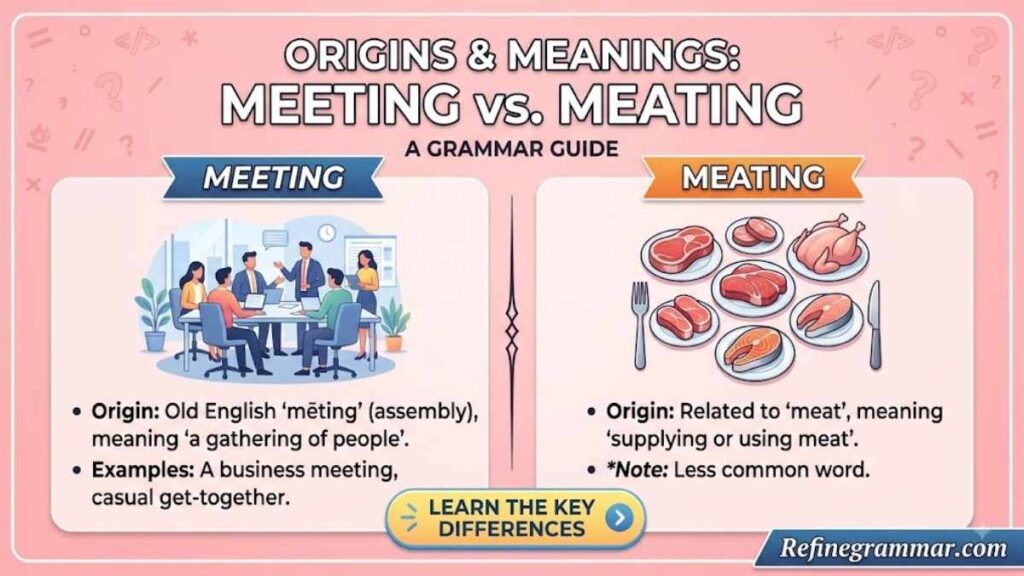
Every confusing word pair has a root cause, and this one is no exception. Understanding where each word comes from makes the Meating vs Meeting choice almost automatic.
Meeting Meaning in English
“Meeting” comes from the verb meet, which has meant “to come together” for centuries. As a noun, a meeting is a planned or informal gathering of people who assemble to talk, plan, or make decisions. As a verb form (the present participle of “meet”), it describes an action in progress “She is meeting the client at noon.” This dual role is exactly why the word shows up so often in business, school, and casual conversation.
Meating Meaning
“Meating” is not a word most dictionaries recognize for describing a gathering. In the rare cases it does appear, it relates to meat supplying, preparing, or processing meat, as in older butchery or hunting contexts. Outside of that narrow, largely historical usage, “meating” in a sentence about people getting together is simply a misspelling of “meeting.”
Meting Meaning
A third lookalike, meting, is a real and separate word. It’s the present participle of mete, meaning to distribute or hand something out most often used in the phrase “meting out punishment” or “meting out justice.” It has nothing to do with gatherings, which makes it a sneaky third option to rule out when you’re double-checking spelling.
Full Meeting Meaning
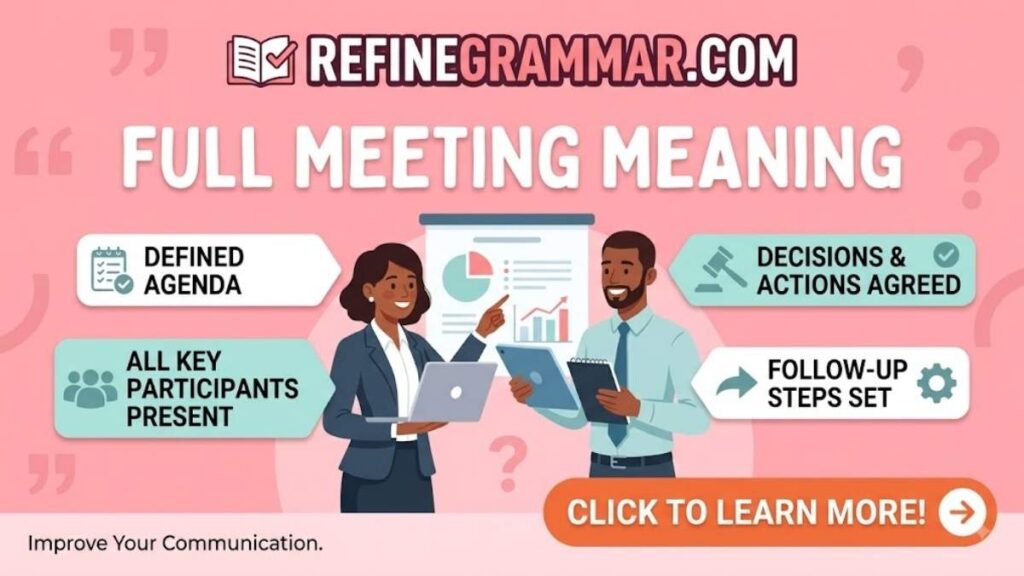
In its fullest sense, a meeting is any occasion where two or more people come together in person, by phone, or over video to share information, discuss a topic, solve a problem, or make a decision. Meetings can be formal (a scheduled board meeting) or informal (two coworkers grabbing coffee to talk through a project). The word also covers virtual formats like a Google Meet session, a Zoom call, or a conference bridge. No matter the setting, the spelling stays the same: meeting, never “meating.”
Is ‘Meating’ a Word?
Technically, “meating” exists in a handful of specialized or archaic contexts tied to meat preparation, but it is not a standard English word for describing a gathering. Major dictionaries either omit it entirely or list it only as an obscure, rarely used term. For everyday writing emails, reports, invites, homework treat “meating” as an error every time it shows up in place of “meeting.” This is the same pattern you’ll see in other confusable pairs, similar to how writers mix up carrer or career simply because the correct spelling looks slightly different from how it sounds.
Correct Spelling and Pronunciation
Both words are pronounced almost identically “MEE-ting” which is exactly why the typo spreads so easily. The only difference on the page is a single letter: an “e” versus an “a” in the second syllable.
| Word | Spelling | Pronunciation | Standard English Word? |
| Meeting | m-e-e-t-i-n-g | MEE-ting | Yes |
| Meating | m-e-a-t-i-n-g | MEE-ting | No (except rare meat-related use) |
| Meting | m-e-t-i-n-g | MEE-ting | Yes (different meaning) |
A simple memory trick: “meeting” has two E’s, just like the word “meet” it comes from. If you can remember that meetings begin with people meeting, the correct spelling follows naturally.
How to Use ‘Meeting’ in Sentences
Once you’re confident in the spelling, using “meeting” correctly comes down to matching it with the right grammatical role.
- As a noun: “The marketing meeting starts at 10 AM.”
- As a present participle verb: “We are meeting at the coffee shop before the presentation.”
- As part of a compound phrase: “Please check the meeting agenda before you join.”
- In a scheduling context, similar to how you’d confirm a timeframe or time frame for a project, always confirm the meeting time in writing to avoid confusion.
Keeping the subject-verb structure simple and the spelling consistent is usually enough to keep your writing polished and professional.
Why ‘Meating’ is Usually Incorrect
The Meating vs Meeting mix-up almost always comes down to typing speed and phonetic interference your fingers move faster than your brain double-checks the spelling. Autocorrect doesn’t always catch it either, because “meating” isn’t flagged as a nonsense string; it just looks like a real, if unusual, word. The result: a typo that slips past spellcheck and lands in a client email or a job application, where it can look careless. Just as writers often second-guess atleast or at least, the safest habit with “meeting” is to proofread out loud before you hit send.
Google Meet vs Meeting
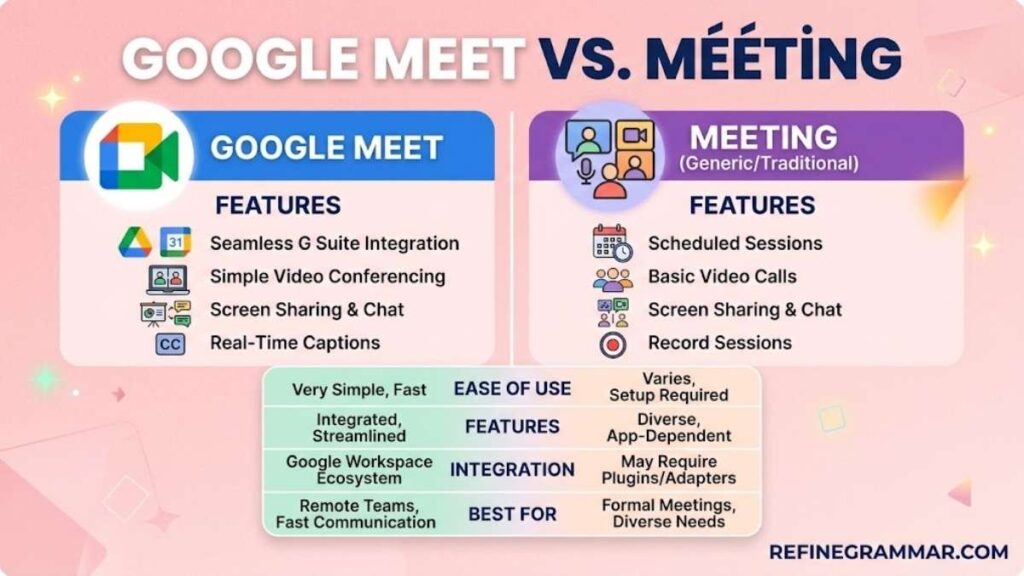
“Google Meet” is a proper noun the name of Google’s video-conferencing platform while “meeting” is the general word for the gathering itself. You join a Google Meet to attend a meeting; the platform hosts the event, but the event is still called a meeting. Writers sometimes shorten this to “Google meeting,” which is acceptable informally, but the official product name always keeps its capital letters: Google Meet.
Common Confusions and Mistakes
Meet vs Meat vs Meeting
| Word | Part of Speech | Meaning | Example |
| Meet | Verb | To come together with someone | Let’s meet at noon. |
| Meat | Noun | Animal flesh used as food | We bought fresh meat for dinner. |
| Meeting | Noun / Verb | A gathering, or the act of meeting | The team meeting ran long. |
Meeting vs Meting
As covered earlier, “meting” only applies to distributing something, usually punishment or justice for example, “The judge is meting out a fair sentence.” It should never be confused with a scheduled gathering.
Spelling Mistakes in English
Meating vs Meeting is part of a much larger family of confusable English word pairs, alongside errors like laid out or layed out and to small or too small. These mistakes share a common root: two words that sound alike but are spelled differently, which makes them easy to miss during a quick read-through.
Scenarios
- Email: “Let’s schedule a meating tomorrow at 2 PM.” Incorrect. Should read “meeting.”
- Calendar invite: “Parent-teacher meating is scheduled for Friday.” Incorrect. Should read “meeting.”
- Chat message: “Join the meating link when you’re ready.” Incorrect. Should read “meeting.”
Examples for Clarity
Seeing both words used correctly side by side makes the difference stick.
1. We had a productive meeting with the design team this morning.
2. The butcher spent the afternoon meating the counter display for the weekend sale (a rare, meat-related use).
3. Her schedule is packed with back-to-back meetings this week.
4. Before the is it 26 or 26th question comes up on the invite, the finance team wants a budget meeting locked in on the calendar.
Practice Session: Meating vs Meeting
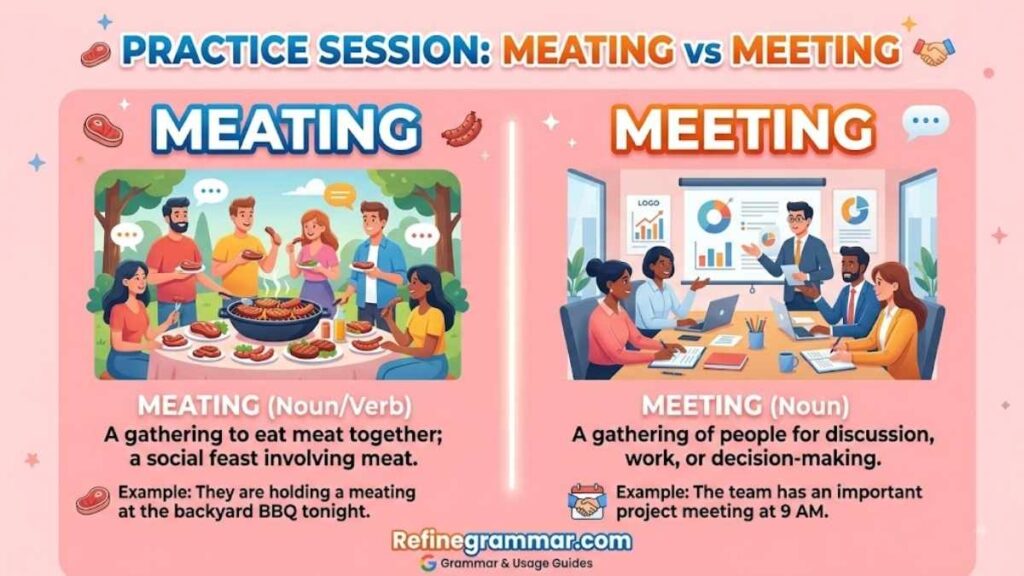
Test what you’ve learned with this short exercise before moving on to the FAQs.
Fill in the Blank
1. The weekly team ______ starts at 9 AM sharp.
2. We are ______ the new client at the airport.
3. The judge is ______ out the final ruling. (hint: not about gatherings)
Correct the Sentences
- “We have a client meating tomorrow.” → We have a client meeting tomorrow.
- “Join the meating link.” → Join the meeting link.
- “The school meating was canceled.” → The school meeting was canceled.
Scenarios
Imagine sending a calendar invite titled “Quarterly Meating.” A recruiter or client will still understand what you mean, but the typo can quietly undercut the professionalism of an otherwise strong message a lesson worth remembering the same way you’d double-check a resume for something like a misspelled job title.
Answer
1. meeting 2. meeting 3. meting
Tips to Avoid Mistakes
- Remember: “meeting” has two E’s, just like “meet.”
- Read your sentence aloud before sending your ear often catches what your eyes skip.
- Don’t rely solely on spellcheck; “meating” can pass as a real word to some tools.
- When in doubt, ask: is this about people gathering? If yes, it’s meeting.
FAQs
Is it “meating” or “meeting” which spelling is correct?
“Meeting” is correct for a gathering of people. “Meating” is almost always a typo.
What does “meet” mean, and how is it different from “meeting”?
“Meet” is the base verb for coming together; “meeting” is the noun (or ongoing verb form) describing that gathering.
Can “meet” and “meat” be used together in the same sentence?
Yes for example, “We’ll meet for lunch and order meat skewers,” since the two words have unrelated meanings.
Are “meat” and “steak” the same thing?
No. Meat is the general category of animal flesh eaten as food, while steak is one specific cut of meat.
Are “meat” and “beef” the same, or is there a difference?
Beef is a specific type of meat that comes from cattle, so all beef is meat, but not all meat is beef.
Can any type of meat be called a steak?
No. A steak refers to a flat cut of meat, usually beef, fish, or poultry, sliced across the grain.
What are the different types of meetings?
Common types include team meetings, one-on-ones, status updates, brainstorming sessions, and board meetings.
What are the four main types of business meetings?
Decision-making, problem-solving, information-sharing, and team-building meetings are the four widely recognized types.
What are the four basic purposes of a meeting?
Meetings typically aim to inform, decide, solve problems, or build alignment among participants.
What is a meeting, and what are its main types?
A meeting is a gathering for discussion or decision-making; main types include in-person, virtual, formal, and informal meetings.
Conclusion
The Meating vs Meeting debate has a simple resolution: “meeting” is the correct word whenever you’re describing people coming together, while “meating” belongs almost exclusively to rare, meat-related contexts. Because the two words sound identical when spoken, the mistake is easy to make and just as easy to fix once you know the rule.
Proofread your invites, remember that “meeting” carries the same double-E as “meet,” and you’ll never let a stray letter undercut your professionalism again. And if grammar mix-ups like this one keep tripping you up, it’s worth bookmarking a reliable favs or faves-style reference guide so you always have the correct spelling one click away.
