
If you have ever typed a sentence and paused, unsure whether to write “grately” or “greatly,” you are not alone. The Grately vs Greatly question is one of the most common spelling mix-ups in everyday and professional writing. This guide settles the Grately vs Greatly debate for good, with clear definitions, real examples, and simple rules you can apply immediately.
The Quick Answer You Need First
“Greatly” is the only correct spelling. “Grately” is not a recognized English word it is simply a common misspelling that happens when writers drop the first “e” from “great.” Whenever you are debating Grately vs Greatly, remember: greatly is the word your dictionary, your spell-checker, and your reader expect to see.
What Does “Greatly” Actually Mean?
Greatly Definition
“Greatly” means “to a large or significant extent.” It intensifies a verb or an adjective, showing that something happened, changed, or mattered by a large amount. For example, “The new update greatly improved performance” tells the reader that the improvement was substantial, not minor.
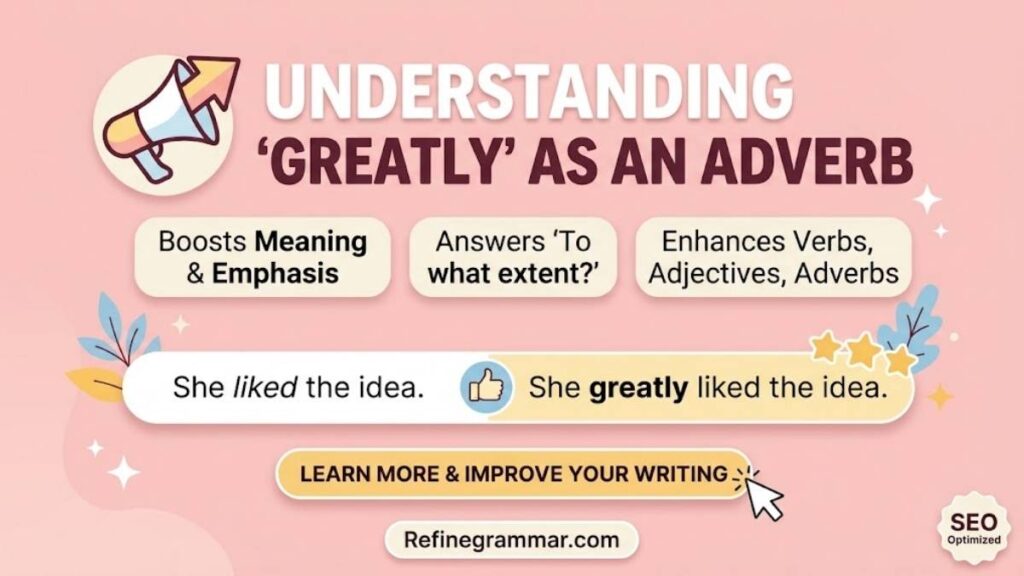
Understanding “Greatly” as an Adverb
Key Fact
“Greatly” is an adverb formed by adding “-ly” to the adjective “great.” Adverbs like this typically describe the degree or manner of an action, which is exactly the role “greatly” plays in a sentence.
Examples of Adverbs in English
- Quickly describes how fast something happens
- Greatly describes the degree or extent of something
- Carefully describes the manner of an action
- Rarely describes frequency
Grately Meaning: Why It Doesn’t Exist
There is no accepted grately meaning in standard English dictionaries because “grately” has never been an official word. It is purely a phonetic slip people hear “greatly” spoken quickly and reproduce the sound without the correct spelling.
Why It Happens
The confusion in Grately vs Greatly usually comes from typing speed, autocorrect gaps, or simply misremembering the spelling of “great.” Because “great” already contains a tricky vowel combination, it is an easy word to distort when adding a suffix.
Is Grately a Word? Let’s Clear It Once and For All
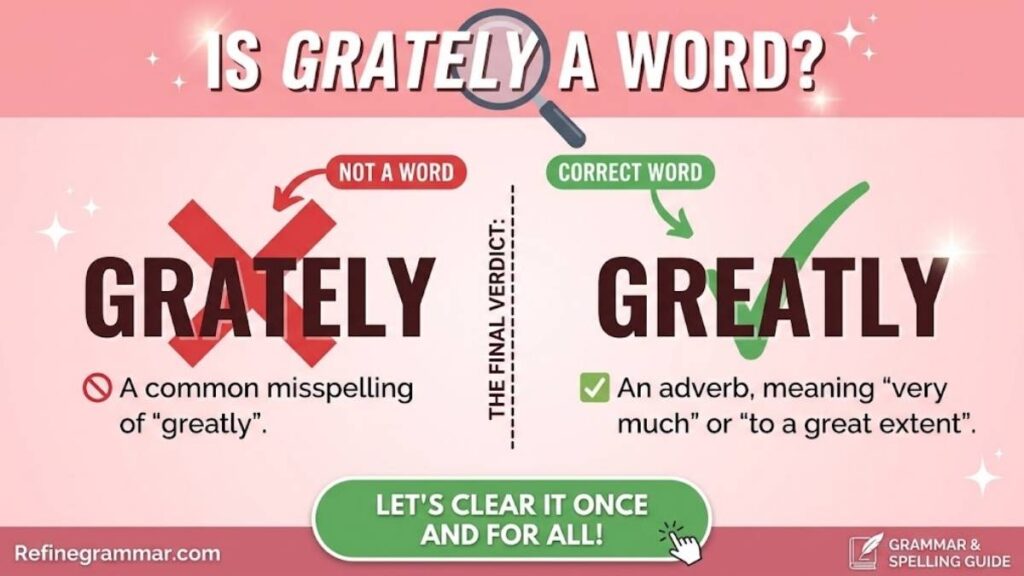
No “grately” is not a word. It does not appear in Merriam-Webster, Cambridge Dictionary, or Oxford Learner’s Dictionaries. Whenever the Grately vs Greatly question comes up in writing tools or grammar checkers, “grately” will always be flagged as an error.
Important Insight
Search engines still show high search volume for “grately,” which proves how common the typo is but popularity does not make a misspelling correct.
Why Do People Confuse Grately vs Greatly?
Main Causes
- Typing too fast and skipping a letter, similar to how people mix up sponser vs sponsor.
- Relying on how the word sounds rather than how it is spelled
- Autocorrect not catching the error because “grately” looks close enough to a real word
- Copying a mistake from another source without checking it
Larger Pattern
This is part of a broader pattern of prefix and letter-swap errors in English, the same pattern seen in encorporate vs incorporate and encode vs incode, where a single misplaced letter changes a word from correct to incorrect.
Difference Between Greatly vs Grately (Simple but Critical)
The table below makes the Grately vs Greatly difference easy to see at a glance.
| Word | Correct? | Notes |
| Greatly | Yes | Standard adverb meaning “to a large extent” |
| Grately | No | Common misspelling; not in any dictionary |
This kind of one-letter confusion is common across English, much like the mix-up between carrer or career, where a missing letter changes the whole word.
How to Spell Greatly Correctly Every Time
Correct Spelling of Greatly
G-R-E-A-T-L-Y. Notice the “ea” combination from “great,” followed directly by “-ly.”
Common Incorrect Variations
- grately
- greatley
- greatlly
- greatliy
Memory Trick
Think of the phrase “great” + “ly.” If you can spell “great” correctly, you can spell “greatly” correctly just add the suffix without changing anything else.
How to Use Greatly in a Sentence (Real Examples)
Examples of Greatly in Sentences
- Her presentation greatly impressed the entire team.
- The company greatly reduced its shipping times this year.
- I greatly appreciate your patience during the delay.
- The results were greatly influenced by the new methodology.
- His attitude greatly improved after the feedback session.
Greatly Usage Patterns That Sound Natural
Common Structures
“Greatly” usually sits directly before the verb or past participle it modifies, such as “greatly reduced,” “greatly appreciated,” or “greatly improved.”
More Examples
- The new policy greatly benefits small businesses.
- Sales greatly exceeded expectations this quarter.
- The team’s morale was greatly boosted by the win.
Greatly or Grately Appreciated The Correct Choice
Correct
“Greatly appreciated” this is the standard, professional phrase used in emails, letters, and everyday conversation.
Incorrect
“Grately appreciated” is a spelling error and should never appear in formal or professional writing.
Why It Matters
Phrases like “greatly appreciated” often appear in emails to clients, managers, and colleagues, so a misspelling here can quietly damage credibility.
Grately or Greatly Missed Don’t Get This Wrong
The correct phrase is always “greatly missed,” used to express that someone or something is deeply missed. “Grately missed” is incorrect in every context.
Tip
If you are ever unsure mid-sentence, mentally replace “greatly” with “very much.” If the sentence still makes sense, “greatly” is the word you need.
What’s the Real Issue?
The real issue behind Grately vs Greatly is not grammar it is spelling. Both words would function the same way in a sentence if “grately” existed, but only “greatly” is a real, dictionary-approved word.
Important Point
Spelling errors like this one are easy to fix once you know the rule, which is why the Grately vs Greatly mix-up rarely persists once a writer learns the correct form.
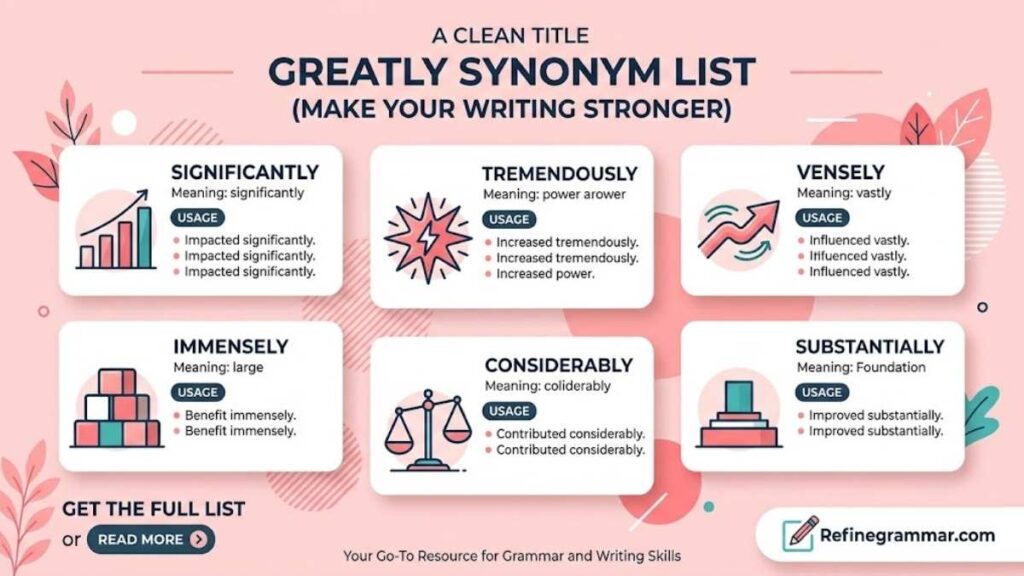
Greatly Synonym List (Make Your Writing Stronger)
Greatly Synonyms
- Significantly
- Considerably
- Substantially
- Immensely
- Tremendously
- Vastly
Example Upgrade
Instead of “The results greatly improved,” try “The results improved substantially” for variety in longer pieces of writing.
A Small Mistake That Hurts Credibility
Scenario
Imagine sending a client email that reads: “Your feedback is grately appreciated.”
Impact
A single misspelling like this can make a professional message look rushed or careless, even if the rest of the writing is polished.
Correct Version
“Your feedback is greatly appreciated.”
Result
The corrected sentence reads as polished, confident, and professional exactly the impression most writers want to give.
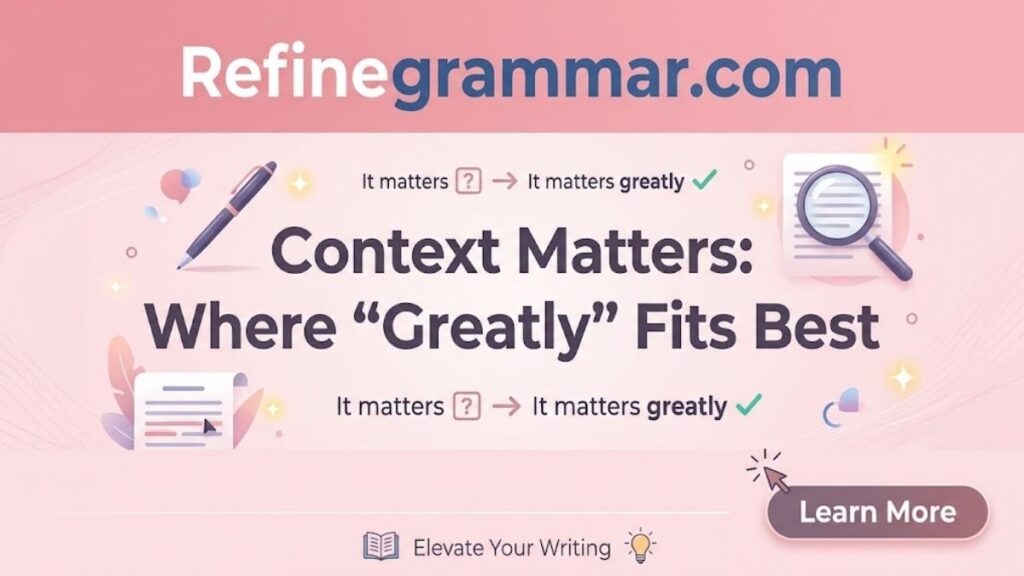
Context Matters Where “Greatly” Fits Best
Professional Writing
In emails, reports, and proposals, “greatly” is the preferred choice for expressing degree, as in “greatly valued” or “greatly improved.”
Academic Writing
Academic papers often use “greatly” to describe the extent of an effect, such as “the treatment greatly reduced symptoms.”
Casual Writing
In everyday conversation and casual writing, “greatly” still works well, though shorter alternatives like “really” or “a lot” are also common.
UK usage note: British English follows the same spelling as American English for “greatly” there is no regional variation, so writers in the UK, US, Canada, and Australia should all use the same spelling.
Common Mistakes Like Grately vs Greatly
Other Common Errors
- too small or to small a mix-up between an intensifier and a preposition
- laid out or layed out confusion over irregular past tense verbs
- how to correctly write the 26th uncertainty around numbers and ordinal spelling
- as well or aswell a spacing error that changes correctness entirely
- dysregulated vs disregulated a prefix mix-up common in clinical writing
- emersion vs immersion two real words that are easy to confuse
- meating vs meeting a homophone-driven spelling mistake
Spelling Rules for Words Ending in -ly
Basic Rule
Most adjectives become adverbs by simply adding “-ly” without changing the base word, the same rule that applies when checking cocoon or cacoon spellings against their root forms.
Examples
- Great → Greatly
- Quick → Quickly
- Careful → Carefully
- Rare → Rarely
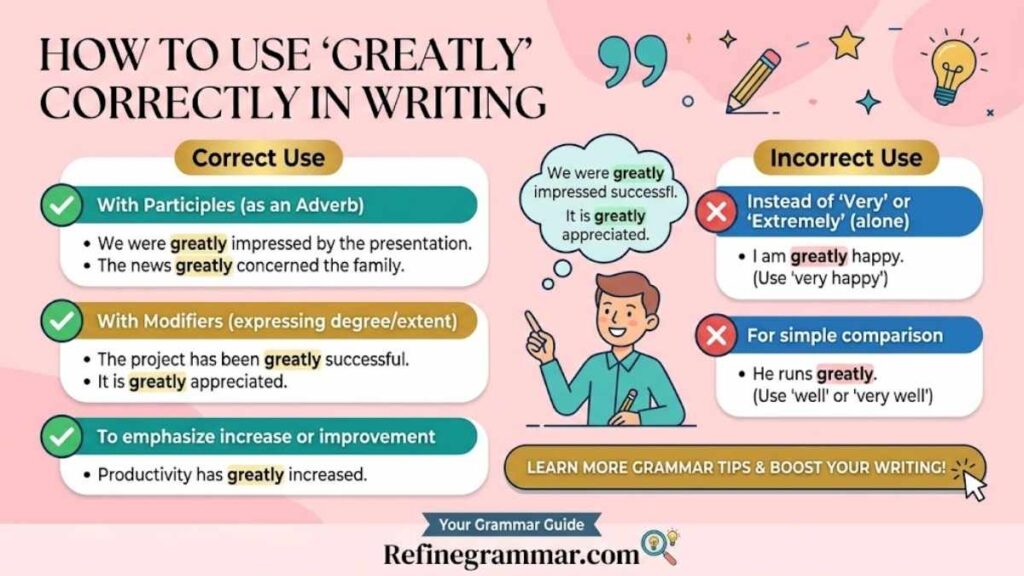
How to Use Greatly Correctly in Writing
Quick Checklist
- Double-check the spelling: G-R-E-A-T-L-Y
- Place it directly before the verb it modifies
- Use it to show degree, not manner
- Avoid pairing it with another intensifier like “very greatly”
Quick Practice (Make It Stick)
Fill in the Blank
1. Your help is ______ appreciated. (greatly / grately)
2. The plan was ______ improved after feedback. (greatly / grately)
Choose the Correct Word
3. We ______ missed you at the event. (greatly / grately)
Answer key: 1) greatly, 2) greatly, 3) greatly in every case, greatly is the only correct choice.
Key Takeaways (Simple and Clear)
Greatly Is Correct and Widely Used
“Greatly” is the standard, dictionary-approved adverb used across professional, academic, and casual writing.
Grately Is a Spelling Mistake
“Grately” has no dictionary entry and should always be corrected to “greatly.”
What Happens When You Use It
Using “grately” in writing can make a message look unpolished, even when the surrounding content is strong.
Greatly Means “To a Large or Significant Extent”
This is the core definition to remember whenever the Grately vs Greatly question resurfaces.
Quick Comparison
| Greatly | Grately |
| Correct spelling | Incorrect spelling |
| Found in all major dictionaries | Not found in any dictionary |
Always Proofread Your Writing
A quick proofread catches most spelling issues before they reach a reader.
Simple Proofreading Tips
- Read your sentence aloud slowly
- Use a grammar checker as a second layer, not a replacement for proofreading
- Keep a list of words you personally tend to misspell
Why It Matters
Clean, correct spelling builds trust with readers, clients, and employers which is exactly why the Grately vs Greatly distinction is worth remembering.
Insight
Reference Cambridge Dictionary Definitions
Cambridge Dictionary defines “greatly” as an adverb meaning “very much,” reinforcing that it is the only recognized form in the Grately vs Greatly comparison.
FAQs
Which is correct, “greatly” or “grately”?
“Greatly” is correct; “grately” is a misspelling.
What is the difference between greatly and grately?
“Greatly” is a real adverb; “grately” does not exist in standard English.
Is it grately appreciated or greatly appreciated?
It is always “greatly appreciated.”
Is “grately missed” or “greatly missed” the correct phrase to use?
“Greatly missed” is correct; “grately missed” is incorrect.
What does “greatly” mean?
It means “to a large or significant extent.”
How do you spell “greatly”?
G-R-E-A-T-L-Y.
Is it correct to say “I greatly appreciate”?
Yes, this is a correct and commonly used phrase.
Is greatly a correct word?
Yes, it is a standard English adverb found in every major dictionary.
What is a better word than “greatly”?
Alternatives include significantly, considerably, and immensely, depending on tone.
How do you use “greatly” in a sentence?
Place it before the verb it modifies, such as “The update greatly improved speed.”
Final Thoughts
The Grately vs Greatly debate has a simple resolution: “greatly” is correct, and “grately” is not a real word. By remembering the definition, the spelling pattern, and a few natural examples, you can confidently avoid this mistake in every email, essay, and message you write. Once you internalize the Grately vs Greatly rule, it becomes second nature just like avoiding other common English mix-ups.
