
If you’ve ever paused mid-sentence wondering whether to write encode or incode, you’re not alone. This one-letter mix-up trips up students, writers, and even experienced developers. The Encode vs Incode question has a clear, simple answer, and once you understand why, you’ll never second-guess yourself again.
In this guide, you’ll learn what encode means, why incode isn’t a standard word, how encoding works in real life and in programming, and how to avoid mistakes that quietly damage your writing’s credibility.
Quick Answer (No Confusion)
Encode is correct. Incode is not a standard English word it’s almost always a misspelling of encode, with one narrow exception: a specific identity-verification company uses “Incode” as a brand name. When it comes to Encode vs Incode in everyday writing, grammar, or programming, encode is the only correct choice.
What Does Encode Mean? (Clear Definition + Core Idea)
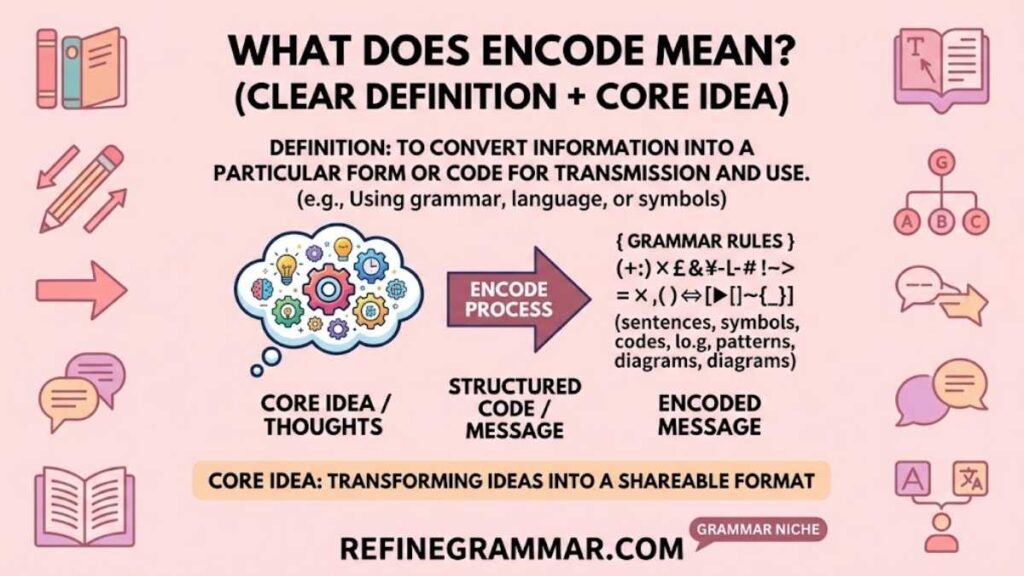
Encode Definition in Computer Science
In computer science, to encode means to convert data from one format into another so a system, program, or device can store, process, or transmit it correctly. Programmers encode text, images, audio, and video into formats like binary, Base64, or UTF-8 every day.
Meaning in English (Simple Explanation)
In everyday English, encode simply means to change information into a code or format that carries the same meaning in a different form. Think of Morse code, sign language, or even a locked diary all are ways of encoding a message.
What Does Encode Mean in Real Life?
Everyday Encoding Examples
You encode information constantly, often without realizing it:
- Typing a text message that your phone converts into digital signals
- Scanning a QR code, which stores a web address as a pattern of squares
- Setting a password, which your device encodes before storing it
Example Sentences
- The app will encode your data before sending it to the server.
- The camera encodes video in real time while recording.
Types of Encoding (Essential Knowledge)
Main Types of Encoding
Character Encoding
Converts letters and symbols into binary so computers can display text correctly (ASCII, UTF-8).
Binary Encoding
Represents data using only 0s and 1s, the foundational language of hardware.
URL Encoding
Converts special characters in a web address into a safe format, such as %20 for a space.
Audio/Video Encoding
Compresses raw audio or video into formats like MP3 or MP4 for streaming.
What Is Incode? (Honest Reality Check)

Incode Meaning
Incode has no established meaning in standard English or computer science. Some writers mistakenly use it to describe embedding hidden information inside a file, but this usage is informal, inconsistent, and not recognized by dictionaries or programming documentation. When people search Encode vs Incode, they’re almost always trying to confirm that encode is the real word and it is.
Is Incode a Real Word?
No, not in standard usage. The only legitimate exception is Incode, a proper noun used by a digital identity-verification company a rare naming exception, a little like knowing whether to write 26 or 26th in a date. Outside of that specific brand name, incode should never appear in your writing.
Why Do People Confuse Encode vs Incode?
Common Causes
Several factors drive the Encode vs Incode mix-up:
- The prefixes “en-” and “in-” sound nearly identical when spoken quickly
- Autocorrect and spell-check tools sometimes miss the error
- Non-native English speakers often transfer prefix patterns from other languages
Visual similarity between the two words causes quick typing mistakes, much like the confusion between similarly spelled pairs such as carrer or career.
Encode or Incode in Tagalog (Filipino Usage Explained)
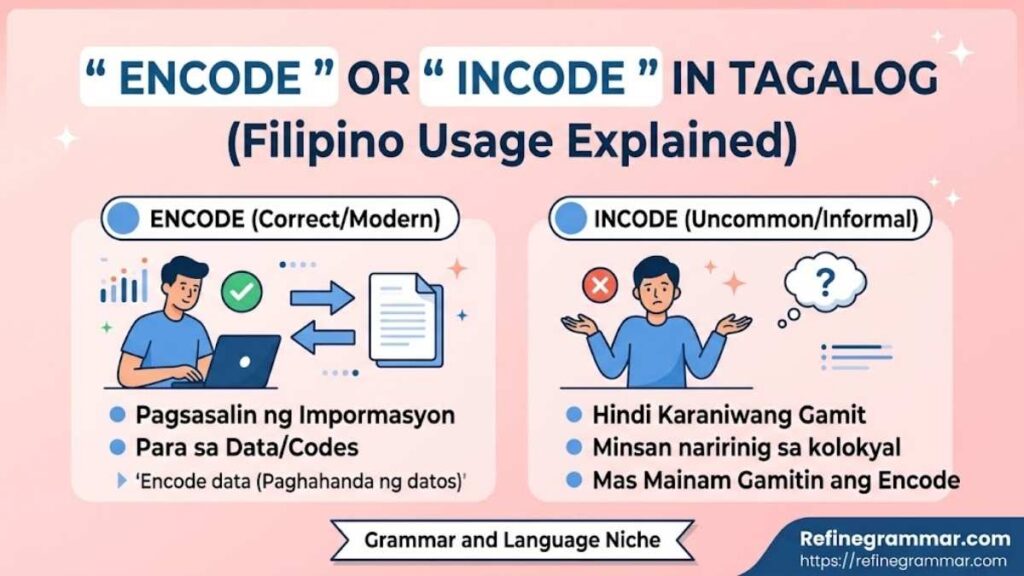
In Filipino and Tagalog contexts especially in call centers and BPOs “encode” is commonly used to mean “to type” or “to enter data,” as in “i-encode mo ang impormasyon.” This is a legitimate regional usage of encode, not incode.
Encode Meaning in Urdu
In Urdu and Roman Urdu writing, encode ka matlab hai kisi maloomat ya data ko aik mukhtalif format mein tabdeel karna converting text into a digital or secure format. Whether you’re writing in English, Urdu, or Tagalog, the Encode vs Incode rule stays the same: only encode is correct.
Encode vs Incode Meaning
At its core, the Encode vs Incode meaning comparison comes down to legitimacy: encode has a dictionary-backed, universally understood meaning, while incode does not, except as a brand name. If you’re unsure which to use, default to encode every time.
Encode vs Incode Difference (Side-by-Side Breakdown)
The table below makes the Encode vs Incode difference easy to see at a glance, in the same clear-cut way that resolving atleast or at least becomes obvious once you see the rule spelled out.
| Feature | Encode | Incode |
| Standard English word | Yes | No |
| Found in dictionaries | Yes | No |
| Used in programming | Yes, constantly | No |
| Grammatically correct verb | Yes | No |
| Valid as a proper noun | No | Yes (brand name only) |
Encode vs Incode Examples
- Correct: Please encode this file before uploading.
- Incorrect: Please incode this file before uploading.
- Correct: The system encodes user passwords automatically.
- Incorrect: The system incodes user passwords automatically.
These examples work the same way commonly confused terms like to small or too small trip people up until they see the correct pattern clearly.
Encode vs Incode Grammar (Why Only One Works)
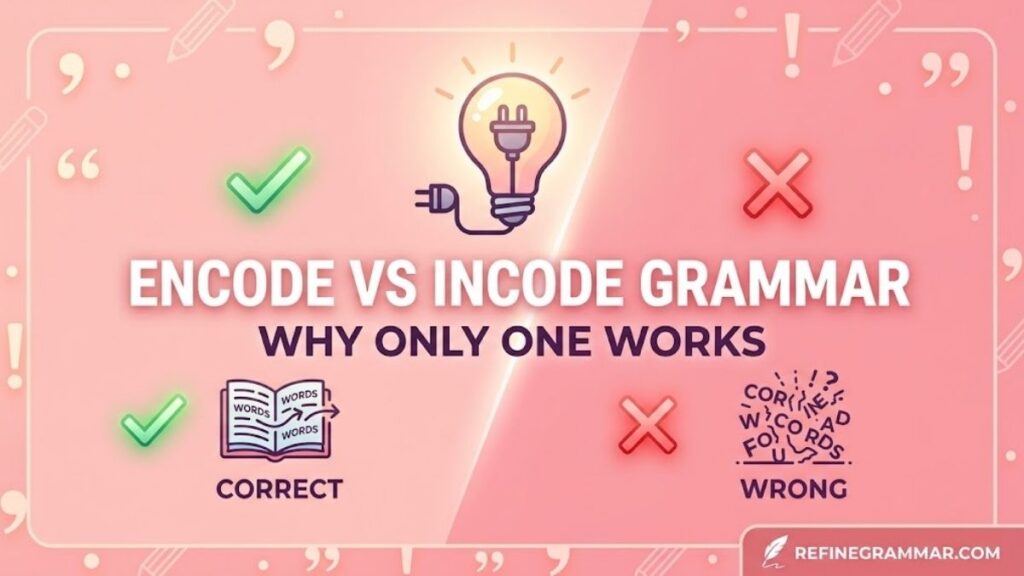
Grammar Role
Encode is a transitive verb it always needs an object (you encode something). Incode cannot function as a verb, noun, or adjective in standard English grammar, which is exactly why it fails in every sentence structure.
Examples
- Correct: The developer encoded the string.
- Incorrect: The developer incoded the string.
- Correct: We need to encode this data before transmission.
How to Use Encode Correctly in Writing
Basic Patterns
Use encode plus an object: encode data, encode a message, encode a file, encode a signal. It also works in passive voice: “The data was encoded.” Much like getting laid out or layed out right depends on knowing the base verb, encode always keeps its “en-” prefix regardless of tense.
Examples
- Present: I encode files daily.
- Past: The message was encoded yesterday.
- Gerund: Encoding data properly prevents errors.
Can You Use Incode in Any Context?
Incorrect Usage
“You need to incode this video.” This fails because incode isn’t a recognized verb.
Correct Version
“You need to encode this video.”
Encoding in Programming (Deep Explanation)
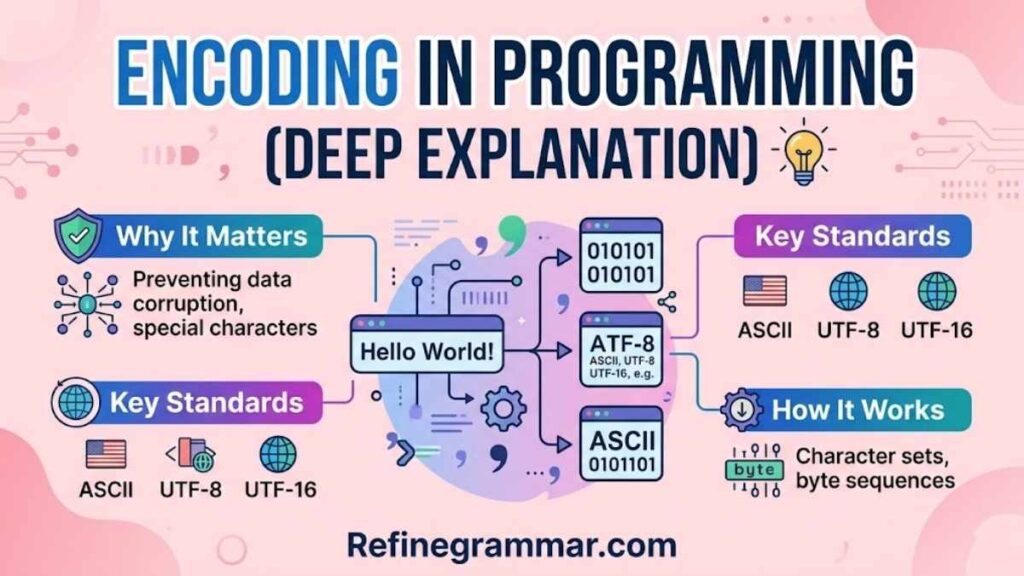
Why Encoding Is Necessary
Computers only understand binary, so text, images, and audio must be encoded into a machine-readable format before they can be stored, processed, or transmitted. Without encoding, data would be unreadable across different systems.
Input vs Encode: What’s the Difference?
Input refers to raw data entered into a system; encode refers to converting that input into a structured format. Input happens first, and encoding happens afterward to make it usable.
Encode vs Code: What’s the Difference?
Code is a broad term referring to any system of symbols or programming instructions. Encode is the specific act of converting information into a code. In short, code is the result or the language, and encode is the action a distinction a little like the one between emersion and immersion, where one word describes a static state and the other an active process.
Data Encoding Techniques (Technical Detail)
Common Methods
Binary Encoding
Converts data into 0s and 1s for machine processing.
Base64 Encoding
Converts binary data into readable ASCII text, often used for email attachments.
UTF-8 Encoding
The most widely used character encoding standard, supporting nearly every language on the web.
Character Encoding Examples
The letter “A” is encoded as 01000001 in binary and as 65 in ASCII. Emojis and accented characters rely on UTF-8 encoding to display correctly.
Binary Encoding Explained Simply
Binary encoding is the foundation of all digital encoding every file, image, and message is ultimately reduced to 0s and 1s that computers can interpret.
Encode vs Encrypt vs Decode (Important Distinction)
Clear Comparison
| Term | Meaning | Reversible Without a Key? |
| Encode | Convert data into a readable or transmittable format | Yes |
| Encrypt | Convert data to hide it from unauthorized users | No, needs a key |
| Decode | Reverse the encoding process | Yes |
This distinction matters just as much as knowing the difference between dysregulated and disregulated in careful writing using the wrong term in technical documentation can mislead readers about security.
Text Encoding vs Encryption
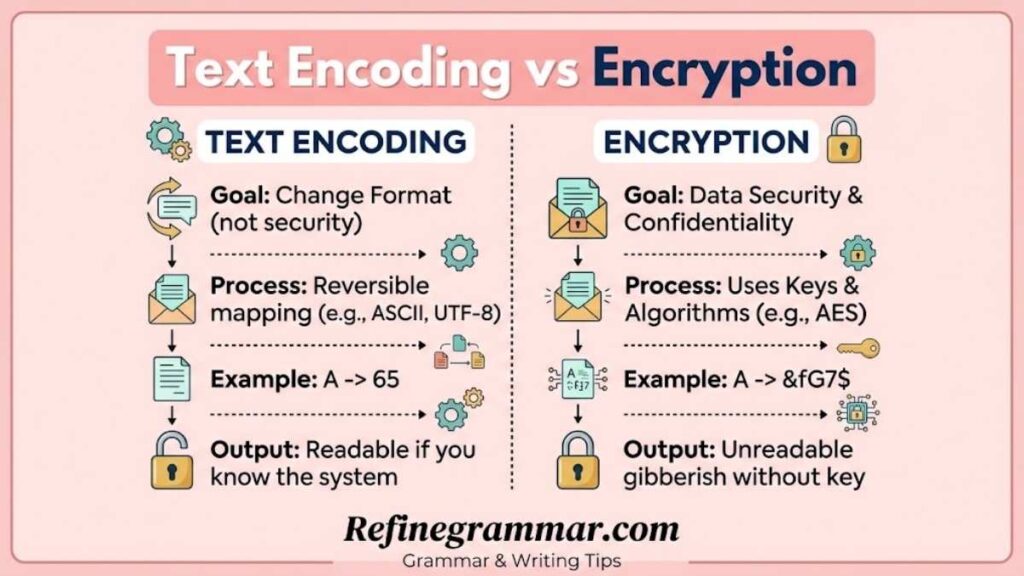
Encoding
Encoding makes data usable and transferable. It isn’t designed for security and can typically be reversed without a key.
Encryption
Encryption protects data by scrambling it so only someone with the correct key can read it.
Read Mora: Sponser vs Sponsor: Difference, Meaning & Correct Usage
Impact of the Mistake
Scenario
A developer writes in official documentation: “Incode the request body before sending.”
What Happens
Readers may search for a function called “incode” that doesn’t exist, wasting time and creating confusion.
Correct Version
“Encode the request body before sending.”
Result
Clear instructions and credible documentation this is why Encode vs Incode matters beyond grammar, much like knowing whether to write favs or faves affects how polished your writing looks.
Common Mistakes to Avoid
Using “incode” Instead of Encode
The single most common error tied to the Encode vs Incode confusion.
Confusing Encode with Encrypt
Encoding is not security. Don’t use it interchangeably with encryption.
Ignoring Context
Check whether you mean converting data (encode), hiding data (encrypt), or reversing a process (decode).
Why Encode Is the Correct Word
Encode has dictionary backing and consistent use across computer science, linguistics, and everyday communication. Incode simply doesn’t share that foundation.
Read More: Encorporate vs Incorporate: Correct Usage Explained (2026)
Encode Meaning in Communication
In communication theory, to encode means converting a thought into words, symbols, or signals a receiver can decode and understand the basis of all human communication.
Context Matters: Where Encode Is Used
Computer Science
Encoding data structures for storage, indexing, and efficient processing.
Web Development
URL encoding, HTML entity encoding, and API payload encoding are used constantly, and choosing the right one depends on context, much like settling on a timeframe or time frame depends on the situation you’re describing.
Digital Communication
Messaging apps encode text, emojis, and media before sending them across networks.
Encoding Examples in Real Life
From grocery-store barcodes to HD streaming, encoding quietly powers modern life a small detail with a big impact, much like getting a spelling pair such as cocoon or cacoon right.
Quick Practice (Lock It In)
Fill in the Blank
- Please ______ this file before sending. (encode)
- The app automatically ______s your password. (encode)
Fix the Sentence
Incorrect: “We need to incode the message.” Correct: “We need to encode the message.” Just like sorting out meating or meeting takes one quick check, fixing Encode vs Incode mistakes takes seconds once you know the rule.
Key Takeaways (Simple and Clear)

- Encode is always correct; incode is not a standard word
- Incode is only valid as a brand name
- Encode means to convert data into a code or format
- Don’t confuse encode with encrypt
- When in doubt, default to encode
Just as as well or aswell has exactly one correct form, the Encode vs Incode debate has exactly one winner: encode.
FAQs
Is it “encode” or “incode” which one is correct?
Encode is correct; incode is not a standard English word.
What does “encode” mean in simple words?
To change information into a code or format so it can be stored or shared.
What does it mean to encode a message?
It means converting the message into a format like binary or a cipher so it can be transmitted or protected.
What does it mean to encode a word?
To represent that word using a coding system, such as ASCII or Unicode.
Is “incode” a real word, or a common misspelling?
It’s mostly a misspelling of encode, except when used as a specific brand name.
What is another word for “encode”?
Convert, transform, or translate into a code.
What is an example of encode?
Converting a text message into binary before sending it over a network.
What’s the difference between “code” and “encode”?
Code is the system of symbols; encode is the act of converting information into that system.
Is coding and encoding the same thing?
No, coding usually means writing programs, while encoding means converting data formats.
How do I encode data or text?
Use an encoding standard like UTF-8, Base64, or ASCII depending on your platform or programming language.
Final Thoughts
The Encode vs Incode debate really comes down to one simple habit: trust encode every time, whether you’re writing documentation, a school assignment, or a casual message. Incode has no real footing in standard English or programming the only place it belongs is as a brand name. Once that rule sticks, you’ll write with more confidence and avoid a mistake that quietly undermines otherwise polished, professional content.
