
If you have ever paused mid-sentence wondering whether to write “sponser” or “sponsor,” you are not alone. This is one of the most common spelling mix-ups in business, marketing, and everyday writing. The short answer: only “sponsor” is correct. “Sponser” is a misspelling with no dictionary standing, no matter how often it shows up in emails, social captions, or sponsorship proposals.
This guide breaks down the Sponser vs Sponsor debate from every angle meaning, spelling logic, real-world usage, and the small memory tricks that make the mistake disappear for good. By the end, you will never second-guess the word again.
What the Word Actually Represents
A sponsor is a person, brand, or organization that provides financial or material support to an event, individual, or cause, usually in exchange for visibility, goodwill, or a defined benefit. Understanding the Sponser vs Sponsor question starts with understanding what the correct word actually means.
The word functions as both a noun and a verb:
- Noun: “The company became the official sponsor of the marathon.”
- Verb: “They agreed to sponsor the youth football league.”
There is no version of this word, in any accepted English dictionary, that is spelled with an “e” in place of the “o.” That single letter is the entire Sponser vs Sponsor argument, and English spelling rules settle it decisively in favor of “sponsor.”
How the Word Actually Works Sponser vs Sponsor
“Sponsor” traces back to the Latin word spondere, meaning “to pledge” or “to promise solemnly.” That root explains the “-or” ending, which English commonly uses for agent nouns describing someone who performs an action (actor, director, sponsor). “Sponser,” with an “-er” ending, breaks that pattern and has never been recognized as an alternate spelling by any major dictionary.
This is precisely why the Sponser vs Sponsor confusion persists English has plenty of “-er” agent nouns (teacher, writer, sponsor’s near-cousin “supporter”), so the brain naturally reaches for the more familiar ending.
Why the Confusion Happens
Spelling confusion like this rarely happens in isolation. English is full of word pairs that trip up even experienced writers because they sound alike, look similar, or follow inconsistent patterns. A few other examples worth bookmarking:
- People often debate timeframe or time frame the same way they debate one-word versus two-word spellings elsewhere.
- Casual writing frequently confuses favs or faves as an abbreviation for “favorites.”
- Formal writing often stumbles over atleast or at least, a spacing error similar in spirit to “sponser.”
- Comparative phrasing sometimes muddles to small or too small.
- Past-tense confusion appears in laid out or layed out.
- Even numerals cause hesitation, as seen in is it 26 or 26th debates.
- Career-related writing often misfires on carrer or career.
- Nature vocabulary isn’t immune either, with cocoon or cacoon causing regular mix-ups.
- Everyday connectors like as well or aswell show how spacing errors sneak into casual writing.
- Psychology-adjacent terms like dysregulated vs disregulated confuse writers unfamiliar with the prefix rule.
- Similarly, emersion vs immersion trips people up because both are real words with different meanings.
- And homophony drives mix-ups like meating vs meeting.
Recognizing these patterns makes the Sponser vs Sponsor mistake easier to understand it is not a one-off error but part of a much larger family of English spelling traps.
Correct Spelling Sponsor Clear Visual Comparison
| Feature | Sponsor (Correct) | Sponser (Incorrect) |
| Dictionary status | Listed in Merriam-Webster, Cambridge, Oxford | Not listed in any major dictionary |
| Word origin | Latin spondere (“to pledge”) | No recognized origin |
| Ending pattern | “-or” agent noun | “-er” incorrect for this word |
| Usage in business | Standard, professional | Flagged as a typo |
| Search engines | Recognized, ranks correctly | Treated as a misspelling |
Why “Sponser” Is Always Incorrect in English
There is no context formal, informal, technical, or creative where “sponser” is acceptable. Spell-checkers flag it, style guides ignore it, and dictionaries simply do not list it. The Sponser vs Sponsor comparison isn’t close: one is a real, documented word, and the other is a spelling error that happens to be common.
A few reasons the error keeps spreading:
- Auto-correct sometimes fails to catch it in fast typing.
- Non-native English speakers transfer spelling patterns from their first language.
- Visual similarity to words like “answer” or “customer” creates false confidence.
How to Spell Sponsor Correctly (Practical Memory Approach)
The easiest way to lock in the correct spelling is to connect it to its meaning. A sponsor “supports” and both words share the “or” ending pattern common to supportive, agent-based roles (supporter, sponsor, donor).
Quick memory tricks:
- Think “sponsOR” rhymes with “donOR” both give support, both end in “-or.”
- Say it slowly: SPON-sor, not SPON-ser.
- Picture a sponsorship banner reading “Official Sponsor” visual repetition builds spelling memory fast.
How to Use Sponsor in English (Real Contexts and Examples)
Once the Sponser vs Sponsor spelling is settled, the next step is using the word naturally and correctly in a sentence.
- “The energy drink brand will sponsor the racing team for the next three seasons.”
- “Our conference is looking for a title sponsor to cover venue costs.”
- “She sponsored her niece’s education after her niece finished school.”
- “The nonprofit relies on corporate sponsors for most of its annual budget.”
Read More: https://refinegrammar.com/encorporate-vs-incorporate/
Sponsor Definition With Real Examples Across Industries
Marketing Context
In marketing, a sponsor typically pays for brand placement, product visibility, or association with an event’s audience. Sponsorship deals often include logo placement, social media mentions, and on-site branding in exchange for measurable reach.
Education Context
In education, a sponsor may fund a scholarship, mentor a student, or financially support an academic program. Sponsored students often receive tuition, housing, or research funding tied to specific commitments.
Sports Context
In sports, sponsors fund teams, athletes, stadiums, or entire leagues. Jersey sponsorships, stadium naming rights, and athlete endorsement deals are some of the most visible sponsor relationships in the world.
How Business Relationships Actually Work Sponser vs Sponsor
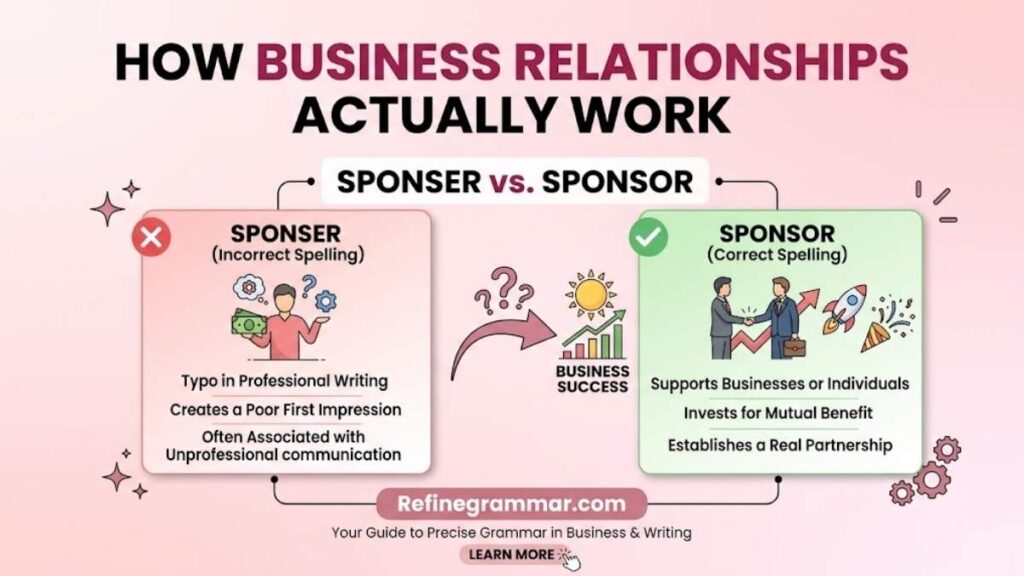
A sponsorship is fundamentally a two-way exchange, not a donation. The sponsor provides funding, products, or resources, while the sponsored party provides visibility, access, or association. Clear contracts typically define:
- Financial or in-kind contribution amount
- Duration of the sponsorship agreement
- Branding rights and placement
- Performance expectations or deliverables
Types of Sponsors and Their Roles
Now that the Sponser vs Sponsor spelling question is settled, it helps to understand that “sponsor” itself covers several distinct roles.
| Sponsor Type | Typical Role |
| Title Sponsor | Primary funder; event or product is named after them |
| Presenting Sponsor | Secondary-level branding, often “presented by” |
| In-Kind Sponsor | Provides products/services instead of cash |
| Media Sponsor | Provides advertising or broadcast exposure |
| Corporate Sponsor | Company-level financial backing |
Sponsor Synonyms and Related Vocabulary
Common synonyms and related terms include: backer, patron, benefactor, underwriter, supporter, and financier. While these words overlap in meaning, “sponsor” remains the standard term in business, sports, and media contexts specifically because of its formal, contractual connotation.
Sponsor Forms and Variations in Usage
| Form | Example |
| Sponsor (noun) | “He is our new sponsor.” |
| Sponsor (verb) | “They will sponsor the event.” |
| Sponsored | “The event was fully sponsored.” |
| Sponsoring | “The brand is sponsoring three athletes this year.” |
| Sponsorship | “The sponsorship agreement runs for two years.” |
Every one of these forms keeps the same “-or” root spelling “sponser,” “sponsered,” or “sponsership” are incorrect in every case.
What Is a Sponsor in Recovery Contexts
In addiction recovery programs such as twelve-step groups, a sponsor is an experienced member who provides guidance, accountability, and support to someone newer in the program. This person is called a sponsor, and the person they support is sometimes referred to as a “sponsee.” The spelling rule doesn’t change based on context recovery, sports, education, and business all use the identical correct spelling.
Common Mistakes People Make With Sponsor
Error Identification
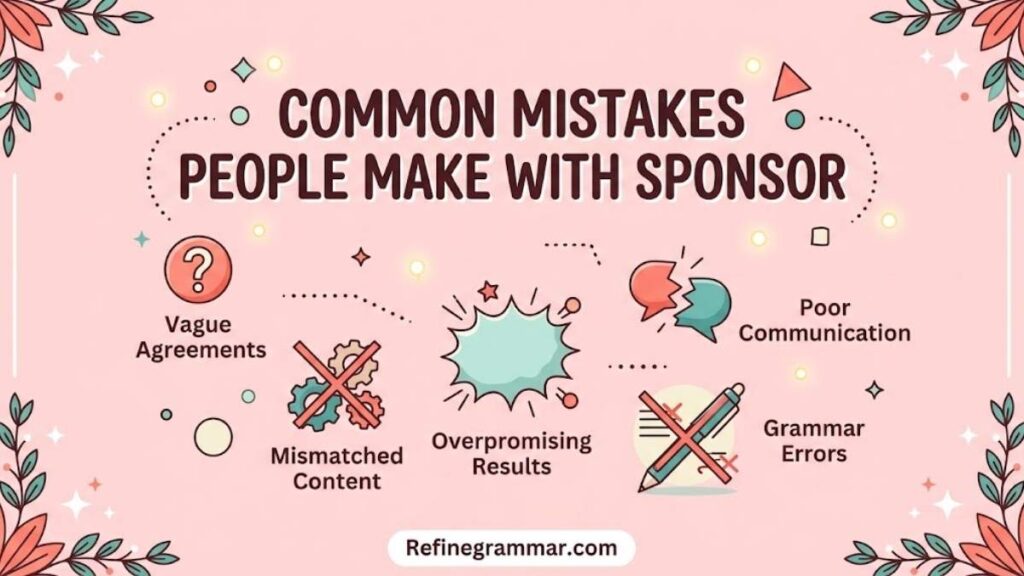
- Writing “sponser” instead of “sponsor” in formal proposals
- Misspelling derived forms like “sponsered” instead of “sponsored”
- Confusing “sponsor” with “sponsee” in recovery-related writing
- Dropping the second “s” in “sponsorship,” producing “sponorship”
- Overusing informal synonyms in place of the precise business term
Practice Exercises Sponser vs Sponsor
These short exercises reinforce the Sponser vs Sponsor rule through active recall rather than passive reading.
Fill in the Blank
- The gym is looking for a corporate _______ (sponsor/sponser).
- Our school event was proudly _______ (sponsored/sponsered) by a local bakery.
Sentence Correction
- Incorrect: “The team thanked their main sponser for the season.”
- Correct: “The team thanked their main sponsor for the season.”
Application
Write one sentence using “sponsor” as a noun and one sentence using it as a verb.
Quick Recall Assessment
Cover the answer key above and try spelling “sponsor” from memory three times in a row without checking. If you write it correctly all three times, the Sponser vs Sponsor mistake is officially behind you.
FAQs
Is “sponser” or “sponsor” the correct spelling?
“Sponsor” is the only correct spelling; “sponser” is a common misspelling with no dictionary backing.
What is the meaning of “sponsor”?
A sponsor is a person or organization that financially or materially supports an event, individual, or cause.
Is “sponser” a real word in English?
No, “sponser” does not appear in any major English dictionary and is always considered an error.
Who does a sponsor actually sponsor?
A sponsor supports an individual, team, event, program, or organization in exchange for visibility or agreed benefits.
What is the difference between “sponsor” and “sponsorship”?
“Sponsor” refers to the person or entity giving support, while “sponsorship” refers to the arrangement or agreement itself.
How is “sponsor” used in sports (e.g., sports sponsorships)?
In sports, sponsors fund teams, athletes, or events in exchange for branding, exposure, or promotional rights.
What’s the difference between a “sponsor” and a “sponsee”?
A sponsor provides guidance or support, while a sponsee is the person receiving that support, especially in recovery programs.
What is the plural of “sponsor”?
The plural is “sponsors,” formed simply by adding an “s.”
How do you check the correct spelling of “sponsored”?
Remember the base word “sponsor” keeps its “-or” spelling even when “-ed” is added, forming “sponsored.”
Can a sponsored person also sponsor someone else?
Yes, a person or organization can be sponsored in one context while acting as a sponsor in another.
Final Thoughts
The Sponser vs Sponsor debate has a simple, permanent resolution: “sponsor” is correct in every context, and “sponser” is always a spelling mistake. Whether you are drafting a sponsorship proposal, writing about sports partnerships, or discussing recovery support systems, sticking to “sponsor” keeps your writing accurate, professional, and credible. Once the “-or” ending is locked into memory, this is one spelling error you will never make again.
