
English is full of word pairs that quietly change meaning with a single added syllable, and complaint vs complain is one of the most searched examples of this. Most native speakers use both words correctly without ever thinking about the grammar rule behind them, while students, customer service teams, and even professional writers sometimes swap the two in emails, medical notes, and legal filings.
This guide breaks down complaint vs complain in plain, practical language: what each word means, how to use complaint and complain in a sentence, when to file a complaint (not a “complain”), how the pair is pronounced, and how the words shift meaning in customer service, medical, and legal writing. Real examples and a qComplaint vs Complain Pronunciation\uick-reference table are included throughout so you never have to second-guess complaint vs complain again.
Complaint vs Complain: Meaning
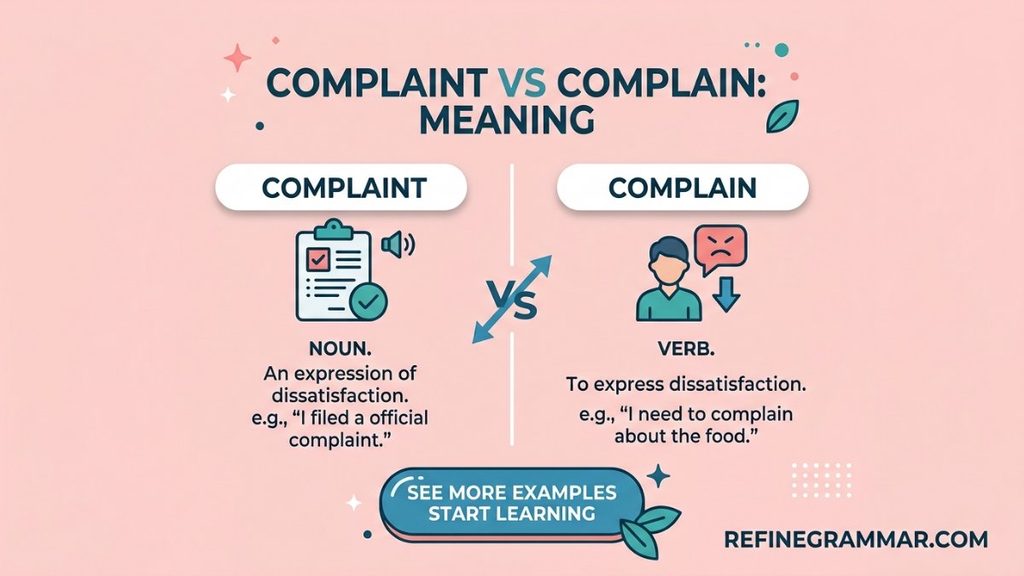
The core difference in complaint vs complain comes down to grammar, not meaning. Complaint is a noun. It names a thing: a statement of dissatisfaction, an ailment, or a formal grievance. Complain is a verb. It describes an action: the act of expressing that dissatisfaction out loud or in writing.
Once that distinction clicks, complaint vs complain stops being confusing. You complain (verb) about something, and the result of that action is a complaint (noun). It is the same relationship you see in other easily confused word pairs the kind of mix-up that also trips people up with career and carrer, where one spelling is simply wrong rather than a different part of speech.
Difference Between Complain and Complaint With Example
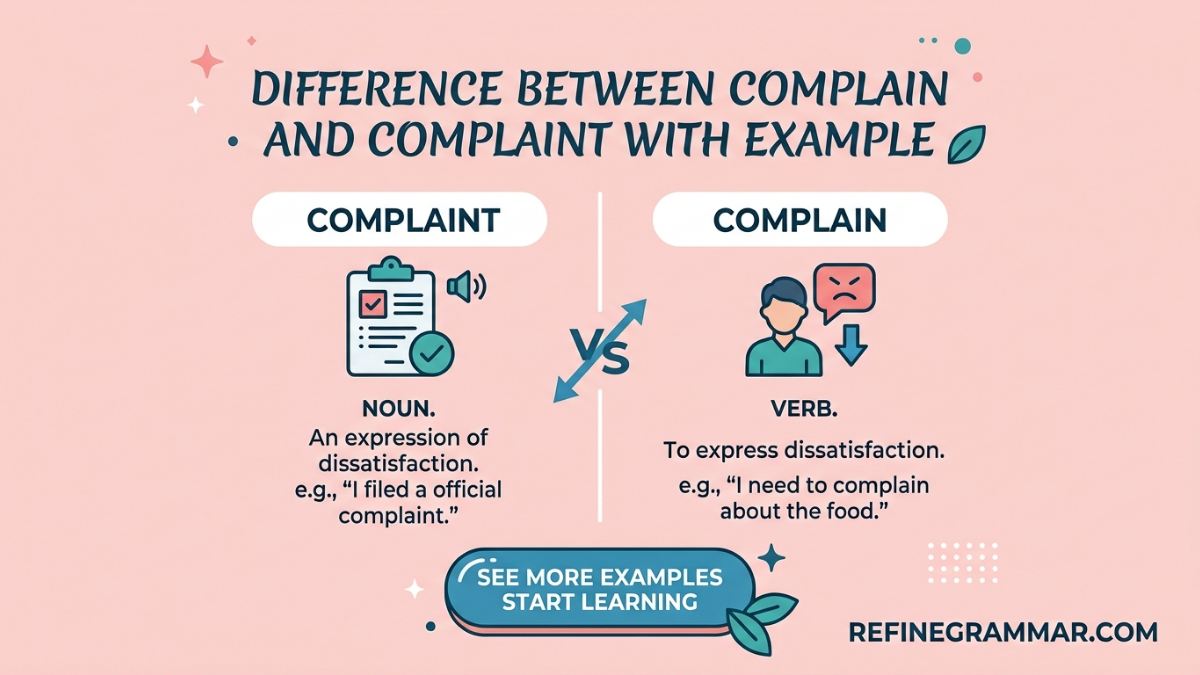
The table below lays out the difference between complain and complaint side by side, including part of speech, function, and a sample sentence for each.
| Word | Part of Speech | Function | Example Sentence |
| Complaint | Noun | Names a grievance, problem, or ailment | She filed a complaint with HR. |
| Complain | Verb (base form) | Describes the act of expressing dissatisfaction | Guests often complain about slow Wi-Fi. |
| Complains | Verb (3rd person singular) | Used with he/she/it in present tense | He complains about the traffic daily. |
| Complaints | Noun (plural) | Multiple grievances or reports | The store received five complaints this week. |
Notice the pattern: complaint always behaves like a thing you can count, hold, file, or receive, while complain always behaves like something a person does. That single test resolves almost every case of complaint vs complain confusion.
Complaint and Complain in a Sentence
Seeing complaint and complain in a sentence side by side makes the grammar rule concrete:
- Complaint (noun): “The customer’s complaint was resolved within 24 hours.”
- Complain (verb): “Please don’t complain until you’ve tried the product yourself.”
- Complaint (noun): “His chief complaint on arrival was severe back pain.”
- Complain (verb): “Employees who complain about scheduling should speak with their supervisor.”
Just as writers second-guess whether to say cocoon or cacoon, they often second-guess complaint vs complain in the same sentence but the noun/verb test above settles it every time.
File a Complaint or Complaint
This is one of the most common searches around complaint vs complain, and the answer is straightforward: you always file a complaint, never “file a complain.” Because file is a verb that needs a noun as its object, and complaint is the noun that fits. “File a complain” is grammatically incorrect in every context customer service, HR, and legal writing all use “file a complaint.”
The same logic applies as well to related phrases: you lodge a complaint, submit a complaint, and receive a complaint the noun form is required after each of these action verbs.
Complaint vs Complain Pronunciation
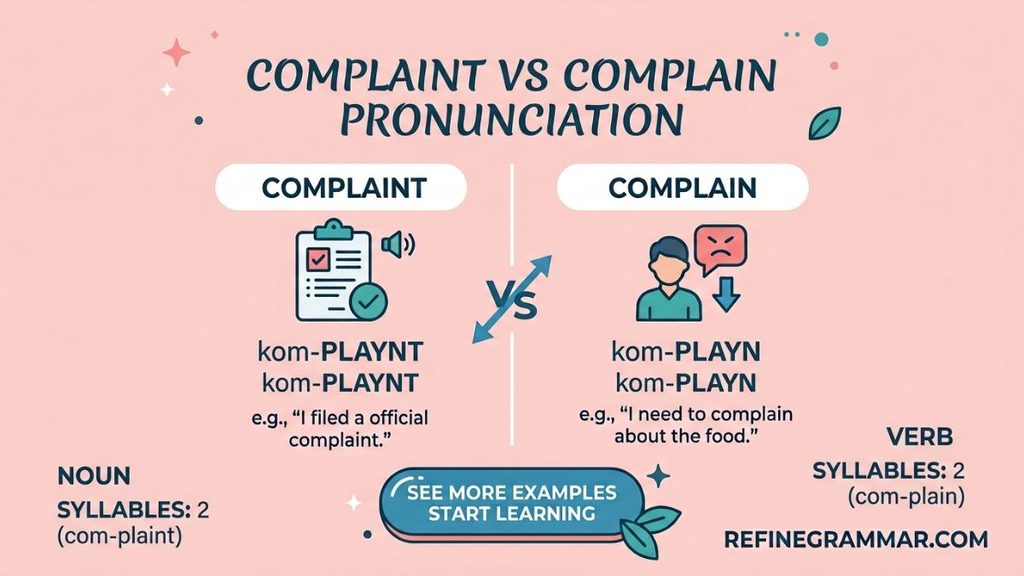
Pronunciation is another small but real source of confusion in complaint vs complain, since the two words share the first syllable but end differently.
| Word | Pronunciation (US) | Rhymes With |
| Complaint | kuhm-PLEYNT | “paint,” “saint” |
| Complain | kuhm-PLEYN | “rain,” “main” |
Both words carry the stress on the second syllable. The only spoken difference is the final consonant sound the “t” at the end of complaint is what marks it as the noun form.
Complain or Complaint Examples
Here are more real-world complain or complaint examples across different contexts:
- “I don’t want to complain, but the room wasn’t ready at check-in.” (verb)
- “We take every customer complaint seriously.” (noun)
- “She tends to complain about minor issues.” (verb)
- “The formal complaint outlined three specific violations.” (noun)
- “Don’t hesitate to complain if the service falls short.” (verb)
Customer Complaint or Complain
In business writing, customer complaint is always the correct noun phrase never “customer complain.” Support teams log a customer complaint, track complaint resolution times, and analyze complaint trends. The verb shows up separately, describing what the customer does: “The customer will complain if the refund is delayed.” Getting complaint vs complain right in customer-facing documents matters for professionalism, since “customer complain” reads as a clear grammar error to any native speaker.
Formal Complaint vs Complain
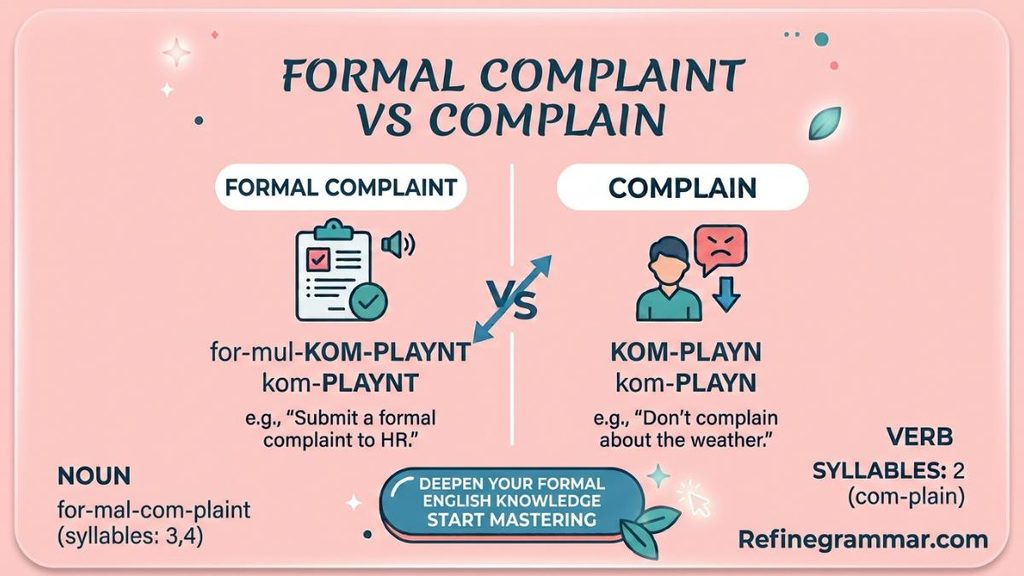
A formal complaint is a written, documented grievance submitted through an official channel HR, a regulator, or a company’s support system. “To complain,” on the other hand, can be entirely informal and spoken: venting to a friend, muttering about the weather, or mentioning dissatisfaction in passing. The gap between formal complaint vs complain is really a gap in process, not just grammar: a formal complaint usually triggers an investigation or written response, while informally complaining does not.
Chief Complaint vs Complain
In medicine, chief complaint (often abbreviated “CC”) is a specific clinical term: the primary symptom or reason, usually recorded in the patient’s own words, that brings them in for care. For example, a chart might read: “Chief complaint: chest pain for two hours.” The verb complain also appears constantly in medical writing, as in “the patient complains of dizziness,” which is standard clinical phrasing for describing a reported symptom. So chief complaint vs complain in a medical record breaks down exactly like it does elsewhere: the chief complaint is the documented noun, and the patient complains (verb) of that symptom.
Verified Complaint vs Complain
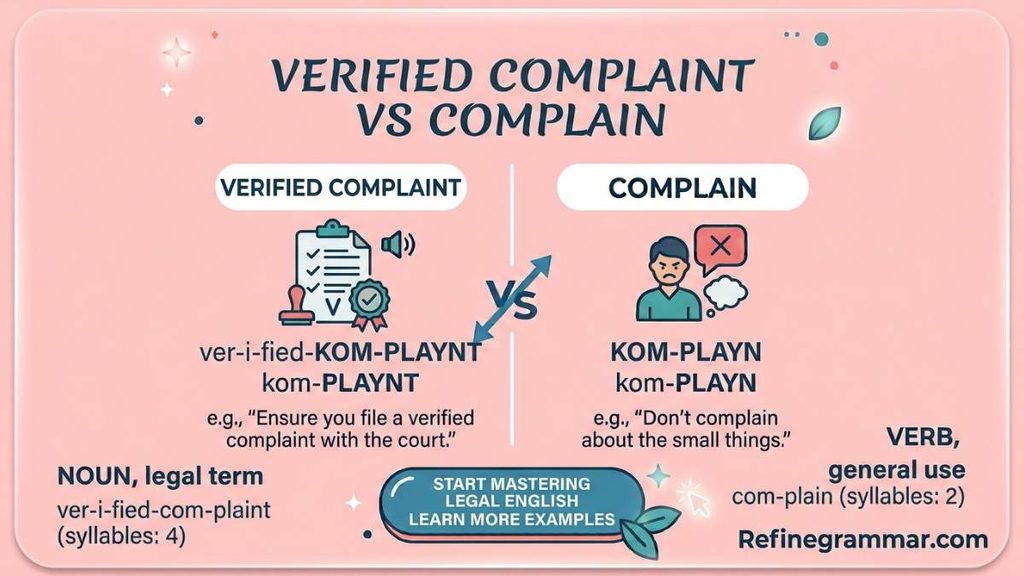
In legal contexts, a verified complaint is a formal pleading in which the person filing it swears, under oath, that the facts stated are true as opposed to an unverified complaint, which is simply signed by an attorney. “Verified complain” is not a legal term and is never correct; only complaint functions as the noun naming the legal document itself.
Criminal Complaint vs Complain Affidavit
A criminal complaint is the formal document often paired with a supporting affidavit that charges someone with a crime and starts criminal proceedings. The affidavit that accompanies it lays out sworn facts supporting the charge. As with every other example on this page, only complaint is grammatically valid here; “criminal complain affidavit” is incorrect. Legal writing is a place where getting complaint vs complain wrong is especially noticeable, since these documents are formally filed with a court.
Complaints vs Complain
“Complaints vs complain” usually comes up when someone is unsure whether to pluralize the noun or conjugate the verb. Remember: complaints is simply the plural noun (“multiple complaints were filed”), while complain stays a base-form verb used with I/you/we/they (“they complain often”), shifting to complains for he/she/it. Mixing these up is a small error, similar in spirit to writers who encode a message correctly but still mistype related word pairs under deadline pressure.
Define Complaint vs Complain
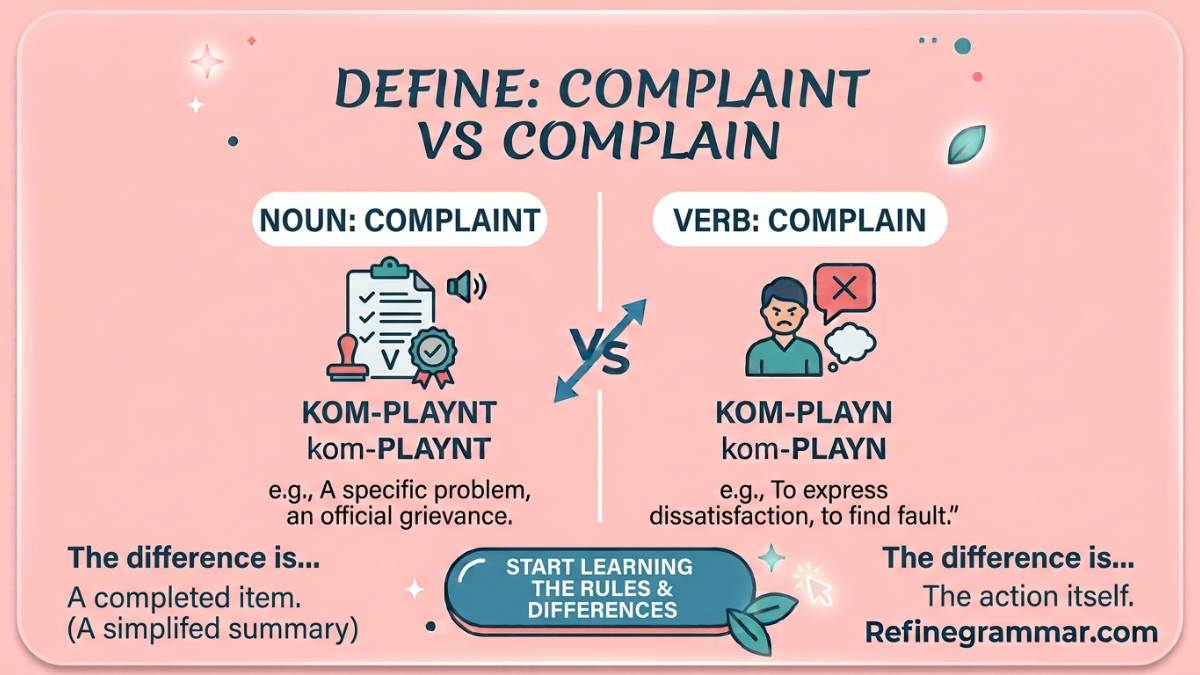
Quick definitions to bookmark:
- Complaint (noun): a statement expressing dissatisfaction, an ailment, or a formal grievance.
- Complain (verb): to express dissatisfaction, discomfort, or a grievance, in speech or writing.
This is also the point where writers polishing a longer document should submit it for a final proofread, since word-pair mix-ups like complaint vs complain are exactly the kind of small error that slips past a quick self-edit.
FAQs
What is the difference between complain and complaint?
Complain is a verb describing the act of expressing dissatisfaction; complaint is a noun naming the grievance itself.
Is complaint the same as complain?
No. They are related but grammatically different: one is a noun, the other a verb.
What is a softer word for complaint?
Concern, issue, or feedback are commonly used as gentler alternatives to complaint.
How to say a complaint in a nice way?
Frame it as feedback or a concern, and focus on the specific issue rather than blame.
What is a nicer word for “complaints”?
Concerns, feedback, or observations often soften the tone in professional writing.
What are the four types of complaints?
Common categories include product, service, billing, and behavioral or staff complaints.
Is it correct to say a complaint?
Yes “a complaint” is correct, since complaint is a countable noun.
What is a professional way to say a complaint?
Use “raise a concern” or “submit feedback” for a more diplomatic, professional tone.
Do we say “complaint” or “complain”?
Use complaint for the noun (the issue) and complain for the verb (the action).
How do you use complaint in a sentence?
As a noun: “She submitted a formal complaint about the delayed shipment.”
Final Thought
At its core, complaint vs complain is simply noun versus verb the thing versus the action. You complain, and the result is a complaint. Whether you’re writing a customer email, a medical chart, or a legal filing, keeping that one distinction in mind, much like remembering greatly over its misspelled twin, is all it takes to get complaint vs complain right every single time.
