
If you’ve ever paused mid-sentence wondering whether to write “sleeve” or “sleave,” you’re not alone. The debate around sleeve vs sleave is one of the most common spelling mix-ups in English, and it trips up native speakers just as often as learners. The two words look almost identical, sound nearly the same when spoken quickly, and yet they mean completely different things.
This guide breaks down the sleeve vs sleave confusion once and for all covering definitions, real usage, sleeve types, and the exact answer you need before your next email, essay, or product description. It’s part of a wider family of commonly confused word pairs that catch even confident writers off guard.
What is the meaning of sleave?
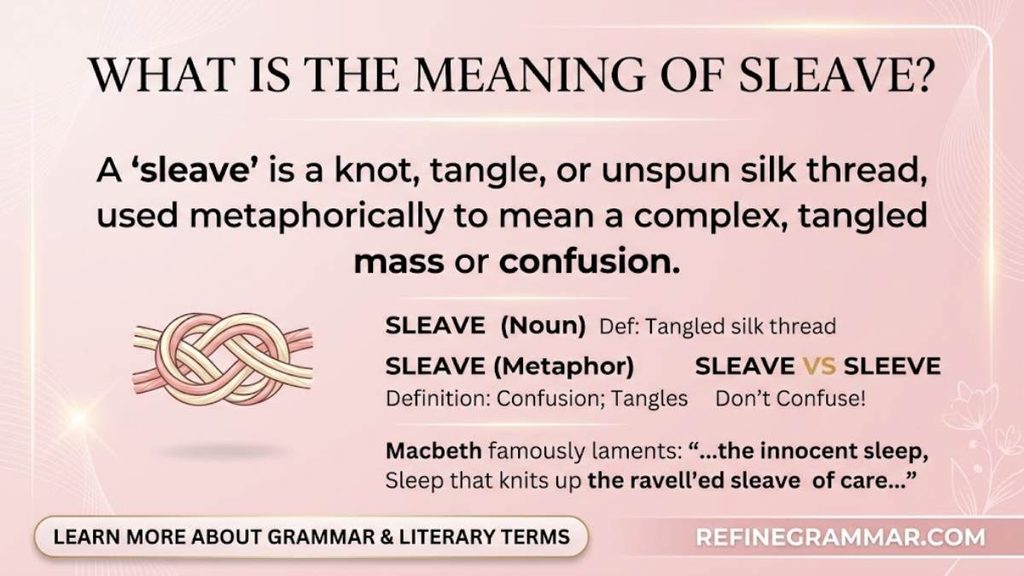
“Sleave” is a real but rare English word. Historically, it referred to untwisted or unravelled silk thread the kind of raw, fine fiber used before it was spun into finished yarn. It survives mainly in older literature; Shakespeare famously used the phrase “the sleave of care” in Macbeth, where it symbolized tangled, knotted worry.
Outside of poetry, textile history, or word games, “sleave” almost never appears in modern writing. When people type it today, they are usually reaching for “sleeve” and simply mistyping it, which is exactly why the sleeve vs sleave question keeps coming up in search results much like other spelling variants that trip writers up.
Is “sleave” a valid word in Scrabble?
Yes. “Sleave” is accepted in most official Scrabble dictionaries because it is a legitimate, dictionary-recognized word, even though it is rarely used outside of word games and historical texts.
What does “slive” mean?
“Slive” is an obscure dialectal verb meaning to move sideways, sneak, or slip away quietly. It is unrelated to “sleeve” or “sleave” and is essentially obsolete in standard modern English.
What is the definition of sleeve?
A sleeve is the part of a garment like a shirt, jacket, dress, or sweater that covers all or part of the arm. It’s one of the most common words in everyday English, appearing in fashion, idioms, technology, and casual conversation alike. Whenever the sleeve vs sleave question comes up in a clothing context, “sleeve” is always the answer. The confusion is similar in spirit to British versus American spelling differences, where one small letter changes what looks “correct” at a glance.
What is the full meaning of sleeve?
Beyond clothing, “sleeve” also describes any tube-like covering that protects or encases something, such as a laptop sleeve, a record sleeve, or a mechanical sleeve bearing.
What does the slang term “sleeve” mean?
Casually, “having something up your sleeve” means having a secret plan, trick, or hidden advantage ready to use.
What is the definition of an arm sleeve?
An arm sleeve is a fitted tube of fabric, often compression material, worn over the arm for warmth, support, sun protection, or improved blood circulation during exercise.
What is another word for “sleeve”?
Depending on context, synonyms include sheath, casing, cover, or jacket (for protective sleeves), and arm covering in clothing contexts.
What is sleeve?
In the simplest terms, a sleeve is any covering shaped to fit over or around something, most commonly the arm portion of a garment.
What are the three types of sleeves?
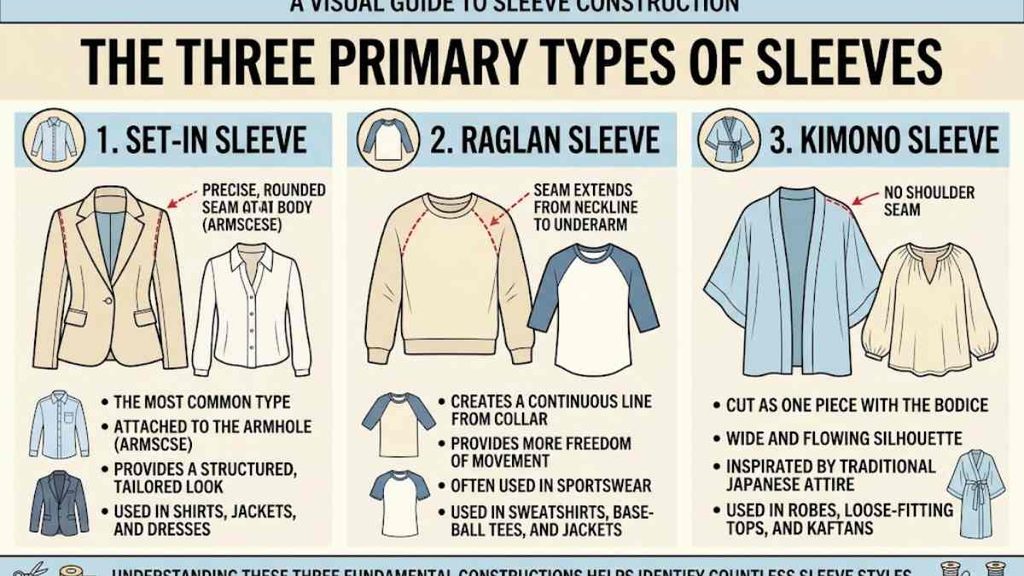
Sleeve vs Sleave is purely a spelling question, but once you’re settled on “sleeve,” it helps to know how many forms a sleeve can actually take. Fashion designers generally group sleeves into three broad categories based on length and construction: attached sleeves (sewn separately and joined at the armhole, like set-in sleeves), integrated sleeves (cut as one piece with the garment body, like kimono or dolman sleeves), and sleeveless designs (no sleeve at all, just a finished armhole). Within these three groups, dozens of specific styles exist.
| Category | Examples | Best For |
| Attached (Set-in) | Set-in, Raglan, Puff | Structured, tailored looks |
| Integrated | Kimono, Dolman, Batwing | Relaxed, flowing silhouettes |
| Sleeveless | Cap, Tank, Strapless | Warm weather, layering |
What are the different types of sleeve styles?
Common styles include set-in, raglan, puff, bishop, bell, cap, kimono, dolman, and three-quarter sleeves, each shaping the garment’s silhouette differently.
What are the 3 basic types of sleeves in a PDF?
Sewing and pattern-making guides typically classify sleeves into three basic construction types: set-in sleeves, raglan sleeves, and kimono (or dolman) sleeves, which most other styles are built from.
What are the different types of hand sleeves?
Hand or arm sleeves include compression sleeves, cooling sleeves, tattoo sleeves (a style of body art), and protective work sleeves used in manual labor.
What type of sleeve is most flattering?
A three-quarter or set-in sleeve is often considered the most universally flattering, as it balances arm coverage with a tailored shoulder line.
Which sleeve is trending now?
Puff sleeves and voluminous bishop sleeves have remained popular for several seasons, along with relaxed dolman styles for casual wear.
What is the 3-3-3 rule for clothes?
The 3-3-3 rule is a minimalist styling guideline suggesting three tops, three bottoms, and three pairs of shoes can be mixed into multiple outfits unrelated to sleeve construction itself.
What is a sleve?
Search data shows that many people typing “sleeve vs sleave” actually mistype it as “sleve.” “Sleve” (without an “a”) is not a standard English word. It is almost always a simple typo for either “sleeve” or, less often, “sleave.” Whenever this spelling appears in search results, it reflects the same underlying sleeve vs sleave confusion, just with an extra letter dropped.
Which is correct: “sleeve” or “sleave”?
“Sleeve” is correct for everyday writing about clothing or coverings. “Sleave” is technically real but limited to historical or literary contexts.
Is sleve a scrabble word?
No. “Sleve” is not found in standard Scrabble dictionaries; only “sleeve” and “sleave” are valid entries.
What is a sleeve slang for?
In slang, a “sleeve” can also refer to a tattoo covering the entire arm, commonly called a “sleeve tattoo.”
What does “sleave” mean?
It refers to untwisted silk or fine thread an old textile term rarely used in modern English.
What does “sleve” mean?
Nothing on its own; it carries no independent definition and is treated purely as a misspelling.
Is “sleave” a word?
Yes, technically, though it is archaic and appears almost exclusively in historical or literary writing today.
What is the difference between sleeve and sleave in clothing terminology?
This section answers the sleeve vs sleave clothing question directly. In clothing terminology, the distinction is simple: “sleeve” is the correct, standard term for the arm-covering part of a garment, while “sleave” has no place in fashion or apparel writing at all its meaning belongs to raw silk thread, not finished clothing. It’s another word pair that trips up writers who assume similar spelling means similar meaning. Anyone drafting product descriptions, style guides, or fashion content should treat the sleeve vs sleave distinction as a hard rule rather than a stylistic choice.
Is “sleave” a real word or a common misspelling?
This is the crux of the entire sleeve vs sleave debate. Both, depending on context. “Sleave” is a genuine, dictionary-listed word when referring to silk fiber, so it isn’t inherently wrong. However, in roughly 99% of modern instances online, it appears as an unintentional misspelling of “sleeve.” This kind of informal spelling mix-up is common across English. If your sentence is about clothing, laptops, or protective covers, “sleave” is a mistake, not a stylistic variant.
Are there popular brands known for innovative sleeve designs?

Once the sleeve vs sleave spelling question is settled, the more interesting conversation is design. Several apparel and accessory brands are recognized for creative sleeve construction and detailing.
Fashion houses experimenting with dramatic puff and bishop sleeves, activewear brands specializing in compression arm sleeves for athletes, and tech accessory makers producing padded laptop and tablet sleeves all compete on sleeve design as a key differentiator, whether the focus is style, performance, or protection.
How do sleeve materials affect comfort and durability?
Material choice matters just as much as getting the sleeve vs sleave spelling right, since the wrong fabric can undo an otherwise great design.
- Cotton breathes well and feels soft but wrinkles easily and offers moderate durability.
- Polyester and nylon blends resist wrinkles, dry quickly, and hold shape longer, making them common in activewear sleeves.
- Wool insulates effectively for cold-weather sleeves but requires more careful care.
- Neoprene or spandex blends used in compression and protective sleeves stretch for mobility while maintaining a snug, supportive fit.
Choosing the right fabric depends on whether the sleeve prioritizes everyday comfort, athletic performance, or protective durability.
FAQs
These quick answers cover the most common sleeve vs sleave questions people search for, along with a few other frequently confused terms worth knowing.
Q1: What is the meaning of sleave?
Sleave is an old term for untwisted silk or fine thread, rarely used outside literature and textile history.
Q2: What is the definition of sleeve?
A sleeve is the part of a garment covering the arm, or any tube-like protective covering.
Q3: Which is correct: “sleeve” or “sleave”?
“Sleeve” is correct for everyday and clothing-related writing; “sleave” fits only historical or literary contexts.
Q4: Is “sleave” a real word or a common misspelling?
It’s a real, archaic word, but in most modern writing it’s simply a misspelling of “sleeve.”
Q5: What is the difference between sleeve and sleave in clothing terminology?
“Sleeve” covers the arm in clothing; “sleave” refers to raw silk thread and has no clothing meaning.
Q6: Is “sleave” a valid word in Scrabble?
Yes, it’s accepted in official Scrabble dictionaries as a legitimate word.
Q7: What does “slive” mean?
It’s an obscure, largely obsolete dialect word meaning to move or slip away sideways.
Q8: What are the three types of sleeves?
Attached (set-in), integrated (kimono/dolman), and sleeveless designs.
Q9: What type of sleeve is most flattering?
Three-quarter and set-in sleeves are widely considered the most universally flattering.
Q10: What is another word for “sleeve”?
Sheath, casing, cover, or arm covering, depending on context.
Conclusion
Sleeve vs Sleave comes down to one simple rule: use “sleeve” for anything related to clothing, arm coverings, or protective cases, and reserve “sleave” only for historical references to raw silk thread. Once you understand where each word comes from, the confusion disappears, and your writing instantly reads as more polished and professional. Like many easily mixed-up word pairs in English, the fix is simply knowing the small distinction that changes the entire meaning.
