
If you have ever paused mid-text wondering whether to type “I would love to” or “I would love too,” you are not alone. This mix-up is one of the most common spelling slips in everyday writing, and it happens because the two words sound identical when spoken aloud. This guide answers the I Would Love To or Too question in plain language, with real examples, quick memory tricks, and answers to the exact questions people search for.
Quick Answer: Is It “I Would Love To” or “I Would Love Too”?
The correct phrase is “I would love to.” “I would love too” is incorrect in this context, because “too” cannot replace the infinitive marker “to.” Whenever you are accepting an invitation or expressing a wish to do something, “to” is the word you need.
What Does “I Would Love To” Mean?
Definition
“I would love to” is a warm, enthusiastic way of accepting an offer or expressing a strong desire to do something. The word “to” introduces an infinitive verb, even when that verb is left unsaid.
Why Native Speakers Use It So Often
It sounds friendlier than a plain “yes” and softer than “I want to.” That is why it turns up constantly in invitations, work emails, and casual conversation.
Everyday Examples
- I would love to join you for dinner.
- She would love to visit Japan someday.
- We would love to help with the project.
I Would Love To or Too – Meaning
When people type “I Would Love To or Too” into a search bar, they are really asking which spelling carries the meaning of acceptance or desire. That meaning belongs to “to,” never “too.”
Is “I Would Love To” or “I Would Love Too” Correct?
Why “To” Is Correct
“To” completes the infinitive verb phrase, even when the main verb is dropped for brevity, as in a short reply like “I’d love to.” The sentence is understood as “I would love to [do something].”
Why “Too” Is Incorrect
“Too” means “also” or “excessively.” Neither meaning fits directly after “love” in this structure, so “I would love too” reads as an unfinished or confusing sentence.
I Would Love To or Too – Reddit Discussions
Grammar forums and community threads consistently reach the same conclusion: native speakers treat “too” here as a typo, not an acceptable variant, especially in formal writing.
Understanding the Difference Between “To” and “Too”
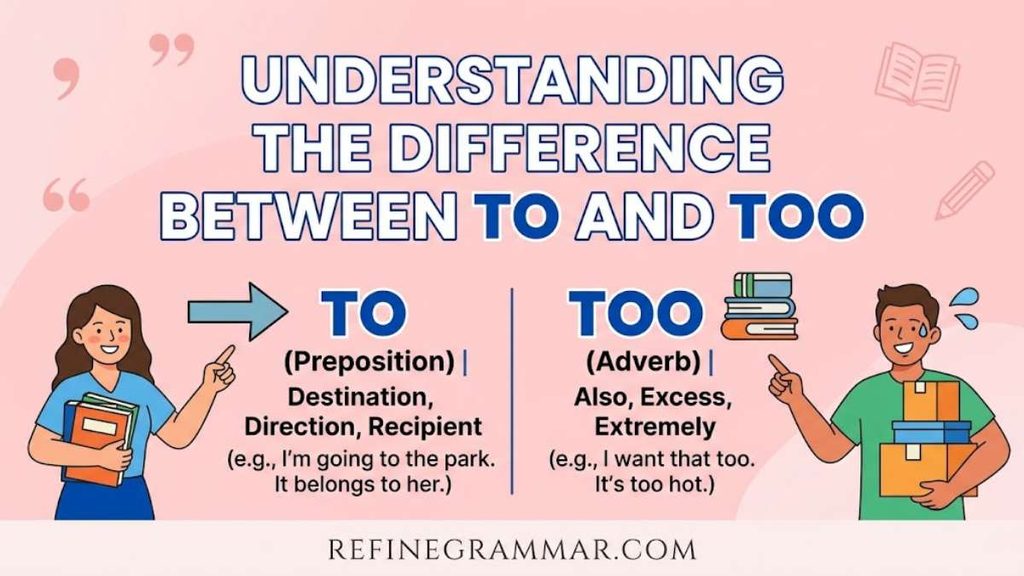
What Does “To” Mean?
“To” works as a preposition or an infinitive marker. It can show direction, as in “go to the store,” or introduce a verb, as in “want to leave.”
What Does “Too” Mean?
“Too” is an adverb meaning “also,” as in “I want cake too,” or “excessively,” as in “This coffee is too hot.”
Comparison Table
| Word | Function | Example |
| To | Preposition / infinitive marker | I would love to travel. |
| Too | Adverb meaning “also” | I would love that too. |
| Too | Adverb meaning “excessively” | This soup is too salty. |
To or Too – Examples
- Correct: I would love to see that movie.
- Correct: I would love it too, if you invite me.
- Incorrect: I would love too see that movie.
Why People Confuse “To” and “Too”
They Sound Exactly the Same
Homophones cause more spelling errors than almost anything else in English. The same pattern shows up in other mixed-up pairs, like career and carrer, or cocoon and cacoon.
Fast Typing
When typing quickly on a phone, an extra letter slips in easily. It is the same reason people accidentally write aswell instead of as well without noticing.
Autocorrect Isn’t Perfect
Autocorrect catches misspelled words, but not correctly spelled words used incorrectly. That is also why mistakes like dysregulated versus disregulated or sponser instead of sponsor slip past spell check.
Learning English
Non-native speakers sometimes learn “to” and “too” together and blend their spellings, the same way learners often confuse emersion and immersion.
Examples of “I Would Love To” in Sentences
Invitations
“Would you like to come to the wedding?” “I would love to!”
Offers
“I would love to help you move this weekend.”
Professional Conversations
“I would love to discuss this opportunity further at your convenience.”
Everyday Conversations
“That sounds fun, I would love to tag along.”
Emails
“Thank you for the invite — I would love to attend the conference.”
I Would Love To or Too – Examples
- I would love to come with you. (correct)
- I would love to come with you too. (correct, meaning “also”)
- I would love too come with you. (incorrect)
When “Too” Is Correct After “I Would Love To”
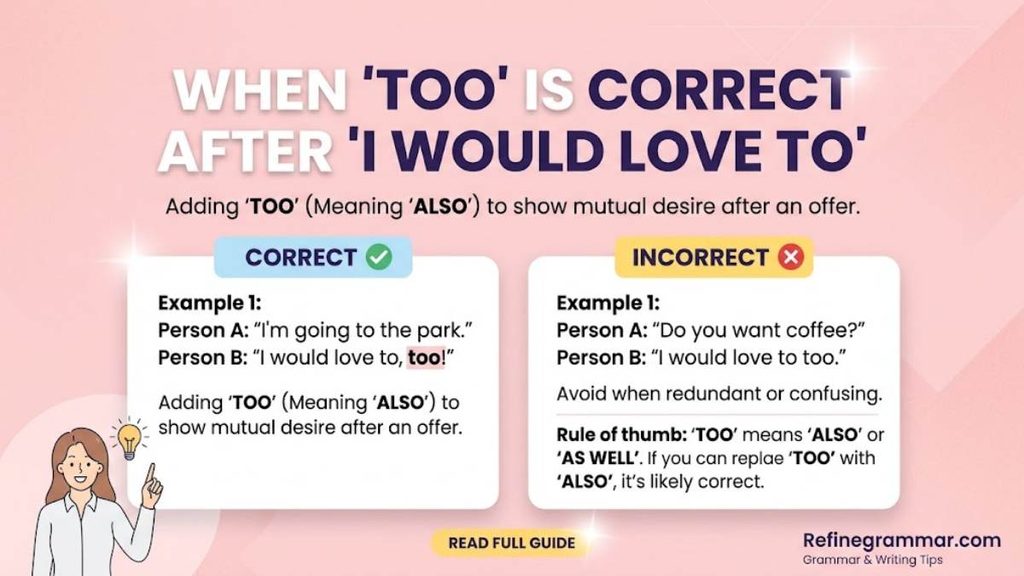
“Too” Meaning “Also”
“Too” is correct when it means “also” and sits at the end of a full sentence, such as: “If you are going, I would love to come too.”
“Too” Meaning “Excessively”
“Too” also works when describing something as more than enough, such as: “I would love a slice, but not too big.”
She Would Love To or Too
The same rule applies to every subject: “She would love to help” is correct, while “she would love to help too” adds the meaning “in addition to someone else.”
Common Incorrect Examples and Their Corrections
| Incorrect | Correct |
| I would love too see you. | I would love to see you. |
| We would love too join the trip. | We would love to join the trip. |
| He would love too try it. | He would love to try it. |
I Would Love To But Meaning
Adding “but” after “I would love to” signals a polite decline: “I would love to attend, but I already have plans.” It keeps the tone warm while turning down the offer.
Grammar Rule Behind “I Would Love To”
The Infinitive Structure
“Would love” is typically followed by the infinitive form “to + verb,” such as “to travel,” “to help,” or “to see.”
Why Another Verb Usually Follows
The infinitive needs an action to attach to, so a verb almost always follows “to,” unless it is understood from context and dropped for brevity.
Why “I’d Love To.” Is Still Correct
Ending a sentence with just “to” is grammatically fine, because the missing verb is implied from the previous line of conversation. This is called ellipsis.
“I’d Love To” vs Similar Expressions
I’d Like To
A calmer, slightly less enthusiastic way to accept an offer.
I Want To
More direct and less formal, often used with close friends or family.
I’d Be Happy To
A polite, professional alternative common in workplace emails.
I’d Be Delighted To
A more formal, elevated option suited to written correspondence.
I’d Enjoy
A simple, understated way to show interest without heavy emphasis.
Comparison Table
| Phrase | Tone |
| I would love to | Enthusiastic, warm |
| I would like to | Polite, neutral |
| I want to | Direct, casual |
| I would be happy to | Professional, courteous |
| I would be delighted to | Formal, elevated |
I Would Love To or Too – Synonym
If you are searching for an alternative to avoid repeating “I would love to or too” across a document, consider “I would gladly” or “I would be thrilled to.”
Formal vs Informal Usage
Business Emails
“I would love to schedule a follow-up call next week” reads as enthusiastic yet professional.
Job Interviews
“I would love to bring my experience to this role” signals genuine interest without sounding overeager.
Customer Service
“I would love to help resolve this for you” softens a support interaction.
Everyday Conversation
“I would love to grab coffee sometime” works casually among friends.
Common Mistakes English Learners Make
- Writing “too” instead of “to” after “would love.”
- Forgetting the verb after “to” when it is not actually implied.
- Overusing “too” at the end of every sentence.
These mix-ups sit alongside other frequent English errors, such as writing encorporate instead of incorporate, encode instead of incode, or grately instead of greatly.
Quick Tip
If you can replace the word with “also” and the sentence still makes sense, use “too.” If not, use “to.”
Quick Memory Tricks
Trick One
Two O’s in “too” stand for “also” — think of the extra O as an extra item added on.
Trick Two
If the sentence needs a verb right after the word, it is almost always “to.”
Trick Three
Read the sentence aloud and ask, “Am I adding something, or introducing an action?” That answers whether it is “too” or “to.”
Real-Life Conversation Examples
At Work
“Can you join the client call?” “I would love to, send me the link.”
With Friends
“We are grabbing tacos tonight.” “I would love to come!”
Text Message
“Movie night Friday?” “Yes, I would love to!”
Phone Conversation
“Would you be open to a quick chat tomorrow?” “I would love to, what time works?”
I Love You To or Too
This is a separate but related mix-up. “I love you too” (meaning “as well”) is the correct romantic reply, not “I love you to.”
FAQs
Is It Correct to Say “I Would Love To”?
Yes, it is correct and commonly used to accept an offer or express a wish.
Which Is Correct: “I Would To” or “I Would Too”?
Neither is correct on its own; the full accepted phrase is “I would love to.”
Which Is Correct: “I Love Too” or “I Love To”?
“I love to” is correct before a verb, such as “I love to read”; “too” only fits when it means “also.”
When Should I Use “Too” vs “To”?
Use “too” for “also” or “excessively”; use “to” before a verb or to show direction.
In short, I would love to is the phrase to reach for whenever you are accepting an invitation or sharing a wish. Save “too” for moments when you mean “also” or “excessively.” A quick mental check before you hit send will keep this common mix-up out of your writing for good.
Final Thoughts:
“I would love to” is the correct phrase “too” never fits before an unspoken verb. Keep “too” for “also” or “excessively,” and this mix-up disappears for good.
Related Grammar Confusions Worth Bookmarking
Mixing up “to” and “too” is common, but it is far from the only pair that trips people up. A few more worth reviewing:
