
If you’ve ever typed a sentence fast and then paused, wondering whether it’s tried or tryed, you’re not alone. This is one of the most common spelling mix-ups in English, and it trips up native speakers and learners alike.
The short answer: tried is correct, and tryed is not a real word in standard English. But knowing the rule behind it and why so many people still write tryed will help you avoid this mistake permanently.
In this guide, we’ll break down the spelling rule, show real examples, compare British and American usage, list the most common mistakes, and answer every question people search for around tried or tryed. By the end, you’ll never second-guess this word again.
Tryed or Tried – Quick Answer
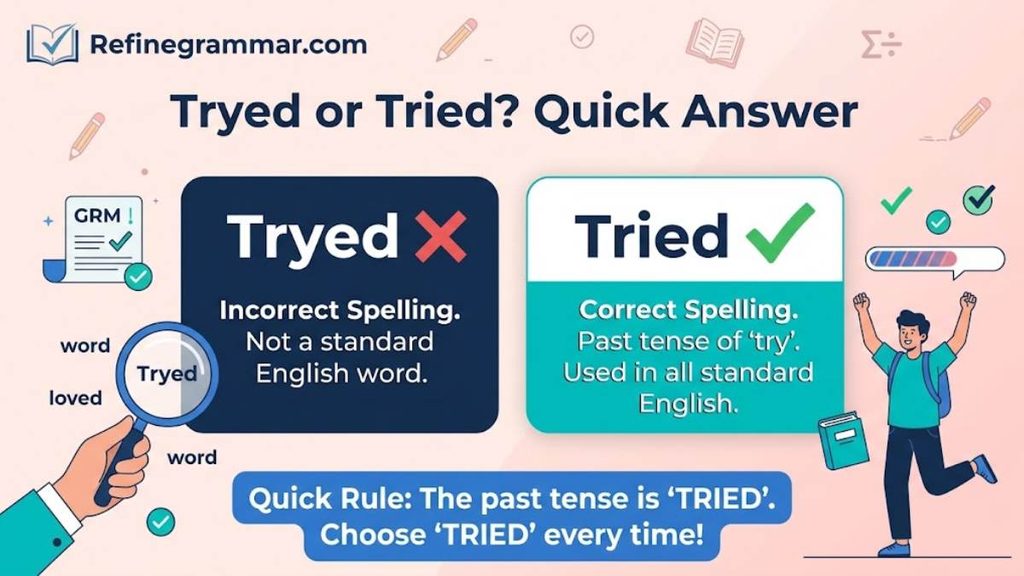
Tried is the only correct spelling. It is the past tense and past participle of the verb try. Tryed is a misspelling that does not appear in any recognized English dictionary.
The confusion between tried or tryed happens because many regular verbs simply add -ed to form the past tense (walk becomes walked, play becomes played). But try ends in a consonant plus y, and that changes the rule.
- Correct spelling: tried
- Incorrect spelling: tryed
- Part of speech: verb (past tense and past participle)
- Base form: try
- Rule applied: change y to i, then add -ed
The Origin and Spelling Rule
The debate over tried or tryed comes down to one of the oldest spelling conventions in English: the y to i rule. When a verb ends in a consonant followed by y, you drop the y and add -ied to form the past tense.
The word try comes from Old French trier, meaning to sift or select, and it entered English in the 13th century. Over centuries, English spelling rules settled around consonant-plus-y endings, which is why try became tried rather than tryed.
This same rule governs hundreds of everyday verbs, which is exactly why understanding it once solves the tried or tryed question for good.
Examples of the Rule
| Base Verb | Correct Past Tense |
| try | tried |
| cry | cried |
| fry | fried |
| carry | carried |
| study | studied |
| worry | worried |
| hurry | hurried |
| apply | applied |
Notice the pattern: every one of these verbs ends in a consonant plus y, and every one drops the y for i before adding -ed. This is exactly why tried, not tryed, is the correct form.
British English vs American English
Unlike words such as colour/color or organise/organize, the tried or tryed debate has nothing to do with regional spelling differences. Both British English and American English use the identical spelling: tried.
There is no British variant of tryed, no American variant of tryed, and no accepted regional exception anywhere in the English-speaking world. This makes tried one of the more universally consistent words in English grammar.
So if you’ve been wondering whether tryed might be acceptable in one dialect, the answer is simple: it isn’t, anywhere.
Read More: In-Person vs In Person: The Correct Usage Guide (2026)
Which Spelling Should You Use?
When choosing between tried or tryed for any piece of writing, the decision is simple: always use tried. Whether you’re writing an email, an essay, a resume, a text message, or a novel, tried is the only spelling accepted by dictionaries, grammar checkers, and style guides.
If you’re ever unsure between tried or tryed while typing quickly, a simple mental check helps: does the base verb end in a consonant plus y? If yes, drop the y and add -ied. That’s how you land on tried every time.
Common Mistakes with Tryed or Tried
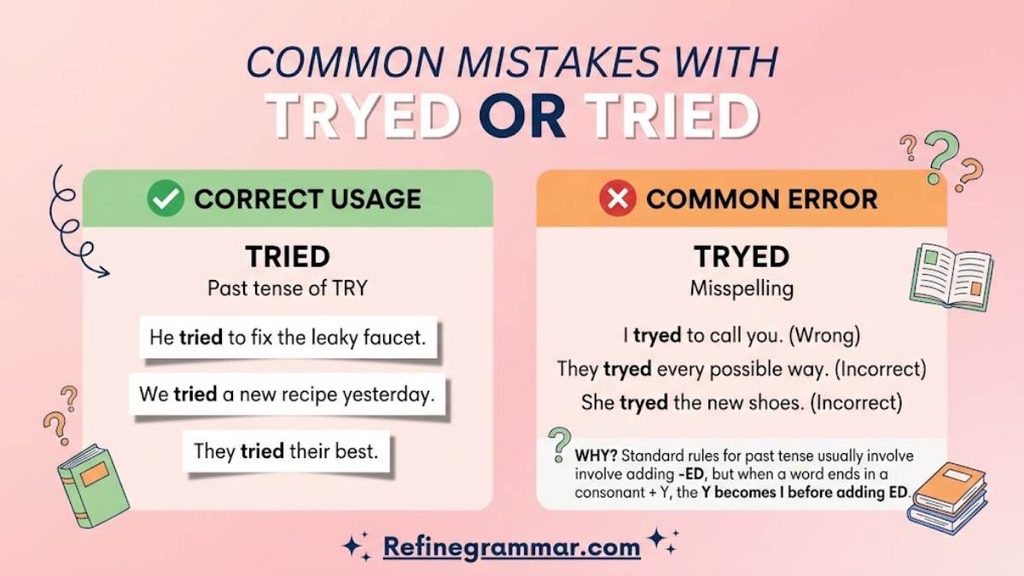
Most people who write tryed aren’t careless they’re applying a spelling pattern that works for other verbs but doesn’t apply here. Here are the three mistakes behind the tried or tryed confusion.
Mistake 1: Adding -ed directly
The most frequent error is treating try like a regular verb ending in a consonant and simply tacking on -ed, producing tryed. This works for verbs like walk (walked) or jump (jumped), but not for verbs ending in consonant + y.
Mistake 2: Forgetting the “y to i” rule
Some writers know the past tense sounds different but forget the specific mechanic: y changes to i before -ed is added. Skipping this step is exactly how tryed slips into an email or an assignment.
Mistake 3: Confusing with words ending in vowel + y
Verbs ending in a vowel plus y, like play, stay, and enjoy, simply add -ed without changing the y (played, stayed, enjoyed). Because these words look similar to try, writers sometimes wrongly assume try follows the same pattern, leading straight to the tried or tryed mix-up.
Read More: Weather vs Whether vs Wether: The Simple Difference
Tried in Everyday Examples
Seeing tried used correctly in real sentences makes the rule easier to remember than any explanation alone.
- I tried my best on the exam, even though it was harder than expected.
- She tried three different recipes before finding the perfect one.
- They tried to fix the printer themselves before calling support.
- We tried calling him twice, but the line was busy both times.
- He tried on five pairs of shoes before choosing the right size.
Google Trends & Usage Data
Search interest in tried or tryed spikes regularly, which shows this isn’t a rare typo it’s a recurring question for thousands of English speakers and learners every month.
Search data consistently shows tried dominating as the standard, dictionary-confirmed spelling, while tryed appears mainly in search queries from people actively checking the correct form, not in published, edited writing. That gap itself confirms which spelling professional writers and editors treat as correct.
Comparison Table: Tryed vs Tried
| Feature | Tried | Tryed |
| Dictionary status | Recognized in all major dictionaries | Not a recognized word |
| Grammar correctness | Correct past tense of try | Incorrect spelling |
| Usage in British English | Standard and accepted | Never accepted |
| Usage in American English | Standard and accepted | Never accepted |
| Spelling rule followed | Consonant + y changes to i, then -ed | Rule not applied |
| Appears in formal writing | Yes, always | No |
| Common in casual typos | N/A | Yes, frequent |
Tried in Different Tenses
| Tense | Form | Example Sentence |
| Base form | try | I try to wake up early every day. |
| Present simple (he/she/it) | tries | She tries her hardest in every match. |
| Past simple | tried | He tried to explain the situation calmly. |
| Past participle | tried | They have tried every possible solution. |
| Present participle | trying | We are trying to finish the project on time. |
Related Words and Forms
Once the tried or tryed question is settled, it helps to know the related word family so every form stays consistent across your writing.
- Try (base verb) to attempt or test something
- Tries (third-person singular present) she tries, he tries, it tries
- Trying (present participle / gerund) currently in the middle of attempting
- Tried (past tense and past participle) already attempted
- Trial (noun) an attempt, test, or formal legal proceeding
- Tried-and-true (compound adjective) proven to work reliably
Pronunciation Guide
Tried is pronounced /traɪd/, rhyming with side, ride, and guide. The word has one syllable, and the ending sounds like a soft “d,” not “ed” as a separate syllable.
This single-syllable pronunciation is another clue that tried, not tryed, is correct tryed would visually suggest a different, incorrect pronunciation pattern that doesn’t match how English speakers actually say the word.
FAQs
Is “tried” a correct word?
Yes, tried is the correct past tense and past participle of try, recognized in every major English dictionary.
Is “tryed” a word?
No, tryed is not a recognized word in English; it’s a common misspelling of tried.
What is correct, tryed or tried?
Tried is correct. Between tried or tryed, only tried follows standard English spelling rules.
Is the correct spelling “tried” or “tryed”?
The correct spelling is tried; tryed does not appear in dictionaries or formal writing.
What does “tried” mean?
Tried means attempted, tested, or made an effort to do something, often referring to past action.
Is it correct to say “I tried my best”?
Yes, “I tried my best” is grammatically correct and a very common English expression.
What is another word for “trying”?
Synonyms for trying include attempting, endeavoring, striving, and making an effort.
What is a better word for “tried”?
Depending on context, attempted, tested, or endeavored can work as alternatives to tried.
Is it trys or tries in a sentence?
Tries is correct; trys is a misspelling, following the same y-to-i rule as tried.
What is the difference between tries and trys?
Tries is the correct present-tense form; trys is simply an incorrect spelling with no dictionary standing.
Final Thought
The tried or tryed debate has one clear winner: tried is correct, always, in every dialect and context.
Remembering the consonant-plus-y rule turns this from a recurring doubt into an automatic habit.
Once you’ve internalized it here, you’ll never type tryed by mistake again.
