
Ever paused mid-email, unsure whether to write totalling or totaling? You’re not alone. This one small letter trips up writers, students, and even insurance adjusters every day. The good news: the totalling vs totaling debate isn’t really a debate at all. It comes down to geography, not grammar. Once you know the rule, you’ll never second-guess that extra L again.
In this guide, you’ll learn exactly when to use each spelling, why the difference exists, and how the word shifts meaning when someone says a car got totaled. We’ll also cover regional quirks in Canada and Australia, so you can write with confidence no matter who’s reading.
Totalling vs Totaling: What’s the Difference?
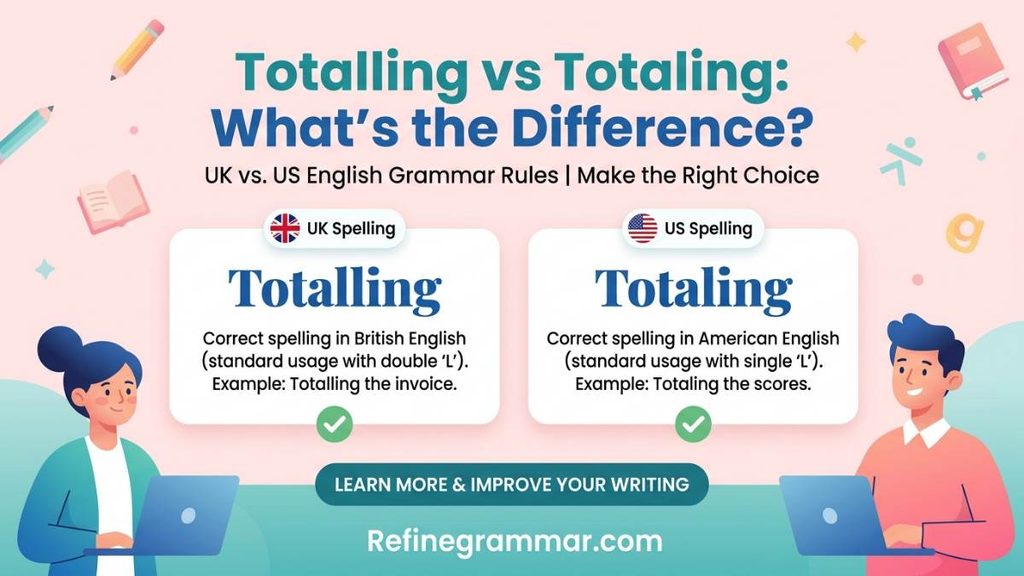
Here’s the short version: totaling is the American spelling, and totalling is the British spelling. Both come from the same root word,total, and both mean the same thing. The split happens only when you add an ending like-ing or-ed.
American English usually keeps a single consonant before adding a suffix, unless the stress falls on the final syllable. British English, on the other hand, tends to double the final consonant almost every time, regardless of stress. That’s why you’ll seetraveling versustravelling,canceling versuscancelling, and, of course, totaling versus totalling.
Think of it like a regional accent, but for spelling. Neither version is sloppy or incorrect. They’re just two branches of the same language tree, shaped by different style guides over the past two centuries.
You can trace much of this split back to Noah Webster, the American lexicographer who published his own dictionary in the early 1800s. Webster wanted American English to look distinct from British English, so he trimmed silent letters and simplified doubled consonants wherever he could. That reform is why Americans write color instead of colour, and it’s the same instinct behind totaling instead of totalling. Britain never adopted those changes, so its spelling stayed closer to older conventions.
Learn More: Take Affect vs Take Effect? The Definitive, Correct Answerf
Which Is Correct, Totaling or Totalling?
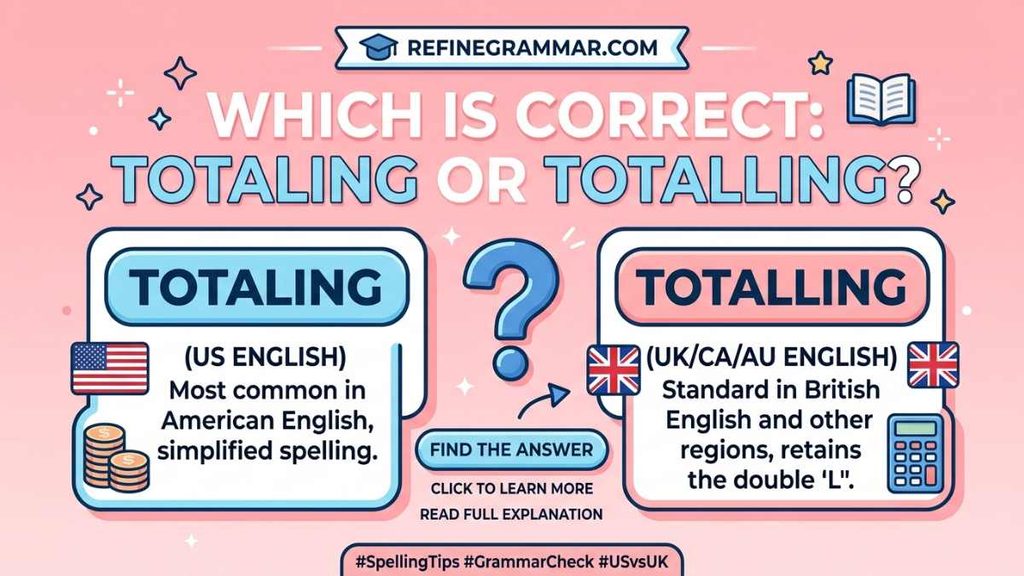
Both spellings are correct, but the right one depends on your audience. If you’re writing for an American reader, a US-based company, or a publication that follows AP style, stick with totaling. If you’re writing for a British, Irish, or broadly Commonwealth audience, totalling fits better.
Style guides back this up clearly:
| Style Guide | Preferred Spelling |
| Merriam-Webster (US) | totaling |
| Cambridge Dictionary (UK) | totalling |
| AP Stylebook (US) | totaling |
| Oxford DicTotalling vs Totaling in Canadationaries (UK) | totalling |
Editors care about consistency more than personal preference. Pick one spelling and use it throughout your document. Switching between totaling and totalling in the same piece looks like a typo, even when both forms are technically valid.
Does Totaling Have One L or Two?
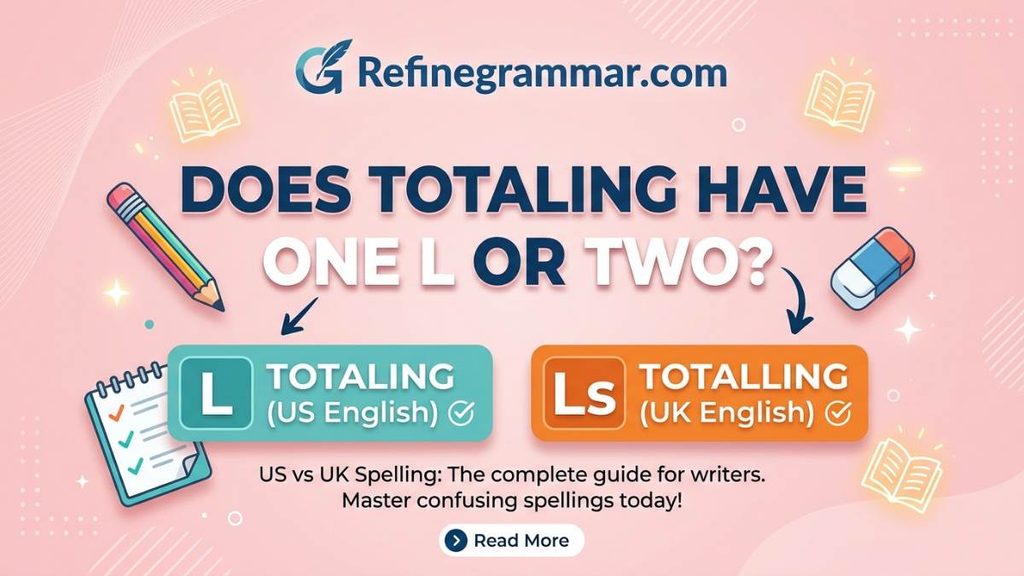
This is where most of the confusion starts. Totaling has one’’ L’’ in American English. Totalling has two L’s in British English. That single letter is the entire difference between the two words.
Here’s a quick way to remember it: American English tends to trim extra letters, while British English holds onto older spelling conventions. The same one-L-versus-two-L pattern shows up across dozens of similar verbs:
- Traveling (US) vs. Travelling (UK)
- Modeling (US) vs. Modelling (UK)
- Canceling (US) vs. Cancelling (UK)
- Labeling (US) vs. Labelling (UK)
Once this pattern clicks, you’ll spot it everywhere, not just with total. It’s a small rule, but it carries a lot of predictive power once you’ve memorized it.
There’s a technical grammar rule hiding behind all of this, too. In British English, a finalL doubles before a suffix as long as the word ends in a single vowel plus L, no matter where the stress falls. American English only doubles that final consonant when the stress lands on the last syllable. Sincetotal is stressed on the first syllable (TOH-tal, not toh-TAL), American rules skip the doubling, while British rules apply it anyway. That’s the whole mechanism behind totaling vs totalling in a nutshell.
What Does Totalling Mean?
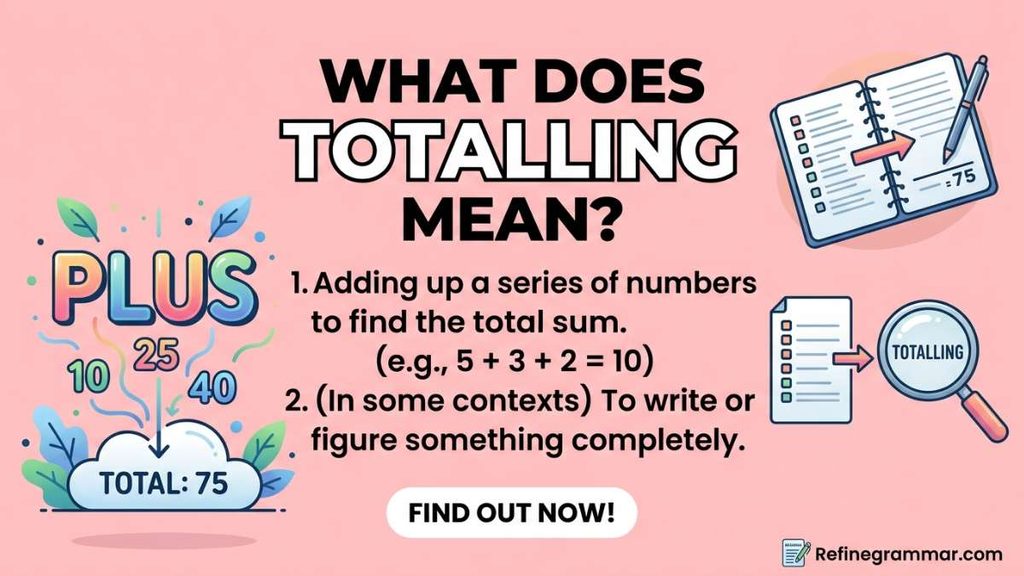
At its core,totalling (ortotaling) means adding numbers together to reach a final sum. If your grocery bill items add up to $47.50, they total that amount. Accountants, cashiers, and spreadsheet formulas all use the word this way constantly.
But there’s a second, more colorful meaning in everyday American speech: to total a car means to damage it so badly that repairing it costs more than the vehicle is worth. Insurance companies use this term formally, and it’s crept into casual conversation everywhere. You’ll rarely hear totalling a car in this sense outside American English, since the wrecked-vehicle meaning developed mainly in the US.
So context matters.The scores are totalling 200 points refers to addition.He totaled his car refers to serious damage. Same root word, two very different outcomes.
You’ll also hear total used as an adjective, meaning complete or absolute, as in total silence ora total disaster. That sense doesn’t change spelling with region, since it never takes the-ing or-ed suffix that causes all the confusion in the first place. The spelling split only matters for the verb forms.
How Do You Use Totalling in a Sentence?
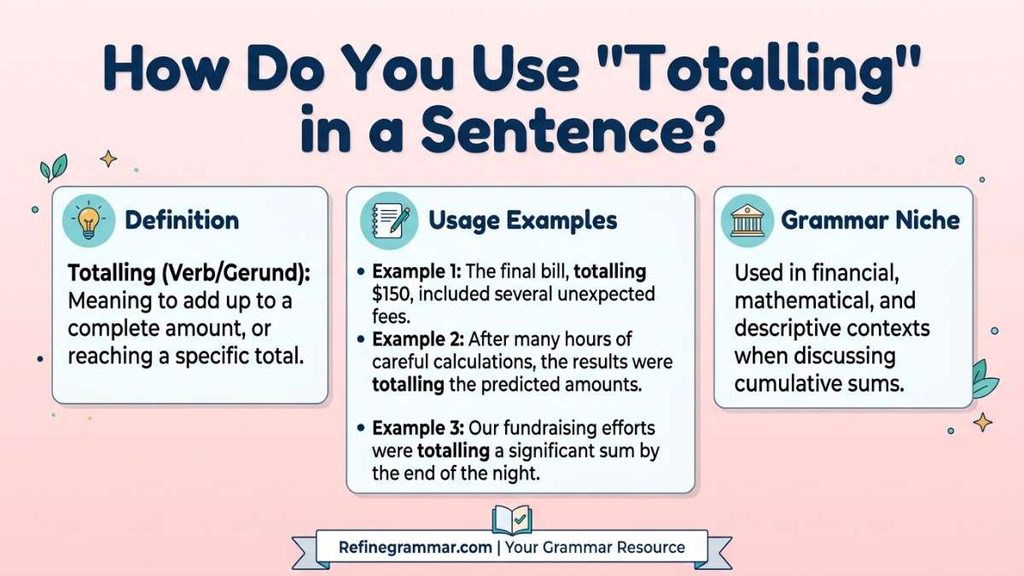
Seeing the word in action helps the spelling stick. Here are a few examples in both American and British forms:
American English (totaling):
- The invoice items are totaling $312 before tax.
- Sales this quarter are totaling well above last year’s numbers.
- After totaling the votes, the committee announced a winner.
British English (totalling):
- The donations kept totalling up throughout the charity event.
- She spent the afternoon totalling receipts for the accountant.
- Attendance figures were totalling close to ten thousand by evening.
Notice the sentences work identically; only the spelling shifts. That’s the whole game with US and UK spelling differences. The grammar, word order, and meaning stay put.
Canadian English sits in an interesting middle ground between British and American conventions, and this word is no exception. Oxford’s Canadian references list totalling and totalled as the usual Canadian forms, leaning toward the British pattern.
That said, Canadian usage isn’t uniform. Many newspapers and news organizations follow Canadian Press style, which leans closer to American conventions in several areas. Canadian book publishers, meanwhile, often prefer British-style spelling. So you might see totaling in a wire-service news story and totalling in a novel published in Toronto, both from Canadian writers.
If you’re writing for a Canadian audience, totalling is the safer default for formal or literary work, though totaling won’t look glaringly wrong in journalistic or American-influenced contexts.
Learn More: Defence or Defense: Correct Spelling Explained (US vs UK)
Totalling vs Totaling in Australia
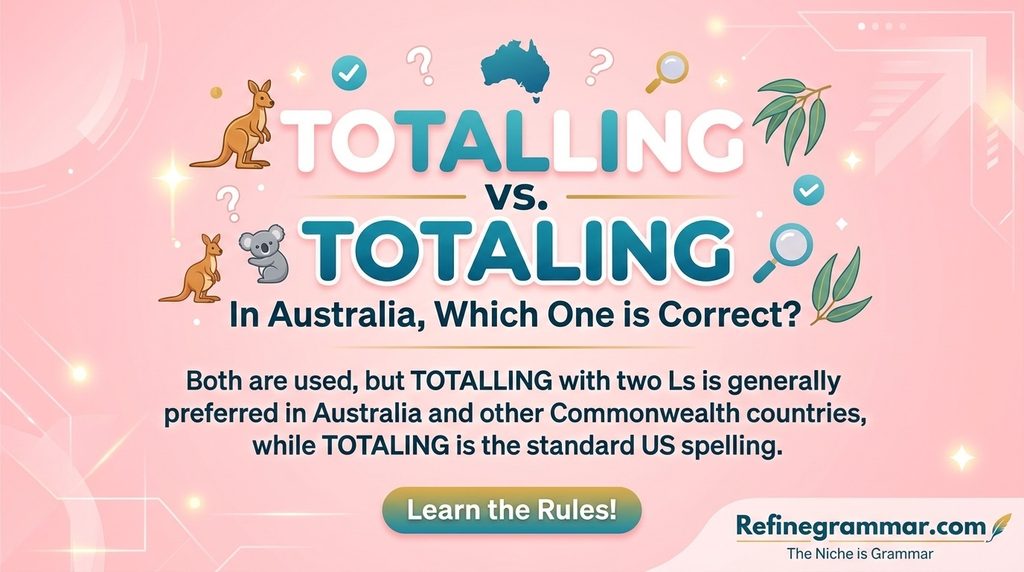
Australian English follows British spelling conventions closely, and that pattern holds firm here. Totalling, with two L’s, is the standard form across Australian newspapers, schools, and government documents.
You’ll rarely see totaling (the single-L American spelling) in Australian writing unless the source material comes from a US company or publication. Australian style guides, including those used by major universities and media outlets, consistently favor the doubled-consonant British forms across similar verbs like travelling, modelling, and cancelling.
So if your audience is in Sydney, Melbourne, or anywhere else in Australia, totalling is the correct and expected spelling.
Frequently Asked Questions
Which is correct, totaling or totalling?
Both are correct. Totaling is standard American English, while totalling is standard British English.
Does totaling have one L or two?
Totaling has one L in American English. The British spelling, totalling, has two.
What does totalling mean?
It means adding numbers to reach a sum, or informally, wrecking a vehicle beyond repair value.
How do you use totalling in a sentence?
Use it wherever you’d use adds up to, such asThe costs are totalling $500 this month.
Which is correct, totalled or totaled?
Totalled is British; totaled is American. Both are accepted past-tense spellings in their respective regions.
Is total or totals correct?
It depends on the subject. Usetotal for plural subjects and totals for singular, third-person subjects, like he totals.
What is another word for totals?
Common alternatives include sums, amounts, aggregates, or tallies.
Why do they call it totaling a car?
Insurers use the term because repair coststotal or match the car’s entire pre-crash value, making repairs financially pointless.
Do I get any money if my car is totaled?
Usually yes. Insurers typically pay out the car’s actual cash value, minus your deductible, once they declare it totaled.
How do they decide if a car is totaled or not?
Insurers compare estimated repair costs against the vehicle’s market value; if repairs exceed a set percentage of that value, they total it.
Final Thought
The totalling vs totaling question really just boils down to American versus British spelling habits. Pick totaling for US audiences and totalling for UK, Australian, or most Canadian readers. Stay consistent, and you’ll never trip over that extra L again.
